
Cycling your aquarium
Published
Translated from German with AI assistance and reviewed by our editors.
A well-running aquarium is a more or less self-contained ecosystem. However, it is a long way until it gets there. In our Aquascaping Wiki article The nitrogen cycle in the aquarium we explain exactly how the biological cycle in the aquarium works, so here just briefly: In the aquarium, beneficial bacteria - also called filter bacteria - make sure that organic waste from leftover food, the excretions of fish and invertebrates, plant debris and everything else that accumulates as organic residue is broken down and metabolized. This happens in several stages involving different bacteria, and it can take a while until this chain works properly. For this reason, a newly set up aquarium or aquascape is at first still a rather fragile construct.
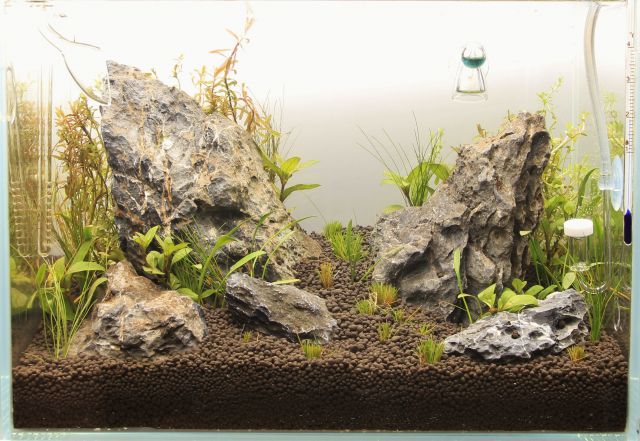
A newly set up nano aquarium.
The nitrogen breakdown chain
You often hear that a newly set up aquarium or aquascape first has to "cycle". That is exactly what is meant: the biological breakdown chain gets going and the bacteria start to work. First, protein is metabolized into ammonium or - depending on the pH value - into ammonia. The filter bacteria in turn convert this into nitrite, which is toxic to fish, and then other types of bacteria take care of converting the toxic nitrite into relatively harmless nitrate. Since the individual bacterial strains are not really present yet in a fresh aquarium, they first have to develop.

Source: Public Domain via Wikimedia Commons
The filter bacteria - or how do the bacteria get into the aquarium?
Waiting
Interestingly, the bacteria involved in the nitrogen cycle are not purely aquatic microorganisms, quite the opposite. They are actually soil bacteria that can also survive and work in water, but only if it is sufficiently rich in oxygen. That is also the reason why these bacteria are part of ordinary dust - so in principle it is enough to simply leave the aquarium standing for a while, and the suitable bacteria will arrive on their own. Here, however, you have no control over which species settle in and whether a balanced bacterial flora develops.
Material from running tanks
The filter bacteria also colonize all interfaces in the aquarium, that is, primarily all surfaces: roots, stones, plants, the grains of the substrate ...
If you now introduce something from other aquariums, such as an already used piece of driftwood or a plant, it immediately brings the corresponding bacterial films along. This too is a way of providing a basic stock of bacteria. Here, too, the bacteria develop slowly, and the cycling phase is not shortened significantly.
Seeding with filter detritus
By so-called "seeding", squeezing out a filter sponge from a running tank, we introduce an enormous number of beneficial bacteria into the aquarium right away, which can shorten the cycling time. Can - not must; it is still possible that the peaks mentioned above occur, even if they are often very small. You should know, however, that every aquarium develops its own distinct bioflora of bacteria that is tailored precisely to the conditions in that aquarium - this can lead to a strong loss of species diversity. It is not certain that this bioflora will also suit the new aquarium, and in aquarium practice there are repeatedly aquariums that are seeded with filter detritus and still never really get going.
Seeding with a bacteria product

A newly set up nano aquarium.
Bacteria products such as Seachem Stability or JBL Filter Boost contain a large number of different bacteria, from which the specific bacterial flora that is perfect for this one aquascape or aquarium can develop. For the same reason, by the way, it is a good idea to re-seed the aquarium with bacteria every now and then. Conditions can also change in running tanks, and then it is possible that the impoverished bacterial flora is no longer perfectly adapted. It therefore makes sense to "top it up" every now and then. Provided they are stored correctly, these commercially available filter starters are very effective. Nevertheless, you should not stock the aquarium right away but first let the system develop. What is very important here, however, is a supply of food so that the newly introduced bacteria do not die off again immediately. A few fish flakes per week are enough for this.
Seeding with a soil infusion
Because filter bacteria are soil bacteria, a remedy from the good old toolbox of the earliest days of the aquarium hobby also works very well: the soil infusion. To make it, simply put a few crumbs of untreated garden soil into a glass of water, stir well and let the soil settle again. Add approx. 1 tablespoon of this water to the tank for every 50 liters of aquarium water. This gives you a large variety of different bacteria, from which the suitable bioflora can then develop. Caution: Too much soil infusion can result in impressive bacterial blooms, so you should definitely not pour too much of it into the aquarium. Here, too, you should give the aquarium biology some time to stabilize before stocking.
The peaks - ammonium peak
Since the bacteria adapt gradually, an aquarium goes through various so-called peaks during the cycling phase. First the ammonium rises, because the bacteria that break down ammonium are not yet present in sufficient numbers. The ammonium peak usually passes relatively unspectacularly and unnoticed, because ammonium in itself has no negative effect on the aquarium animals. Ammonia, which is formed proportionally at high pH values, is not quite as harmless; depending on the concentration, clear signs of poisoning can occur here. For this reason, at least at the beginning, in an aquarium that is quickly stocked with animals, you should monitor the ammonium content with a suitable aquarium water test. Once enough ammonium-metabolizing bacteria have formed, the high concentration of ammonium / ammonia subsides again and the next peak announces itself: the frequently mentioned "nitrite peak".
The peaks - nitrite peak
This term describes the phenomenon that occurs after the rise in ammonium/ammonia - nitrite is the next stage of the breakdown in the nitrogen cycle. Here, too, there are not yet enough nitrite-degrading bacteria, which is why the nitrite concentration in the water can rise significantly. With a suitable nitrite test you can detect this peak, even though nitrite values can occasionally occur in the aquarium that "blow" the test and lead to readings that are no longer on the scale. Don't panic, though: the nitrite-degrading bacteria multiply and the nitrite value drops again.
The nitrite-degrading bacteria metabolize NO2 to nitrate (NO3). As a result, the nitrate value in the aquarium rises slightly. You should monitor it with a nitrate test. If it rises excessively, enough water has to be changed until it is back in ranges that are safe for fish - if necessary even more often.
The initial stocking
Because the biological system in the aquarium is still quite fragile at the beginning, you should not add all the fish right away but give the bacteria the chance to adapt in number to the higher supply of nutrients. It is best to start with hardy snails such as Malaysian trumpet snails or ramshorn snails. However, the algae eaters so popular with aquascapers, such as nerite snails or staghorn snails, should not be put into fresh aquariums - they need an impressive amount of algae and biofilm and would simply starve here! After that, you move on to shrimp - Amano shrimp or Neocaridina are a good choice here and can help to get the aquarium biology going. After that you could continue, for example, with a few catfish (provided enough biofilm has meanwhile developed), and then come the schooling fish such as neons or danios.

Espei rasboras, Rasbora espei. Copyright: Chris Lukhaup.
Which algae like to appear in the still unstable ecosystem of the aquarium during the cycling phase, and how best to deal with them, we have explained in a separate wiki article: "Algae in the cycling phase". You can read how best to fertilize during the cycling phase here: "Fertilization in the cycling phase".
Header photo: Copyright by Chris Lukhaup.