 Aquarium live food: Artemia nauplii
There are many kinds of live food for the aquarium hobby. Freshly hatched Artemia nauplii are a popular food that you can raise quite easily yourself. In this article, we present instructions for raising Artemia in more detail.
The brine shrimp as live food for ornamental fish
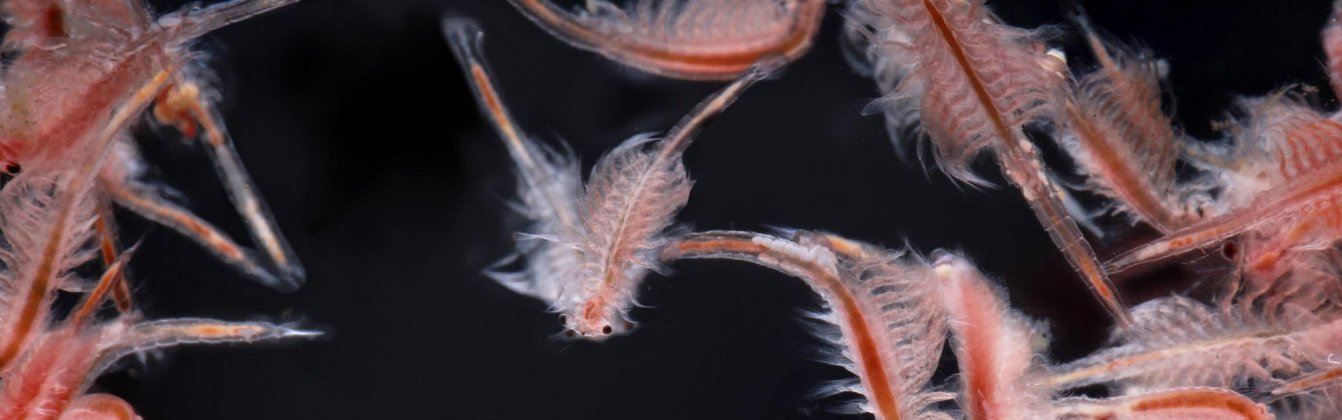
Artemia salina is a well-known representative of the so-called prehistoric crustaceans, and not only in the aquarium hobby. Like other species of the genus Artemia, it occurs in many lakes around the world that have a suitable salinity. It belongs to the fairy shrimp group (branchiopods), a subclass of the crustaceans. Brine shrimp have an elongated body and possess eleven pairs of legs, with which they can move quickly through the water. In addition, the movements of the limbs provide oxygen and bring food particles to the animal. Their strong red to orange body color is striking and is caused by an increased hemoglobin concentration. Their coloring is not caused by special food (for example food containing carotene) but depends on the oxygen content of the water - the less O2 is present, the stronger the little crustaceans take on color.
Adult brine shrimp can grow up to 1.5 cm and, even in the adult stage, are a popular live and frozen food in the aquarium hobby. In this article, however, we deal specifically with freshly hatched Artemia nauplii, which develop from the eggs of the brine shrimp. Artemia salina produces resting eggs that are extremely resistant and survive even long dry periods. In nature, this circumstance secures the survival of the little crustaceans even in extreme habitats; in live food culture for the aquarium hobby it is an advantage as well, because the eggs keep for a very long time and are very easy to handle and store.
The primary larva of the brine shrimp, also called a nauplius, is characterized by its high nutritional value and its small size. Artemia nauplii are extremely popular above all as food for very small fish that eat only live food (for example Dario dario or dwarf rasboras of the genus Boraras) and for fry that are being raised. They are simply an ideal live food for small fish mouths.
Raising Artemia nauplii
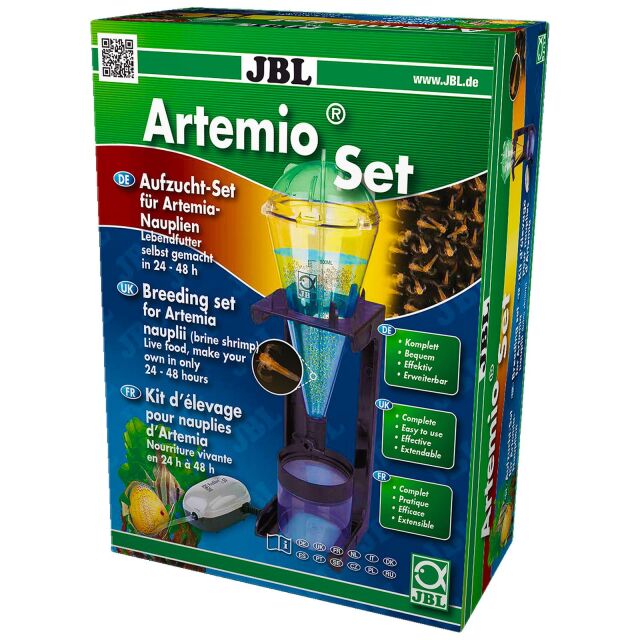
Raising Artemia salina is not difficult in principle. You need a hatching container that is not too large and closes as tightly as possible (incubator), resting eggs and, of course, sea salt, since the water should have a salinity of about 3 to 4 %. 32 to 35 g of salt are added per liter of water (please follow the manufacturer's instructions here). The right salt concentration is crucial, because if the salinity is too low, the hatch rate is poor. Too much salt, on the other hand, leads to delayed hatching and excessive red coloring of the animals. Normal table salt with iodine or anti-caking agents is not suitable. In some cases, ready-packaged mixtures of salt and eggs that already have the right ratio can be bought, such as ArtemioMix from JBL. Handling is particularly easy here. Only a few grams of eggs are needed, so you should definitely follow the manufacturer's recommendation.
In addition, as an aquarist, you need equipment for aerating the hatching container to ensure good oxygen content and suitable water movement. A standard diaphragm air pump with air tubing and optionally an air stone is the usual choice. Ideally, the air supply should be adjustable in strength with a suitable valve. The aeration should be gentle enough but still move the eggs sufficiently. Water movement that is too strong lets too much water evaporate, causes unsightly splashes and, above all, swirls the already hatched little crustaceans around too much. They then have to expend too much energy to hold their own against the current, and as a result their nutritional value as live food decreases. Aeration that is too weak, on the other hand, does not bring enough oxygen into the water, and a large part of the eggs are not moved, sink to the bottom and die. Gentle circulation is ideal, so that all the eggs stay in motion.
Hatching success also depends on the temperature, which should ideally be 20 to 25° Celsius in the water. This can be achieved with a suitable aquarium heater, or you can place the hatching container in a warmer spot (for example on a radiator). The hatch rate at a higher temperature (25°) is significantly higher, but the animals' metabolism then also works faster. They should therefore be fed very promptly. The nauplii also do not hatch in complete darkness, so the hatching kit should not be operated in a closed cabinet or the like.
Feeding Artemia nauplii
Once all the prerequisites for raising are met, visible success appears after just a few days. To the naked eye, the nauplii can then be recognized in the water as bright orange glowing dots. They are even easier to see if you switch off the aeration, because the eggshells and the hatched animals then separate from each other: the nauplii tend to sink, while the empty eggshells rise to the top. When it comes to feeding, the aeration is likewise switched off briefly, because ideally you only want to put the larvae into the aquarium, and not the eggs and eggshells. They would only needlessly pollute the water and can even cause digestive problems in sensitive fish. Since the prehistoric crustaceans like to orient themselves toward light, you can use this to lure the animals to a particular spot in the hatching container with a light source and siphon them off there in a targeted way.
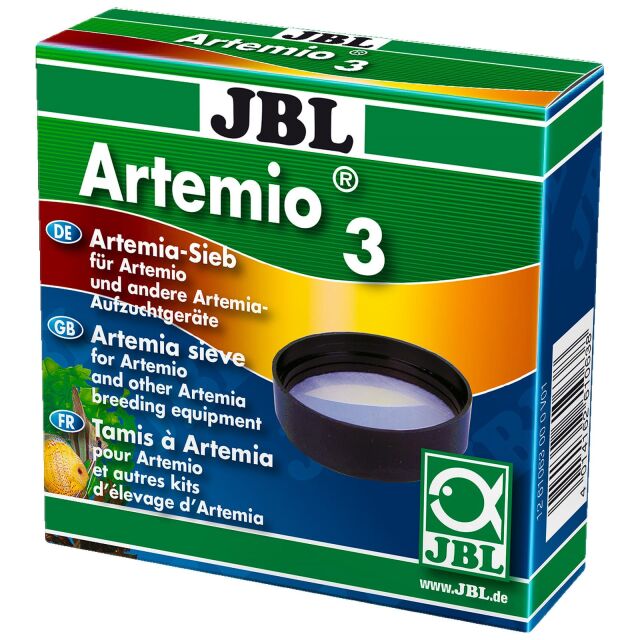
Normal fish nets are far too large for this tiny live food; instead, very fine-meshed sieves are often used for straining. If you drain off some salt water from the hatching container to pass it through the sieve and so isolate the nauplii, the water should be collected in a container and then returned to the incubator, so that the amount of water is the same as before siphoning.
Finally, using the sieve, the live food is briefly rinsed under running tap water to remove the salt water. The nauplii themselves contain no more salt than freshwater animals. The Artemia nauplii can then be fed in the aquarium straight away. As with all kinds of food, the same applies here: only feed as much as the fish eat up within a few minutes. Leftover food leads to unnecessary water pollution, especially because nauplii die off relatively quickly in fresh water. In small aquariums in particular, it is also advisable to switch off filters and pumps while adding the food, so that the nauplii are not sucked into the filter.
Raising brine shrimp further to adulthood
If you want to raise Artemia salina beyond the larval stage to adult animals, this is also possible. The full-grown shrimp are also popular feeder animals or are kept for observation as "living prehistoric crustaceans". However, this requires feeding the brine shrimp with special phytoplankton. Manufacturers such as JBL offer liquid food for this (ArtemioFluid). Under good conditions, the animals have reached the adult stage after about two weeks. Although the brine shrimp should be fed daily, you only feed again once the water is clear again. To keep water pollution low, regular water changes are recommended, and the fresh water should of course be prepared with a corresponding amount of salt.