We use cookies to offer you an optimal shopping experience. These cookies can be grouped into categories. The necessary ones are essential for your purchase. Functional services enable additional content such as videos and maps. With further cookies we produce anonymized statistics. Others serve primarily marketing purposes and are used for the personalization of advertising. These cookies are used by 11 Services used in the shop. You can decide for yourself which cookies you want to allow.
We store your choice on your device (“local storage”) and ask you again after 12 months at the latest. You can change it at any time under “Cookie Preferences” in the footer. You can find details on cookie lifetimes and necessary cookies in our privacy policy.
These services are required to run the shop and for your purchase and cannot be switched off.
Strictly necessary cookies enable basic functions and are required for the website to work properly.
Shop functions: Essential Shop functions This includes: JTLSHOP (cookie, until you close the browser; keeps your session, the cart and your login), consent (browser storage; remembers your cookie choice, 12 months at most, during the session also in session storage), has_starting_point, cur_product_id and product_page_visits (session storage; navigation between products) as well as aquasabi-search-index-last-url, aquasabi-search-index-results and aquasabi-search-index-data (session storage; search results and lists when paging). easyVision: easyVision lets website visitors customize the display – e.g. by adjusting contrast, font size, line and letter spacing, color rendering, a blue light filter or by disabling animations. Developed and hosted in Germany, the service is GDPR-compliant and supports statutory accessibility requirements (BFSG) from 2025. The service loads its scripts from cdn.sitecockpit.com and stores your settings (easy-vision-*) in your browser storage (no cookies). Reviews: aquasabi_guid (cookie, 12 months) is only set when you click “Helpful” under a review. It stores a random ID so that the same person cannot count a review as helpful more than once. Sorting and view: aquaSort and aquaDisplayType (cookies, 90 days) store the sorting or view (gallery or list) that you choose in a product list. They are only set when you choose a sorting or view. Amazon Pay: Payment processing with Amazon Pay. The service provider is Amazon Payments Europe S.C.A. Where Amazon Pay is offered (e.g. in the cart and at the checkout), the shop loads scripts and images from static-eu.payments-amazon.com, payments-eu.amazon.com and m.media-amazon.com and sets cookies (language, ledgerCurrency, apay-session-set). You can find out more in the privacy policy at https://www.amazon.de/gp/help/customer/display.html?nodeId=GRFTMVHP4HXMESSP PayPal: Payment processing with PayPal. The service provider is PayPal (Europe) S.à r.l. et Cie, S.C.A. Where PayPal is offered (e.g. in the cart and at the checkout), the shop loads scripts from www.paypal.com; for invoice payment via PayPal, c.paypal.com is added for fraud prevention. PayPal stores an entry in your browser storage (__paypal_storage__), and the shop remembers the chosen PayPal payment method in session storage (chosenPPCPaymentOption). You can find out more in the privacy policy at https://www.paypal.com/en/legalhub/paypal/privacy-full Sofortüberweisung: On the confirmation page after an order with this payment method the shop loads a Klarna logo from x.klarnacdn.net.
Additional functions such as embedded videos and maps, spam protection in forms or the rating badge. Data is transferred to the respective provider when they load.
Show Youtube Videos
Displaying videos
Processing company:Google Ireland Limited, Google Building Gordon House, 4 Barrow St, Dublin, D04 E5W5, Ireland
Terms of use: https://policies.google.com/privacyShow Shopauskunft Rating-Badge
Used to provide the services of shopauskunft.de.
Processing company:Händlerbund Management AG
Terms of use: https://www.shopauskunft.de/datenschutzIntegration of Google Maps services
Performance measurement; Providing personalized services, including content and ads; Providing our services
Processing company:Google Ireland Limited
Terms of use: https://policies.google.com/privacy?hl=enTo submit forms on this page, you need to consent to the transfer of data and storage of third-party cookies by Google. With your consent, reCAPTCHA, a Google service to avoid spam messages via contact forms, will be embedded. This service allows us to provide our customers with a safe way to contact us via online forms. At the same time, the service prevents spam bots from compromising our services. After you gave your permission, you might be asked to answer a security prompt to send the form. If you do not consent, unfortunately you cannot use the form. Please contact us in a different way.
Stopping spam bots
Processing company:Google Inc.
Terms of use: https://policies.google.com/privacyHelps us understand how the shop is used so that we can improve it.
We measure which pages and products are viewed and how visitors move through the shop. Google Analytics sets cookies (_ga, _ga_*) and sends usage data to Google.
Audience measurement and analysis of how the shop is used
Processing company:Google Ireland Limited
Terms of use: https://policies.google.com/privacy?hl=enMeasures our advertising and enables personalised advertising on other sites.
We measure whether an ad on Facebook or Instagram led to a purchase and show visitors relevant ads again. Cookies are set for this: _fbp and _fbc (Meta) and as_fbclid (ours, 30 days; remembers the ID of the ad click). Meta receives data about your actions in the shop (e.g. product views, cart, purchase), your IP address and browser information; for a purchase our server may also send them directly to Meta (Conversions API). More in our privacy policy (retargeting/remarketing and conversion tracking).
Measure advertising success and show relevant ads again (Facebook, Instagram)
Processing company:Meta Platforms Ireland Limited, Merrion Road, Dublin 4, D04 X2K5, Irland
Terms of use: https://www.facebook.com/privacy/policy/We measure whether an ad on TikTok led to a purchase. Cookies are set for this: _ttp, ttclid and _tt_* (TikTok) and as_ttclid (ours, 30 days; remembers the ID of the ad click). TikTok receives data about your actions in the shop (e.g. product views, cart, purchase), your IP address and browser information; for a purchase our server may also send them directly to TikTok (Events API). More in our privacy policy (retargeting/remarketing and conversion tracking).
Measure the success of ads on TikTok
Processing company:TikTok Technology Limited, 10 Earlsfort Terrace, Dublin, D02 T380, Irland
Terms of use: https://www.tiktok.com/legal/page/eea/privacy-policy/enWe measure whether an ad in ChatGPT led to a purchase. Cookies are set for this: __oppref and __obref (OpenAI) and as_oppref (ours, 30 days; remembers the ID of the ad click). OpenAI receives data about your actions in the shop (e.g. product views, cart, purchase), your IP address and browser information; for a purchase our server may also send them directly to OpenAI (Conversions API). Data may be transmitted to OpenAI OpCo, LLC (USA). More in our privacy policy (retargeting/remarketing and conversion tracking).
Measure the success of ads in ChatGPT
Processing company:OpenAI Ireland Limited, 1st Floor, The Liffey Trust Centre, 117-126 Sheriff Street Upper, Dublin 1, D01 YC43, Irland
Terms of use: https://openai.com/policies/eu-privacy-policy/We measure whether an ad led to a purchase and show visitors relevant ads again. Google Ads sets cookies (e.g. _gcl_*) and receives purchase data, where applicable in hashed form (SHA-256).
Measure advertising success and show relevant ads again (remarketing)
Processing company:Google Ireland Limited
Terms of use: https://policies.google.com/privacy?hl=enWe use cookies that are essential for payment processing through our partners. Please select which payment providers you would like to use.
In order to unlock offers for extended payment options, in particular express checkout and payment in instalments, we require your consent to the data transfer and storage of third-party cookies of the payment provider PayPal. This allows us to also offer you express checkout and payment by instalments. Without your consent, only the technically necessary data transfer to PayPal will take place, but you will then not be able to use the express checkout or extended offers for payment by instalments on this site.
Using express checkout and Displaying offers for payment in instalments for individual items or your entire purchase.
Processing company:PayPal
Terms of use: https://www.paypal.com/de/webapps/mpp/ua/privacy-full?locale.x=en-GB
Your consent ID:
With this randomly generated number we can show on request what you selected. It contains no information about you.
Would you like to see these contents? Activate the desired contents for one session only or allow the website to remember these settings. Once you have given your consent, the third-party data can be loaded. For this, third-party cookies might be stored on your device. You can change these settings at any time (footer: “Cookie Preferences”). For further details, please see the Privacy notice.
By Aram Schneider Published Updated
Translated from German with AI assistance and reviewed by our editors.
Contents
Oxygen gas (O2) is a component of air and can dissolve in water. In principle, it is of enormous importance for all living things in the aquarium. This applies not only to animals such as ornamental fish, shrimp, snails and crayfish, but also to many microorganisms such as bacteria, which need the gas for chemical processes. Aquatic plants also need oxygen, although they naturally produce it themselves through photosynthesis as well. In this article we show how important oxygen is for an aquarium and give tips for a better oxygen supply.
For most living things in the aquarium, especially ornamental fish, shrimp, crayfish and snails, oxygen is vital for respiration. This gas is taken up through respiratory organs such as lungs or gills, often also through the entire body surface, and is then distributed throughout the body via the bloodstream. In this way all organs are supplied with O2. In the cells, energy for all life processes is then obtained by oxidizing organic substances with the oxygen. Carbon dioxide (CO2) is produced as a waste product. Because of this so-called aerobic respiration, oxygen is of immense importance for all animal inhabitants of the aquarium.
The element oxygen (O) is also one of the basic building blocks of most organic compounds and thus of living things themselves. The animals, however, do not take up this oxygen as O2 from the air or the water, but with the organic nutrients in which it is chemically bound.
O2 is also important for many microorganisms in the aquarium − apart from those that do not need oxygen because they are capable of so-called anaerobic cellular respiration. But, for example, bacterial genera such as Nitrosomonas and Nitrosospira, which are so important for the nitrogen cycle, need oxygen. They oxidize ammonium (NH4) to nitrite (NO2); the next step from nitrite to nitrate (NO3) is carried out by genera such as Nitrobacter and Nitrospira, which also need oxygen for it. Hence, oxygen is of great importance for the biological balance and the breakdown of pollutants.
The concentration of oxygen in aquarium water should if possible not drop into the range of only 4 to 5 mg/l O2. If you measure such low values, you can speak of an oxygen deficiency. For the aquarium hobby there are suitable oxygen tests with which the O2 content in the water can be checked.
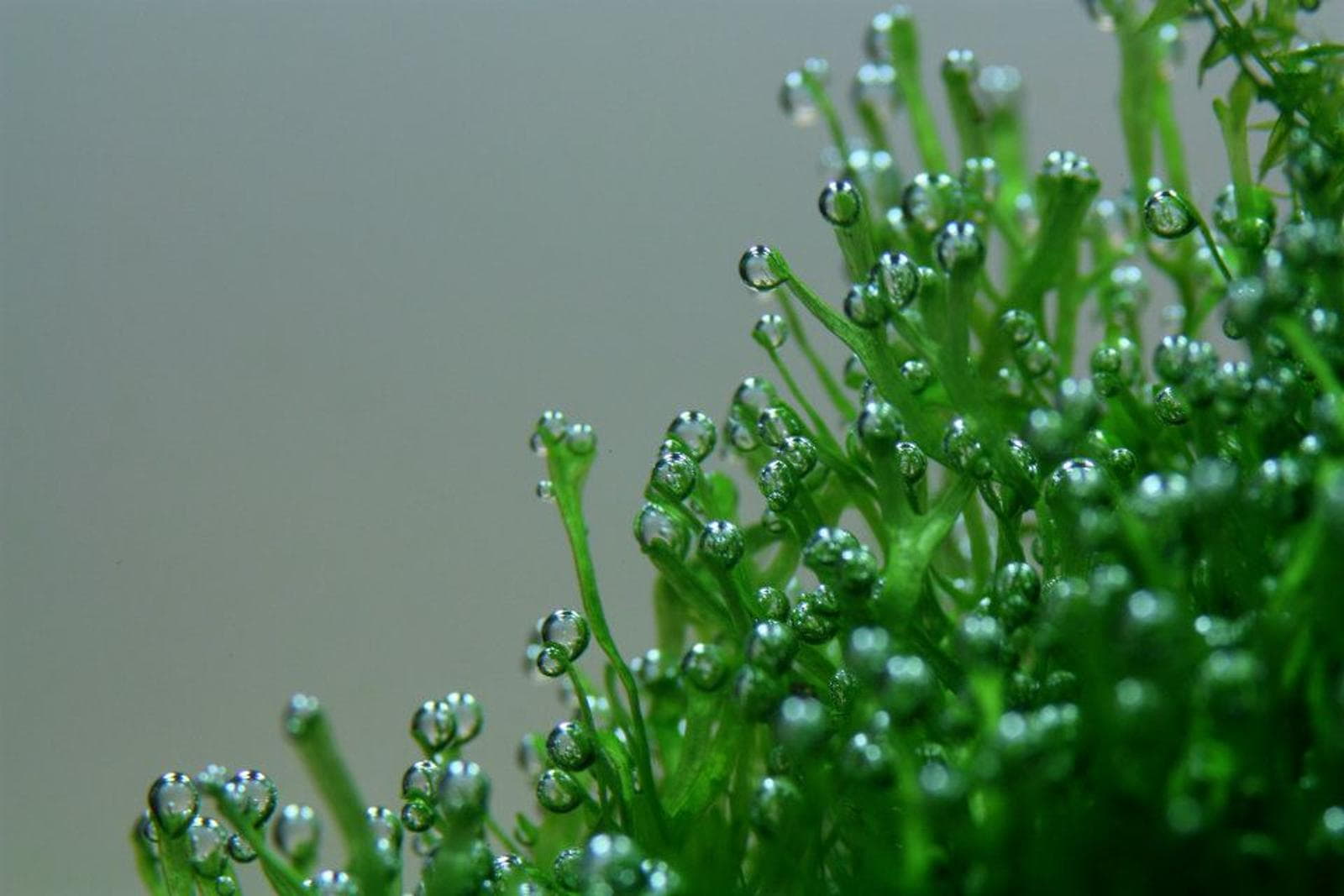
Plants need oxygen too. Just like animals, they need it to obtain energy from organic substances through aerobic cellular respiration. However, they also produce oxygen themselves during photosynthesis. Here, light energy is used to make glucose and oxygen gas from water and carbon dioxide. Plants can take up oxygen from the air or the water for their respiration and additionally use the oxygen from their own photosynthesis. Conversely, they use the CO2 from respiration for photosynthesis. For plants, the O2 supply to the roots is especially important, because these must breathe in order to live. As a rule, however, roots cannot produce their own oxygen through photosynthesis. In their natural habitats, aquatic and marsh plants also mostly grow in low-oxygen soils. Here a system of air channels helps them transport oxygen. This system, called aerenchyma, runs through the entire plant. In this way, roots and other underground organs can be reliably supplied with oxygen. Some aquatic plants are even able to release oxygen through the roots and thereby enrich the soil with O2.
Most aquarium plants have such a well-developed aerenchyma, but epiphytes such as Anubias, Java fern and Bucephalandra do not. In nature, they mostly sit on rocks in and next to fast-flowing waters. Their roots and rhizomes are not adapted to low-oxygen conditions and therefore also depend in the aquarium on the oxygen in the open water or in a coarse, well-flushed substrate.
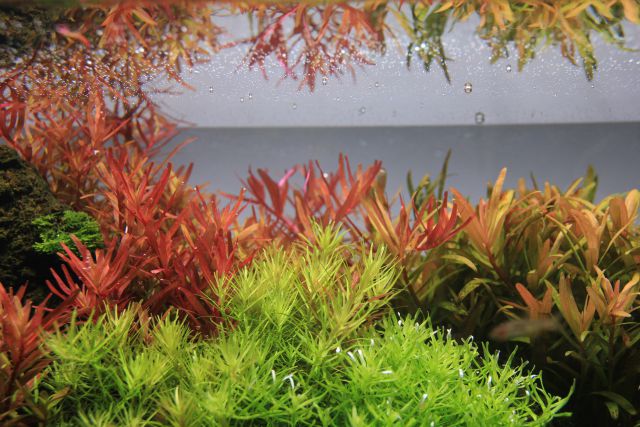
In the aquarium, the aquatic plants produce oxygen during the lighting period, that is, usually during the day. The plants do respire then as well, but they normally release more oxygen through photosynthesis than they consume through respiration. At night, however, when it is dark, no photosynthesis takes place, only respiration, the reverse process, so to speak. During this time the plants need O2 and release CO2. In very densely planted aquariums with a lot of fast-growing plant mass, an oxygen shortage can therefore sometimes occur at night, which can then have a negative effect on the inhabitants. Shrimp in particular can suffer from this. The aquarist then regularly discovers a few dead animals in the morning, again and again. Here, aerating the aquarium at night can help. We have presented exactly how to proceed in this separate article.
Water can only absorb oxygen to a certain extent. This ability also depends strongly on the water temperature. As the temperature rises, the water's capacity to absorb oxygen drops; conversely, cooler water can absorb more oxygen.
Especially in aquariums that need rather higher temperatures because of their stocking, the aquarist should therefore make sure there is a good oxygen supply. These include, for example, South American aquariums, especially those with discus, aquariums with African cichlids, but also themed aquariums with a focus on Sulawesi.

![]()
A lack of oxygen in the water can often be recognized in the animals by the fact that they stay near the water surface and have an increased breathing rate. Typical is fish "hanging" under the water surface, combined with gasping. But it is not only fish; invertebrates, too, can indicate oxygen deficiency through their behavior. Snails then crawl up the aquarium glass in large numbers, and shrimp try to reach the surface using aids such as aquatic plants and decorative objects such as driftwood. This behavior can be caused not only by oxygen deficiency but also by an elevated nitrite content or too strong a CO2 concentration. You should determine this more precisely with targeted testing. For this, the aquarist can find suitable tests in specialist stores for determining the oxygen, carbon dioxide and nitrite concentration in the aquarium water.
If there is a lack of oxygen in the aquarium, there are several approaches to solving the problem.
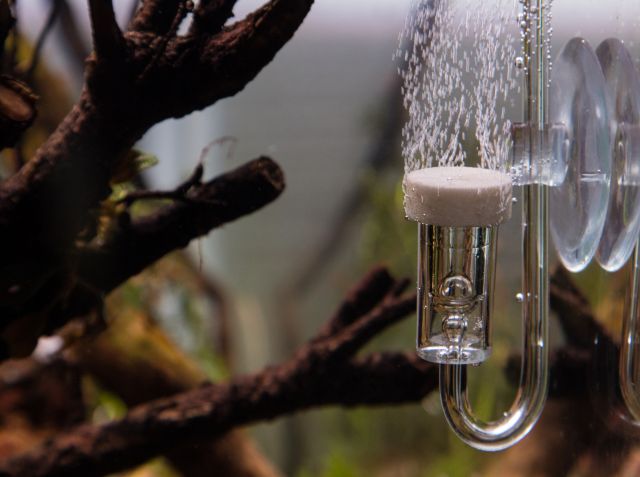
The simplest and most obvious solution is additional aeration of the aquarium. As a rule, this is done with an air stone in the aquarium, which is connected to a diaphragm pump via an air hose and carries ambient air into the water. The air stone, or diffuser, breaks the air up into smaller bubbles, which then rise in the aquarium. Depending on the size of the bubbles and the corresponding surface agitation, CO2 is also driven out. Sometimes the breathing of the ornamental fish and other aquarium inhabitants can be impaired by too high a carbon dioxide concentration. Driving out CO2 with an air stone then makes breathing easier for them. In a planted aquarium, however, the aquatic plants may grow worse if a lot of CO2 is driven out, since it is the source of the essential plant nutrient carbon. You get a similar effect on the oxygen and carbon dioxide concentration if you adjust the filtration of the aquarium a little, for example by positioning the filter outflow higher so that the water surface is agitated more. Or you use a skimmer, or surface skimmer, as the filter inflow.
If an oxygen deficiency is due to the temperature in the aquarium having risen sharply (for example on very hot summer days), the O2 content can be increased by cooling the aquarium. Of course, you should proceed gently here so as not to shock the stock. We have presented measures for cooling an aquarium in more detail here.
There are certainly other technical aids in the aquarium hobby for adding oxygen. In the shrimp scene in particular, the use of an oxydator is very popular. Installing a Twinstar sterilizer also increases the oxygen concentration in the aquarium. Both products also have other positive effects (for example reducing germ pressure), which we have described in more detail in the case of Twinstar in this article.
A fairly popular argument for the importance of aquatic plants is that they are natural oxygen producers, and accordingly adding more plants to the aquarium is recommended to increase the O2 content. For a noticeable effect to occur, however, it is also important to supply the aquatic plants optimally with enough light and all essential nutrients. In addition to carbon from CO2, this includes micronutrients (iron and other trace elements) as well as macronutrients, above all potassium, nitrogen and phosphorus. You can read how to feed aquarium plants properly in this article.
And as already mentioned above, aquarium plants are oxygen donors only during the lighting period, not in the dark when no photosynthesis takes place.
