We use cookies to offer you an optimal shopping experience. These cookies can be grouped into categories. The necessary ones are essential for your purchase. Functional services enable additional content such as videos and maps. With further cookies we produce anonymized statistics. Others serve primarily marketing purposes and are used for the personalization of advertising. These cookies are used by 11 Services used in the shop. You can decide for yourself which cookies you want to allow.
We store your choice on your device (“local storage”) and ask you again after 12 months at the latest. You can change it at any time under “Cookie Preferences” in the footer. You can find details on cookie lifetimes and necessary cookies in our privacy policy.
These services are required to run the shop and for your purchase and cannot be switched off.
Strictly necessary cookies enable basic functions and are required for the website to work properly.
Description:
Shop functions: Essential Shop functions This includes: JTLSHOP (cookie, until you close the browser; keeps your session, the cart and your login), consent (browser storage; remembers your cookie choice, 12 months at most, during the session also in session storage), has_starting_point, cur_product_id and product_page_visits (session storage; navigation between products) as well as aquasabi-search-index-last-url, aquasabi-search-index-results and aquasabi-search-index-data (session storage; search results and lists when paging).
easyVision: easyVision lets website visitors customize the display – e.g. by adjusting contrast, font size, line and letter spacing, color rendering, a blue light filter or by disabling animations. Developed and hosted in Germany, the service is GDPR-compliant and supports statutory accessibility requirements (BFSG) from 2025. The service loads its scripts from cdn.sitecockpit.com and stores your settings (easy-vision-*) in your browser storage (no cookies).
Reviews: aquasabi_guid (cookie, 12 months) is only set when you click “Helpful” under a review. It stores a random ID so that the same person cannot count a review as helpful more than once.
Sorting and view: aquaSort and aquaDisplayType (cookies, 90 days) store the sorting or view (gallery or list) that you choose in a product list. They are only set when you choose a sorting or view.
Amazon Pay: Payment processing with Amazon Pay.
The service provider is Amazon Payments Europe S.C.A. Where Amazon Pay is offered (e.g. in the cart and at the checkout), the shop loads scripts and images from static-eu.payments-amazon.com, payments-eu.amazon.com and m.media-amazon.com and sets cookies (language, ledgerCurrency, apay-session-set). You can find out more in the privacy policy at https://www.amazon.de/gp/help/customer/display.html?nodeId=GRFTMVHP4HXMESSP
PayPal: Payment processing with PayPal.
The service provider is PayPal (Europe) S.à r.l. et Cie, S.C.A. Where PayPal is offered (e.g. in the cart and at the checkout), the shop loads scripts from www.paypal.com; for invoice payment via PayPal, c.paypal.com is added for fraud prevention. PayPal stores an entry in your browser storage (__paypal_storage__), and the shop remembers the chosen PayPal payment method in session storage (chosenPPCPaymentOption). You can find out more in the privacy policy at https://www.paypal.com/en/legalhub/paypal/privacy-full
Sofortüberweisung: On the confirmation page after an order with this payment method the shop loads a Klarna logo from x.klarnacdn.net.
Additional functions such as embedded videos and maps, spam protection in forms or the rating badge. Data is transferred to the respective provider when they load.
Show Youtube Videos
Description:
Displaying videos
Processing company:
Google Ireland Limited, Google Building Gordon House, 4 Barrow St, Dublin, D04 E5W5, Ireland
Helps us understand how the shop is used so that we can improve it.
We measure which pages and products are viewed and how visitors move through the shop. Google Analytics sets cookies (_ga, _ga_*) and sends usage data to Google.
Description:
Audience measurement and analysis of how the shop is used
Measures our advertising and enables personalised advertising on other sites.
We measure whether an ad on Facebook or Instagram led to a purchase and show visitors relevant ads again. Cookies are set for this: _fbp and _fbc (Meta) and as_fbclid (ours, 30 days; remembers the ID of the ad click). Meta receives data about your actions in the shop (e.g. product views, cart, purchase), your IP address and browser information; for a purchase our server may also send them directly to Meta (Conversions API). More in our privacy policy (retargeting/remarketing and conversion tracking).
Description:
Measure advertising success and show relevant ads again (Facebook, Instagram)
We measure whether an ad on TikTok led to a purchase. Cookies are set for this: _ttp, ttclid and _tt_* (TikTok) and as_ttclid (ours, 30 days; remembers the ID of the ad click). TikTok receives data about your actions in the shop (e.g. product views, cart, purchase), your IP address and browser information; for a purchase our server may also send them directly to TikTok (Events API). More in our privacy policy (retargeting/remarketing and conversion tracking).
We measure whether an ad in ChatGPT led to a purchase. Cookies are set for this: __oppref and __obref (OpenAI) and as_oppref (ours, 30 days; remembers the ID of the ad click). OpenAI receives data about your actions in the shop (e.g. product views, cart, purchase), your IP address and browser information; for a purchase our server may also send them directly to OpenAI (Conversions API). Data may be transmitted to OpenAI OpCo, LLC (USA). More in our privacy policy (retargeting/remarketing and conversion tracking).
Description:
Measure the success of ads in ChatGPT
Processing company:
OpenAI Ireland Limited, 1st Floor, The Liffey Trust Centre, 117-126 Sheriff Street Upper, Dublin 1, D01 YC43, Irland
We measure whether an ad led to a purchase and show visitors relevant ads again. Google Ads sets cookies (e.g. _gcl_*) and receives purchase data, where applicable in hashed form (SHA-256).
Description:
Measure advertising success and show relevant ads again (remarketing)
We use cookies that are essential for payment processing through our partners. Please select which payment providers you would like to use.
In order to unlock offers for extended payment options, in particular express checkout and payment in instalments, we require your consent to the data transfer and storage of third-party cookies of the payment provider PayPal. This allows us to also offer you express checkout and payment by instalments. Without your consent, only the technically necessary data transfer to PayPal will take place, but you will then not be able to use the express checkout or extended offers for payment by instalments on this site.
Description:
Using express checkout and Displaying offers for payment in instalments for individual items or your entire purchase.
Your consent ID:With this randomly generated number we can show on request what you selected. It contains no information about you.
Data privacy settings
Would you like to see these contents? Activate the desired contents for one session only or allow the website to remember these settings. Once you have given your consent, the third-party data can be loaded. For this, third-party cookies might be stored on your device. You can change these settings at any time (footer: “Cookie Preferences”). For further details, please see the Privacy notice.
Among the water values in an aquarium, the so-called total hardness, abbreviated GH, plays a decisive role in aquaristics. In this article we explain what this water value represents and what the difference is to carbonate hardness.
Definition of total hardness
In Germany and Austria the unit for the degree of hardness of water is given in °dH (degree of German hardness). Internationally, however, there are other units such as ppm (parts per million), also called American hardness, but also French, English or Russian hardness. All these units can be converted into each other. In aquaristics the German hardness and the ppm-indication have prevailed.
The total hardness is often abbreviated as GH and describes how hard or soft the water is. A kind of ranking order was determined, in which a water with a value below 8.4 dH° is defined as soft, from 8.4 to 14 dH° as medium-hard and from 14 dH° as hard. This classification can be traced back to the new detergents and cleaning agents law (WRMG) passed by the German Bundestag on 1 February 2007.
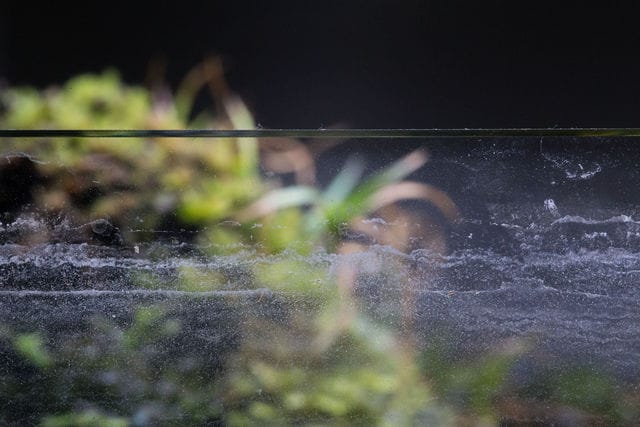
So-called alkaline earth metal ions are dissolved in the water. These mainly include magnesium and calcium, but also elements such as radium, strontium or beryllium, which only occur in the form of trace elements. The sum of these alkaline earth metals dissolved in the liquid is determined as the total hardness, the ions are described as hardness builders. Normally these metal ions are present in water in dissolved form, but depending on external influences and circumstances they can form insoluble compounds and precipitate as solids. Then, for example, lime develops, we aquarists know all too well in the form of annoying deposits (lime edges) on the discs of the aquarium. Harder water has an increased tendency to calcify. The formation of limescale residues in household appliances such as electric kettles, coffee machines or dishwashers is usually also due to water with a higher total hardness.
Total hardness and carbonate hardness
The so-called carbonate hardness (KH) is related to the total hardness, as it represents a certain part of the GH. Alkaline earth metal ions dissolved in water can bring carbonates and hydrogen carbonates with them. These are called carbonate hardness (or temporary hardness). The KH can be removed by boiling the liquid. Magnesium and calcium carbonates are deposited as solids. The carbonate hardness plays a very special role in aquaristics: Due to the so-called lime-carbonic acid equilibrium, the KH is related to the pH value and the CO2 concentration. These factors influence each other. In an aquarium the carbonate hardness serves primarily to buffer the pH value in the neutral range and thus to avoid acid drops or pH increases. By the way: the above does not mean that all alkaline earth metals have to be bound to carbonates and hydrogen carbonates and therefore the GH has the same value as the KH. As a rule, the carbonate hardness is lower than the total hardness. In rare exceptions, it is even the other way round that the carbonate hardness is higher. This is due to the fact that other carbonate compounds are present in the water, but are not linked to alkaline earth ions. An example is sodium hydrogen carbonate. According to the definition, such a carbonate compound is not actually part of the KH, but aquaristic water tests also record these compounds and thus indicate a correspondingly increased KH as a result. Strictly speaking, such a KH test does not measure the pure carbonate hardness, but the so-called acid binding capacity (SBV).
Total hardness in aquaristics
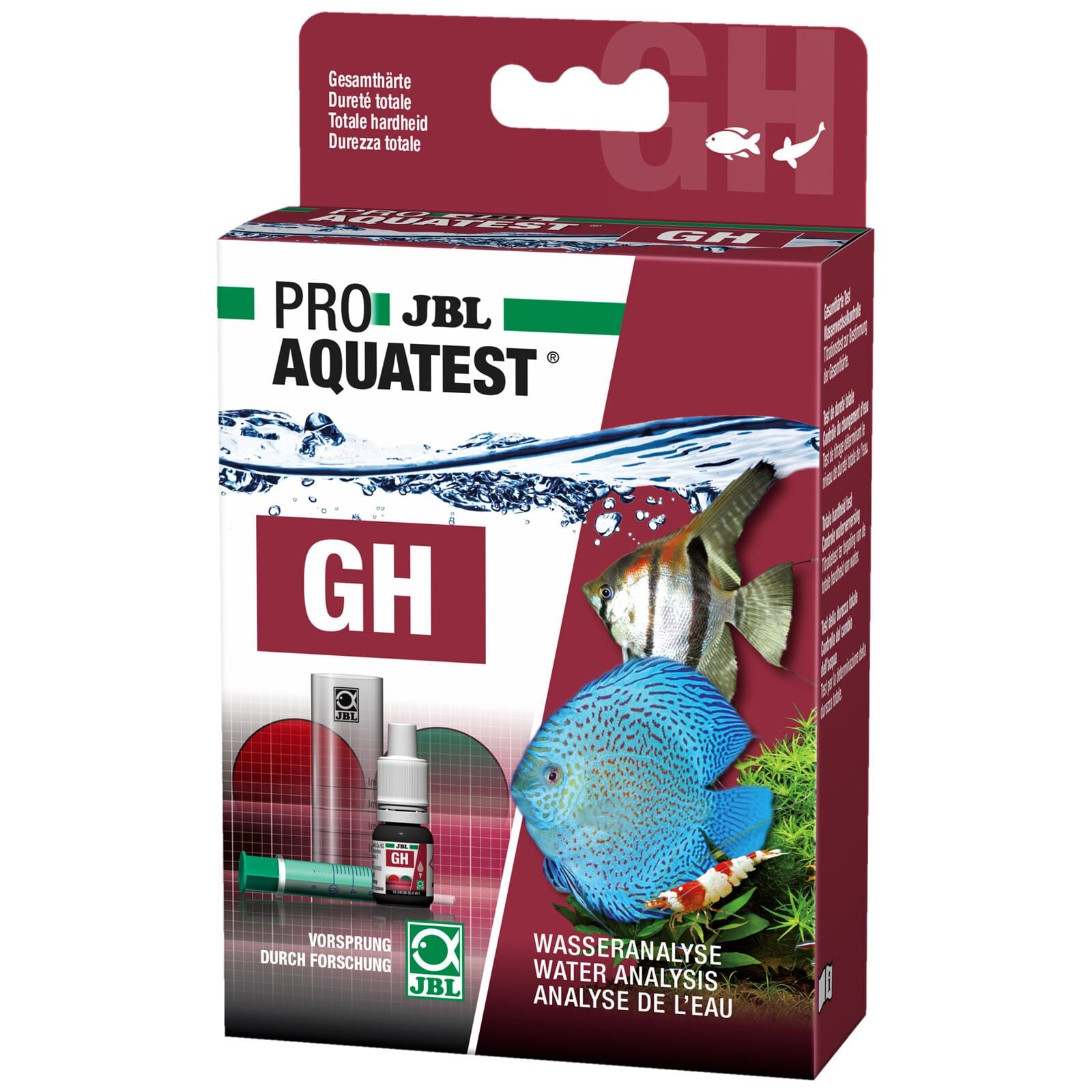
Although all alkaline earth metals form the total hardness, in aquarium water only the elements calcium and magnesium are of primary importance, as these occur in very large quantities, while the rest is usually only present in the form of trace elements. 7.144 mg/l Ca or 4.346 mg/l Mg are each responsible for 1 °dH total hardness. In aquaristics there are many aquatic plants, ornamental fish and invertebrates, which prefer soft and sour water due to their original habitat. If too many alkaline earth ions are dissolved in the water, the osmotic pressure on the inhabitants increases, which can lead to stress and even metabolic disorders. On the other hand, the water should not be so poor in minerals that it causes deficiency symptoms and growth problems. In particular, the bacterial flora required in the aquarium to break down pollutants needs a certain mineral content and thus a certain total hardness. Calcium and magnesium are also important macro nutrients for the healthy growth of aquatic plants. They prefer certain conditions that can have an enormous effect on the vitality of aquarium plants (see also "The calcium-magnesium ratio"). The element calcium is important for the animal inhabitants in the aquarium for the structure of their skeleton, especially for invertebrates such as snails, crabs and shrimps, whose outer skeleton consists predominantly of calcium. The total hardness (GH) can be very easily measured and read off with a corresponding water test.
Softening the water in the aquarium
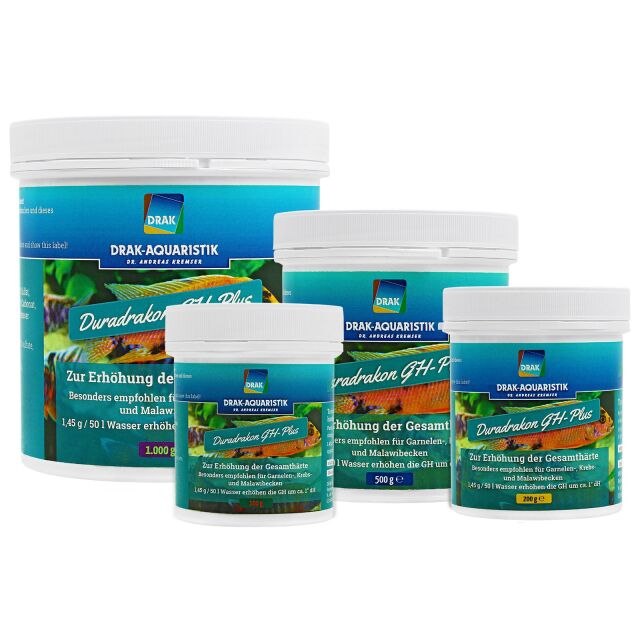
If the total hardness is too high, there are several possibilities for the aquarist to soften the water in the aquarium. The simplest solution is to mix it with softer water such as rainwater or osmosis water. By means of a reverse osmosis system or a cation exchanger, water can be almost completely demineralised. If you want to use such a so-called zero water in the aquarium, you should mix it with harder water to obtain a minimum of important minerals. Alternatively, specially designed hardening salts can also be used for this purpose, which offer important minerals and trace elements in optimal proportions and which allow a much more precise dosage than blending with harder water.
Another way to soften hard water would be to use certain care products developed for this purpose. Examples are the Discus Buffer or the Acid Regulator from Seachem, which are precipitated by calcium and magnesium.