Water change

By Aram Schneider Published Updated
Translated from German with AI assistance and reviewed by our editors.
While a constant supply of freshwater happens by itself in natural streams, an aquarium is by definition, a closed system. So here, man has to help out in order to provide new, unencumbered water. We’ll explain to you here, why water changes are important and how to do them best..
Why do I need to change the water?
Especially with regard to animal stocking, it is important to exchange the water in order to reduce the resulting organic load. This is caused, among other things, by food residues, dying plant material and excretions of the inhabitants. Useful bacteria, which are settled mainly in the filter and soil, can degrade these pollutants in an aquarium. This mainly consumes oxygen. Aquatic plants can partially use these degradation products as nutrients. Nonetheless, there may be an accumulation of organic matter without water change, especially those that can not be degraded in the aquarium, such as fats and proteins.
Another important issue in aquariums with a focus on animal stocking is the so-called germ load. Over time, the number of pathogens (bacteria, fungi, viruses) in aquarium water will continue to increase. A regular, large water change with unloaded water helps to reduce the germ load again. In order to keep these as low as possible, breeders in particular rely on technical measures that reduce the bacterial pressure. This can be realized by using a UV sterilizer or Twinstar Sterilizers.
Regarding the fertilization of aquatic plants, a water change provides a kind of "reset". This prevents, for example, that certain nutrients are accumulating too much. On the other hand, new minerals are added to the fresh water that could have been used up in the aquarium.
If hardening stones were used in an aquascaping layout (e.G. the ever popular Seiryu Ryuoh), increases the carbonate and total hardness, especially when carbon fertilization is done via a CO2 system. Depending on the amount of hardening rock, the increase in hardness within a week can be quite dramatic. In these cases, the regular water change is important to lower the hardness again.
We therefore recommend a regular partial water change of at least 50% per week.
Execution
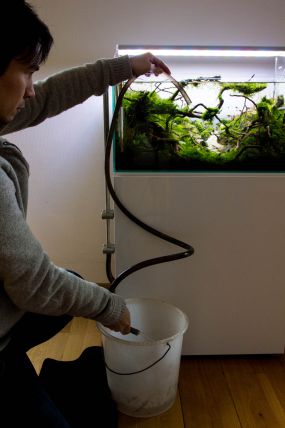
An old-school method is the so-called siphoning. A bucket is placed on the floor and the old water gets emptied using a hose. One hose end is held into the aquarium, then, using your mouth, the water is sucked in at the other end of the hose. As soon as the water flows into the hose, move the lower end of the hose into the bucket as soon as you can. Later the bucket gets emptied and reused to fill the aquarium with fresh water.
Disadvantages:
- High effort, especially for larger aquariums.
- Need to carry heavy objects.
- When sucking on the hose, there’s a risk of getting “dirty” water in your mouth.
Advantages:
- When siphoning with a hose, cleaning work can be done splendidly. It’s easy to siphon away sludge, plant residues and singular substrate particles.
- Easily done with small aquariums.
More effective is the indrodution and draining of water using hoses and pumps, close proximity to a water connection provided. This method is especially easy to pull off when an external filter is installed. The hose should be equipped with a quick release on the outlet side.
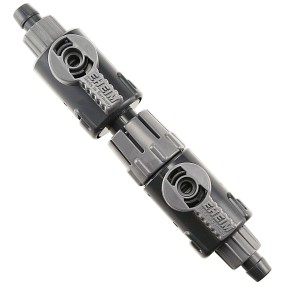
When changing the water, the filter is disconnected from the mains and blocks both valves on the coupling. Then the filter outlet hose is disconnected using the coupling. A longer hose is connected to the filter. For this purpose, this hose should also be provided with a matching coupling. The coupling is now closed again and the longer hose is allowed to end in a water drain (for example the sink). Then the two valves on the coupling are opened and the filter is reconnected to the mains. The filter now pumps the aquarium water through the hose and into the sink.
In order to supply fresh water, you can also conveniently use hoses. Suitable adapters for indoor-taps have become available from various gardening suppliers which can be easily plugged to a tap, enabling the easy connection of a hose via a click system.
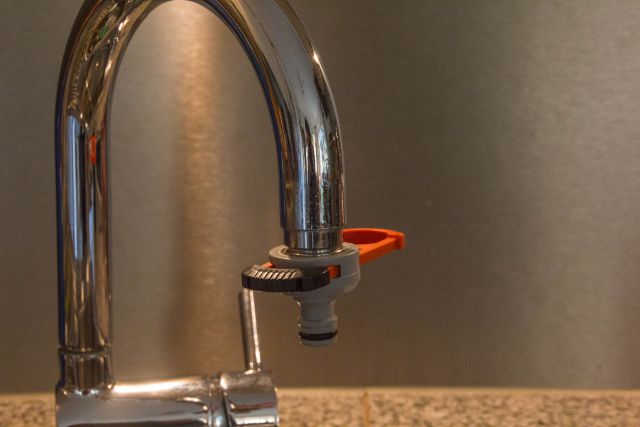
A suitable faucet adapter for garden hoses.
Since it is difficult to regulate the faucet at the same time and also keep the hose in the aquarium, there is the possibility to modify the garden hose. Using a simple shut-off valve and a short piece of 12/16 mm filter hose you can for example connect a disused filter inlet with the hose. This can be nonchalantly hung over the rim of the aquarium, enabling you to walk over to the tap.
Caution: the valve isn’t exactly pressure-resistant and shouldn’t be used to shut off the water but only to gently regulate the inflow speed. To play it save, the connections can be further secured using hose clips.
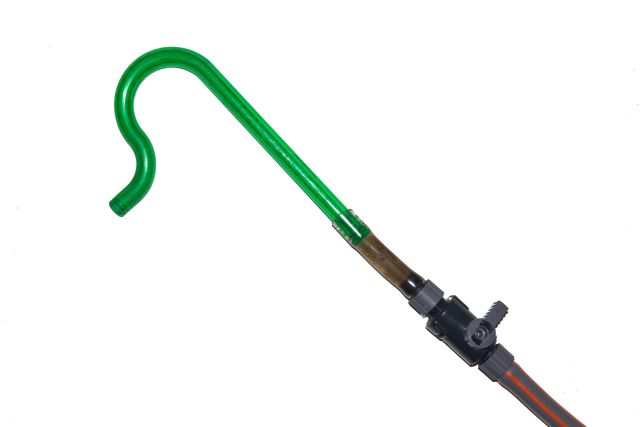
Filter inflow fixed to a garden hose
Cleaning measures when changing water
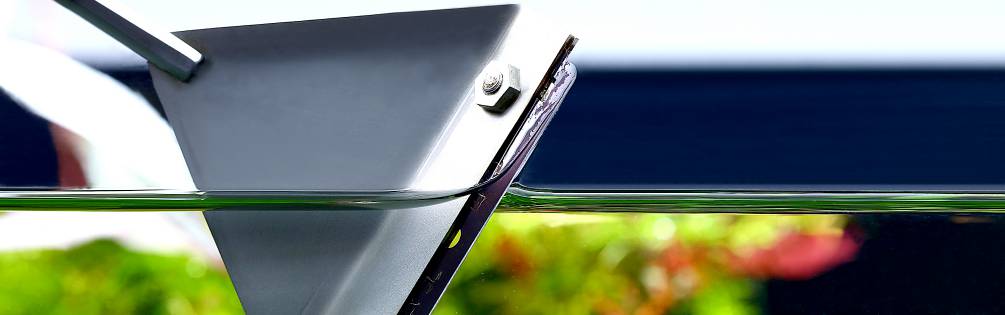
Once the water level in the aquarium has been lowered, you should use this state to clean the windows. This way, tiny plant parts often stick to the top of the aquarium’s edges, which would otherwise be floating on the surface. You do not have to puzzle them out of the tank individually, but you can just wipe them off very easily with a piece of kitchen paper. Also, the glass panes are now easier to clean, especially in the upper area, as you do not have to dip your hands into the water. Lime deposits can be easily removed using a scraper.
Water treatment
Since animals and plants sometimes require certain water values, it is important to adjust the parameters of the freshwatert. Sensitive animals could otherwise be severely stressed by the sudden change. Of particular note is the temperature of the water to be admitted. Too cold or even hot water may cause a shock to the aquarium inhabitants.
For water conditioning purposes like setting other parameters such as the carbonate and total hardness, one can resort to ready-to-use salt mixtures, which have become very popular especially in the keeping of shrimp or discus fish. Many breeders rely on the combination of such salts with reverse osmosis water to always come to the same desired freshwater parameters after a water change.
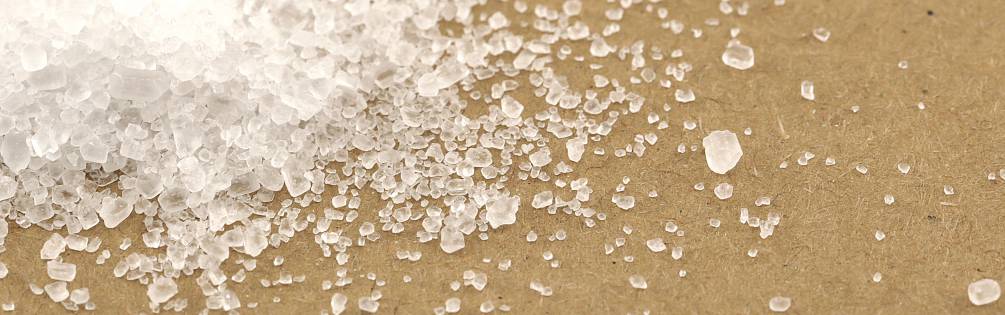
But also for the successful keeping of aquarium plants one can use the time of the water change to optimize water values. You can fertilize the freshwater with liquid fertilizers to ideal values. Many plant aquarists use this moment to improve the ratio of calcium to magnesium. This can easily be done by adding epsom salt (for more info refer to the following article: "the calcium-magnesium ratio").
Another popular method, immediately after the water change, is to add phosphate to a specific target value (for example, 0.5 mg / l). For this purpose, a liquid phosphate fertilizer is suitable as a single component, such as the Aqua Rebell Basic Phosphat. In the run of the week, however, no further phosphate is added, so that the measurable value approaches zero. Since aquatic plants can store this nutrient well, it is not necessary to keep it permanently in the measurable range. Apart from that, phosphate is rather reaction-happy in open water, with this method of addition you prevent possible reactions with other nutrients in solution.
As a rule, the use of tap water does not pose a risk to the animal inhabitants. However, caution is advised if new copper pipes have been installed in your home. From time to time, sewer pipes are also flushed or cleaned by the drinking water supplier. In some cases more dangerous substances such as chlorine can be used. Usually this process is announced by the provider in a timely manner. To rule out problems with possibly dangerous substances it is advised to treat the tapwater with a water conditioner.
Evaporation
Especially in open aquariums, evaporation plays a role not to be underestimated. Since only pure water escapes by evaporation (H 2 O), but all solutes remain in the aquarium, it should ideally be topped up with osmosis water. Otherwise, there will be a steady accumulation of minerals in the aquarium water.