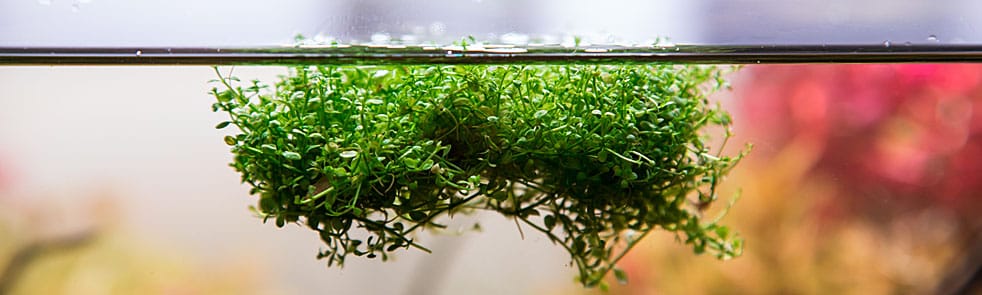
 Aquatic plants floating up
Who doesn't know the problem: you are so proud as an aquascaper of your dense Cuba pearlweed carpet in the foreground of the aquarium - and then one day the inexplicable happens: parts of the ground cover plant separate from the substrate and float up. We explain why this happens and what you can do about it in this article.
Causes of aquarium plants floating up
First of all, a bit of physics: of course, all objects whose density is lower than that of water float. As a rule, this also includes all the plants in the aquarium. Most of them (leaving pure floating plants aside) stay in place because they are anchored with roots in the substrate or have fixed themselves to aquarium wood or stones with holdfasts. If this connection comes loose, most aquatic plants drift up to the water surface. This phenomenon can occur even with larger individual plants or even with connected plant cushions.
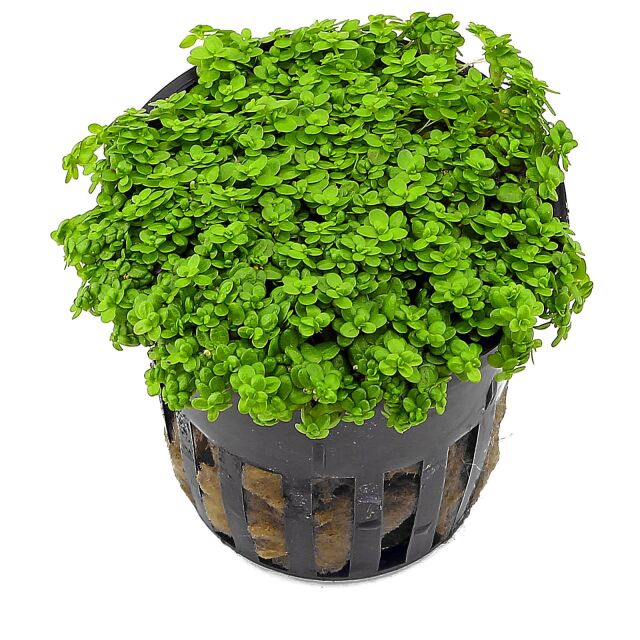
Hemianthus callitrichoides"Cuba" - Cuba dwarf pearlweed
In aquarium practice, very fine, shallow-rooted, small-staying foreground plants such as the aforementioned Cuba pearlweed have proven particularly prone to floating up, but also Elatine hydropiper, Glossostigma elatinoides and Riccia fluitans (if it is used as a ground cover plant). If you as an aquascaper neglect the regular trimming of these plants, the cushions become too thick over time. It can then happen that the lower parts die off due to lack of light and the carpet thus loses its hold in the substrate. Healthy but very tall stands of ground cover plants can also float up: a lot of plant mass also produces a lot of oxygen when good conditions such as sufficient light and nutrients are present. If the visible production of oxygen bubbles on the aquatic plants is so strong that the buoyancy of the gas bubbles exceeds the strength of the root hold, plant cushions can likewise detach from the substrate and rise to the water surface.
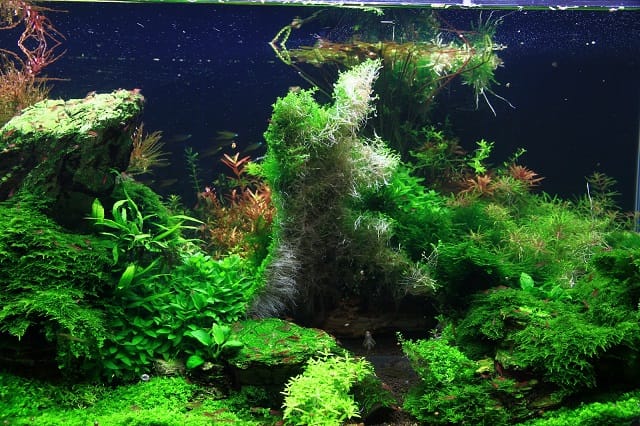
A large piece of Elatine hydropiper is coming up
Countermeasures
A foreground plant frequently affected by the phenomenon of floating up is Hemianthus callitrichoides"Cuba" (often simply abbreviated as HCC). This aquarium plant has extremely fine roots that do not grow very long. Regularly cutting the ground cover plant down to just a few centimeters is an important maintenance measure to counteract the growth of excessively thick cushions. It is also helpful, when setting up the aquarium, to use substrates with a small particle size, such as sand or powder soil, in the zones where the fine-rooted aquatic plants are to be planted.
By the way: instead of HCC, you can also use MMC (Micranthemum sp."Montecarlo-3"). The look of this plant is very similar; it only has slightly larger leaves. The advantages, however, are the following: Micranthemum sp."Montecarlo-3" is somewhat easier to keep when it comes to nutrient supply, it has longer roots and, even when forming thicker cushions, is not as prone to floating up as Hemianthus callitrichoides"Cuba".
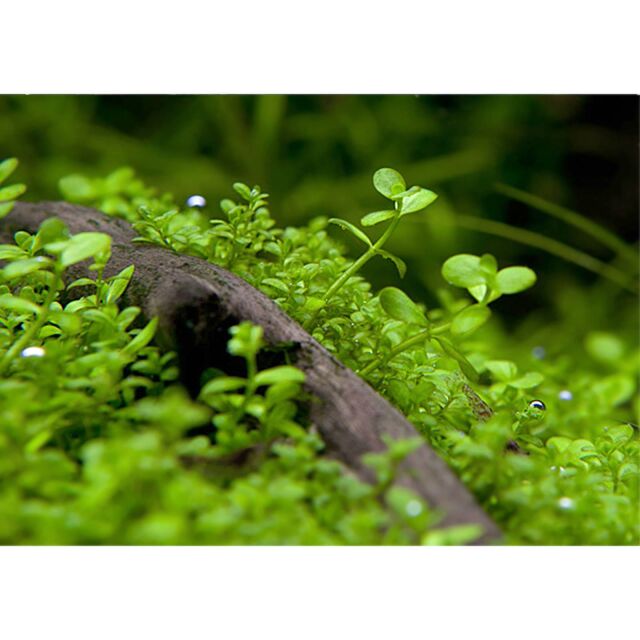
Micranthemum sp."Montecarlo-3"
To prevent such scenarios in general, it is a good idea to create a so-called mixed carpet. Here, different ground cover plant varieties are mixed with one another. This way you can combine an aquatic plant species that roots less well and tends to float up with ground cover plants that develop a more pronounced root system. One example would be the combination of Cuba pearlweed and Eleocharis. Takashi Amano made use of the runner formation of Glossostigma elatinoides to anchor Riccia fluitans better to the ground as a ground cover plant. Such a mix, by the way, also creates a much more natural look in the aquascape.
If some areas of the ground cover plant are already somewhat loose and no longer so well rooted, a few of these immediate measures help:
- Scatter substrate over the plant group again. The extra weight keeps the plants down and lets them root better again too.
![Weighing down Eleocharis with gravel]()
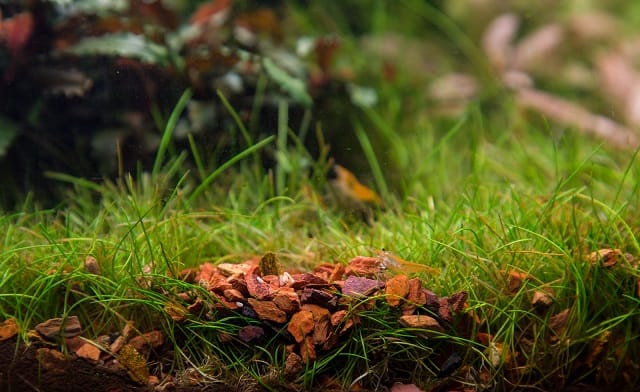
Here Eleocharis is being weighed down with some gravel
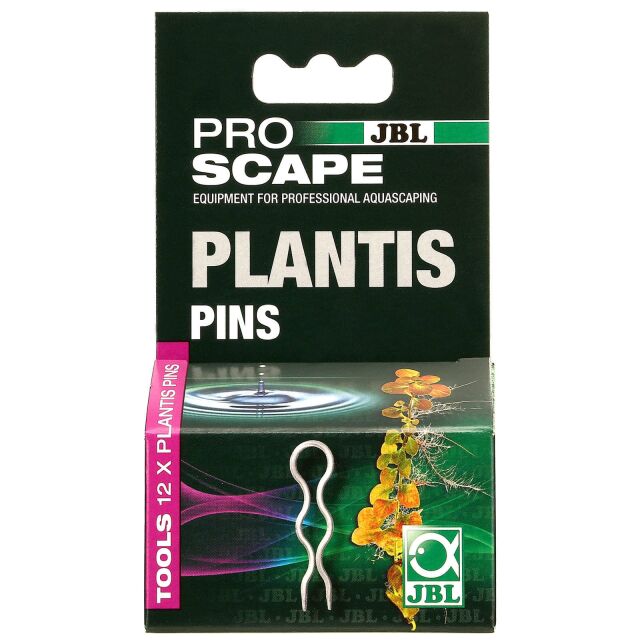
- Use plant pins such as JBL Plantis. These help anchor the plant portion better to the ground.
![JBL - ProScape - Plantis - 12x]()
Plant pins as emergency help
Help as a last resort
If parts of the ground cover plant have already come loose, the only thing that really helps is replanting it. However, it should then not be planted again as a complete, connected carpet, since its buoyancy would be far too strong. It is better to make many small portions out of it, which are easier to replant with tweezers and stay down better. Unfortunately, this measure first disturbs the look of your aquarium layout, of course, because freshly planted foreground plants do not look particularly nice at first when the rest of the design has already been running for a while and has grown in.
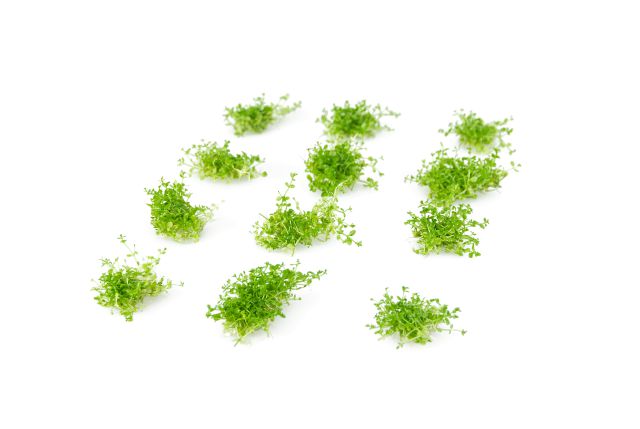
HCC in individual portions
If the look absolutely has to be preserved (for example so as not to miss a final shot or a contest entry that is coming up soon), you can cheat a little by leaving the connected cushions in the aquascape as intact as possible and then tying or gluing them onto flat stones or moss mesh. Following the puzzle principle, the seams can be concealed by clever placement. This method saves the design for a certain period but does not fix the cause of the ground cover plants floating up in the foreground of your aquascape. In the long term, the foreground plants should in any case be replanted in small individual pieces as described above.