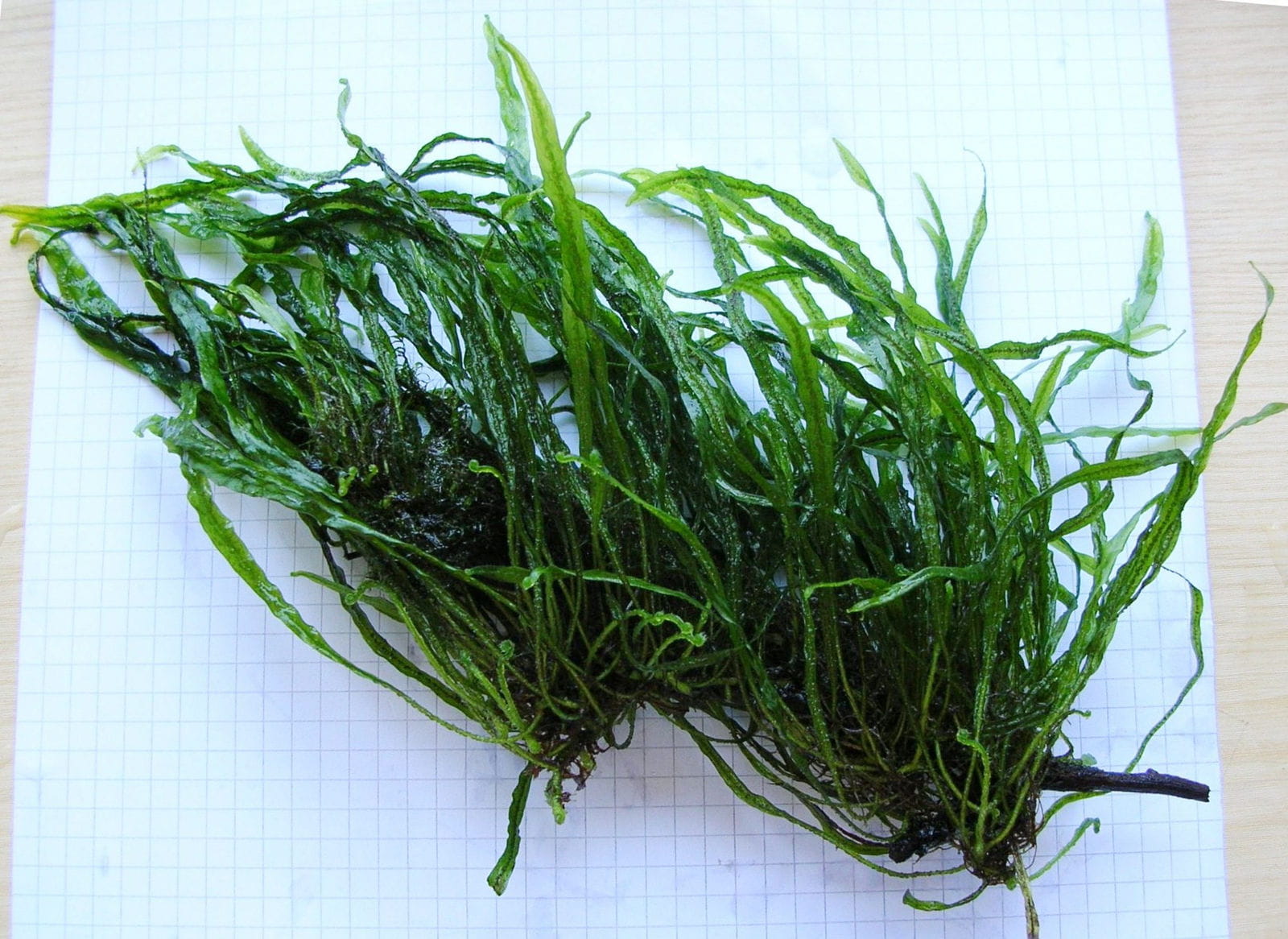
Narrow, Needle, Mini or Taiwan java fern?
Published
Translated from German with AI assistance and reviewed by our editors.
This article was published by Heiko Muth on July 2, 2013 in the Flowgrow Aquascaping Network.
Every now and then the question about the difference between "Needle Leaf" and "Narrow" java fern comes up in forums. But these two names are used in the aquarium hobby for at least three different Microsorum pteropus forms.
This muddle of names causes contradictory information about the differences between the narrow-leaved java ferns. It is also written, for example, that M. pteropus "Narrow" and "Needle Leaf" are actually the same and even identical to M. pteropus "Philippine".
© Heiko Muth (2009)
Distinguishing java fern forms is often uncertain because the appearance depends greatly on the growing conditions and on the age of the plants. I cultivated three plants designated among other things as "Narrow" for several years, both emersed and submersed, under roughly the same conditions, so I am sure that they differ consistently.
Because of the confusion of names around these three java fern forms, I will first present them here under the "working names" fern 1, fern 2 and fern 3 and then make suggestions for their designations.
There are, however, still further somewhat different forms of the “Narrow“ and “Needle Leaf“ type in cultivation. Microsorum pteropus is a polymorphic (variable-formed) species with countless variants and gradual transitions.
Fern 1: the true "Needle Leaf"
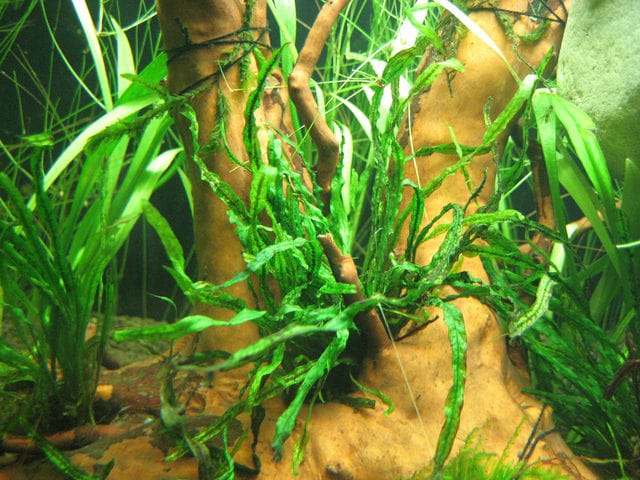
Fern 1 - © Lukas („Jagahansi“) (2011)
This extremely narrow-leaved java fern is apparently kept quite rarely. Besides “Needle Leaf“ it has been given various other designations. At first it was unclear which species it belongs to. According to Christel Kasselmann (2005), who had received the fern from Wim Tomey of the Netherlands, it is known as Microsorum pteropus “narrow“, “angustifolius“ or “narrow-leaved“ and has been in cultivation since about 1996. She identified it as a form of Microsorum pteropus. Nevertheless, it is often still passed on as an undetermined Microsorum species (M. sp. "Mini"). Hobbyists in the Netherlands call it Microsorum brassii (a synonym of M. pteropus). I am sure that fern 1 (like fern 2 and 3) belongs to the species M. pteropus. I will come back to this and to the name M. brassii further below. I received the plant from Günter Oberjatzas (without a name), Claus Christensen (under the designation “Rainer, very narrow“) and Christian Gäbler (as Microsorum sp. “Mini“). I have no information about its wild origin. The designation M. pteropus “Narrow“ is also used for ferns 2 and 3, which differ from fern 1.
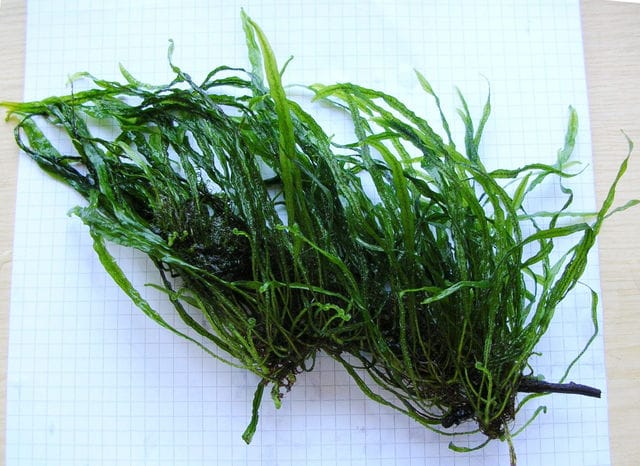
Fern 1 - © Heiko Muth (2007)
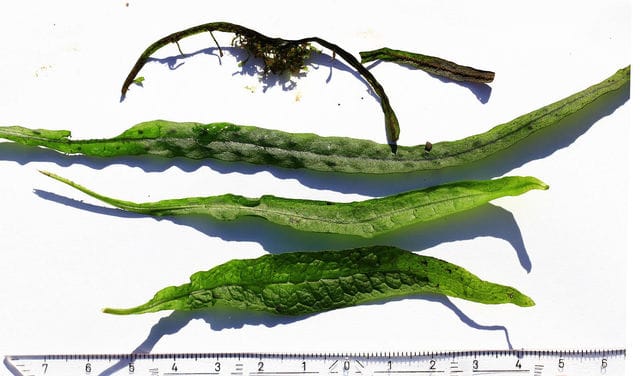
The submersed leaves are only about 3-5 mm wide and have a linear shape. They have no lobes at the base of the leaf blade, unlike "normal" large-growing java ferns, which often develop three-lobed leaves as old plants. Over a long period, the leaves of fern 1 in my aquarium hardly grew longer than 10 cm. After more than a year of undisturbed growth, it then produced leaves up to about 30 cm long, but never more than 5 mm wide.
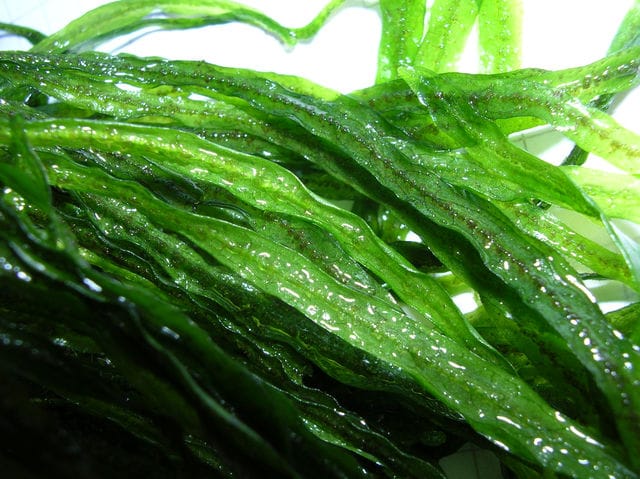
Fern 1 - © Heiko Muth (2007)
The base of the leaf blade tapers gradually into the short leaf stalk. The leaf tip is drawn out long and thin. Occasionally, leaves develop with a tip that is forked once or several times, similar to M. pteropus ’Windeløv’ (picture 7).
The leaves are in part a darker shade of green than other java fern forms. They often look somewhat "crumpled", bent irregularly back and forth. The leaf margin is more or less regularly wavy. The leaf midrib is about 0.5 mm thick. As with the other java ferns, the underside of the midrib is covered with scales (called "paleae" in ferns), which often carry a dark brown tuft of hairs. In fern 1 (and fern 2), the scale cover is often quite conspicuous and dark-colored. Small scales with tufts of hairs also sit on the lateral veins. The leaf venation is very simple compared with other java ferns; it consists only of the lateral veins fused together in arches and a few branching, hardly reticulated finer veins (picture 9). Sporangia clusters (sori, singular: sorus) are found rather sparsely on older, fully grown plants, have a roundish shape and are arranged on the underside of the leaf in an irregular row parallel to the midrib.
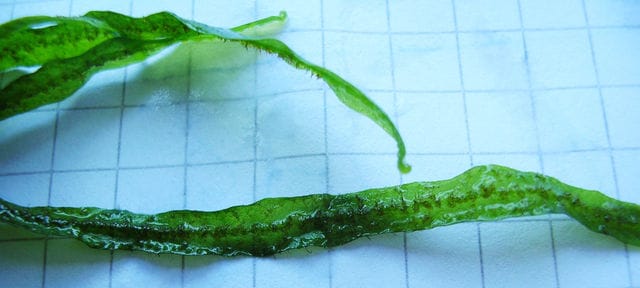
Fern 1 - © Heiko Muth (2007)
Young plants form on the leaves rather rarely. As with other M. pteropus forms, they develop most strongly on detached older leaves.
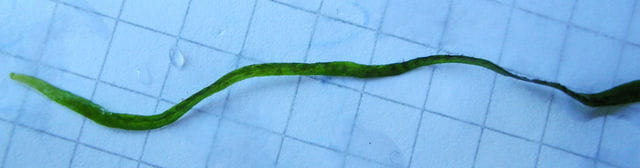
Fern 1, very narrowly drawn-out leaf tip (grid squares: 5x5 mm). © Heiko Muth (2007)
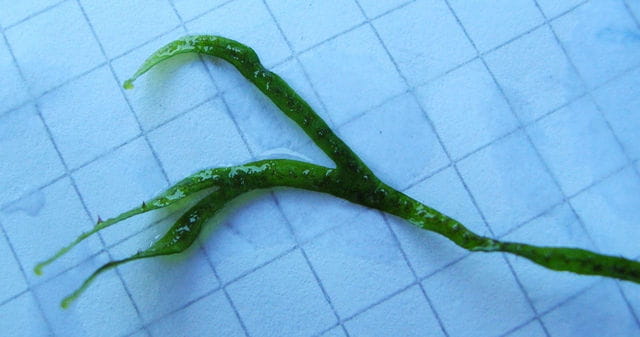
Fern 1, leaf tip forked twice. © Heiko Muth (2007)
Fern 1 grows and multiplies more slowly than other M. pteropus forms. In the Old Botanical Garden in Göttingen it grew worse emersed than submersed, while under the same conditions other java fern variants grew without problems and lushly in the land form. The few emersed leaves of fern 1 were short and stunted, and in part the plants died off. Claus Christensen also told me that this java fern does not grow well emersed. Probably for this reason it is poorly suited to commercial propagation in aquatic plant nurseries and will therefore likely continue to be obtainable rather from other aquarists than from specialist retailers.
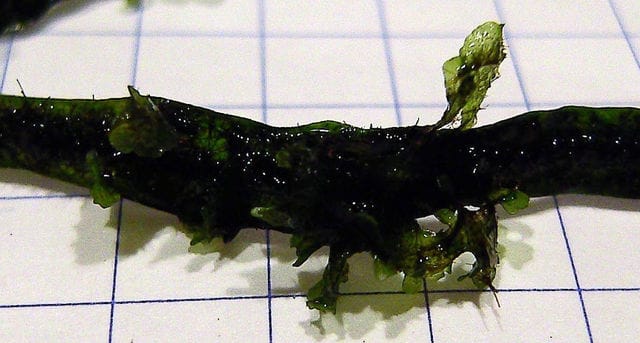
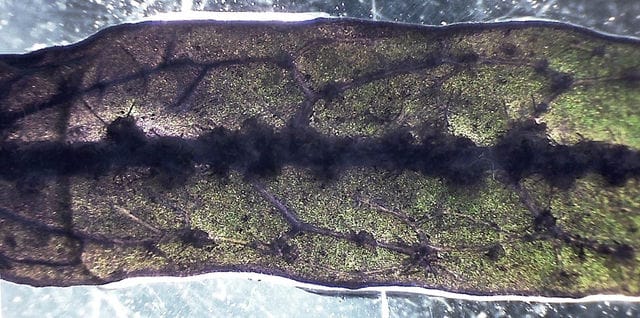
It is also strange with this fern that prothalli not infrequently develop on the underside of the leaf midrib of old leaves, as Bertram Wallach (2008) already mentioned. They are ribbon-shaped, branched and recall a Riccardia species a little. If you detach these thalli from the leaf, they keep growing independently; you can cultivate them like a moss.
Fern 1 - © Marcel Dykierek (2009)
Fern 1 - © Heiko Muth (2011)
Normally, fern gametophytes (prothalli) germinate from spores. In this case, however, they develop as outgrowths of the leaf stalk tissue at the base of the scales. They are covered on the edge and on the underside with brown, hair-like rhizoids. Under magnification, these rhizoids look like the hairs on the scales and on the roots of the java fern.
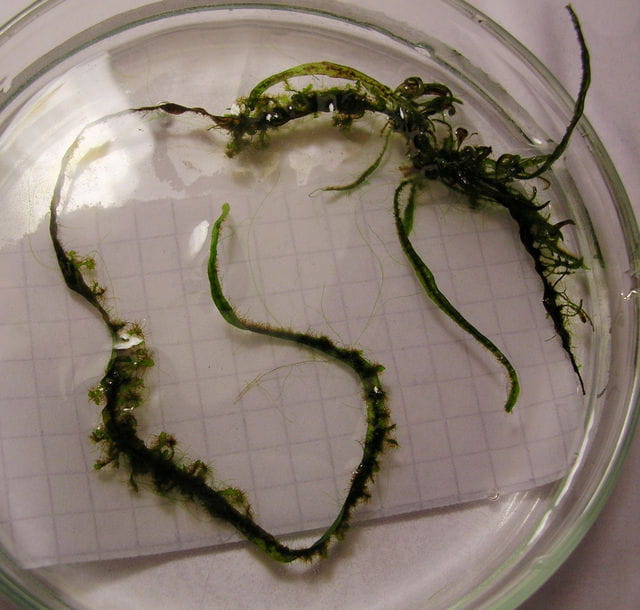
A detached leaf of fern 1 lay around in my aquarium for several months, kept growing steadily at the tip and formed many young plants and "prothalli".
© Heiko Muth (2008)
© Heiko Muth (2007)
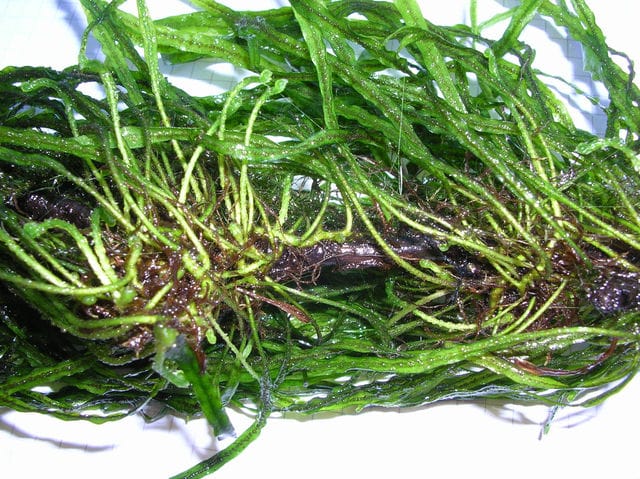
Also striking in fern 1 are the very short roots compared with "normal" java fern. The rhizomes are about 1-2 mm thick. The spacing of the leaves on the rhizome is quite small, so over time this fern forms compact bushes.
Fern 2, the larger “Needle Leaf“ version: Microsorum pteropus “Taiwan“
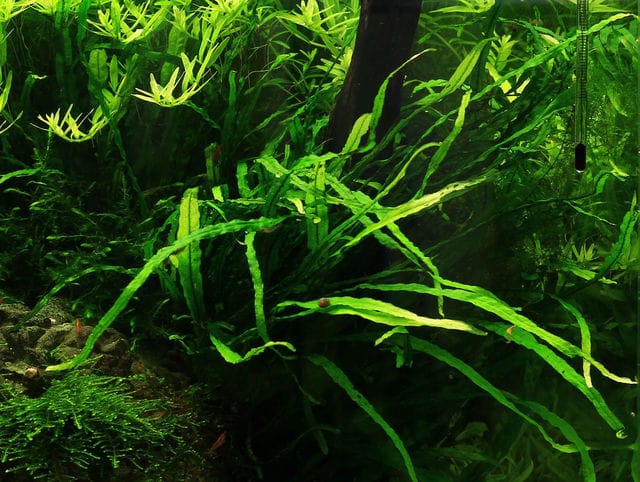
Fern 2 - © Tobias Coring (2010)
By Microsorum pteropus “Needle Leaf“ what is usually meant is not fern 1 but the plant that I call fern 2 here. It seems to be cultivated much more often than fern 1. Fern 2 is often also called M. pteropus “Narrow“; under this designation it can be seen, for example, in many aquascapes by Takashi Amano, but it differs from the cultivar M. pteropus ‘Narrow‘ from the company Tropica (presented further below as fern 3). Claus Christensen gave me the designation Microsorum pteropus “Taiwan“ for fern 2. It is unclear whether this plant is a wild collection from Taiwan or was merely imported from there as a cultivated plant.
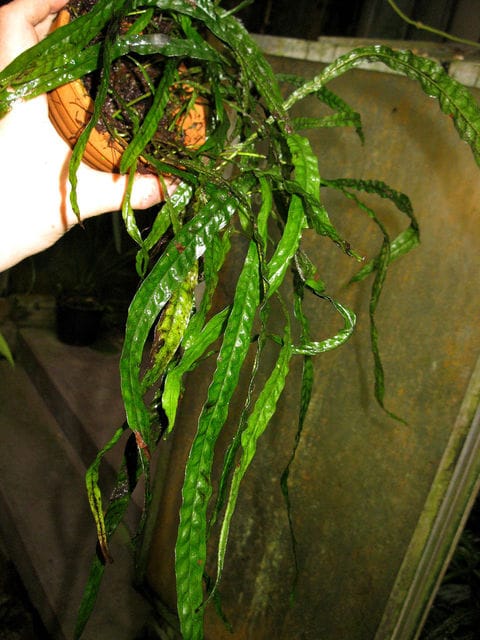
© Heiko Muth (2009)
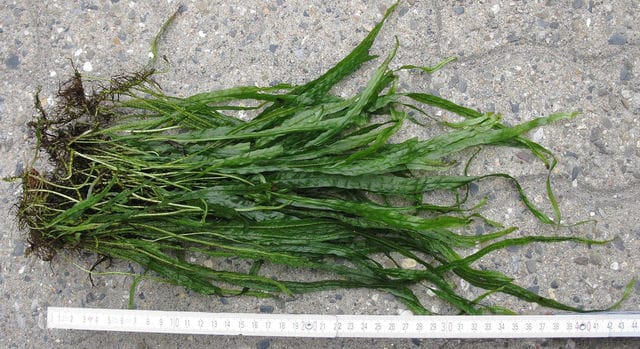
Fern 2 - © Heiko Muth (2011)
Fern 2 can probably best be described as a much larger-growing version of fern 1. The leaves are likewise linear (to very narrowly lanceolate), short-stalked and have a regularly wavy margin.
Characteristics of fully grown submersed plants:
- Leaves approx. 20-45 cm long and over 5 mm, mostly 10-15 mm, sometimes up to 20 mm wide, leaf blades about 20-30 times as long as wide
- Distance between any two lateral veins approx. 6-10 mm
- the connecting vein between the ends of the lateral veins near the leaf margin is less strongly curved than in fern 3
- Leaf midrib approx. 1 mm thick at half the length of the leaf, more or less densely covered with dark brown scales
- Leaf blade tapers gradually into the approx. 2-5 cm long leaf stalk
- Leaf tip drawn out long and thin, sometimes forked
- Rhizome approx. 2-2.5 mm thick
- Roots mostly up to 5 cm long (relatively short, similar to fern 1)
- Sori (sporangia clusters) often rather sparse (picture 16)
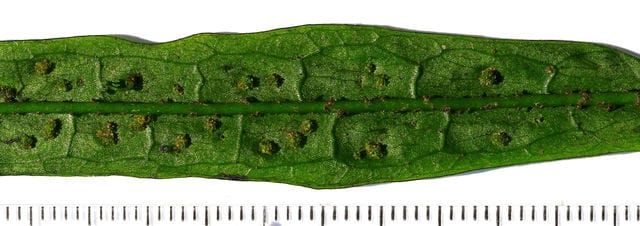
Fern 2, submersed leaf, underside with sporangia clusters (sori), millimeter scale below. © Tobias Coring (2009)
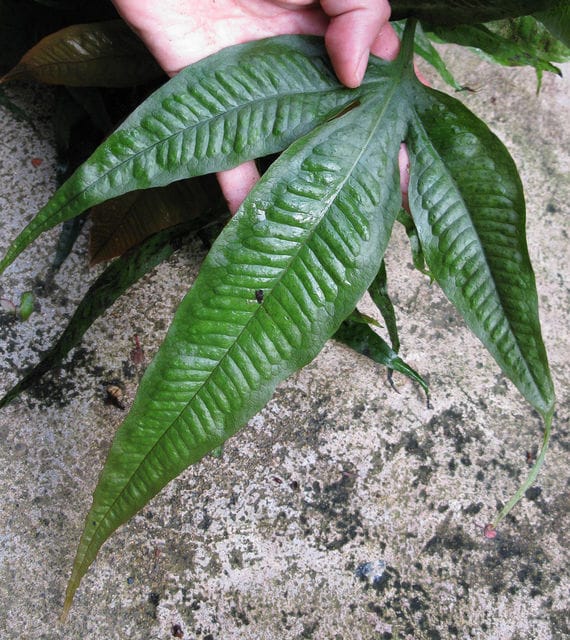
Fern 2 is also mistakenly called M. pteropus ‘Philippine‘, probably because the leaves can be quite strongly bullate (hammered) (as in fern 3). Practically all java fern forms, however, have more or less bullate leaves. In the true M. pteropus ‘Philippine‘ from Tropica this is only particularly pronounced; the finer veins also stand out clearly as furrows on the upper side of the leaf, which makes the leaves look downright wrinkled. In addition, the leaves of ‘Philippine‘ have a broader, more strongly lanceolate shape (picture 24). In fern 2, by contrast, the finer venation on the upper side of the leaf is barely visible and the upper side of the leaf is quite smooth, not only compared with ‘Philippine‘ but also with fern 3 and other java fern forms.
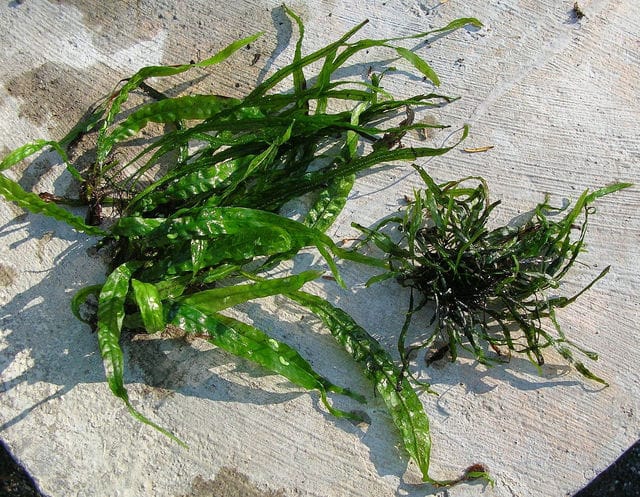
Left: fern 2, right: fern 1 - © Heiko Muth (2006)
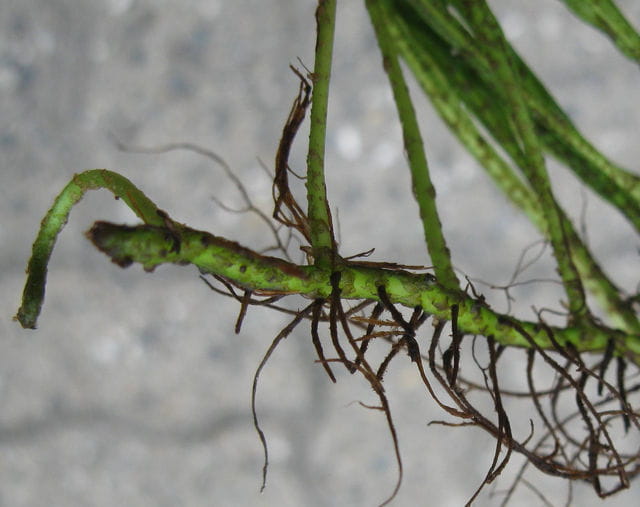
Rhizome of fern 2 - © Heiko Muth (2011)
Under the same conditions in the aquarium, fern 2 not only becomes considerably larger than fern 1 but also grows and multiplies faster. Emersed, it grows just as well as other, "normal" java fern forms. I have not yet found "prothalli" on the leaf midribs of fern 2, but I have found them between the roots. Whether they had developed from root tissue, I do not know. The ribbon-shaped, branched thalli grow somewhat larger than those of fern 1. Sporophytes (the actual fern plants) develop on them, corresponding to fern 2.
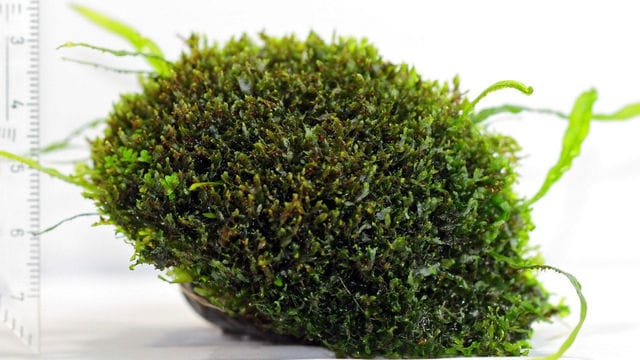
Prothalli of fern 2 - © Tobias Coring (2011)
When fern 2 grows well, it can quickly become too large in small aquariums. Fern 1, on the other hand, is made for nano and small aquariums. In large tanks, the two “Needle Leaf“ types, which differ in size but are otherwise very similar, can be planted one behind the other so that they enhance the perspective effect. In emersed culture the leaves generally become broader, up to a little over 2 cm, have a somewhat more lanceolate shape and do not develop such long drawn-out tips as underwater.
Fern 3: Microsorum pteropus ‘Narrow‘ from Tropica
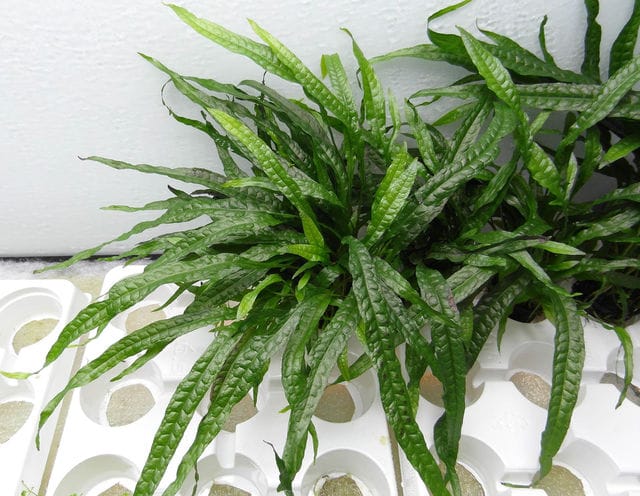
Fern 3
This fern is listed by the company Tropica as Microsorum pteropus ‘Narrow’ (number 008A). It is similar to fern 2, which is also often called ‘Narrow’, but under the same conditions it differs by a rather narrowly lanceolate, less linear leaf shape, often a somewhat lighter green color and longer leaf stalks, a less regularly wavy leaf margin and less drawn-out leaf tips. On an emersed plant from the trade, I measured leaves up to approx. 34 cm long and 2.2 cm wide with leaf stalks up to 13 cm long. Submersed leaves are (as in fern 2) generally narrower and shorter-stalked than emersed leaves. The distance between any two lateral veins is approx. 5-7 mm. The connecting vein between the lateral veins is more strongly curved than in fern 2.
On fully grown emersed plants, leaves can develop with a lateral lobe on one or both sides of the base of the leaf blade - unlike ferns 1 and 2, but as in the "large" java fern forms.
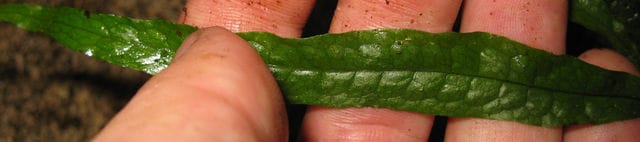
Fern 3
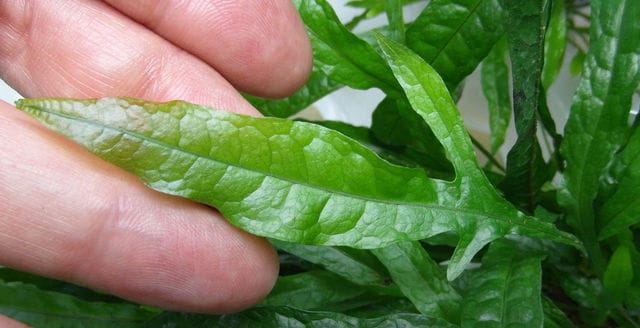
Fern 3 - © Heiko Muth (2012)
The distances between the lateral veins of the leaves are mostly smaller (approx. 5-7 mm), and at the same leaf width the midrib is somewhat narrower (approx. 0.6 mm) than in fern 2 (approx. 1 mm). The scale cover on the leaf midrib is mostly less conspicuous. Overall, the plant looks more similar to "normal" java fern forms than to the two java ferns of the “Needle Leaf“ type.
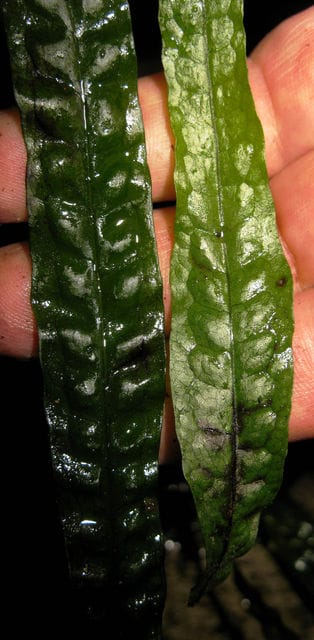
Fern 2, fern 3
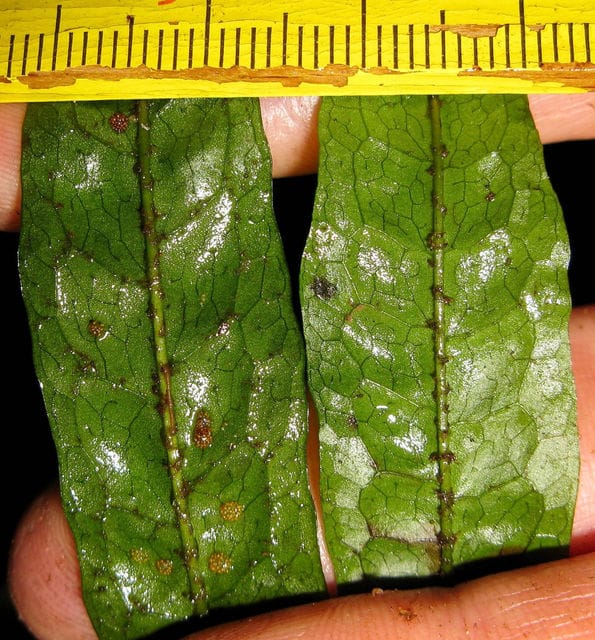
Fern 2, fern 3
Fern 1, fern 2, fern 3 and M. pteropus ‘Philippine‘
There are other relatively small, narrow-leaved java fern forms in cultivation under various trade names and with often unclear differences, e.g.
Microsorum pteropus “Short Narrow Leaf“ or M. pteropus „Serpentifolia“. In the early 1990s I received a plant in Berlin as a very small-growing new java fern form, but emersed it grew to over 40 cm tall and developed in part three-lobed leaves as well as long, thin rhizomes with relatively wide leaf spacing. It looks similar to M. pteropus ‚Narrow‘ but overall grows somewhat larger and broader-leaved. A similar form is called “Red, narrow“ or “Orange“; in it the young, still growing leaves are reddish in color, as in the large, broad-leaved M. pteropus cultivar ‘Red‘, and the relatively thin rhizomes grow submersed rather ascending than creeping. There are likewise small-growing java ferns with relatively broad leaves as well as large-growing, strong forms with a thick rhizome but very long, narrow leaves.
Really only Microsorum pteropus, or different species after all?
As already mentioned, the small “Needle Leaf“ type, fern 1, is referred to in the hobby, among other things, as an undetermined Microsorum species (Microsorum sp.) and also as Microsorum brassii. The name Microsorum brassii Copeland is treated by H. P. Nooteboom (1997) as a synonym of M. pteropus (Blume) Copeland. The plant described as M. brassii was found in Papua New Guinea, is relatively small and has undivided, narrowly lanceolate leaves approx. 1 cm wide and 20 cm long. A photo of the type herbarium specimen of M. brassii (Brass 1153) can be found online:
http://calphotos.berkeley.edu/cgi/img_query?enlarge=3333+3333+1007+0912, http://plants.jstor.org/specimen/mich1190754
Christel Kasselmann (2005) photographed corresponding plants at the natural site in Papua New Guinea. Small, narrow-leaved M. pteropus forms are widespread not only in Papua New Guinea but generally in tropical Asia and sometimes also occur together with larger, broader-leaved forms (Hovenkamp & al. (1998), Kasselmann (2005)). They have also been described under further names (e.g. Microsorum pteropus var. minor (Beddome) C. Christensen & Tardieu), which according to Nooteboom are likewise synonyms of M. pteropus. The type specimen of Microsorum brassii has more strongly lanceolate, broader leaves than fern 1 and is therefore more similar to, for example, fern 3. With their ribbon-shaped leaves, ferns 1 and 2 correspond more to the type of Polypodium zosteriforme Wall. ex Mett. (Myanmar: Tenasserim, http://plants.jstor.org/specimen/bm001038395), likewise a synonym of Microsorum pteropus. It therefore does not make sense to call fern 1 and other java fern forms Microsorum brassii.
Because fern 1 differs so conspicuously from "normal" java fern, one could doubt that it belongs to Microsorum pteropus. Christel Kasselmann (2005) identified it as M. pteropus based on the arrangement and nature of the sporangia clusters (sori) and the leaf tissue structure. Further characteristics also speak for this species assignment.
Many species are counted in the genus Microsorum, although there are very different views on the number of species. The Microsorum species belong to the polypody family (Polypodiaceae) and, within this family, together with closely related genera such as Belvisia, Lecanopteris, Lepisorus or Leptochilus, form a group of relatives: the microsoroid ferns. Incidentally, there may be changes in genus assignments. For example, it has turned out that M. pteropus is more closely related to Leptochilus species than to other Microsorum species (Kreier & al. 2008).
Most species of the microsoroid ferns occur in tropical forests as epiphytes on trees, but also on rock or soil. M. pteropus represents an exception in this group of relatives as an aquatic plant. In nature the species mostly grows only periodically flooded on and in flowing waters, but in some places also permanently underwater. Some Leptochilus species also colonize stream and river banks as rheophytes (plants tolerant of flooding and adapted to current), but probably cannot be considered aquatic plants.
The microsoroid ferns can be recognized by a particular combination of characteristics, among them net-veined leaves and characteristics of the scales on the rhizomes (so-called peltate or pseudopeltate, clathrate scales).
Nooteboom (1997) and Bosman (1991) describe M. pteropus (in Bosman Colysis pteropus) as an extremely variable species but do not accept subspecies or varieties. There are evidently so many transitions between the M. pteropus forms in nature that no groups within the species can be meaningfully delimited. According to the descriptions, the leaves can have lateral lobes or be simple (undivided) and reach 3.5-30 cm in length and 2-55 mm in width.
In Microsorum pteropus, young plants form on the leaves (proliferating leaves). They develop on the underside of the leaf, often at the spots where the sporangia clusters otherwise sit. Among the microsoroid ferns this is known only from M. pteropus. Proliferating leaves otherwise also occur in many other ferns, which are not more closely related and do not count among the microsoroids. For example, in Bolbitis heteroclita young plants develop on the upper side of the leaf, unlike in java fern.
For fern 1 this results in the following:
- The venation and scale characteristics of fern 1 fit the microsoroid ferns.
- Using the identification keys to the microsoroid ferns by Nooteboom and Bosman, fern 1 can be identified as M. pteropus and falls within the stated range of variation of the species.
- Nothing is known about the natural sites of fern 1, but it is certainly an aquatic plant, because in cultivation it grows even better underwater than emersed.
- As is typical for M. pteropus, fern 1 forms young plants on the underside of the leaf.
The species M. pteropus can normally be recognized most easily by its venation pattern: the lateral veins branching off from the midrib fork near the leaf margin, are connected to one another in arches and thereby form a row of large meshes that enclose a finer network of veins. Between the large meshes and the leaf margin lie smaller meshes. The sori (sporangia clusters) are located only within the large meshes and are scattered or arranged in 1-2 irregular rows between the lateral veins (picture 25).
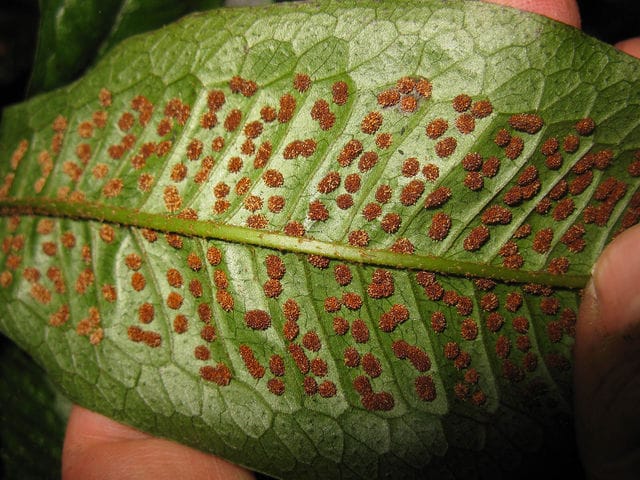
M. pteropus ‚Red‘ (emersed). © Heiko Muth (2009)
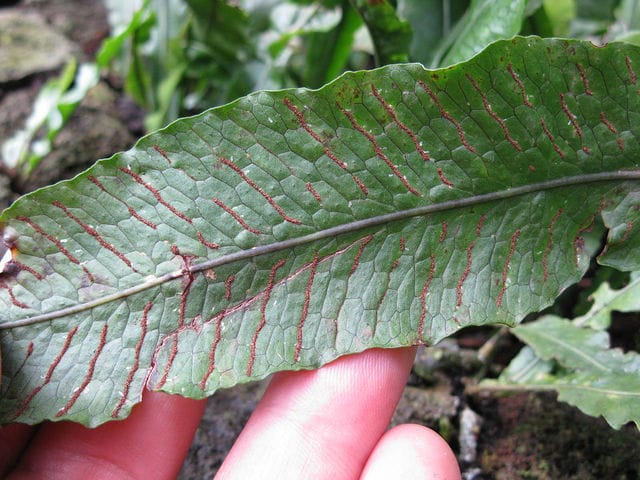
Leptochilus sp. - © Heiko Muth (2010)
This pattern can still be recognized well in ferns 2 and 3 (picture 23), but hardly at all in the very simple venation of fern 1. According to the "Flora Malesiana” (Hovenkamp et al. 1998), however, narrow-leaved rheophytic forms of M. pteropus can best be distinguished from other similar-looking fern species by the leaf midrib densely covered with scales. This applies to fern 1. In many other microsoroid ferns, e.g. Leptochilus species (picture 26), the underside of the midrib is rather bare or sparsely covered with scales.
So what are they correctly called?
Despite their differences, ferns 1, 2 and 3 belong to the one variable species Microsorum pteropus, and no accepted scientific names are available for naming different forms. With cultivated plants, however, you want to make fine distinctions and need names of their own even for forms that differ only slightly from one another under the same conditions. In such cases, auxiliary designations in double quotation marks can be attached to the accepted botanical name. If the plants have been described as cultivars, they can be distinguished by cultivar names in single quotation marks. I was unable to find out who first came up with the designation “Needle Leaf“ and when, and whether originally fern 1, fern 2 or perhaps yet another similar java fern form that I do not know was meant. “Needle Leaf“ certainly fits the extremely narrow-leaved fern 1 best, so I suggest here calling only this one that. To distinguish between fern 1 and 3, I designate fern 2 here as M. pteropus “Taiwan“, although this auxiliary designation has so far been little used and it is unclear whether this M. pteropus form originally comes from Taiwan.
For fern 3 there is already the cultivar name M. pteropus ‘Narrow‘, and the plants labeled as such by the company Tropica are evidently uniform.
Here is an overview of the three java fern forms presented and their designations:
Fern 1
Previous designations:
Microsorum sp. “Mini”, M. brassii, M. pteropus “Needle Leaf”, “angustifolius”, “narrow-leaved”, “Narrow”
Brief description:
Leaves linear, including stalk approx. 10-30 cm long and 3-5 mm wide, margin quite regularly wavy, leaf tip occasionally forked, leaf otherwise without lobes.
My suggestion for the designation:
Microsorum pteropus “Needle Leaf”
Fern 2
Previous designations:
Microsorum pteropus “Needle Leaf”, “Narrow”, “Taiwan”
Brief description:
Leaves linear to very narrowly lanceolate, including stalk up to approx. 40 cm long and 2 cm wide (length-to-width ratio about 20-30), distance between any 2 lateral veins approx. 6-10 mm, leaf margin quite regularly wavy, leaf tip occasionally forked, leaf otherwise without lobes.
My suggestion for the designation:
Microsorum pteropus “Taiwan”
Fern 3
Previous designations:
Microsorum pteropus ‘Narrow’ (named as a cultivar, company Tropica)
Brief description:
Leaves narrowly lanceolate, including stalk up to approx. 34 cm long and 2 cm wide (length-to-width ratio up to approx. 15), distance between any 2 lateral veins approx. 5-7 mm, leaf margin slightly and irregularly wavy, on fully grown emersed plants sometimes 1 lobe on one or both sides of the base of the leaf blade.
My suggestion for the designation:
For information, and in part also plants and photos, I thank Claus Christensen, Tobias Coring, Marcel Dykierek, Christian Gäbler, Claudia Hary, Stephan Karlick, Christel Kasselmann, Hans-Peter Kreier, Lukas („Jagahansi“), Günter Oberjatzas, Anja Richter, Michael Schwerdtfeger and Bertram Wallach.
Literature
- Bosman, M.T.M. (1991): A monograph of the ferngenus Microsorum (Polypodiaceae): including an attempt towards a reconstruction of the phylogenetic history of the microsoroids. Leiden botanical series volume 14. Rijksherbarium/HortusBotanicus, Leiden
- Hovenkamp et al. (1998): Polypodiaceae. Flora Malesiana II 3: 1–234
- Kasselmann, Christel (2005): A polymorphic fern: new growth forms of the java fern [in German]. DATZ 10/2005: 18-23
- Kasselmann, Christel (2010): Aquarium plants [in German]. 3rd edition. DATZ Aquarienbuch, Ulmer Verlag
- Kreier, H.-P.,Zhang, X.-Ch., Muth, H. & Schneider, H. (2008): The microsoroid ferns: Inferring the relationships of a highly diverse lineage of Paleotropical epiphytic ferns (Polypodiaceae, Polypodiopsida). Molecular Phylogenetics and Evolution 48(3):1155-67
- Nooteboom, H. P. (1997): The Microsoroid Ferns (Polypodiaceae). Blumea 42(2): 261-395
- Wallach, Bertram (2008): Mosses and moss-like plants for the aquarium [in German]. Aquarium live, issue 2 (Feb./March) 2008, pp. 36-43
- http://calphotos.berkeley.edu/
- http://www.tropica.com/dk/planter/plantebeskrivelse.aspx?pid=008A
- http://plants.jstor.org/specimen/bm001038396
- http://plants.jstor.org/specimen/mich1190754