We use cookies to offer you an optimal shopping experience. These cookies can be grouped into categories. The necessary ones are essential for your purchase. Functional services enable additional content such as videos and maps. With further cookies we produce anonymized statistics. Others serve primarily marketing purposes and are used for the personalization of advertising. These cookies are used by 11 Services used in the shop. You can decide for yourself which cookies you want to allow.
We store your choice on your device (“local storage”) and ask you again after 12 months at the latest. You can change it at any time under “Cookie Preferences” in the footer. You can find details on cookie lifetimes and necessary cookies in our privacy policy.
These services are required to run the shop and for your purchase and cannot be switched off.
Strictly necessary cookies enable basic functions and are required for the website to work properly.
Description:
Shop functions: Essential Shop functions This includes: JTLSHOP (cookie, until you close the browser; keeps your session, the cart and your login), consent (browser storage; remembers your cookie choice, 12 months at most, during the session also in session storage), has_starting_point, cur_product_id and product_page_visits (session storage; navigation between products) as well as aquasabi-search-index-last-url, aquasabi-search-index-results and aquasabi-search-index-data (session storage; search results and lists when paging).
easyVision: easyVision lets website visitors customize the display – e.g. by adjusting contrast, font size, line and letter spacing, color rendering, a blue light filter or by disabling animations. Developed and hosted in Germany, the service is GDPR-compliant and supports statutory accessibility requirements (BFSG) from 2025. The service loads its scripts from cdn.sitecockpit.com and stores your settings (easy-vision-*) in your browser storage (no cookies).
Reviews: aquasabi_guid (cookie, 12 months) is only set when you click “Helpful” under a review. It stores a random ID so that the same person cannot count a review as helpful more than once.
Sorting and view: aquaSort and aquaDisplayType (cookies, 90 days) store the sorting or view (gallery or list) that you choose in a product list. They are only set when you choose a sorting or view.
Amazon Pay: Payment processing with Amazon Pay.
The service provider is Amazon Payments Europe S.C.A. Where Amazon Pay is offered (e.g. in the cart and at the checkout), the shop loads scripts and images from static-eu.payments-amazon.com, payments-eu.amazon.com and m.media-amazon.com and sets cookies (language, ledgerCurrency, apay-session-set). You can find out more in the privacy policy at https://www.amazon.de/gp/help/customer/display.html?nodeId=GRFTMVHP4HXMESSP
PayPal: Payment processing with PayPal.
The service provider is PayPal (Europe) S.à r.l. et Cie, S.C.A. Where PayPal is offered (e.g. in the cart and at the checkout), the shop loads scripts from www.paypal.com; for invoice payment via PayPal, c.paypal.com is added for fraud prevention. PayPal stores an entry in your browser storage (__paypal_storage__), and the shop remembers the chosen PayPal payment method in session storage (chosenPPCPaymentOption). You can find out more in the privacy policy at https://www.paypal.com/en/legalhub/paypal/privacy-full
Sofortüberweisung: On the confirmation page after an order with this payment method the shop loads a Klarna logo from x.klarnacdn.net.
Additional functions such as embedded videos and maps, spam protection in forms or the rating badge. Data is transferred to the respective provider when they load.
Show Youtube Videos
Description:
Displaying videos
Processing company:
Google Ireland Limited, Google Building Gordon House, 4 Barrow St, Dublin, D04 E5W5, Ireland
Helps us understand how the shop is used so that we can improve it.
We measure which pages and products are viewed and how visitors move through the shop. Google Analytics sets cookies (_ga, _ga_*) and sends usage data to Google.
Description:
Audience measurement and analysis of how the shop is used
Measures our advertising and enables personalised advertising on other sites.
We measure whether an ad on Facebook or Instagram led to a purchase and show visitors relevant ads again. Cookies are set for this: _fbp and _fbc (Meta) and as_fbclid (ours, 30 days; remembers the ID of the ad click). Meta receives data about your actions in the shop (e.g. product views, cart, purchase), your IP address and browser information; for a purchase our server may also send them directly to Meta (Conversions API). More in our privacy policy (retargeting/remarketing and conversion tracking).
Description:
Measure advertising success and show relevant ads again (Facebook, Instagram)
We measure whether an ad on TikTok led to a purchase. Cookies are set for this: _ttp, ttclid and _tt_* (TikTok) and as_ttclid (ours, 30 days; remembers the ID of the ad click). TikTok receives data about your actions in the shop (e.g. product views, cart, purchase), your IP address and browser information; for a purchase our server may also send them directly to TikTok (Events API). More in our privacy policy (retargeting/remarketing and conversion tracking).
We measure whether an ad in ChatGPT led to a purchase. Cookies are set for this: __oppref and __obref (OpenAI) and as_oppref (ours, 30 days; remembers the ID of the ad click). OpenAI receives data about your actions in the shop (e.g. product views, cart, purchase), your IP address and browser information; for a purchase our server may also send them directly to OpenAI (Conversions API). Data may be transmitted to OpenAI OpCo, LLC (USA). More in our privacy policy (retargeting/remarketing and conversion tracking).
Description:
Measure the success of ads in ChatGPT
Processing company:
OpenAI Ireland Limited, 1st Floor, The Liffey Trust Centre, 117-126 Sheriff Street Upper, Dublin 1, D01 YC43, Irland
We measure whether an ad led to a purchase and show visitors relevant ads again. Google Ads sets cookies (e.g. _gcl_*) and receives purchase data, where applicable in hashed form (SHA-256).
Description:
Measure advertising success and show relevant ads again (remarketing)
We use cookies that are essential for payment processing through our partners. Please select which payment providers you would like to use.
In order to unlock offers for extended payment options, in particular express checkout and payment in instalments, we require your consent to the data transfer and storage of third-party cookies of the payment provider PayPal. This allows us to also offer you express checkout and payment by instalments. Without your consent, only the technically necessary data transfer to PayPal will take place, but you will then not be able to use the express checkout or extended offers for payment by instalments on this site.
Description:
Using express checkout and Displaying offers for payment in instalments for individual items or your entire purchase.
Your consent ID:With this randomly generated number we can show on request what you selected. It contains no information about you.
Data privacy settings
Would you like to see these contents? Activate the desired contents for one session only or allow the website to remember these settings. Once you have given your consent, the third-party data can be loaded. For this, third-party cookies might be stored on your device. You can change these settings at any time (footer: “Cookie Preferences”). For further details, please see the Privacy notice.
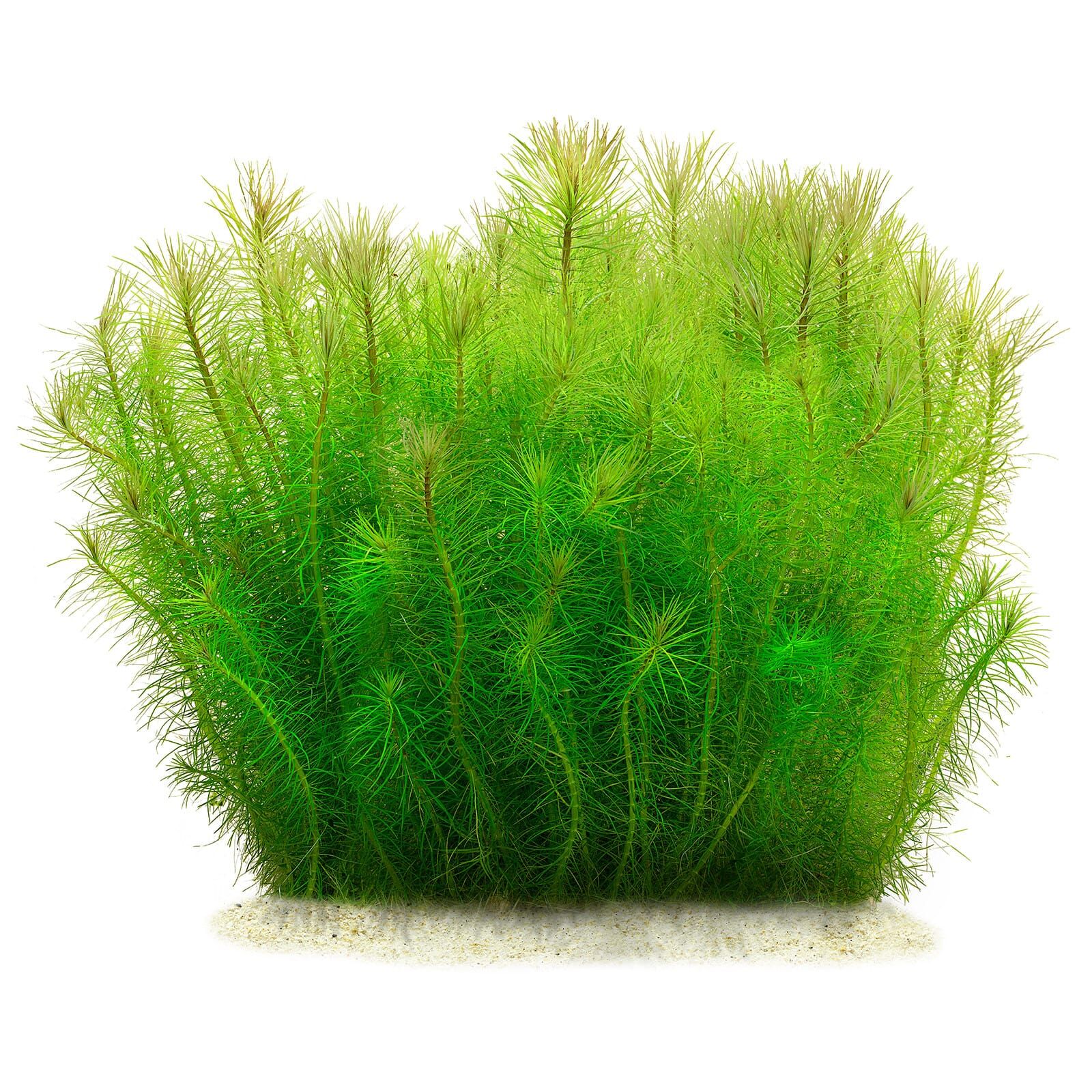
The Indian star plant has been known and popular in the aquarium hobby for over ten years under the name Pogostemon erectus. However, the nurseries Dennerle (Germany) and Tropica (Denmark) have recently been labelling this aquarium plant as Pogostemon deccanensis. What is behind this? And what about the clearly different-looking "Pogostemon deccanensis", which has been available as a tissue culture plant for some time?
Alleged Rotala verticillaris turns out to be Pogostemon
Like many aquarium plants, the Indian star plant was first marketed under an erroneous name: Rotala verticillaris. In the 2000s, aquarists in the USA brought the plant to flower in emersed culture and realised that, with its magnificent candle-like inflorescences, it did not belong to Rotala but to the genus Pogostemon. Cavan Allen (USA) stated on the aquaticplantcentral.com website in 2009 that it was Pogostemon erectus. He mentioned in this context that in the book "Aquatic and Wetland Plants of India" (Cook 1996) Pogostemon deccanensis is listed as a synonym of P. erectus (in the spelling "Pogostemon erectum"). Under the name P. erectus, the plant spread worldwide in the aquarium hobby and trade around 2010.
Rotala verticillaris is not a synonym of Pogostemon erectus, but a species of Rotala native to India and Sri Lanka. It is not clear to me whether this plant has also been kept in aquaria before or whether the name simply came into the aquarium hobby through misidentification. It is described as a plant with very narrow, whorled leaves, as is known from Rotala wallichii, but also various Pogostemon species. However, the latter have significantly different flowers and also belong to a different plant family (mint family, Lamiaceae; Rotala: loosestrife family, Lythraceae). Rotala verticillaris is the type species of the genus Rotala. Because its leaf whorls are reminiscent of the spokes of a wagon wheel, the first person to describe it, Carl von Linné, gave it the genus name Rotála in 1771, which means ‘wheel-like’ in Latin (rota = wheel).
But back to the Indian star plant and the name Pogostemon deccanensis.
Pogostemon erectus and P. deccanensis: Two similar species from southern India
Christel Kasselmann (Germany) and Karen Randall (USA) visited known locations of Pogostemon erectus in the states of Kerala and Karnataka in south-west India in November 2014. They collected several specimens, some of which they herbarised and some of which they took back alive for culture experiments. However, the aquarium cultivation of the plants was not successful, unlike with "P. erectus" from the aquarium plant trade. Later, C. Kasselmann examined flowering plants of the latter, which Manuel Sauer (Germany) had sent her, and compared them with the P. erectus herbarium specimens from India. She came to the conclusion that "P. erectus" from the trade was Pogostemon deccanensis. She published this in the journal DATZ (Kasselmann 2019).
As mentioned above, Cook (1996) considers this name to be a synonym of P. erectus. C. Kasselmann's investigations, however, are based on the later published monograph of the genus Pogostemon by Bhatti & Ingrouille (1997), in which P. deccanensis and P. erectus are described as distinct species. The examined "P. erectus" from the trade corresponds in its characteristics to the species description of P. deccanensis and the plant collected in India to that of P. erectus.
Pogostemon deccanensis (Panigrahi) Press (1982), named after the Deccan Plateau in India, is therefore the correct botanical name for the Indian star plant from the aquarium hobby, which can therefore also be called the Deccan star plant. Like Pogostemon erectus (Dalzell) Kuntze (1891), this species is native to wetlands of south-west India.
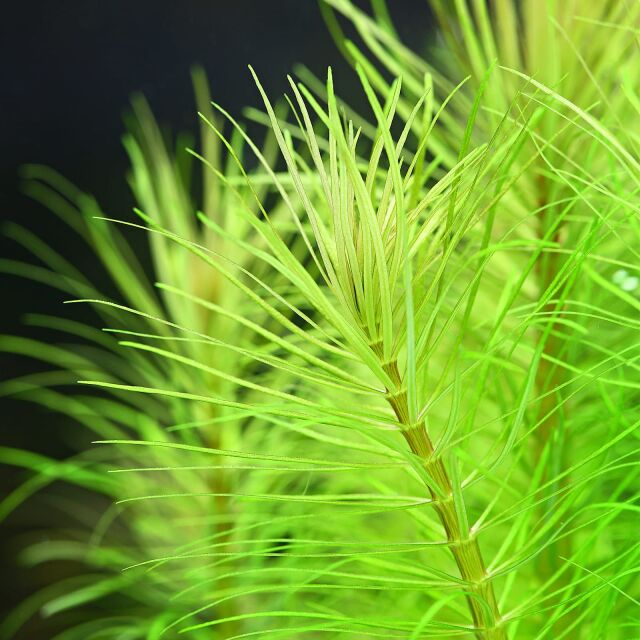
Detailed information can be found in the aforementioned DATZ article (Kasselmann 2019), where the small differences between the two species are also specified. They primarily concern flower and fruit characteristics: Length of the flower spikes, shape and hairiness of the calyx, size of details of the corolla, length and hairiness of the stamens and shape and size of the fruits (nutlets). At 1.5 to 2 cm, the submersed leaves of Pogostemon erectus are significantly shorter than those of P. deccanensis, where they are 2 to 4.6 cm long.
Flowering emerged Pogostemon deccanensis.
"Pogostemon deccanensis" from ADA: true P. erectus?
Confusingly, however, another plant has been in cultivation for some time under the name "Pogostemon deccanensis". It came onto the global market years ago as a tissue culture plant via the ADA company. Compared to the aquatic plant identified as P. deccanensis, it grows more slowly in the aquarium and has higher requirements in terms of light intensity, nutrient and CO2 supply. The needle-like underwater leaves remain significantly shorter than those of P. deccanensis.
It cannot be ruled out that this mystery plant is Pogostemon erectus as defined by Bhatti & Ingrouille (1997)! However, this could only be verified on the basis of flowering specimens in the terrestrial form, especially as there are a number of other aquatic Pogostemon species that are distinguished primarily by details of the flowers.
We have provisionally named the ADA plant Pogostemon cf. deccanensis in order to distinguish it from the true P. deccanensis.
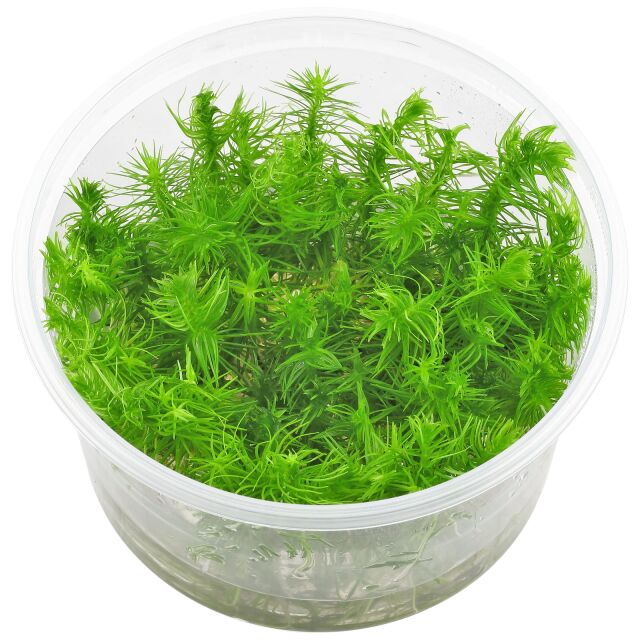
Pogostemon cf. deccanensis, In-Vitro-plant.
Final remarks
Unfortunately, aquarium plant names change from time to time. There may be various reasons for this, such as changes in classification or correction of incorrect determinations. The first identification of the Indian star plant was based on a publication (Cook 1996) in which P. deccanensis was not recognised as a separate species and could therefore only be Pogostemon erectus. However, the characteristics of the plants examined match the respective species descriptions in the later published Pogostemon monograph by Bhatti & Ingrouille (1997), so it makes sense to refer to the aquarium plant previously called "Pogostemon erectus" as Pogostemon deccanensis.
However, this name is particularly confusing in the aquarium hobby because of ADA's "Pogostemon deccanensis" (for the time being Pogostemon cf. deccanensis), which is certainly misnamed and could, funnily enough, be a true Pogostemon erectus. As I said, the species affiliation of this plant would still have to be verified on the basis of its flowers.
Bhatti, G.R. & Ingrouille, M. (1997): Systematics of Pogostemon (Labiatae). Bull. Nat. Hist. Mus. (Bot.) 27: 77–147.
Cook, C.D.K. (1996): Aquatic and Wetland Plants of India. A reference book and identification manual fort he vascular plants found in permanent or seasonal fresh water in the subcontinent of India south of the Himalayas. Oxford University Press (1996): 224.
Kasselmann, C. (2019): Pogostemon deccanensis oder erectus. Welche Art pflegen wir? DATZ 72 (1/2019): 42-47.