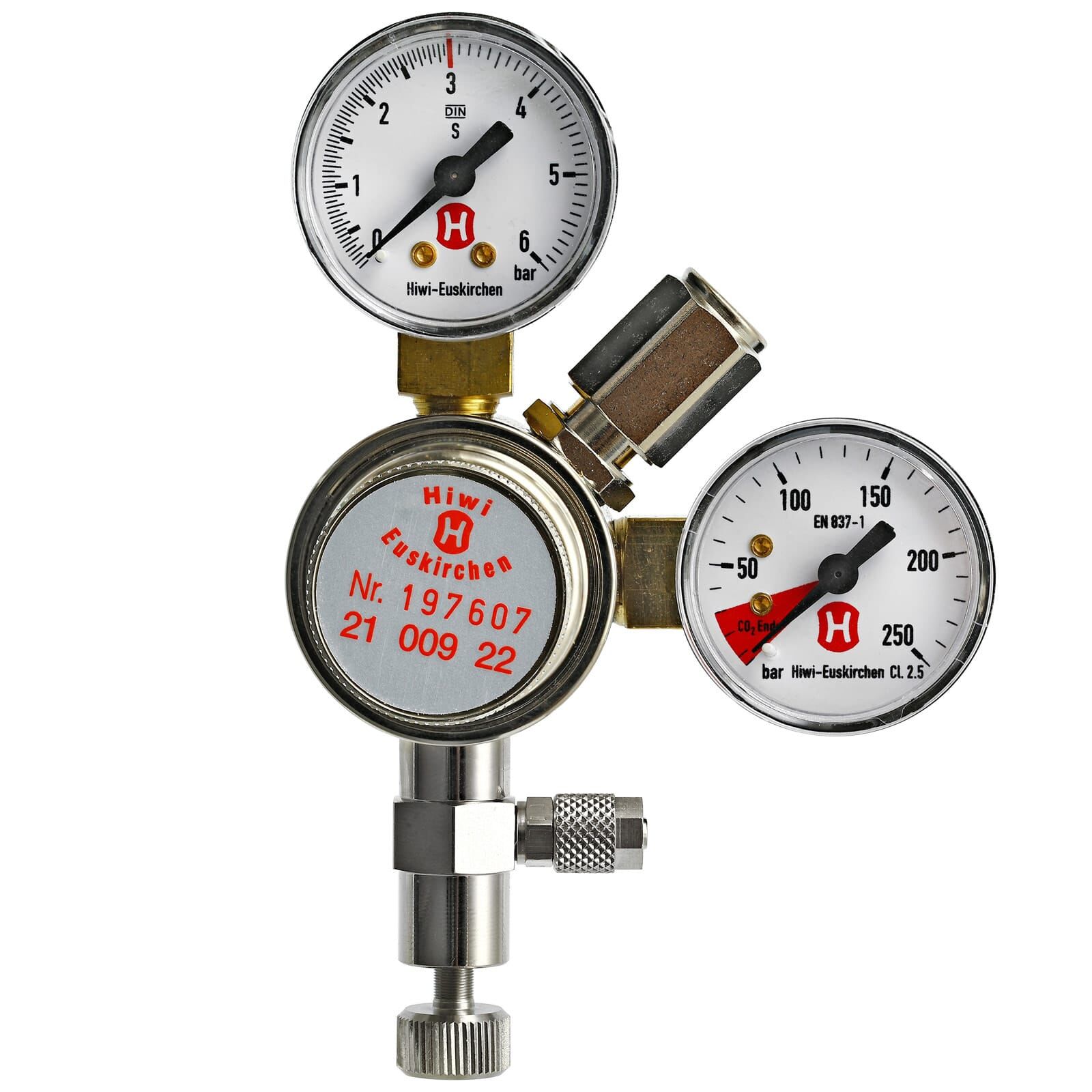
 Cleaning the Hiwi pressure reducer
Sometimes, problems can occur during the dark phase with a CO2 system that also has a solenoid valve. These show up, for example, as fluctuating pressure during night shut-off. This can be caused by microscopic dust and foreign particles that have accumulated in the pressure reducer. The dust can get in, for example, because refilling a CO2 cylinder is not done in a clean room. Dust particles can then end up in the cylinder and thus later also in the pressure reducer.
Cleaning the pressure reducer
To remove any micro dust from the pressure reducer, it is simply blown out. For this, the pressure reducer should first not be connected to the cylinder. The working pressure is turned all the way up (right stop). The fine needle valve, on the other hand, is closed.
Now the CO2 cylinder is connected for a few seconds. The high pressure triggers the relief valve, which then blows the gas carrying the micro dust out of the pressure reducer. This process should be repeated two to three times.
To put the CO2 system at the aquarium back into operation, first close the valve for the working pressure. The fine needle valve is opened slightly, and the remaining pressure or gas now escapes from the pressure reducer. Now connect the cylinder to the system. You should first close the needle valve and can then set the working pressure to the desired value.
The correct bubble rate can then be fine-tuned with the needle valve. Keep in mind that the system always reacts to pressure changes with a slight delay. After setting a certain bubble rate, you should therefore check it after a few hours and make a correction if necessary.
Note: This procedure is not suitable for a dual-stage pressure reducer.
Source and copyright of the video - Hiwi Euskirchen