 Standard diffuser or inline diffuser?
For planted aquariums, some users use so-called inline diffusers in addition to standard CO2 diffusers. These CO2 dosing devices are integrated into the circuit of an external filter, similar to a reactor. Where do the differences lie? Which is better for your aquarium? We clear it up.
The CO2 diffuser
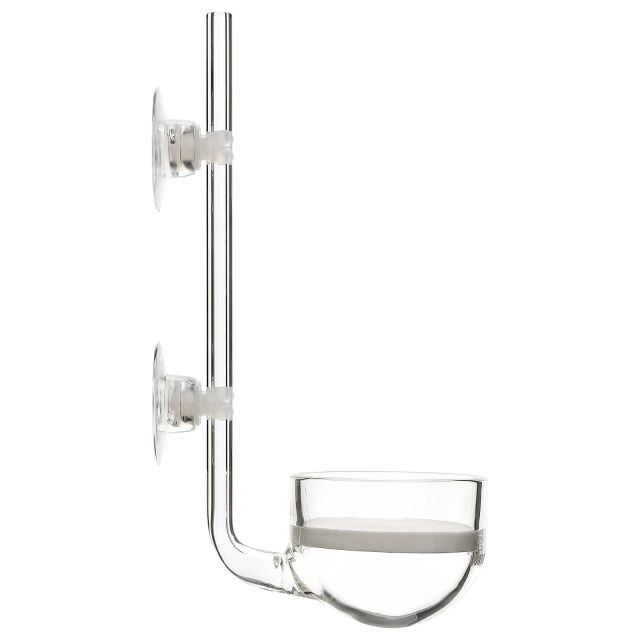
In general, a diffuser is a very efficient way of supplying your aquatic plants with the carbon they need. The gas is usually pressed through a ceramic membrane under pressure and thus atomized into many tiny little bubbles. The smaller size increases solubility in the water, so more CO2 reaches the plants than with other dosing devices such as a reactor, Flipper or Paffrath bowl.
CO2 diffusers are made from various materials; products made of glass, stainless steel or acrylic are popular. The size of the membrane and of the diffuser adapts to the tank size, so there are small models for nano aquariums and diffusers with a large membrane surface for larger aquariums. Diffusers made of acrylic or glass in particular are hardly noticeable thanks to their transparent look. Still, they are objects inside the aquarium that can be perceived visually as equipment. To keep the membrane transparent and permeable, regular cleaning is necessary. For this, the diffuser is placed in a bleach bath outside the water and put back into the aquarium after cleaning (for instructions, see here).
The inline diffuser
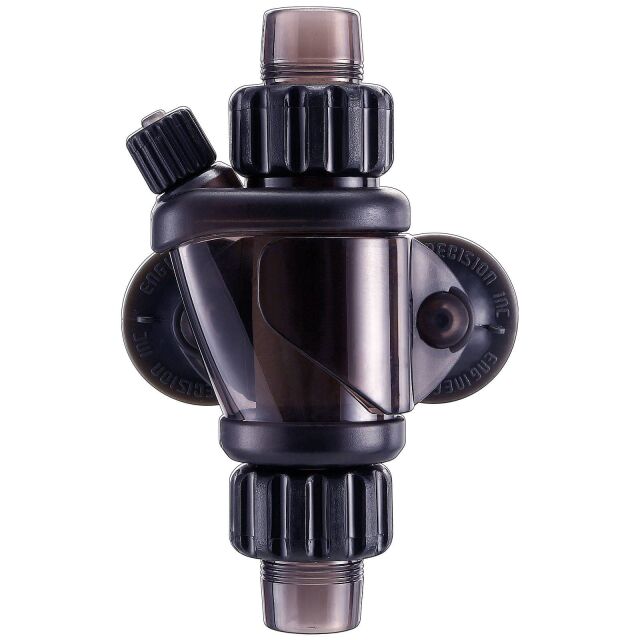
The inline diffuser is a finely atomizing dosing device that is integrated into the filter circuit of an external filter. For this, the diffuser is installed in the tubing run between the filter canister and the filter outlet. The advantage is that you can hide the technical component in the cabinet, so the inside of the tank stays free of this equipment. The cleaning effort is also sometimes lower. Since no light reaches it, the membrane does not get as covered in algae and does not need to be cleaned as often as a standard diffuser.
Inline diffusers need high pressure; they usually work at pressures of around 2 bar. An inline diffuser is by no means suitable for bio CO2, and only to a limited extent for pressure reducers with a fixed working pressure. An external filter is also a mandatory requirement.
Some aquarists find the "mist" that results from the fine atomization and is spread everywhere in the aquarium by the current visually disturbing. You can certainly work on the settings or use an inline diffuser with a not-so-extremely fine membrane (for example the JBL ProFlora CO2 Taifun Inline Diffuser), but to a certain degree, mist formation from the finest bubbles is simply part of how an inline diffuser works.
Inline diffusers show their strengths above all in larger aquariums. The fine atomization combined with distribution by the current increases efficiency. An inline diffuser is therefore also suitable for very large aquariums, where a single standard diffuser might sometimes reach its limits.
Conclusion
If you want to hide your CO2 equipment or have a very large aquarium, you are in good hands with an inline diffuser. Keep in mind, however, the high working pressure and sometimes a little "mist" in the aquarium due to the very fine atomization. An external filter must be available.
Classic diffusers, whether made of glass, stainless steel or acrylic, are available for many different aquarium sizes. There are many suitable dosing devices, especially in the field of nano aquaristics, that also look very stylish. Because of the possible "mist" as well, a standard diffuser is better placed in a smaller aquarium. A higher cleaning interval is probably necessary compared with an inline diffuser. Standard diffusers also shine with fine atomization and thus good solubility of the gas, though. Especially when no external filter is available, diffusers are the best way to dissolve CO2 in the water. Often not quite as high a working pressure is needed as compared with inline diffusers. This makes the diffuser easier to adjust, especially for smaller aquariums.