 Aquarium filter humming?
When aquarium filters make noise, it can be an unpleasant disturbance for the owner. Is there a defect? Is it always like this? Here we give some valuable tips for dealing with extra noises coming from the filter.
Noises after a new purchase
When you have just bought a new filter, are setting it up and starting it for the first time, the anticipation is of course great. One drawback when dealing with the aquarium filter can of course be this: you don't know the particular filter model yet and therefore don't know how the device behaves. If extra noises occur right after start-up, first of all, rest assured. This actually happens quite often, since especially in the very beginning the system still has to settle in or even run in a little. So something doesn't necessarily have to be broken. Common causes of extra noises include air left in the filter circuit or an impeller that is still running in. After just a few days, a certain smoothness of operation often sets in on its own. Is a filter still too loud? We present more specific solutions for particular noise problems further below.
Rattling noises from the filter
A fairly piercing and sharp rattle, in which two hard objects hit each other at short intervals, is often a sign of an impeller that is no longer running optimally. Sometimes it has a wobble and no longer runs true, so that it makes contact with its surroundings in the filter. Small artifacts such as pebbles, dirt or substrate particles may also have been sucked into the filter and cause these noises at the impeller. The remedy is therefore to open the filter once while it is switched off and take a look at the impeller. Very often, simply cleaning this technical component or the complete filter head already helps. If the impeller has a wobble and no longer runs straight, it can usually be reordered without any problem as a spare part and then simply replaced.

Noises caused by air pockets in the filter
A filter that is not completely filled with water is much louder. The aquarium owner should therefore make sure to fill the filter completely again, especially after a new installation, after cleaning or after the water change, in order to get pleasantly quiet operation again. Especially during a new setup, air pockets and corresponding noises can occur. Often the system simply needs a little time here, and the quiet returns on its own after a few days. To remove air from the filter or to fill it with water, many filters have corresponding devices (such as so-called priming aids).
If air pockets form in a filter that has already been running for a longer time, you need to check whether the water flow is disturbed somewhere. Clogged hoses, overly dirty filter materials or filter pipes narrowed by algae or dirt are very often the cause. A thorough overall cleaning very often helps here.
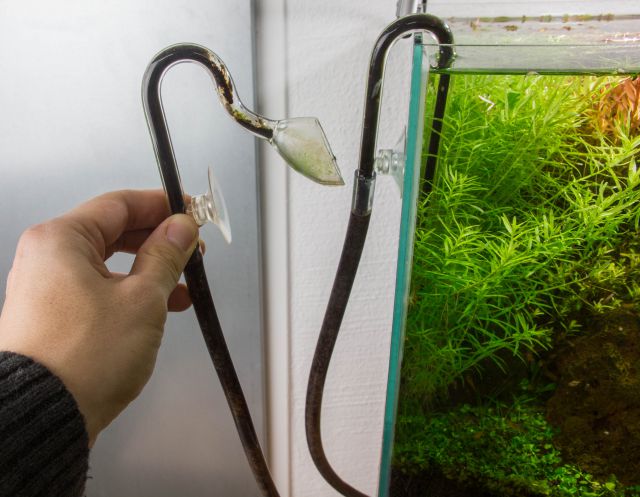
Humming filter
A certain baseline level of humming (usually quite low-frequency) is completely normal for a filter. This is because the current in our power grid pulses at a certain frequency (usually 50 Hz). An electrical product like a filter has a transformer that converts the current. This produces certain vibrations, which can be transferred to other objects and thus amplify the noise. However, both amplified disturbing noises and the standard hum of a filter can sometimes be reduced in volume by certain measures. Here are some tips for that.
Making the filter quieter
If the normal operating noises of a filter are bothersome, you can certainly reduce their volume a little further. Of course, it depends first and foremost on the type of filter, that is, whether it is a hang-on-back filter, an internal filter or an external filter. In principle, it is mainly about transferring as few vibrations as possible. When other objects start to vibrate, clearly audible disturbing noises beyond the normal humming often result.
Internal filter
With an internal filter, you really have quite few ways of influencing the noise. The advantage of an internal filter, however, is this: the mere fact that this filter is underwater already contributes greatly to a lower volume. The main thing to pay attention to here is that the filter housing has as little direct contact with the aquarium glass as possible (except, of course, via the suction cups with which such a filter is usually attached). The power cable sticking out of the water should also be installed so that there is little to no contact with the aquarium pane or other objects (for example the cover glass).

Hang-on-back filter
Because of the way they are installed, hang-on-back filters are somewhat more prone to transferring vibrations and therefore to developing disturbing noises. They often consist of a filter housing with a lid resting loosely on top. This connection often already causes a higher noise level. As a test, you can compare by running the filter without the lid for a short time. Operation is indeed much more pleasant then. Of course, such a filter should not be run without its lid permanently (please observe the manufacturer's instructions). Often, though, a few tiny pieces of foam rubber glued between the lid and the filter can already achieve a clear reduction in volume. Similar problem spots can be the points of contact between the glass and the filter, which can be resolved just as easily.

External filter
External filters usually sit in a cabinet under the aquarium. Most filters of this type already have several rubber feet from the factory, which already absorb a large part of the vibrations. If you also place the filter on a thicker mat of foam rubber or foam, the volume is reduced significantly once more.

You should make sure, however, that the filter's stability does not suffer. Inside the cabinet, too, other objects should not touch the filter if possible. Some aquarists take a somewhat broader approach and insulate the inside of their cabinet with acoustic foam.
