We use cookies to offer you an optimal shopping experience. These cookies can be grouped into categories. The necessary ones are essential for your purchase. Functional services enable additional content such as videos and maps. With further cookies we produce anonymized statistics. Others serve primarily marketing purposes and are used for the personalization of advertising. These cookies are used by 11 Services used in the shop. You can decide for yourself which cookies you want to allow.
We store your choice on your device (“local storage”) and ask you again after 12 months at the latest. You can change it at any time under “Cookie Preferences” in the footer. You can find details on cookie lifetimes and necessary cookies in our privacy policy.
These services are required to run the shop and for your purchase and cannot be switched off.
Strictly necessary cookies enable basic functions and are required for the website to work properly.
Description:
Shop functions: Essential Shop functions This includes: JTLSHOP (cookie, until you close the browser; keeps your session, the cart and your login), consent (browser storage; remembers your cookie choice, 12 months at most, during the session also in session storage), has_starting_point, cur_product_id and product_page_visits (session storage; navigation between products) as well as aquasabi-search-index-last-url, aquasabi-search-index-results and aquasabi-search-index-data (session storage; search results and lists when paging).
easyVision: easyVision lets website visitors customize the display – e.g. by adjusting contrast, font size, line and letter spacing, color rendering, a blue light filter or by disabling animations. Developed and hosted in Germany, the service is GDPR-compliant and supports statutory accessibility requirements (BFSG) from 2025. The service loads its scripts from cdn.sitecockpit.com and stores your settings (easy-vision-*) in your browser storage (no cookies).
Reviews: aquasabi_guid (cookie, 12 months) is only set when you click “Helpful” under a review. It stores a random ID so that the same person cannot count a review as helpful more than once.
Sorting and view: aquaSort and aquaDisplayType (cookies, 90 days) store the sorting or view (gallery or list) that you choose in a product list. They are only set when you choose a sorting or view.
Amazon Pay: Payment processing with Amazon Pay.
The service provider is Amazon Payments Europe S.C.A. Where Amazon Pay is offered (e.g. in the cart and at the checkout), the shop loads scripts and images from static-eu.payments-amazon.com, payments-eu.amazon.com and m.media-amazon.com and sets cookies (language, ledgerCurrency, apay-session-set). You can find out more in the privacy policy at https://www.amazon.de/gp/help/customer/display.html?nodeId=GRFTMVHP4HXMESSP
PayPal: Payment processing with PayPal.
The service provider is PayPal (Europe) S.à r.l. et Cie, S.C.A. Where PayPal is offered (e.g. in the cart and at the checkout), the shop loads scripts from www.paypal.com; for invoice payment via PayPal, c.paypal.com is added for fraud prevention. PayPal stores an entry in your browser storage (__paypal_storage__), and the shop remembers the chosen PayPal payment method in session storage (chosenPPCPaymentOption). You can find out more in the privacy policy at https://www.paypal.com/en/legalhub/paypal/privacy-full
Sofortüberweisung: On the confirmation page after an order with this payment method the shop loads a Klarna logo from x.klarnacdn.net.
Additional functions such as embedded videos and maps, spam protection in forms or the rating badge. Data is transferred to the respective provider when they load.
Show Youtube Videos
Description:
Displaying videos
Processing company:
Google Ireland Limited, Google Building Gordon House, 4 Barrow St, Dublin, D04 E5W5, Ireland
To submit forms on this page, you need to consent to the transfer of data and storage of third-party cookies by Google.
With your consent, reCAPTCHA, a Google service to avoid spam messages via contact forms, will be embedded.
This service allows us to provide our customers with a safe way to contact us via online forms. At the same time, the service prevents spam bots from compromising our services.
After you gave your permission, you might be asked to answer a security prompt to send the form.
If you do not consent, unfortunately you cannot use the form. Please contact us in a different way.
Helps us understand how the shop is used so that we can improve it.
We measure which pages and products are viewed and how visitors move through the shop. Google Analytics sets cookies (_ga, _ga_*) and sends usage data to Google.
Description:
Audience measurement and analysis of how the shop is used
Measures our advertising and enables personalised advertising on other sites.
We measure whether an ad on Facebook or Instagram led to a purchase and show visitors relevant ads again. Cookies are set for this: _fbp and _fbc (Meta) and as_fbclid (ours, 30 days; remembers the ID of the ad click). Meta receives data about your actions in the shop (e.g. product views, cart, purchase), your IP address and browser information; for a purchase our server may also send them directly to Meta (Conversions API). More in our privacy policy (retargeting/remarketing and conversion tracking).
Description:
Measure advertising success and show relevant ads again (Facebook, Instagram)
We measure whether an ad on TikTok led to a purchase. Cookies are set for this: _ttp, ttclid and _tt_* (TikTok) and as_ttclid (ours, 30 days; remembers the ID of the ad click). TikTok receives data about your actions in the shop (e.g. product views, cart, purchase), your IP address and browser information; for a purchase our server may also send them directly to TikTok (Events API). More in our privacy policy (retargeting/remarketing and conversion tracking).
We measure whether an ad in ChatGPT led to a purchase. Cookies are set for this: __oppref and __obref (OpenAI) and as_oppref (ours, 30 days; remembers the ID of the ad click). OpenAI receives data about your actions in the shop (e.g. product views, cart, purchase), your IP address and browser information; for a purchase our server may also send them directly to OpenAI (Conversions API). Data may be transmitted to OpenAI OpCo, LLC (USA). More in our privacy policy (retargeting/remarketing and conversion tracking).
Description:
Measure the success of ads in ChatGPT
Processing company:
OpenAI Ireland Limited, 1st Floor, The Liffey Trust Centre, 117-126 Sheriff Street Upper, Dublin 1, D01 YC43, Irland
We measure whether an ad led to a purchase and show visitors relevant ads again. Google Ads sets cookies (e.g. _gcl_*) and receives purchase data, where applicable in hashed form (SHA-256).
Description:
Measure advertising success and show relevant ads again (remarketing)
We use cookies that are essential for payment processing through our partners. Please select which payment providers you would like to use.
In order to unlock offers for extended payment options, in particular express checkout and payment in instalments, we require your consent to the data transfer and storage of third-party cookies of the payment provider PayPal. This allows us to also offer you express checkout and payment by instalments. Without your consent, only the technically necessary data transfer to PayPal will take place, but you will then not be able to use the express checkout or extended offers for payment by instalments on this site.
Description:
Using express checkout and Displaying offers for payment in instalments for individual items or your entire purchase.
Your consent ID:With this randomly generated number we can show on request what you selected. It contains no information about you.
Data privacy settings
Would you like to see these contents? Activate the desired contents for one session only or allow the website to remember these settings. Once you have given your consent, the third-party data can be loaded. For this, third-party cookies might be stored on your device. You can change these settings at any time (footer: “Cookie Preferences”). For further details, please see the Privacy notice.
If you have to replace the filter in an aquarium that has already been running for a long time, there are certain things to keep in mind. Many important bacteria live inside the filter, and they are indispensable for breaking down pollutants in the aquarium. Here we show you various ways to best replace the filter in a running aquarium without the aquarium inhabitants getting into trouble.
As mentioned, the filter materials of the old filter contain beneficial microorganisms that take part in the nitrogen cycle in the aquarium. They first convert ammonium (NH4) produced from organic waste into nitrite (NO2), and in a further step into nitrate (NO3). While the latter is, in principle, harmless to the inhabitants at the doses usual in an aquarium, nitrite is toxic even in low concentrations, especially for ornamental fish but also for some invertebrates in the aquarium. As the pH rises, the harmless ammonium in the water is increasingly converted into highly toxic ammonia (NH3), which is very dangerous for all fish, shrimp, crayfish and snails. A well-working filter therefore actively protects the animals in the aquarium from these toxic substances.
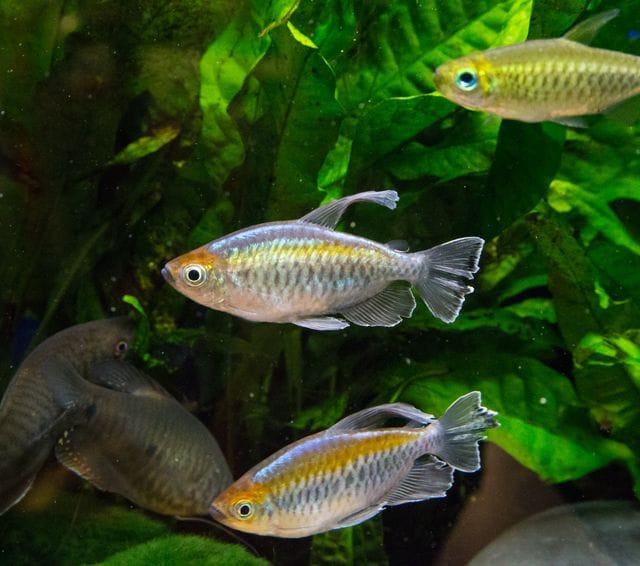
If you simply replace the old, matured filter completely with a new filter with fresh filter materials, important bacteria are removed to a large extent. Unfortunately, it takes some time until the microorganisms have established themselves in the new filter media, so because of the missing number of bacteria, the concentrations of ammonium/ammonia and nitrite in the aquarium may rise. This poses an immediate danger to the stock. Poisoned or even dead animals can be the result. So how do you solve this problem? We present some options in more detail.
General notes
In principle, such a filter change is quite a major intervention in the biological stability of an aquarium. Whichever measure you choose, the health of your stock should come first. As a precaution, it can therefore do no harm to observe the animals more closely over the next few days, to recognize any signs of poisoning and to take countermeasures. Testing the parameters ammonium/ammonia (NH4/NH3) and nitrite (NO2) more often is also a good way to monitor any rise in the substances toxic to fish.
Two filters on the aquarium
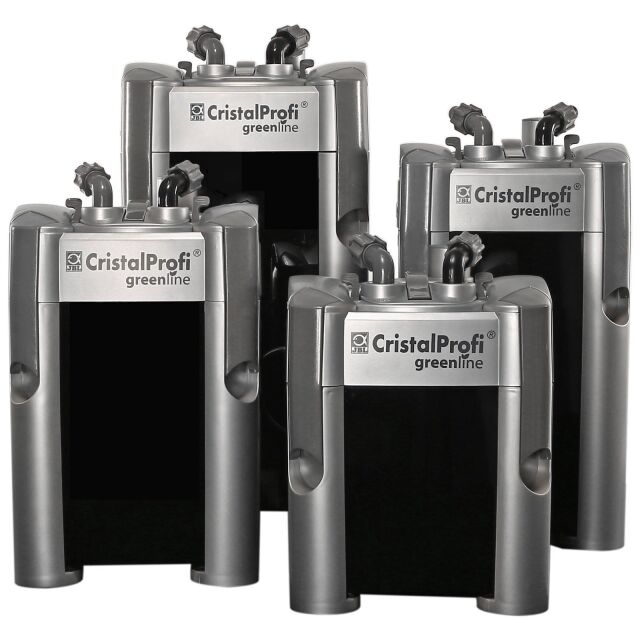
The first option for a (planned) filter swap is to simply let both filters run in parallel on the aquarium for a certain cycling period. The old aquarium filter keeps working as before, and the new filter is installed on the aquarium in addition. The prerequisites, of course, are on the one hand that the old filter still works and on the other that you have the necessary space in and on the aquarium for two devices. This method has the advantage that no important bacteria are lost (they are in the old filter, after all) and the new filter can "cycle in" in peace in terms of the nitrogen cycle.
Once this phase of about two to three weeks is over, you can simply uninstall the old filter while the new filter keeps running. Afterward, though, you should definitely continue to watch your animal stock closely and keep an eye on the ammonium and nitrite levels. According to the experience of some aquarists, a rise in the dangerous fish toxins can still occur.
The assumption is this: although two filters massively increase the colonization sites for bacteria, if there is not enough supply of food, the bacteria do not fully colonize the sites. So you still remove a large part of the bacterial population with the old filter, and a similar, but usually much weaker phenomenon can occur as with an abrupt filter swap.
First, the bacterial strains that convert organic load into ammonium develop fully. The oxidation to nitrite and on to nitrate cannot keep pace with it, however, because the corresponding bacterial populations have not grown to the same extent and still have to develop fully. As a result, an ammonium spike occurs and later a nitrite spike, which the shrunken stock of microorganisms cannot buffer sufficiently.
The remedy here is to seed the new filter media and/or add a bacteria starter made specifically for filters.
Swapping the filter materials
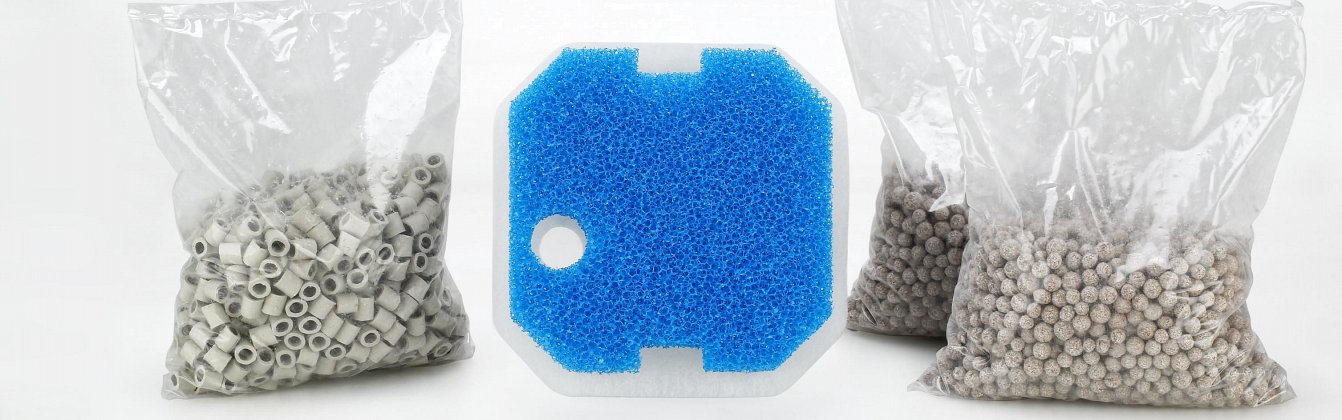
Another good option would be to simply transfer the old filter materials completely and not cleaned, or only roughly cleaned under cold running water, and pack them into the new filter. Remains of old filter sludge still in the filter housing can also be transferred along with them to take the bacteria living in it with you. This of course assumes that the filter media of the new and old filter models are reasonably compatible or can be made to fit. With loose filter material this is usually not a problem; with precisely fitted filter sponge it is more difficult. Here you could try trimming elements that don't fit a little. If there is no suitable solution, you can use the first layer of filter floss / filter foam or the pre-filter of the new filter and place the complete old filter media underneath.
This method has the advantage that it is quite simple and allows nearly all the already established bacterial cultures from the old filter to be transferred. After a while, as part of normal filter maintenance, you can gradually install the new filter materials and thereby replace the old filter media. You should proceed step by step here, though, and never replace everything at once.
Seeding the new filter

Because the bacterial flora in an aquarium adapts very precisely to the conditions in the habitat, it can be greatly reduced to just a few species that work perfectly under exactly the conditions prevailing in the aquarium. Of course, such impoverishment always carries the risk that the bacterial flora can no longer work well when conditions change - that can be just a new light or a different fertilization plan! For this reason, it is advisable anyway to re-seed a running aquarium now and then with a suitable bacteria product - this introduces new strains, and an adapted flora can then develop again in the aquarium from the many bacterial species in the product. A filter swap can be a good opportunity for such a bacterial reset - in this case, you would simply remove the old filter, connect the new filter and seed the media directly according to the package instructions with a bacteria starter made specifically for starting a filter. In the aquarium itself, larger populations of filter bacteria adapted to the aquarium usually also sit on the surfaces and can do their part.
This method makes sense especially when, for example, the old filter media cannot be transferred when switching from an internal filter or hang-on-back filter to an external filter.
Caution: with such a radical filter swap, despite the seeding, you have to check the ammonium levels and the nitrite content of the aquarium water carefully over the following two weeks and, if necessary, do an extra water change outside the usual schedule! It can also help to feed the fish and invertebrates in the aquarium only very sparingly in the days after the filter swap or, if the stock can tolerate it, not at all.
