We use cookies to offer you an optimal shopping experience. These cookies can be grouped into categories. The necessary ones are essential for your purchase. Functional services enable additional content such as videos and maps. With further cookies we produce anonymized statistics. Others serve primarily marketing purposes and are used for the personalization of advertising. These cookies are used by 11 Services used in the shop. You can decide for yourself which cookies you want to allow.
We store your choice on your device (“local storage”) and ask you again after 12 months at the latest. You can change it at any time under “Cookie Preferences” in the footer. You can find details on cookie lifetimes and necessary cookies in our privacy policy.
These services are required to run the shop and for your purchase and cannot be switched off.
Strictly necessary cookies enable basic functions and are required for the website to work properly.
Description:
Shop functions: Essential Shop functions This includes: JTLSHOP (cookie, until you close the browser; keeps your session, the cart and your login), consent (browser storage; remembers your cookie choice, 12 months at most, during the session also in session storage), has_starting_point, cur_product_id and product_page_visits (session storage; navigation between products) as well as aquasabi-search-index-last-url, aquasabi-search-index-results and aquasabi-search-index-data (session storage; search results and lists when paging).
easyVision: easyVision lets website visitors customize the display – e.g. by adjusting contrast, font size, line and letter spacing, color rendering, a blue light filter or by disabling animations. Developed and hosted in Germany, the service is GDPR-compliant and supports statutory accessibility requirements (BFSG) from 2025. The service loads its scripts from cdn.sitecockpit.com and stores your settings (easy-vision-*) in your browser storage (no cookies).
Reviews: aquasabi_guid (cookie, 12 months) is only set when you click “Helpful” under a review. It stores a random ID so that the same person cannot count a review as helpful more than once.
Sorting and view: aquaSort and aquaDisplayType (cookies, 90 days) store the sorting or view (gallery or list) that you choose in a product list. They are only set when you choose a sorting or view.
Amazon Pay: Payment processing with Amazon Pay.
The service provider is Amazon Payments Europe S.C.A. Where Amazon Pay is offered (e.g. in the cart and at the checkout), the shop loads scripts and images from static-eu.payments-amazon.com, payments-eu.amazon.com and m.media-amazon.com and sets cookies (language, ledgerCurrency, apay-session-set). You can find out more in the privacy policy at https://www.amazon.de/gp/help/customer/display.html?nodeId=GRFTMVHP4HXMESSP
PayPal: Payment processing with PayPal.
The service provider is PayPal (Europe) S.à r.l. et Cie, S.C.A. Where PayPal is offered (e.g. in the cart and at the checkout), the shop loads scripts from www.paypal.com; for invoice payment via PayPal, c.paypal.com is added for fraud prevention. PayPal stores an entry in your browser storage (__paypal_storage__), and the shop remembers the chosen PayPal payment method in session storage (chosenPPCPaymentOption). You can find out more in the privacy policy at https://www.paypal.com/en/legalhub/paypal/privacy-full
Sofortüberweisung: On the confirmation page after an order with this payment method the shop loads a Klarna logo from x.klarnacdn.net.
Additional functions such as embedded videos and maps, spam protection in forms or the rating badge. Data is transferred to the respective provider when they load.
Show Youtube Videos
Description:
Displaying videos
Processing company:
Google Ireland Limited, Google Building Gordon House, 4 Barrow St, Dublin, D04 E5W5, Ireland
Helps us understand how the shop is used so that we can improve it.
We measure which pages and products are viewed and how visitors move through the shop. Google Analytics sets cookies (_ga, _ga_*) and sends usage data to Google.
Description:
Audience measurement and analysis of how the shop is used
Measures our advertising and enables personalised advertising on other sites.
We measure whether an ad on Facebook or Instagram led to a purchase and show visitors relevant ads again. Cookies are set for this: _fbp and _fbc (Meta) and as_fbclid (ours, 30 days; remembers the ID of the ad click). Meta receives data about your actions in the shop (e.g. product views, cart, purchase), your IP address and browser information; for a purchase our server may also send them directly to Meta (Conversions API). More in our privacy policy (retargeting/remarketing and conversion tracking).
Description:
Measure advertising success and show relevant ads again (Facebook, Instagram)
We measure whether an ad on TikTok led to a purchase. Cookies are set for this: _ttp, ttclid and _tt_* (TikTok) and as_ttclid (ours, 30 days; remembers the ID of the ad click). TikTok receives data about your actions in the shop (e.g. product views, cart, purchase), your IP address and browser information; for a purchase our server may also send them directly to TikTok (Events API). More in our privacy policy (retargeting/remarketing and conversion tracking).
We measure whether an ad in ChatGPT led to a purchase. Cookies are set for this: __oppref and __obref (OpenAI) and as_oppref (ours, 30 days; remembers the ID of the ad click). OpenAI receives data about your actions in the shop (e.g. product views, cart, purchase), your IP address and browser information; for a purchase our server may also send them directly to OpenAI (Conversions API). Data may be transmitted to OpenAI OpCo, LLC (USA). More in our privacy policy (retargeting/remarketing and conversion tracking).
Description:
Measure the success of ads in ChatGPT
Processing company:
OpenAI Ireland Limited, 1st Floor, The Liffey Trust Centre, 117-126 Sheriff Street Upper, Dublin 1, D01 YC43, Irland
We measure whether an ad led to a purchase and show visitors relevant ads again. Google Ads sets cookies (e.g. _gcl_*) and receives purchase data, where applicable in hashed form (SHA-256).
Description:
Measure advertising success and show relevant ads again (remarketing)
We use cookies that are essential for payment processing through our partners. Please select which payment providers you would like to use.
In order to unlock offers for extended payment options, in particular express checkout and payment in instalments, we require your consent to the data transfer and storage of third-party cookies of the payment provider PayPal. This allows us to also offer you express checkout and payment by instalments. Without your consent, only the technically necessary data transfer to PayPal will take place, but you will then not be able to use the express checkout or extended offers for payment by instalments on this site.
Description:
Using express checkout and Displaying offers for payment in instalments for individual items or your entire purchase.
Your consent ID:With this randomly generated number we can show on request what you selected. It contains no information about you.
Data privacy settings
Would you like to see these contents? Activate the desired contents for one session only or allow the website to remember these settings. Once you have given your consent, the third-party data can be loaded. For this, third-party cookies might be stored on your device. You can change these settings at any time (footer: “Cookie Preferences”). For further details, please see the Privacy notice.
How many fish can I put in my aquarium? Is there a rule of thumb for this? These questions are asked above all by beginners in aquarium keeping who are starting this hobby from scratch. What aquarium owners should look out for when planning the stocking density, we show in this article of our Aquascaping Wiki.
Avoiding overstocking in the aquarium
In principle, basic thoughts on stocking density, and thus the rules of thumb associated with it, aim at species-appropriate care and, above all, at preventing overstocking of the aquarium. Besides the animals' discomfort in social interaction (for example when territories form), overstocking mainly has biological effects: the water is burdened too heavily with pollutants from the many inhabitants. If the owner's maintenance measures and the aquarium's technical setup are not sufficient here, there is a risk that the entire ecosystem in the aquarium will collapse. This situation should therefore be avoided at all costs.
Minimum requirements
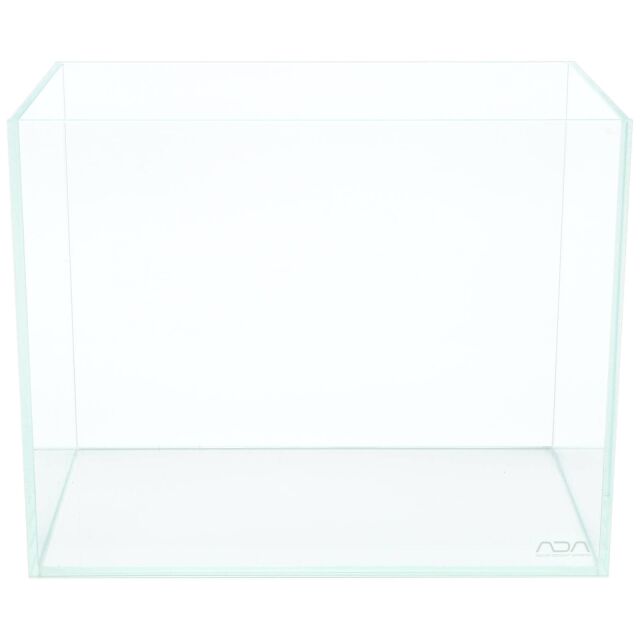
The legal recommendation in Germany calls for a glass tank with at least 54 liters and an edge length of 60 cm for keeping aquarium fish. In Austria, it is even prohibited to keep fish in a smaller aquarium. You are therefore on the safe side if you plan at least a tank with these standard dimensions for keeping fish. Smaller tanks are, by the way, called nano aquariums. These are much more suitable for keeping invertebrates such as dwarf shrimp, crayfish or snails. Sometimes, however, keeping fish in such a nano aquarium is possible. We have put together an overview of nano fish that stay small in this article.
Rule of thumb for calculating fish stocking
In the aquarium scene, certain rules of thumb with fish-per-liter or fish-per-centimeter figures are in circulation. Over the years, the following rules of thumb, for example, have become established:
1 cm of fish length per 1 liter of aquarium water
1 cm of fish length per 30 cm² of area in the aquarium
It should be kept in mind that these rules of thumb only offer a very rough indication and in individual cases are not recommendable at all. As a negative example, it should be mentioned that according to the fish-per-liter formula, two fish of 27 cm each could fit in a standard aquarium with 54 liters of volume. Of course, that is not the case.
With such length figures, it is always important to note that they refer to the expected final size of a fully grown fish. When buying new fish, you often find juveniles in stores, whose size should not be used as a basis for calculation.
Relying solely on these blanket figures therefore does not really make sense in terms of animal welfare. Rather, the stocking density depends on many other factors that have to be taken into account. The aquarist can instead use the results of the rules of thumb as first, very rough guideline values and refine or correct the calculations with the other aspects to be considered.
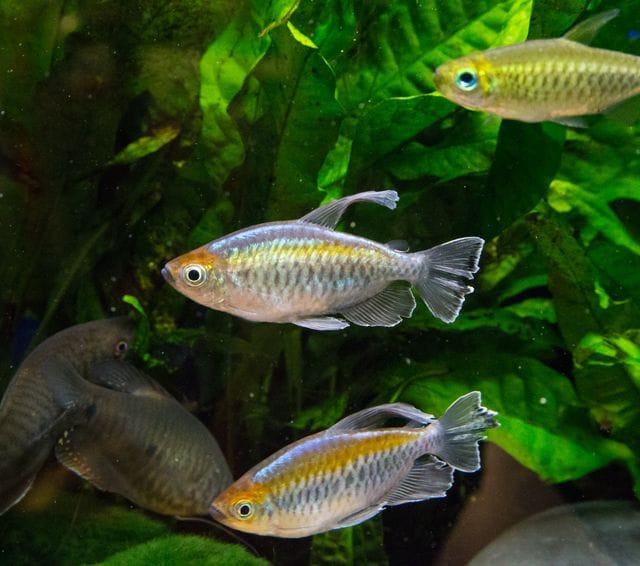
The Congo tetra is a schooling fish that already grows fairly large and needs a correspondingly large aquarium volume.
Factors to consider when choosing livestock
In fact, the stocking density in an aquarium depends on many more things, which we would like to introduce here in more detail. If you take these aspects into account as an aquarium owner, it is somewhat more complicated, but much more animal-friendly when planning your fish stocking.
Size of the aquarium: The size of the glass tank does not only mean the pure volume of contents but also the shape, depth, height and edge length of an aquarium. Fish species that love to swim in particular need species-appropriate open swimming space, so a corresponding edge length matters. An aquarium with a lot of depth and decoration items in it offers many hiding places, which are very important for some animal species. For very deep-bodied fish species such as angelfish or discus, certain minimum tank heights are required. For bottom fish, the footprint (that is, length times depth) is rather decisive. As you can see, the requirements for the size of the aquarium can be quite different. When buying fish, therefore, check the respective profiles for what specifications they give regarding aquarium size. In general: larger fish belong in a large aquarium.
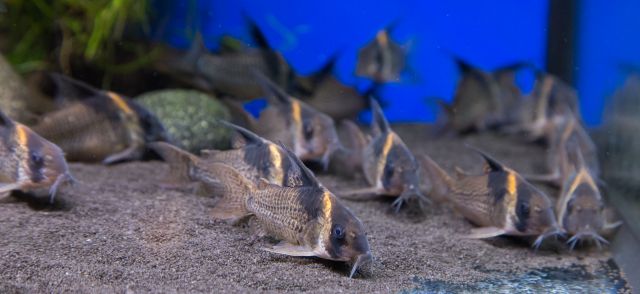
Different water zones: Here the aquarist basically distinguishes between three different swimming zones in which the animals mainly stay. The lower zone is the favorite of many bottom-digging fish with a downturned mouth such as catfish and loaches, but also invertebrates such as shrimp, crayfish and snails. Near the water surface, it is mainly fish species that love current and oxygen that swim, and they often have an upturned mouth. This means that feeding also takes place primarily in this zone. Topminnows and hatchetfish, for example, are fish species that prefer the upper water zone. In between is the middle zone, which mainly represents a transition from bottom to top. Very many fish that love to swim and have a terminal mouth stay primarily in this zone of the so-called open water.
Armored catfish are usually found near the bottom.
If you populate your water zones skillfully, you can even accept a somewhat higher stocking density, since the respective animal species are spread across all height zones in the aquarium. On the other hand, overcrowding only one particular water zone should be avoided at all costs (the middle swimming zone is often affected).
Social behavior: The aquarist should definitely take social interaction into account when choosing livestock. There are fish species that are rather loners or form territories, but also group animals such as schooling fish that only feel comfortable from a certain number of their own species. Especially during the breeding season or when defending a territory, certain fish such as cichlids can become quite aggressive. The remedy here is to choose a sufficiently large aquarium and to offer enough structure with aquatic plants and other decoration to provide enough hiding places.
Species diversity: Especially in the popular community aquariums, owners often keep many different animal species together. Here you can remember: the more different species are used, the more different needs regarding the care conditions clash. It is therefore simpler and better for animal welfare to keep the species diversity rather manageable and well matched. Here the aquarist should deal well with food, social behavior, group size and the preferred swimming zones.
Water parameters: Of course, when choosing livestock, the aquarium owner should make sure to combine species that prefer roughly the same water parameters. These include temperature, pH, general hardness (GH) and carbonate hardness (KH). These conditions are determined on the one hand by the technical setup of the aquarium, but above all by the quality of the source water.
Conclusion
The rules of thumb that are common in aquarium keeping are only conditionally suitable for the final calculation of the stocking density, but they can offer a first indication. The other factors such as the size of the aquarium, social behavior, water parameters, species diversity and preferred water zones should definitely be taken into account as well. Inexperienced aquarists in particular can do better by following the usual fish profiles or by seeking expert advice or the advice of experienced aquarists.
