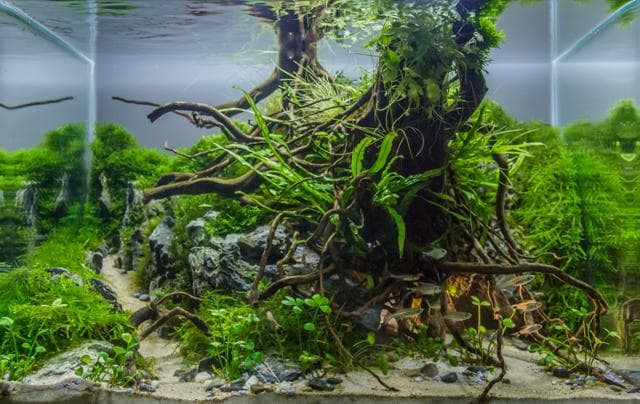
 Daylight entering the aquarium
Aquariums are generally lit artificially by an aquarium lamp, so natural daylight actually plays no role. Nevertheless, sunlight can have certain effects, even if you wouldn't suspect it at first glance.
Daylight entering the tank
If algae in the aquarium (mainly green algae or cyanobacteria) suddenly appear without any notable influences from aquarium equipment, fertilization, water parameters or other recent changes, the factor of daylight entering the tank can sometimes be included in the investigation into the cause. Is the aquarium near a window? Can sunlight hit the aquarium from the front, from the side or even from behind (for example with a room divider) over the course of a day?
In fact, the influence of solar radiation on the aquarium is often underestimated, especially since there are also seasonal fluctuations. If algae growth increases in the spring and summer months (compared with fall and winter), this is an indication that daylight might be playing a role. A few hours of sunlight can already be enough to produce an effect here. The aquarist should also note that the sun moves and daylight entering the tank is therefore not always recognizable at every time. For an accurate analysis, you should observe your aquarium throughout the day to assess the situation.
An example of daylight entering the tank with lux measurements
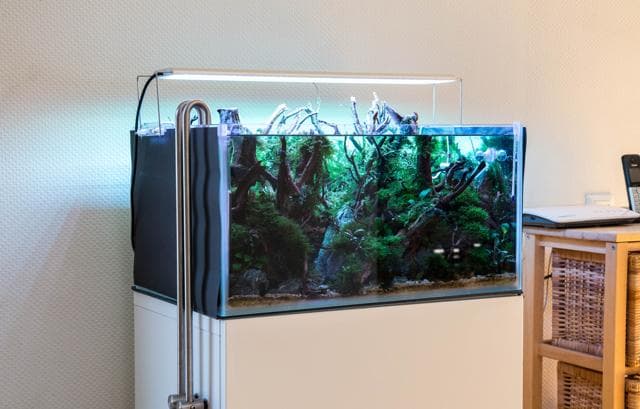
This example aquarium is an aquascape with many slow-growing mosses and a rather low lighting setting, which consequently suits the needs of the aquatic plants well. It stands against an exterior wall that faces south. To its left and right there are large windows that let in a lot of light. Over the course of the day, a good deal of sunlight reaches the left side pane of the aquarium through the left window, especially in the morning. As the sun moves on during the day, its radiation decreases again because the wall is now in the way. Toward evening, light then enters through the right window.
The following lux measurements distributed over the day are meant to illustrate how strong the daylight entering the tank can be at certain times. The sunlight (blue) was measured at the left side pane, and the illuminance of the aquarium lamp (orange) for comparison just above the water surface.
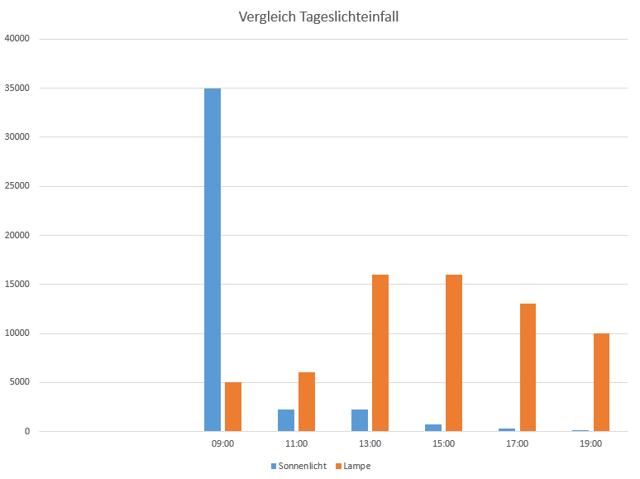
You can clearly see that the incoming daylight produces a certain peak around 9:00 a.m., which, however, lasts only a few hours. Just 2 hours later the effect is negligible again. The aquarium lamp, by the way, follows a programmed daylight simulation with dimming phases in the morning and evening. That is why a certain curve can be seen here. It can also be expected that in the evening hours daylight will again enter the aquarium through the right window. Unfortunately, no measured values are available for this in our example measurement.
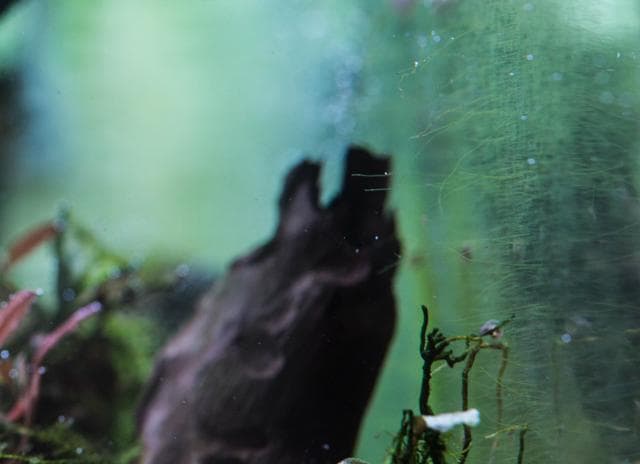
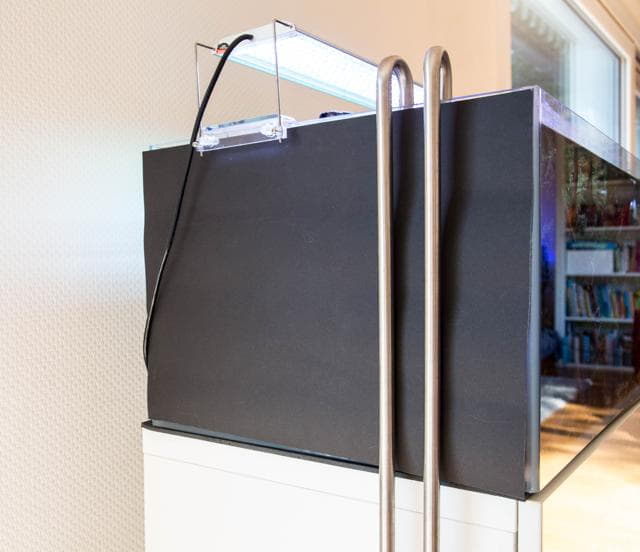
In our example, at any rate, the short but intense incidence of sunlight led to increased growth of green algae. A 14-day blackout treatment managed to remove them again. To block the incoming light, both side panes were darkened with black cardboard. Since then, the aquarium has had no notable algae problems.
Countermeasures
First of all, you need to pinpoint exactly where the sunlight is coming in. Keep in mind that the sun moves over the course of the day and that the light entering the aquarium can change as well (the sun moves from east to west).
If certain areas, such as the side panes or the rear pane of the aquarium, are lit by sunlight, you can cover these areas, for example, with background film (with an aquarium back panel this is a normal procedure anyway for visual reasons). Attaching fairly thick cardboard that blocks as much light as possible is also a good option that can be done quickly and easily.
If areas of the front pane are indeed affected, covering or darkening these areas is not really an option, since they significantly restrict the owner's view into the aquarium. In these cases you could counteract somewhat with the lighting period and light intensity of the aquarium lighting, ideally with a dimmer or LED controller that allows programming a daylight curve. During hours of intense sun, you can thus turn the aquarium lamp down considerably. That also has something positive: silvery fish in particular shine in a very special way under (sideways) incoming sunlight!