 Mounting an aquarium LED
You have been planning the long-awaited switch of your aquarium lighting to energy-saving LEDs, and now you face the task of picking one from the wide range of lamps that fits your aquarium. How do I mount it? How do you install an LED lamp under a cover? In this article, we explain how best to go about it and what types of mounting there are.
Types of installation for open aquariums
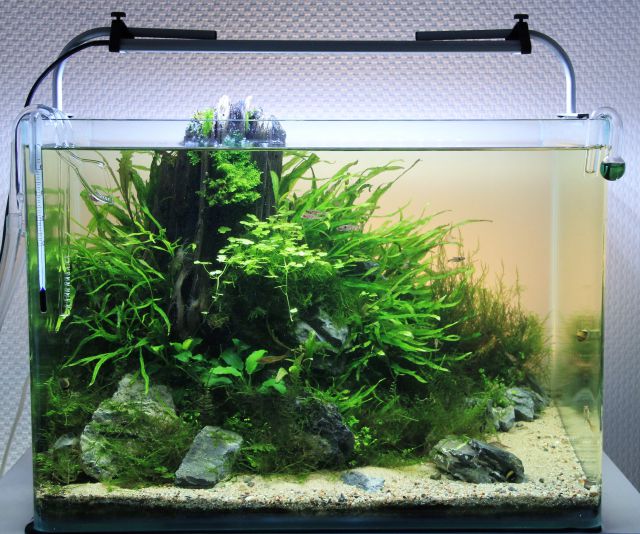
For open aquariums without a cover, the choice is relatively simple. In principle, all LED lamps available as top-mounted lamps or hanging lamps are an option here. The latter is classically attached with a cable suspension to the ceiling or wall near the aquarium. LED hanging lamps can also be positioned very well above an aquarium with suitable tube holders, which are then attached to the base cabinet or to the aquarium glass.
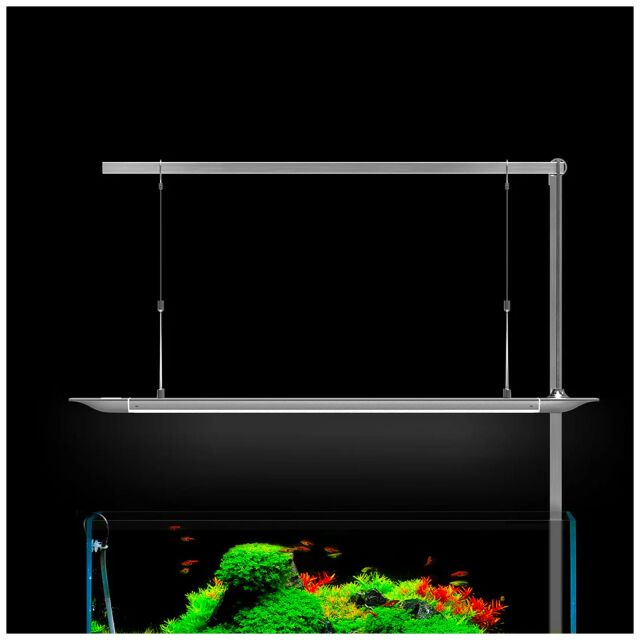
Top-mounted lamps are those that have suitable mounting brackets on the lamp body and sit with them precisely on the side panes of the aquarium. The advantage of these aquarium lights is often a slightly raised position of the lamp above the aquarium, so that better illumination is possible than when the lighting is positioned very close above the water surface.

Available on the market here are top-mounted LED lamps that are either offered to match particular aquarium sizes or are adjustable in length, so that a certain range of aquariums with different edge lengths can be covered. You should keep in mind here: the smaller the actual lamp body is in relation to the length of the aquarium, the worse the illumination at the edges becomes. You should therefore avoid choosing a lamp that is too small with small dimensions, unless a very central light that only shines in the middle is enough for you (for example for an island layout).
Mounting options under an aquarium cover
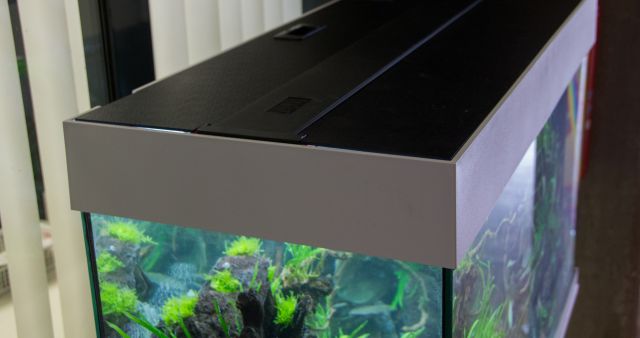
With an aquarium that has a lid or a fixed cover, the old lighting is usually integrated into it. Here it is somewhat harder to find a suitable LED replacement. Nevertheless, there are some solutions in this case that we would like to present. Note, however, that not all LED-based aquarium lamps are designed to be operated under a cover. This can usually be recognized by the protection class rating (IP), or it is clearly pointed out in the product description. For example, some lamps from Chihiros cannot be used inside a lid. Lamps with an IP-58 or IP-68 rating (the 8 as the second digit is what matters here) are fully waterproof and can be completely submerged.
Aquarium LED as a retrofit

Mounting options as a retrofit with a Dennerle Trocal LED.
Do you still have old T5 or T8 fluorescent tubes installed in the aquarium lid? No problem, here the old tube sockets can be used to find a suitable LED solution by means of adapters. This principle is called "retrofit". Many manufacturers state in the description of their lamp bodies which length fits typical fluorescent tube sockets. By the way: the power supply via the tube socket is then generally no longer used. The LEDs often use their own power supply, so only a new power cable has to be run here.
The advantage of this way of installing is that you can be sure you have found a suitable solution. In addition, the aquarium cover can usually continue to be used without problems or restrictions. The disadvantage can of course be that there is then no space for a later upgrade (adding another light bar). But this problem already existed before with the old fluorescent tube sockets.
Hanging LED lamps in
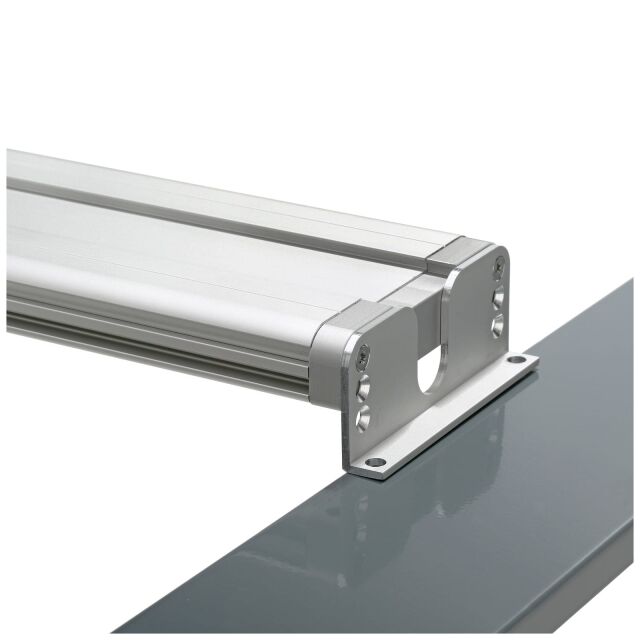
Installing LED light bars is quite simple if the existing aquarium cover has a kind of hang-in frame. That means that guide rails or edges are built in all around inside the cover, in which the old T5 or T8 light bars are already hung. These can then often be slid freely in depth. This is the case, for example, with larger Eheim aquariums. Here, LED lamps of a suitable length can then be chosen quite easily, which generally have extendable universal adapters in the form of metal frame brackets. With these brackets, the LED light bars can be adjusted to the respective length and hung on the guide edge of the cover.
Whether an LED lighting fits properly here (including in terms of height!) has to be measured properly and then compared with the details in the product description. The advantage of the sliding light bars is retained, and if desired and if there is room, you can swap or expand lamp bodies.
daytime solutions for Juwel and Eheim aquariums
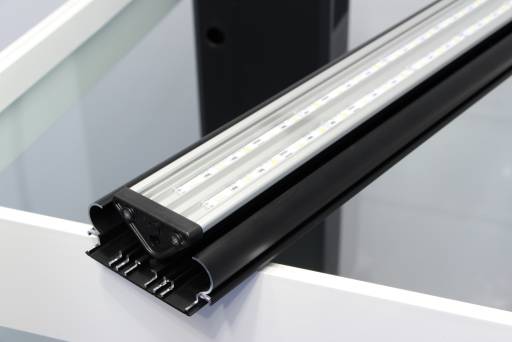
The renowned LED manufacturer daytime offers a very interesting solution, especially for aquariums with a cover in which the lighting is coupled to the so-called center brace. Instead of replacing individual tubes, the complete center brace is simply replaced via an adapter rail, so that the cover remains intact and can be kept. Various LED modules can then optionally be installed in the new center brace, with the number, power and light color individually selectable. You can learn more in this article for Juwel aquariums and here about installation in Eheim aquariums.
Is it better to choose one or two light bars?
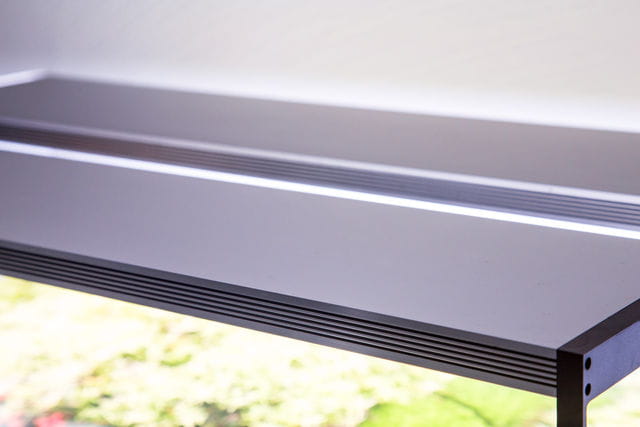
The question of whether to hang one or several lamps over your aquarium is of course a question of budget. But you should note that aquariums with more depth in particular achieve better illumination across the entire area when several light bars are installed. For classic LED light bars in an elongated design, you can reckon on using one lamp for each approx. 30 cm of aquarium depth. An aquarium measuring 60 x 45 x 45 cm is therefore better lit with two lamps. For a standard tank measuring 60 x 30 x 36 cm, one light bar is generally enough.