 Aqua Rebell Basic NPK or Estimative Index?
With Basic NPK and Estimative Index, Aqua Rebell offers two different macronutrient fertilizers. Both contain potassium, phosphate and nitrogen. Where are the differences? Which liquid fertilizer is better for which aquarium? We explain.
Aqua Rebell Basic NPK
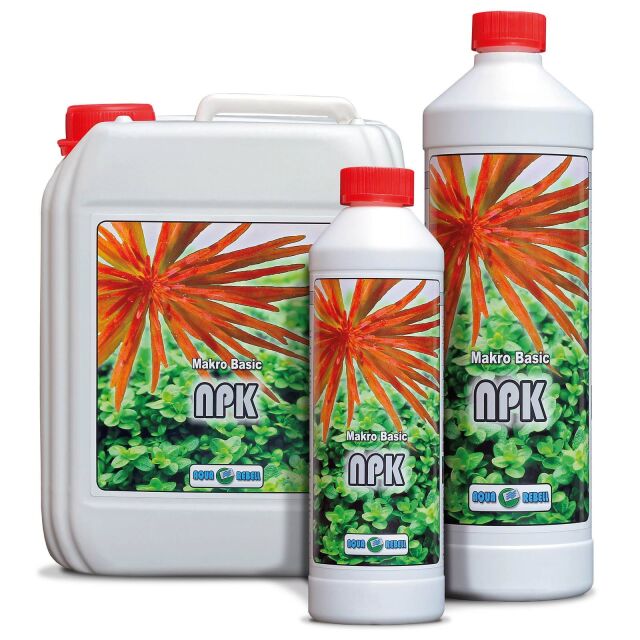
This liquid macronutrient fertilizer is based on the idea of the PMDD system. This abbreviation stands for the "Poor man's dosing drops" (PMDD) system, which was originally developed by Paul L. Sears and Kevin C. Conlin. This fertilization system is based on the principle of phosphate limitation. Here, a planted aquarium is supplied with enough potassium, nitrogen and also micronutrients, but phosphate is added only in small amounts. The nutrient is then taken up directly by the aquatic plants and should hardly be present as a measured value in the water column, so that it is not available to potential algae. The goal is an aquarium that is as algae-free as possible, but also good and controlled aquatic plant growth. Consequently, Basic NPK contains sufficient potassium and nitrogen, but only small portions of phosphate. A little magnesium is also included to round off the macronutrients in the area of general hardness. Micronutrients are not included and can be supplied specifically via a complete iron fertilizer such as Aqua Rebell Basic Eisen. This allows micro- and macronutrients to be separated and thus dosed more flexibly. For good plant growth, carbon should ideally be supplied via a CO2 system.
At 1 ml per 50 liters, Basic NPK supplies the following values:
- 0.5 mg/l NO3
- 0.05 mg/l PO4
- 0.65 mg/l K
- 0.05 mg/l Mg
Aqua Rebell Estimative Index
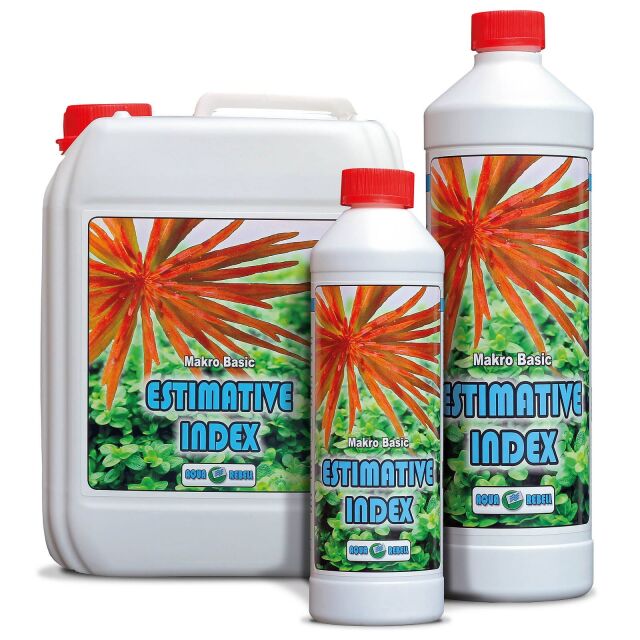
The liquid fertilizer Aqua Rebell Estimative Index also supplies NPK macronutrients. However, it is based on an entirely different supply system, which was originally developed by Tom Barr. Here, unlimited plant growth is the priority, so all nutrients should be available in abundance. Besides nitrogen and potassium, this also means phosphate in higher concentration. The basic idea behind it is a study by Bachmann et al., which shows that there is no connection between algae growth and a high phosphate concentration. The fertilization is based on the maximum uptake rates of aquatic plants, which were determined through tests. So that substances still do not accumulate too much, a weekly 50% water change is planned to perform a kind of reset. Of course, sufficient micronutrients (covered by a complete iron fertilizer) and carbon (via a CO2 system) should also be available. Classically, in the fertilization system of the Estimative Index, the micro- and macronutrients are even added on staggered days. On one day you administer double the daily ration of macronutrients and on the following day double the daily ration of micronutrients. This alternating dosing is carried out three times per week, with one day of fertilization pause.
At 1 ml per 50 liters, Aqua Rebell Estimative Index supplies the following values:
- 0.74 mg/l NO3
- 0.14 mg/l PO4
- 0.56 mg/l K
The direct comparison
As different as the fertilization systems are, so are the nutrient concentrations of the two fertilizers. Basic NPK contains small amounts of magnesium, Estimative Index does not. The latter adds significantly more phosphate (nearly three times as much) and more nitrate (about 50%). In return, it is not as potassium-heavy.
Recommendations
Aqua Rebell Basic NPK is recommended as a macronutrient fertilizer especially for, for example, planted community aquariums. A fairly high fish stocking here sometimes already produces higher NO3 and PO4 concentrations in the water column. Basic NPK rounds off the macronutrients and mainly adds the missing potassium. In normal planted aquariums, it can be used as the base macronutrient fertilizer. Besides sufficient micronutrients via a complete iron fertilizer, an additional nitrogen source is then sometimes necessary if nitrate consumption is quite high. This is quite often the case in lushly planted aquariums with little animal stocking. For this we additionally recommend GH Boost N as a pure nitrate fertilizer.
Estimative Index is aimed primarily at high-tech planted aquariums where unlimited growth is the goal. Here, high-intensity light (60 lumens per liter and more) meets very fast-growing and extremely extensive planting. Often there are very many stem plants and ground cover plants here, as in a Dutch aquarium or a Brazilian-style aquascape. Of course, micronutrients should also be supplied here in addition to CO2. If the nitrogen in the Estimative Index fertilizer is not enough to cover the daily consumption, GH Boost N can likewise be used here as an additional nitrate source.