Liquid fertilizer and water hardness
Published
Translated from German with AI assistance and reviewed by our editors.
It is generally known in planted aquarium keeping that soft, slightly acidic water (with low hardness and a similarly low pH) is especially beneficial for the growth of aquatic plants in an aquarium. But why, actually? In this article, we explain in more detail what effects certain water parameters have on the availability of nutrients for aquarium plants.
Differences between soft and hard water
Experience in aquarium practice has shown that nutrient balance works differently in soft water than in hard water. This became noticeable for aquarists who were confronted with a switch from hard to soft water (or vice versa), for example by moving to a new place. Because of the new water parameters, their "fertilization habits" had to be adjusted significantly. While normal to high doses of complete iron fertilizer were common in harder water, very heavy black beard algae growth appeared rather quickly in softer water with the same fertilization habits. A much lower dose is therefore needed here than in harder water.
Conversely, in aquariums with harder water, besides a higher dosage of micronutrients, a clearly stronger addition of macronutrient elements and carbon dioxide is sometimes also necessary until vital growth finally sets in with the aquatic plants. What is the reason for that? Below we go into the individual parameters of the aquarium water in somewhat more detail.
pH
Strictly speaking, pH has nothing to do with water hardness in the first place. General hardness (GH) is defined as the sum of the dissolved alkaline earth metal ions and indicates whether water is called hard or soft. The pH, on the other hand, determines whether acidic or alkaline properties are present; it refers to the concentration of hydrogen ions. The parameters "acidic" and "soft" are therefore, to begin with, two different things that have to be considered separately. Nevertheless, there are chemical relationships between the pH and the temporary part of water hardness, which is defined as carbonate hardness (KH). Together with the CO2 level, this gives rise to the so-called lime-carbonic acid equilibrium. Certain mutual influences take place here. Put simply, aquarium practice shows that the properties "acidic" and "soft" often occur in combination, just like "hard" and "alkaline".
If you consider the pH as an independent value, however, it does have some effects on nutrient availability. For many plant species, a slightly acidic pH is clearly more beneficial for nutrient uptake. Especially in the soil substrate, a pH below 7 is advantageous for the uptake of important trace elements such as iron, manganese, boron, copper and zinc. Through their roots, plants are also able to acidify the soil by releasing hydrogen ions. This increases the solubility of, for example, iron in the form of Fe3+ and its reduction to Fe2+, which can be taken up better by plants in this oxidation state.
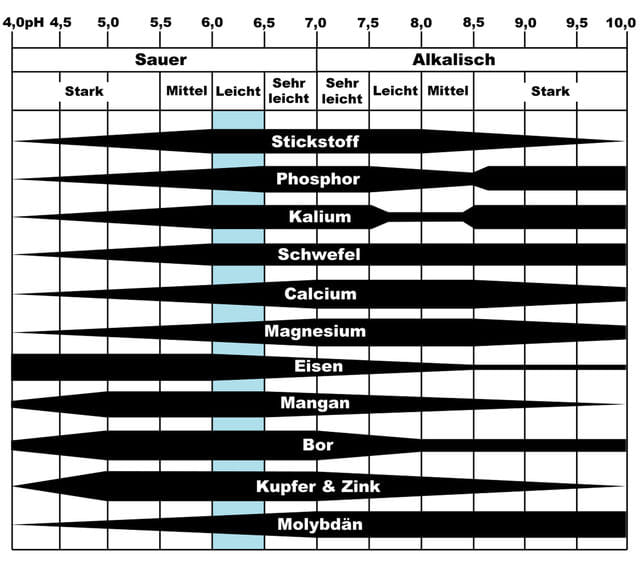
Modified (translated into German) after: CoolKoon - Own work, license: CC BY 4.0.
The figure above shows the solubility of minerals depending on the pH of the soil for land plants. You can clearly see improved uptake of important trace elements at a slightly acidic pH.
To achieve a soil environment that is as acidic as possible in the substrate, active soil substrates are recommended in the planted aquarium. Depending on the type and manufacturer, these are also usually enriched, to a greater or lesser extent, with additional beneficial nutrients for aquatic plants.
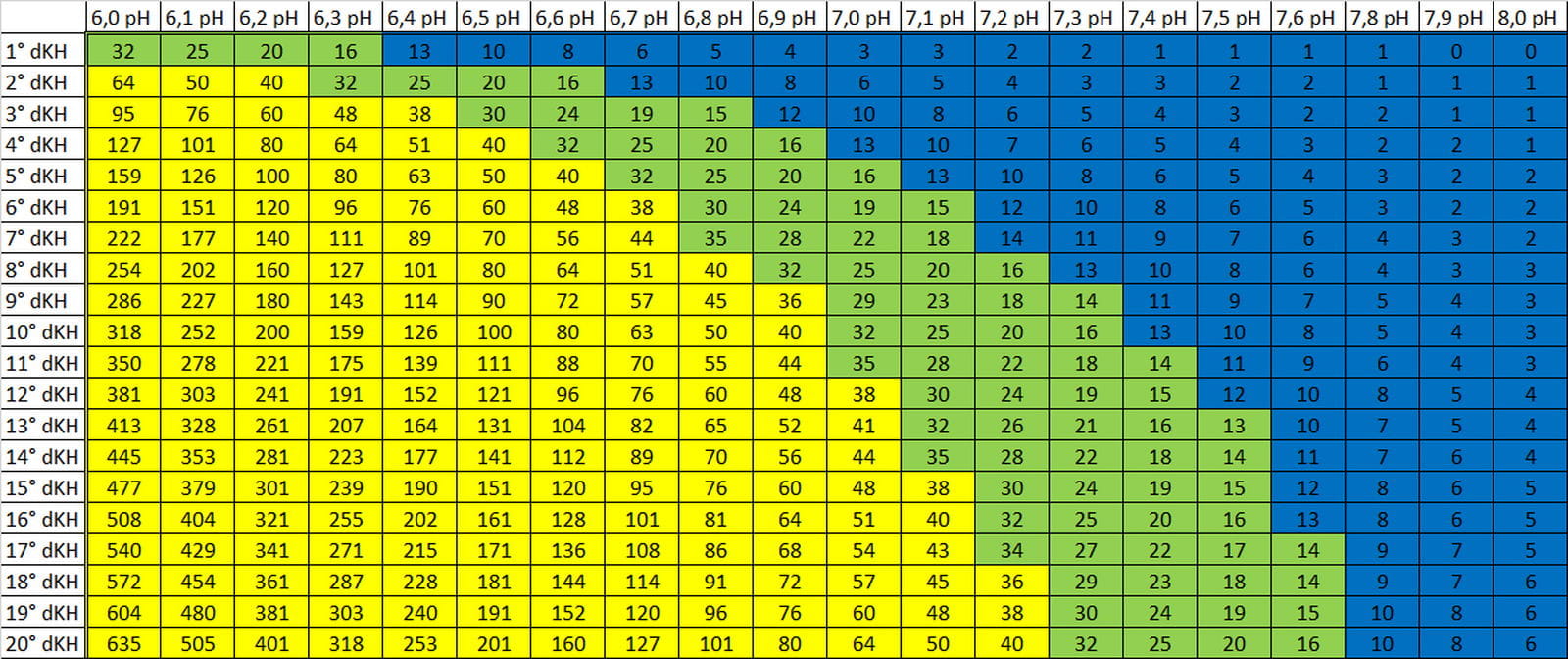
A low pH can be set to a certain level much more easily with a lower carbonate hardness. The reason is the lime-carbonic acid equilibrium already mentioned above. For this, you can consult the so-called CO2-KH-pH tables. As an example, a pH of 6.8 at a KH of 2 can be reached with an addition of just 10 mg/l CO2. At a KH of 4, on the other hand, 20 mg/l CO2 already have to be used to likewise reach a pH of 6.8.
Water hardness and its effect on the nutrient situation in the aquarium
If you look at the definition of the general hardness (GH) of water, a higher degree of hardness is also associated with a higher amount of alkaline earth metals dissolved in it. These include above all calcium and magnesium, but also, for example, strontium, beryllium and barium. The first two elements, calcium and magnesium, count for plants as macronutrients, which are needed in larger amounts. Although the content of all dissolved salts (so not only the alkaline earth metals that are part of the GH) can vary depending on the natural origin of the water, the ratio of the concentrations of these substances to one another is usually quite similar. In this respect, beyond measuring alkaline earth metals, the general hardness (GH) can also be interpreted as an indicator for other parameters of the water, such as the conductivity and the amount of other dissolved salts.
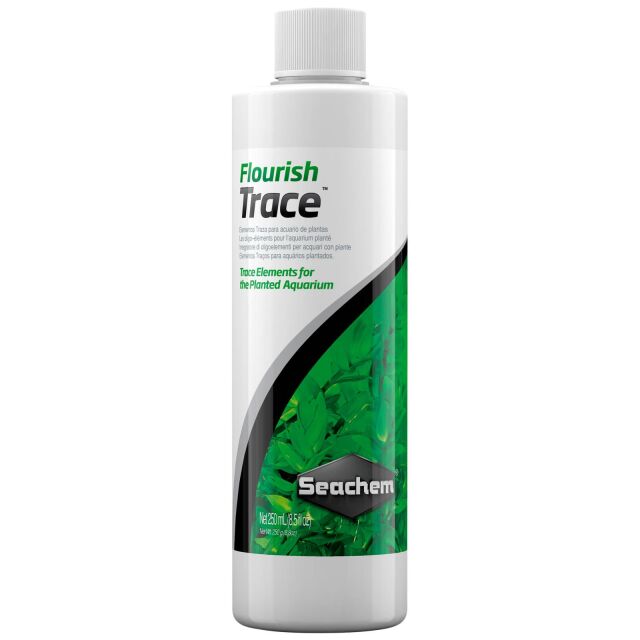
Put casually, you can conclude from this that harder water is richer in minerals and the salts dissolved in it; in other words, the water can tend to be described as "richer in nutrients" with regard to these minerals and certain trace elements. On the other hand, softer water could be understood as rather "low in nutrients". In a lushly growing planted aquarium, there is a corresponding consumption of minerals, so a deficiency situation can sometimes arise more quickly in soft water. This generally affects the elements calcium and magnesium less; the trace elements such as iron, manganese, boron and molybdenum are more often affected. Normally, these are supplied in sufficient amounts by adding a complete iron fertilizer. In a soft-water aquarium, however, it is not uncommon to have the special case that complete iron fertilizer cannot be dosed sufficiently, since it provokes the appearance of red algae such as black beard algae and beard algae. Switching the chelate form with a fertilizer like Aqua Rebell Micro Special Flowgrow often helps here. In it, the nutrients are stabilized more gently (no EDTA is used as a chelator) and are therefore available to the plants more quickly. In very rare cases, fertilizing soft water with a pure trace element fertilizer without iron such as Seachem Trace is sometimes necessary; it sets the right ratio of trace elements without red algae appearing, because it adds no additional iron.
The situation looks somewhat different in harder water. As already described above, water with a higher degree of hardness is also richer in minerals. In extreme cases, the situation can arise where the elements "compete" for uptake at the plant, so that a nutrient blockage results from an oversupply of another nutrient. This is because certain elements act antagonistically. For example, too high a calcium content can have a negative effect on the uptake of potassium and magnesium in aquatic plants. Paradoxically, a deficiency situation therefore arises from an oversupply of minerals and displacement by competing elements. In harder water, you should therefore pay particular attention to a balanced ratio of minerals, especially for the nutrients calcium, magnesium and potassium (see also "The Calcium-Magnesium Ratio"). For similar reasons, very high doses of other fertilizer components are sometimes also necessary to achieve the desired growth results in aquarium plants.
If the aquarist uses harder tap water, it is often extremely rich in calcium but very poor in magnesium. To ensure vital growth in aquatic plants and an ideal ratio of calcium to magnesium of about 3:1 where possible, fertilizing with magnesium using Epsom salt is sometimes necessary here. Especially with disproportionately high calcium concentrations, magnesium deficiency symptoms can easily occur. Similar to an iron deficiency, chlorophyll formation is disturbed as a result, and less leaf green forms. The shoot tips of aquatic plants are often light to white, while the leaf veins often stay green.
CO2 and water hardness
The aquarist should be aware of the following relationships here:
- Through the lime-carbonic acid equilibrium, pH, KH and the CO2 level in water influence each other and have certain basic ratios to one another.
- Carbonate hardness has the function of buffering the pH.
What exactly happens when you add CO2 to an aquarium? First of all, the planted-aquarium keeper wants to provide an important nutrient with it. Introducing carbon dioxide also has chemical effects on the water, though, because a small part of the CO2 reacts to form carbonic acid, which acidifies the water. This lowers the pH. pH controllers in the aquarium are also based on this principle; they keep the pH at a certain value through controlled CO2 injection. Carbonate hardness, or acid-binding capacity, serves as a natural buffer. As the name suggests, the hydrogen carbonates contained in the KH prevent, up to a certain degree, acids added from outside from pulling the pH down immediately.
If carbon dioxide is now introduced into the water via a CO2 system, carbonic acid forms, as described above, which affects the pH. With a higher carbonate hardness, the buffering effect is stronger. This means that the effect of lowering the pH is made much more difficult in this case. For good nutrient availability in a planted aquarium, too high a carbonate hardness is therefore counterproductive.
Limestone and CO2
If the aquarium contains decorative objects (for example stones) and substrates that contain lime (calcium carbonate), this has a negative effect on nutrient availability for the plants. CO2 injection shifts the lime-carbonic acid equilibrium, which wants to bring the system back into balance. The carbonic acid that forms reacts quite aggressively with the lime in solids and combines to form calcium hydrogen carbonate dissolved in the water. As a result, carbonate hardness, pH and general hardness rise while CO2 is consumed for this buffering process. The CO2 consumed in this way is initially no longer available to the aquatic plants as a free nutrient.
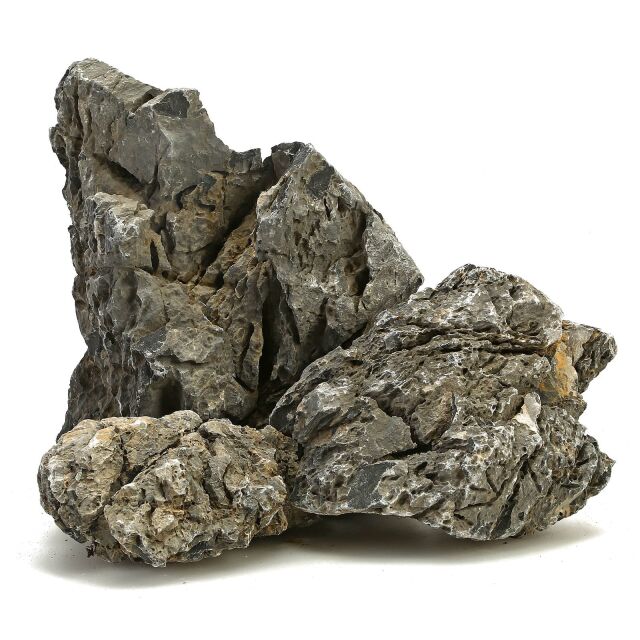
This phenomenon explains the sometimes massive hardening caused by some types of rock that are very popular in aquascaping, such as Minilandschaft (see photo). Besides the poorer CO2 availability, this phenomenon also has a negative effect on other nutrient uptake. The higher carbonate hardness causes a higher pH, which works counterproductively. The ratio among the alkaline earth metals shifts in favor of calcium, so magnesium deficiency symptoms appear in the plants again. We remedy this with regular maintenance such as large water changes and fertilizing with Epsom salt to bring the calcium-magnesium ratio back to a more plant-friendly ratio.
Conclusion
Which plants prefer which degrees of hardness is ultimately species-dependent. There are certainly many aquatic plants that feel more at home in harder water. The likelihood of a deficiency situation due to missing minerals occurring is somewhat lower at a higher general hardness. However: water with less carbonate, and thus "softer" in this respect, is more advantageous for nutrient uptake. Because of the relationships in the lime-carbonic acid equilibrium, it is much easier to reach a pH below 7 through CO2 injection, which improves nutrient availability for aquarium plants. In rather acidic soft water, fewer antagonistic processes related to lime take place, so such high fertilizer additions are not necessary to get vital growth in the aquatic plants.
A good compromise for planted aquariums would therefore be a low-lime environment in the aquarium, a rather low carbonate hardness (KH) combined with a general hardness (for example not below 6 °dGH) that is not designed to be too low in minerals and has a good ratio of calcium to magnesium. A pH slightly below neutral for better nutrient uptake and for more favorable CO2 uptake, together with a sufficient amount of minerals, thus makes a good combination.