 Response Times of Aquatic Plants in the Aquarium
A question often asked among planted-tank aquarists is how long aquatic plants take to react to certain things. This could be, for example, a change in fertilization. In this article, we explain how you can estimate the response time of aquatic plants well.
Mobile and immobile nutrients
Basically, you have to take the different types of nutrients into account here. In botany (primarily for land plants), a distinction is made between mobile and immobile nutrient elements. It therefore depends on how the nutrients are transported within the plants. With regard to deficiency symptoms, this can play an important role. Mobile nutrients are those that the plant can transport relatively well within its system when needed. If a nutrient deficiency occurs, the required elements are transported away from the older leaves and brought to the young parts of the plant. This results above all in a deficiency symptom on the older leaves, which at first cannot be seen on the young shoots. Mobile nutrients include, for example, nitrogen (N) in nitrate form, phosphorus (P) as phosphate, potassium (K) and magnesium (Mg). These are the most important macronutrients for aquatic plants. But micronutrients such as chlorine (Cl), zinc (Zn) and molybdenum (Mo) also count among the mobile nutrients.
Immobile nutrients are, for example, calcium (Ca), sulfur (S), iron (Fe), boron (B) and copper (Cu). Above all, the important iron plays a major role for aquatic plants here. The plant is relatively poor at transporting immobile nutrient elements to where they are needed. Therefore, for example, an iron deficiency shows on the young new growth of the plant, not as strongly on older leaves. With immobile nutrients, the response time is therefore quite short. The plant reacts relatively quickly to a deficiency with a growth disorder. With mobile nutrients, you can assume that this response time takes somewhat longer.
Damage to young leaves caused by missing immobile nutrients can then also be remedied relatively quickly. Chlorosis caused by iron deficiency can be eliminated again in a few days with adjusted fertilization. The pale leaves then regain a healthy green color. Damage caused by mobile nutrients occurs primarily on older leaves. The health of these can only rarely be restored by optimizing fertilization. Here it is rather a matter of judging the plant's later new growth, especially once it gets a little older.
Type of aquatic plant
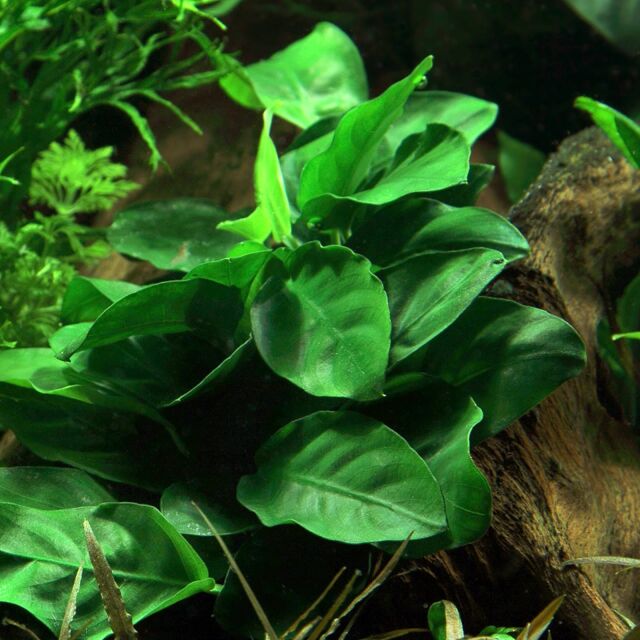
The species or variety of an aquarium plant also plays an essential role here. There are so-called shade plants, which need little light but are also very slow-growing. These include, for example, anubias (see photo above), mosses, ferns or water trumpets. Their metabolism is simply very slow, so a certain nutrient deficiency or an improvement in the nutrient situation shows here accordingly after a longer period. Fast-growing stem plants or ground cover plants can be different. These have a high metabolism and sometimes have to be trimmed every two weeks because they spread so fast. These plants react correspondingly quickly to a change in the nutrient balance. You can also take advantage of this and define the fastest-growing stem plant in your aquarium as a so-called indicator plant. This plant is then the first to show growth changes such as deficiency symptoms. The aquarist can thus react quickly and adjust the fertilization before growth damage occurs in other aquarium plants. Heteranthera zosterifolia is popular for this, for example, because it also has quite large leaves and can show an iron deficiency wonderfully (light to pale shoot tips).
The special role of CO2
Is there a CO2 system or not? This difference can make an enormous difference in plant growth and therefore also in response time. If carbon is missing or lacking, this can significantly slow down the entire metabolism of all plants in the aquarium. Not only fast-growing stem plants are affected, but also, for example, mosses or water trumpets. Even their growth rate is significantly slower without CO2. Without a CO2 system, the aquarist should therefore be prepared for very slow response times. Depending on the plant species, quite a few long weeks or even months can go by here.
Empirical values
If you take a normal planted aquarium with enough light (at least 30 lumens per liter), sufficient liquid fertilization and carbon fertilization for a mixed, species-rich plant stock as the standard, you can assume a response time of about three weeks on average. As a rule, aquatic plants need such a period under the conditions mentioned above before they visibly react to a nutrient optimization. In some cases it can also go faster (for example with iron), but you can gladly wait out the period of three weeks before taking further steps. That way, plants with a slow metabolism also have time to react to changes. If a serious nutrient deficiency has occurred (for example a lack of carbon for several weeks), the aquarium plants also need this time to recover from the damage and refill their reserves.
The response time can be significantly slower if the technical setup or the plant stock deviates from our standard example. This applies especially to a missing CO2 system, little light or a plant stock that consists only of shade plants.