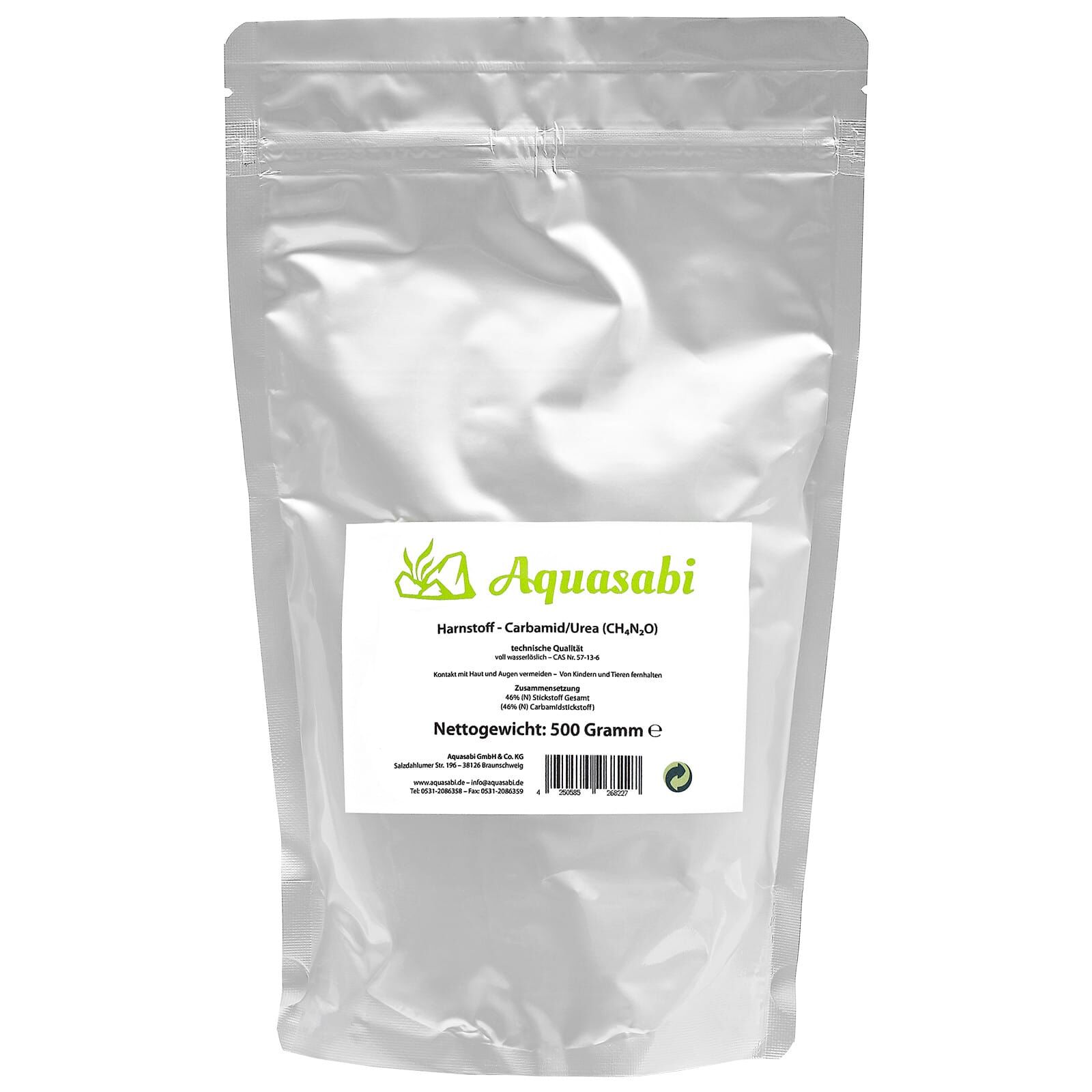
 Urea fertilization in the planted aquarium
For advanced aquarists in particular, fertilizing aquatic plants with nitrogen via urea is a conceivable alternative. In this article, we explain the advantages and disadvantages of urea fertilization and the best way to go about it.
What is urea?
Urea makes you think of urine right away. Urea, also called carbamide, is only one component of urine and, chemically speaking, a so-called carbonic acid diamide, which contains nitrogen, hydrogen, oxygen and carbon. It is a natural organic compound. As a solid, urea is a whitish and odorless substance and can be used excellently for fertilizing plants with nitrogen. Other areas of application are found mainly in cosmetics and medicine, but also in industrial production of, for example, synthetic resins.
Advantages of urea as a nitrogen fertilizer
At around 46%, urea has the highest concentration of nitrogen (N) when you compare other nitrogen fertilizers with one another. This fertilizer is therefore incredibly economical. Apart from nitrogen, it contains no other nutrients, such as potassium, magnesium or calcium, which are often contained in other fertilizers. With carbamide, the aquarist can therefore raise the nitrogen content in a targeted way without influencing other parameters in the aquarium. So if you want to fertilize with little potassium or without hardening the water, urea is an attractive option.
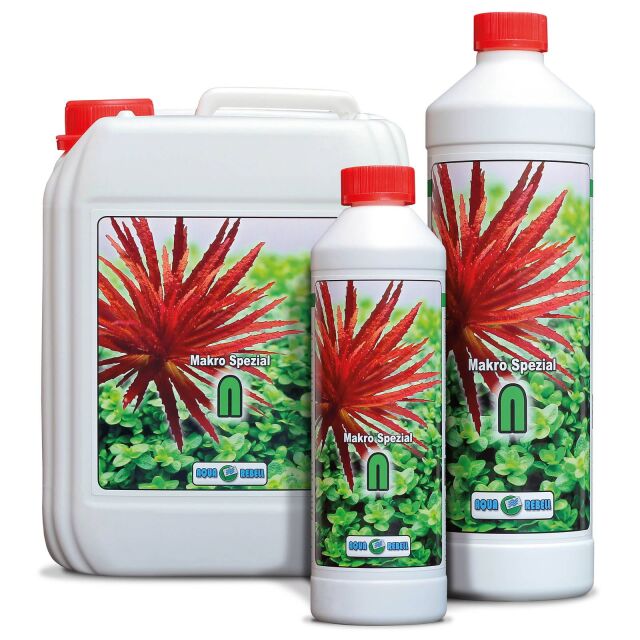
Since urea dissolves in water quite quickly, it can be added both as a solid and as a specially mixed fertilizer solution. The nutrient salt can thus be added flexibly and is easy to handle. Some plant species have a certain affinity for fertilization with urea or its first breakdown stage, ammonium. Depending on the type of aquatic plants, increased growth and optimized plant health can certainly occur after a period of adjustment. Some fertilizers from well-known manufacturers also make use of these advantages and therefore contain a proportion of urea, such as Aqua Rebell Makro Spezial N.
Disadvantages of urea as a nitrogen fertilizer
Unlike other forms of nitrogen such as ammonium or nitrate, urea is not immediately available to plants. Only through the enzyme urease can urea be converted into ammonia or ammonium ions and hydrogen carbonate ions. This process can be carried out above all by bacteria, fungi or tiny invertebrates living in the substrate. But plants are also able to convert urea using urease. Urease is clearly present especially in the seeds of plants. In an aquarium, this first of all means that you should start urea fertilization slowly and sparingly. For the conversion of urea, the necessary bacterial fauna first has to develop, or the plants have to change their enzymatic makeup. On the other hand, a certain time lag is also to be expected purely in terms of measurement, because there is no water test for urea in aquaristics. It takes some time until the urea has been converted first to ammonium, then to nitrite and finally to nitrate. To express urea in measurable terms (with an NO3 test), one therefore speaks of a nitrate equivalent, which corresponds to the value obtained when urea has passed through the entire nitrogen cycle and can then be expressed as nitrate as the end product. In practice in the planted aquarium, however, a further measurement problem arises, because the nitrate equivalent is at first only a theoretical calculation. Along the entire path of the nitrogen cycle that the nitrogen (originally added as urea) passes through, consumption by the aquatic plants can already take place, for example in the form of ammonium. With respect to a measurement with a nitrate test, a certain share therefore falls "by the wayside", so to speak. The measured value thus sometimes expresses only part of the amount of urea added as detected nitrate. The nutrient is not lost, though, but has already been put to use by the plants. Instead of relying on measured values, the aquarist should therefore pay more attention to the appearance of the aquatic plants (deficiency symptoms relating to nitrogen) in order to estimate whether nitrogen fertilization is sufficient to this extent. For that reason, this type of fertilization is recommended above all for advanced planted-aquarium keepers.

Further precautions with urea fertilization
Since urea stands at the beginning of the chain of the nitrogen cycle, so to speak, this can also affect the concentrations of ammonium/ammonia and nitrite in the aquarium. For safety's sake, dosages with urea should always be adjusted sparingly and the parameters NH4 and NO2 should be monitored with suitable water tests, since both elements can be toxic to the inhabitants. With ammonium in particular, there is a strong dependence on the pH value of the water (for further explanation see here).
In principle, urea fertilization is therefore only recommended in aquariums with a pH value (well) below 7. Fluctuations in the pH value, for example through water changes, hardening or CO2 supply, therefore have to be taken into account. As a precaution, urea should not be added at times when the pH can rise temporarily, such as directly after a water change or at night when the lighting and CO2 supply are switched off. Pulse dosing with a urea-containing fertilizer, where correspondingly large amounts are added, should also rather be avoided.
Adding urea
Urea can be added as a solid, but it is even better to make your own fertilizer solution. The nutrient salt dissolves quickly in water and needs no high temperatures for this; room temperature is completely sufficient. You should not heat the fertilizer solution either, since decomposition can otherwise take place. To calculate the nutrient concentrations, we use the Flowgrow nutrient calculator. As a small calculation aid, you can use the rule of thumb that 1 mg/l urea yields approximately 2.06 mg/l NO3 as a nitrate equivalent. Calculated the other way around, approx. 0.49 mg/l urea is needed for 1 mg/l NO3 as a nitrate equivalent. Here is a small example. We want to make 1 liter of nitrogen fertilizer with urea that, at a dosage of 1 ml per 50 liters, reaches a nitrate equivalent of 1 mg/l NO3. We enter 1 as the volume and select "Calculate nutrient input per 1 ml in 50 l" as the calculation type. Under "Nutrient" you can select urea as a separate element; under "Product" we then likewise select Urea - Carbamide. Under nutrient input, based on our rule of thumb, we enter 0.49 mg/l urea and then click "Calculate" at the bottom. The result now states our target of around 1.01 mg/l NO3 as a nitrate equivalent. So the target value is consistent. If you scroll further down, under "Dosage" you get the stated amount of urea that we need for our fertilizer solution, in this case 24.5 g of urea. You now put this amount into a measuring cup and fill it up to the one-liter mark with demineralized water at room temperature. Now the fertilizer solution can be stirred with a suitable object until all the particles of the solid have dissolved. Afterward, the finished solution can be poured into a suitable fertilizer bottle. Now the urea fertilizer is ready to use.