We use cookies to offer you an optimal shopping experience. These cookies can be grouped into categories. The necessary ones are essential for your purchase. Functional services enable additional content such as videos and maps. With further cookies we produce anonymized statistics. Others serve primarily marketing purposes and are used for the personalization of advertising. These cookies are used by 11 Services used in the shop. You can decide for yourself which cookies you want to allow.
We store your choice on your device (“local storage”) and ask you again after 12 months at the latest. You can change it at any time under “Cookie Preferences” in the footer. You can find details on cookie lifetimes and necessary cookies in our privacy policy.
These services are required to run the shop and for your purchase and cannot be switched off.
Strictly necessary cookies enable basic functions and are required for the website to work properly.
Description:
Shop functions: Essential Shop functions This includes: JTLSHOP (cookie, until you close the browser; keeps your session, the cart and your login), consent (browser storage; remembers your cookie choice, 12 months at most, during the session also in session storage), has_starting_point, cur_product_id and product_page_visits (session storage; navigation between products) as well as aquasabi-search-index-last-url, aquasabi-search-index-results and aquasabi-search-index-data (session storage; search results and lists when paging).
easyVision: easyVision lets website visitors customize the display – e.g. by adjusting contrast, font size, line and letter spacing, color rendering, a blue light filter or by disabling animations. Developed and hosted in Germany, the service is GDPR-compliant and supports statutory accessibility requirements (BFSG) from 2025. The service loads its scripts from cdn.sitecockpit.com and stores your settings (easy-vision-*) in your browser storage (no cookies).
Reviews: aquasabi_guid (cookie, 12 months) is only set when you click “Helpful” under a review. It stores a random ID so that the same person cannot count a review as helpful more than once.
Sorting and view: aquaSort and aquaDisplayType (cookies, 90 days) store the sorting or view (gallery or list) that you choose in a product list. They are only set when you choose a sorting or view.
Amazon Pay: Payment processing with Amazon Pay.
The service provider is Amazon Payments Europe S.C.A. Where Amazon Pay is offered (e.g. in the cart and at the checkout), the shop loads scripts and images from static-eu.payments-amazon.com, payments-eu.amazon.com and m.media-amazon.com and sets cookies (language, ledgerCurrency, apay-session-set). You can find out more in the privacy policy at https://www.amazon.de/gp/help/customer/display.html?nodeId=GRFTMVHP4HXMESSP
PayPal: Payment processing with PayPal.
The service provider is PayPal (Europe) S.à r.l. et Cie, S.C.A. Where PayPal is offered (e.g. in the cart and at the checkout), the shop loads scripts from www.paypal.com; for invoice payment via PayPal, c.paypal.com is added for fraud prevention. PayPal stores an entry in your browser storage (__paypal_storage__), and the shop remembers the chosen PayPal payment method in session storage (chosenPPCPaymentOption). You can find out more in the privacy policy at https://www.paypal.com/en/legalhub/paypal/privacy-full
Sofortüberweisung: On the confirmation page after an order with this payment method the shop loads a Klarna logo from x.klarnacdn.net.
Additional functions such as embedded videos and maps, spam protection in forms or the rating badge. Data is transferred to the respective provider when they load.
Show Youtube Videos
Description:
Displaying videos
Processing company:
Google Ireland Limited, Google Building Gordon House, 4 Barrow St, Dublin, D04 E5W5, Ireland
Helps us understand how the shop is used so that we can improve it.
We measure which pages and products are viewed and how visitors move through the shop. Google Analytics sets cookies (_ga, _ga_*) and sends usage data to Google.
Description:
Audience measurement and analysis of how the shop is used
Measures our advertising and enables personalised advertising on other sites.
We measure whether an ad on Facebook or Instagram led to a purchase and show visitors relevant ads again. Cookies are set for this: _fbp and _fbc (Meta) and as_fbclid (ours, 30 days; remembers the ID of the ad click). Meta receives data about your actions in the shop (e.g. product views, cart, purchase), your IP address and browser information; for a purchase our server may also send them directly to Meta (Conversions API). More in our privacy policy (retargeting/remarketing and conversion tracking).
Description:
Measure advertising success and show relevant ads again (Facebook, Instagram)
We measure whether an ad on TikTok led to a purchase. Cookies are set for this: _ttp, ttclid and _tt_* (TikTok) and as_ttclid (ours, 30 days; remembers the ID of the ad click). TikTok receives data about your actions in the shop (e.g. product views, cart, purchase), your IP address and browser information; for a purchase our server may also send them directly to TikTok (Events API). More in our privacy policy (retargeting/remarketing and conversion tracking).
We measure whether an ad in ChatGPT led to a purchase. Cookies are set for this: __oppref and __obref (OpenAI) and as_oppref (ours, 30 days; remembers the ID of the ad click). OpenAI receives data about your actions in the shop (e.g. product views, cart, purchase), your IP address and browser information; for a purchase our server may also send them directly to OpenAI (Conversions API). Data may be transmitted to OpenAI OpCo, LLC (USA). More in our privacy policy (retargeting/remarketing and conversion tracking).
Description:
Measure the success of ads in ChatGPT
Processing company:
OpenAI Ireland Limited, 1st Floor, The Liffey Trust Centre, 117-126 Sheriff Street Upper, Dublin 1, D01 YC43, Irland
We measure whether an ad led to a purchase and show visitors relevant ads again. Google Ads sets cookies (e.g. _gcl_*) and receives purchase data, where applicable in hashed form (SHA-256).
Description:
Measure advertising success and show relevant ads again (remarketing)
We use cookies that are essential for payment processing through our partners. Please select which payment providers you would like to use.
In order to unlock offers for extended payment options, in particular express checkout and payment in instalments, we require your consent to the data transfer and storage of third-party cookies of the payment provider PayPal. This allows us to also offer you express checkout and payment by instalments. Without your consent, only the technically necessary data transfer to PayPal will take place, but you will then not be able to use the express checkout or extended offers for payment by instalments on this site.
Description:
Using express checkout and Displaying offers for payment in instalments for individual items or your entire purchase.
Your consent ID:With this randomly generated number we can show on request what you selected. It contains no information about you.
Data privacy settings
Would you like to see these contents? Activate the desired contents for one session only or allow the website to remember these settings. Once you have given your consent, the third-party data can be loaded. For this, third-party cookies might be stored on your device. You can change these settings at any time (footer: “Cookie Preferences”). For further details, please see the Privacy notice.
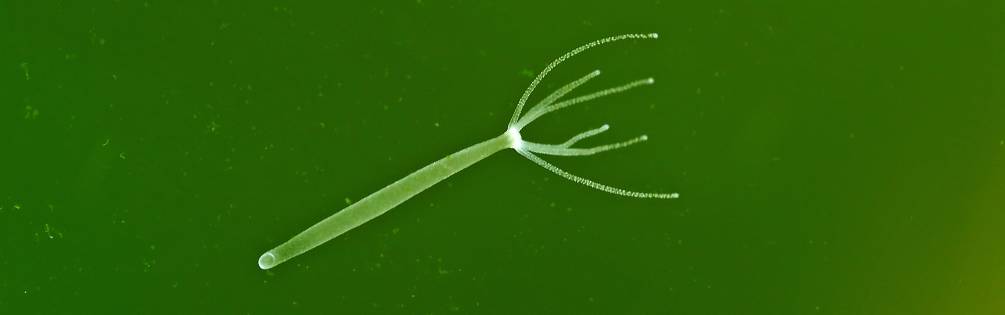
Every once and again, hydra come up in aquariums. These creatures are reminiscent of a skinless umbrella or maybe a tiny coral. Actually, a comparison with corals is not that far-fetched at all, because this freshwater polyp belongs to the same genus as corals, the so-called cnidaria. A lot of misinformation and alarmism goes around the internet concerning these actually very fascinating, lesser creatures. We’ll do our best to bring them a little closer to you.
How do freshwater polyps get into the aquarium, anyway?
First of all, hydra can be introduced by aquatic plants, decoration or (seldom) with fish or invertebrates, especially sitting on snail shells, but also by themselves with the house dust. As a survival strategy, hydra have appropriated the formation of resting eggs, which they produce through sexual reproduction. If the conditions in the habitat become worse, hydra form genitals and begin reproduction by copulation. The resting eggs, produced by this, become part of the house dust after the biotope has dried up. If the aquarium is not hermetically sealed (and for real... which aquarium is?), it may well be that hydra come up even without an existing fish or shrimp population, even though the aquarist might have exclusively used in-vitro plants and brand-new hardscape. And yes, of course you can easily catch yourself a severe case of hydra with live food and especially pond food - meaning self-caught live food from natural bodies of water.
What types are there?
Common types in aquaristics are those hydra native to our region: Chlorohydra (Hydra) viridissima, the green hydra getting its colour from symbiont algae of the genus Chlorella, and Hydra vulgaris, which has a brownish-beige to whitish colour. Hydra grow to sizes between 0,3-1cm, and their tentacles can get up to 2cm long. The green hydra usually stays a little smaller.
How do hydra reproduce?
On the one hand, hydra can multiply asexually by budding, on the other hand, they can reproduce sexually, producing the above-mentioned resting eggs. When budding, a new Hydra sprouts from the body of the adult. When it is big enough, it’ll detach and start its own life.
How do hydra move around?
Hydra are not known for being super motile creatures. They sit and wait for prey. If the environmental conditions are not good enough for them, they are able to release their adhesive “foot” pad from their perch and somersault around, not very quickly, though. Also, a freshwater polyp can form a small bubble of gas under its foot and use the buoyancy to rise towards the water surface.
Are hydra dangerous?
The answer to that is a clear yes and no. Hydra are hunters, have cnidoblasts at the end of their tentacles to paralyze their prey (smaller crustaceans, worms, larvae and similar…), before eating them. There are hydra big enough to conquer a water flea - these specimen are then also capable of catching and eating prey of similar size such as freshly-hatched shrimp larvae or small fish larvae. Hydra are ambush predators and not actively hunting but rather sitting, waiting for the prey to come to them. With the help of their olfactory cells, they perceive the substance glutathione, which is part of animal- and yeast cells and which is released in larger amounts during a nettling. Glutathione causes the tentacles to move towards the hydra’s mouth opening. If protein food is fed near a hydra, this reflex can sometimes be observed as well.
Most hydra are way too small to really threaten the other inhabitants, but it is reasonable to believe that it is at least unpleasant for the shrimp not being able to sit down without getting nettled “thanks” to a carpet of hydra. At a certain severity of freshwater polyp infestation there is certainly a need for action, but you do not need to panic if there’s one or two hydra in your tank. Here, the dear aquarist usually doesn’t have to do anything and a small infestation typically disappears by itself after a while.
Introduction prevention
You can never fully prevent an introduction, since the eggs get into the aquarium through the air. Nevertheless, you can reduce the risk of infestation, if you prevent the transfer from one aquarium to another by having own tools for every tank. A dedicated fish net for every aquarium should be doable. If you don’t want to buy own tweezers and scissors for every tank, you should dip your tools into a saturated saline solution before use. This will kill other germs and parasites as well.
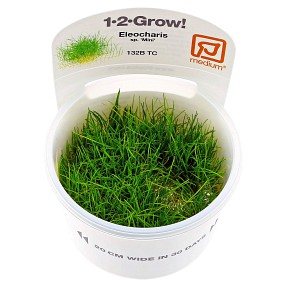
If you want to play it save, pick emerged, potted aquatic plants or - even better - in-vitro plants. These are cultivated in a sterile environment and are guaranteed to be free from pests.
What to do in case of a stronger infestation?
A heavy infestation always means the presence of a lot of food, no difference here between hydra, snails or worms. The aquarist should therefore start with the cause of the problem and not just fight the symptoms (hydra). If many small organisms like cyclops, ostracoda or similar are there, it is problematic that these critters are not just excellent hydra food but also a surefire sign for overfeeding. These little critters are decomposers, taking care of food leftovers. If feeding economically, responsibly and exquisitely, the amount of microorganisms will decrease, and with them - after a short delay - the number of hydra as well. Fine, frosted food goes straight to the hydra so it should be taken care of, that the fish receive this food directly and completely. A feed glass can be a great help here.
Predators such as great pond snails Lymnaea stagnalis are often recommended against hydra, and can help culling the hydra population. You won’t be able to get rid of them completely, and these snails have a reputation of eating aquatic plants, though they rather eat holes in the plants’ leaves than devouring them completely.
Another method is to treat an aquarium with the deworming agents, Flubenol or Panacur. Their active ingredients cause the hydrogen to die off, but they also have a toxic effect on snails and settle in the soil. As a result, they are still active after months. Flubenol in particular is lethal to ALL snails in the aquarium, while Panacur is survived by physidae, Red-rimmed melania and the great ramshorn. An overdose of Panacur may cause malformations and fertility problems in shrimp. Even pomegranate extract has been used successfully against hydra, as well as a lowering of the pH of the aquarium water to less than 4 (the rest of the inhabitants; shrimp, crabs, snails and fish usually do not tolerate this!).
Flubenol and Panacur are only available on prescription from a veterinarian.
It is easy to pick off hydra manually, but it has to be done very carefully: freshwater polyps can regenerate completely from just a few cells. Squishing them or chafing bits off them will INCREASE their population! If hydra are sitting on the aquarium’s panes, it is possible to scrape them off using a bladed window cleaner and suck them away using a hose.
Better and more practical than plucking them off is the method of fogging them with Easy Carbo, lemon juice, hot water or even hydrogen peroxide.
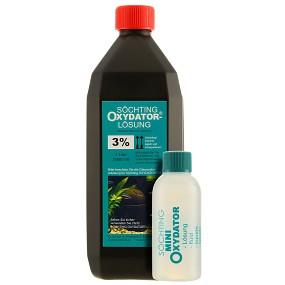
In this case, a syringe charge is deliberately delivered to the hydra. They die or at least let go and fall off the surface, then you should suck them away immediately, in case they recover.