
Parasites in your aquarium

By Aram Schneider Published Updated
Translated from German with AI assistance and reviewed by our editors.
By exchanging or purchasing new fish, shrimp and aquatic plants from submersed cultivation, it is possible to introduce pests into the aquarium. When dealing with live food, especially when procuring it from natural waters in the area, caution is required. There are various pests, some of which are just annoying, where others can be quite dangerous for the aquarium inhabitants. We’ll present some species and how to fight them.
Precautions
Of course you can minimize the risk of infestation. Especially if you own several aquariums, certain hygiene standards should be observed, to prevent cross-contamination from one tank to the other. It is recommended to have a dedicated set of tools for each individual aquarium tank - (fish nets, tweezers, scissors, etc.). If this is not the case, the tools should at least be disinfected before being used in another aquarium. This also serves to prevent parasite-, disease- and algae transmission.
If you want to be on the safe side, buy potted ware or, even better, in-vitro plants. The in-vitro plants are cultivated under absolutely sterile conditions and are guaranteed free of pests.

A good way to track down parasites is to maintain a quarantine when purchasing new plants or animals - this applies both to private purchases, as well as to new acquisitions of animals and conventionally grown plants from local- or online shops. In a separate aquarium, the new inhabitants are observed over a period of time, always checking whether pests have crept in with them. It is definitely recommended not to pour the transport water into the aquarium as well when introducing the animals.
Overview of typical pests in an aquarium
Planarian flatworms

Planarians are predatory worms that can occur relatively frequently in the aquarium. There are several types that differ in terms of body shape, color and reproduction. Most planarians are white or brownish, up to 20 mm long and recognizable by their eye spots, a branching intestine divided into a Y-shaped head and a lighter throat spot in the middle of the body. The triangular head is often mentioned in dscriptions - but not ALL species have this heads-hape. Planarians are rather light-sensitive and prefer the darker nooks and crannies in the aquarium tank. Unfortunately, these animals are easily confused with other worms, especially those in the early stages, which are also on the aquarium panes. These other worms are usually harmless oligocheates or so-called pane worms (Rhabdocolea, Mesostomidae and others), which are also often bright to white colored, but lack the characteristic eye spots, throat spot and also the strongly branched intestine.

Not a parasite: the friendly neighbourhood oligochaeta Pristina sp.
If you touch a planarian or a worm with your finger, these animals tend to stay in their place and contract to a point. Oligochaetes stay stretched when touched. Also, their locomotion is different, it reminds of a caterpillar with forward and backward motions. Planarians and other flatworms have more of a sliding locomotion, like slugs.
Control methods

planaria traps are a possibility, to decimate the amount of parasites. In this case, a trap is set with bait (for example, high-protein feed or raw, unseasoned meat) and placed in the aquarium. The next day you remove the trap, dispose of the pests and repeat the process.
More patient aquarists pluck the worms off the panes or fog ‘em up with acid (like citric acid) and a syringe. Squishing them, does not work. Since planarians contain a large amount of stem cells, a new, complete worm will literally grow from each and every chunk.
The Tiger Dwarf-Loach Yunnanilus cruciatus has proven itself as one fierce predator. These four-centimeter-sized animals are also suitable for smaller aquariums and should be kept in a group. Unfortunately, those fish are pretty rare in trade.
The carnivorous red dot goby Rhinogobius rubromaculatus has turned out to be an avid planarian eater, too. This goby is a group animal that should be kept from five animals upwards. It is only about 4 cm long and is thus already suitable for aquariums from 60 cm edge length upwards. However, they should not be socialized with shrimp as they are considered live food and unceremoniously eaten.

Turbellaria
Another method is a treatment of the aquarium tank with the deworming agent Flubenol. The ingredient Flubendazole causes a metabolic dysfunction in planaria, which lets the parasites starve eventually. Unfortunately, Flubenol is also deadly to all types of snails in the aquarium. The active ingredient settles in the soil and even after several months, it remains absolutely murderous to invertebrates, so that a restocking with snails is impossible even after a long period of time. A treatment with Flubenol needs to be repeated after two to three weeks, since it has no effect on planarian eggs. Aber those two/three weeks it is therefore possible, that new planarians hatch and need to be eradicated again.
Panacur is also a deworming agent. The active ingredient fenbendazole affects the digestive system of worms and ensures, similar to flubenol, death by starvation. Again, the agent unfortunately has a negative effect on snail species living in the aquarium, only red-rimmed melania, great ramshorns and bubble snails seem to survive a treatment. An overdose can also cause deformations in shrimp. A repetition of the cure is also necessary with Panacur after 14 days to destroy newly hatched planaria. Like Flubenol, this agent does nothing against eggs.
Both Panacur and Flubenol are prescription veterinary medicines - and treatment should therefore be consulted with a veterinarian!
Snail-leech

Snail-leeches (Glossiphonia sp.) have a distinct, teardrop-shaped body and a length of up to three centimeters. Depending on the type, the color varies from milky-white to greenish and brownish red. Their digestive system is well-visible to the naked eye, as are accumulations of eggs in the middle of their body. They feed mainly on snails and worms by sucking them out. Their locomotion is similar to an inchworm. They pin the suction cup at the rear end of the base firmly to the ground, push forward with the front end, secure the second, front suction cup and tighten the rear end. In case of danger, they roll up erinaceously. Their surface feels relatively hard. Snails are quite easy to distinguish from planarians.
Control methods
Snail-leeches are usually not as abundant as planarians. In this respect, you can pluck individual specimens off quite easily.
Neither Flubenol nor Panacur work against snail-leeches. Concoctions containing copper are poisonous to them, but if you also keep snails and shrimp in your aquarium, you should keep your hands off them if possible.
Asian leeches

These most commonly found leeches in aquariums are originally from Asia. They are usually introduced with conventionally cultivated plants.
These reddish to brown-red annelids are usually Barbronia weberi. Often, these leeches are slightly darker on the right and left side in the rear half of their body. The Asian leech gets up to 4 cm long and about 4 mm thick. It can be recognized very well by the placement of its eyes: the central pair of eyes is in the middle, the two others are slightly offset on the right or left side of the head.
Like all leeches, Barbronia weberi has a larger suction cup in the back and a smaller one in the front of its body. His mode of locomotion is typical: First, he attaches his rear pad to the ground, then inches its head forward. As soon as the front suction pad has found support, the leech pulls forward its abdomen, so its movement pattern resembles that of an inchworm.
Barbronia weberi belongs to the predatory Rhynchobdellida. It mostly lives off other worms and migde larvae living on the substrate, which he swallows whole. This leech is not dangerous for shrimp, snails and fish. Since Barbronia weberi is not a domestic leech, it may not be released or get into the open land with plant residue. It is able to survive in our climatic conditions and populations of Barrobonia weberi have already been found in the wild in large parts of Europe, including Germany and Austria.
control methods
A mass infestation with Barbronia weberi is an exceptionally rare thing, and single specimens can be plucked off by hand. Many fish like to eat this slender worm. Flubenol or Panacur are useless against leeches. Copper-bearing agents are deadly for them but will also kill shrimp and snails.
Hydra

Hydra (sweet water polyp) appear in the aquarium in a white and a green form. The green form (see picture) lives symbiotically with embedded algae - hence the corresponding hue. The white form does not form symbiotic relationships. Hydra have typical tentacles. Exceptionally large specimens can get up to two inches long, but usually these cnidarians stay much smaller. Hydra like to settle in exposed areas and try to catch, paralyze and eat free-roaming animals with their tentacles, which are armed with nettle cells. However, the young of most shrimp species are already too large for the usually tiny hydra. Only unusually large specimens can be dangerous to them and small fish and fry. However, a severe hydra infestation can cause immense stress in shrimp, when they are unable to find a place to sit without getting stung by cnidoblasts. For this reason, a mass infestation with hydra especially in shrimp breeding tanks is definitely bad news.
Control methods
Manual collection of freshwater polyps should be done with great care, as a single remaining cell is enough to rebuild a complete hydra. In this respect, should never crush or roughly pluck them from the pane. Hydra, clinging to the aquarium’s panes, can be shaved off carefully with a very sharp scraper, and then siphoned away using a hose. Fogging them with Easy Carbo or hydrogen peroxide is helpful. A syringeful of solution is unloaded on single hydra. These get severely harmed and either die or fall off the aquarium pane (then they sgould be siphoned away before they find another settling spot). In case of stronger infestation, however, other measures are necessary.
Similar to the control of planarians, the chemical agents Panacur and Flubenol are effective in getting rid of major pests. With Hydra, much lower concentrations are already effective.
Dragonfly larvae

In the larval stage, these insects live under water and prey on small organisms, including small fish and shrimp. In the aquarium the are rather hard to spot, since they prefer to live in hiding. Depending on the species of the respective dragonfly, the sub-surface larval stage can last a couple of months up to several years. A larva molts several times and can grow to a size of several centimeters. The body shape (long in damselflies, squat in regular dragonflies) and -colour depends on the species. The predatory dragonfly larvae are clearly recognizable by their mouthparts formed into a labial mask, and their three pairs of legs.
Control measures
Using tweezers or a fishnet, the larvae can be removed - though not easily. Native dragonflies are protected and must not be killed! Examinations of specimens caught in aquariums have shown, however, that 98% of these species are not native to us. They were imported mostly from Asia, since dragonflies like to lay their eggs into the plant tissue. Under no circumstances should these animals be released into nature! A clear distinction is only possible by an expert.
Snails
Especially, when purchasing submerse plants, it can’t be guaranteed, that everything is snail-free. Snails and eggs can likely adhere to the plants. Often you see only after a few days first animals crawl through the aquarium. Typical unintentionally introduced species are freshwater snails or (great) ramshorn snails. Although these animals do not appeal to every aquarium owner, for environmental reasons, snails are an asset to any aquarium. They are excellent scavengers and tirelessly graze on biofilms and algic coats.
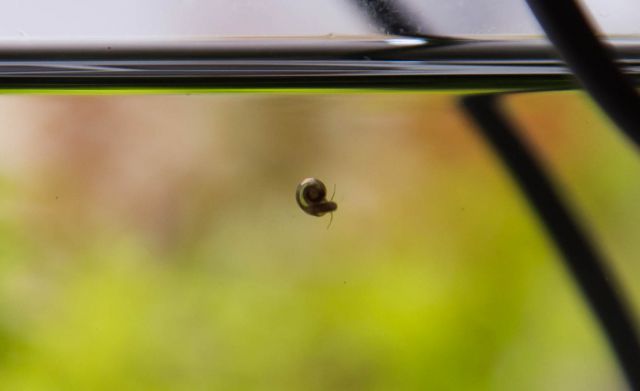
Ramshorn snails only grow to a size of a few centimeters
Snails can adapt to a food situation quite quickly with their multiplication rate. Many aquarists therefore consider a large population as plague. Most of the time, however, this phenomenon is only temporary, for example in the first months of a newly established aquarium. After a longer period of time, the situation often evens out by itself and the number of snails goes back again. Each aquarium only has as many snails as it can provide with food. If you keep on having way too many snails, you might want to reconsider your feeding habits..
Control methods
Especially during the cycling phase, an increasing snail population can only be gotten under control by plucking them off manually and constantly.
Animals like the assassin snail (Clea helena), ut also various blowfish species eat mainly snails. Especially the use of blowfish as “working animals” should be well considered: The animals must be permanently kept species-appropriate! For example, in the long run, puffer fish will need enough snails, as they may otherwise attack other fish or, because of a lack of tooth wear, will no longer be able to feed and starve to death.
A short bath in an alum-solution will help to disinfect newly purchased aquatic plants and kill off potentially present snails. A teaspoon of alum is dissolved in one liter of water and the plants are bathed in it for five minutes. Before planting, they should be rinsed thoroughly. When handling such chemicals, however, one should be familiar with the appropriate safety precautions and disposal regulations.