
We use cookies to offer you an optimal shopping experience. These cookies can be grouped into categories. The necessary ones are essential for your purchase. Functional services enable additional content such as videos and maps. With further cookies we produce anonymized statistics. Others serve primarily marketing purposes and are used for the personalization of advertising. These cookies are used by 11 Services used in the shop. You can decide for yourself which cookies you want to allow.
We store your choice on your device (“local storage”) and ask you again after 12 months at the latest. You can change it at any time under “Cookie Preferences” in the footer. You can find details on cookie lifetimes and necessary cookies in our privacy policy.
These services are required to run the shop and for your purchase and cannot be switched off.
Strictly necessary cookies enable basic functions and are required for the website to work properly.
Shop functions: Essential Shop functions This includes: JTLSHOP (cookie, until you close the browser; keeps your session, the cart and your login), consent (browser storage; remembers your cookie choice, 12 months at most, during the session also in session storage), has_starting_point, cur_product_id and product_page_visits (session storage; navigation between products) as well as aquasabi-search-index-last-url, aquasabi-search-index-results and aquasabi-search-index-data (session storage; search results and lists when paging). easyVision: easyVision lets website visitors customize the display – e.g. by adjusting contrast, font size, line and letter spacing, color rendering, a blue light filter or by disabling animations. Developed and hosted in Germany, the service is GDPR-compliant and supports statutory accessibility requirements (BFSG) from 2025. The service loads its scripts from cdn.sitecockpit.com and stores your settings (easy-vision-*) in your browser storage (no cookies). Reviews: aquasabi_guid (cookie, 12 months) is only set when you click “Helpful” under a review. It stores a random ID so that the same person cannot count a review as helpful more than once. Sorting and view: aquaSort and aquaDisplayType (cookies, 90 days) store the sorting or view (gallery or list) that you choose in a product list. They are only set when you choose a sorting or view. Amazon Pay: Payment processing with Amazon Pay. The service provider is Amazon Payments Europe S.C.A. Where Amazon Pay is offered (e.g. in the cart and at the checkout), the shop loads scripts and images from static-eu.payments-amazon.com, payments-eu.amazon.com and m.media-amazon.com and sets cookies (language, ledgerCurrency, apay-session-set). You can find out more in the privacy policy at https://www.amazon.de/gp/help/customer/display.html?nodeId=GRFTMVHP4HXMESSP PayPal: Payment processing with PayPal. The service provider is PayPal (Europe) S.à r.l. et Cie, S.C.A. Where PayPal is offered (e.g. in the cart and at the checkout), the shop loads scripts from www.paypal.com; for invoice payment via PayPal, c.paypal.com is added for fraud prevention. PayPal stores an entry in your browser storage (__paypal_storage__), and the shop remembers the chosen PayPal payment method in session storage (chosenPPCPaymentOption). You can find out more in the privacy policy at https://www.paypal.com/en/legalhub/paypal/privacy-full Sofortüberweisung: On the confirmation page after an order with this payment method the shop loads a Klarna logo from x.klarnacdn.net.
Additional functions such as embedded videos and maps, spam protection in forms or the rating badge. Data is transferred to the respective provider when they load.
Show Youtube Videos
Displaying videos
Processing company:Google Ireland Limited, Google Building Gordon House, 4 Barrow St, Dublin, D04 E5W5, Ireland
Terms of use: https://policies.google.com/privacyGoogle Recaptcha Service for spam protection
Tracking; Bot protection
Processing company:Google Ireland Limited, Google Building Gordon House, 4 Barrow St, Dublin, D04 E5W5, Ireland
Terms of use: https://policies.google.com/privacyShow Shopauskunft Rating-Badge
Used to provide the services of shopauskunft.de.
Processing company:Händlerbund Management AG
Terms of use: https://www.shopauskunft.de/datenschutzIntegration of Google Maps services
Performance measurement; Providing personalized services, including content and ads; Providing our services
Processing company:Google Ireland Limited
Terms of use: https://policies.google.com/privacy?hl=enHelps us understand how the shop is used so that we can improve it.
We measure which pages and products are viewed and how visitors move through the shop. Google Analytics sets cookies (_ga, _ga_*) and sends usage data to Google.
Audience measurement and analysis of how the shop is used
Processing company:Google Ireland Limited
Terms of use: https://policies.google.com/privacy?hl=enMeasures our advertising and enables personalised advertising on other sites.
We measure whether an ad on Facebook or Instagram led to a purchase and show visitors relevant ads again. Cookies are set for this: _fbp and _fbc (Meta) and as_fbclid (ours, 30 days; remembers the ID of the ad click). Meta receives data about your actions in the shop (e.g. product views, cart, purchase), your IP address and browser information; for a purchase our server may also send them directly to Meta (Conversions API). More in our privacy policy (retargeting/remarketing and conversion tracking).
Measure advertising success and show relevant ads again (Facebook, Instagram)
Processing company:Meta Platforms Ireland Limited, Merrion Road, Dublin 4, D04 X2K5, Irland
Terms of use: https://www.facebook.com/privacy/policy/We measure whether an ad on TikTok led to a purchase. Cookies are set for this: _ttp, ttclid and _tt_* (TikTok) and as_ttclid (ours, 30 days; remembers the ID of the ad click). TikTok receives data about your actions in the shop (e.g. product views, cart, purchase), your IP address and browser information; for a purchase our server may also send them directly to TikTok (Events API). More in our privacy policy (retargeting/remarketing and conversion tracking).
Measure the success of ads on TikTok
Processing company:TikTok Technology Limited, 10 Earlsfort Terrace, Dublin, D02 T380, Irland
Terms of use: https://www.tiktok.com/legal/page/eea/privacy-policy/enWe measure whether an ad in ChatGPT led to a purchase. Cookies are set for this: __oppref and __obref (OpenAI) and as_oppref (ours, 30 days; remembers the ID of the ad click). OpenAI receives data about your actions in the shop (e.g. product views, cart, purchase), your IP address and browser information; for a purchase our server may also send them directly to OpenAI (Conversions API). Data may be transmitted to OpenAI OpCo, LLC (USA). More in our privacy policy (retargeting/remarketing and conversion tracking).
Measure the success of ads in ChatGPT
Processing company:OpenAI Ireland Limited, 1st Floor, The Liffey Trust Centre, 117-126 Sheriff Street Upper, Dublin 1, D01 YC43, Irland
Terms of use: https://openai.com/policies/eu-privacy-policy/We measure whether an ad led to a purchase and show visitors relevant ads again. Google Ads sets cookies (e.g. _gcl_*) and receives purchase data, where applicable in hashed form (SHA-256).
Measure advertising success and show relevant ads again (remarketing)
Processing company:Google Ireland Limited
Terms of use: https://policies.google.com/privacy?hl=enWe use cookies that are essential for payment processing through our partners. Please select which payment providers you would like to use.
In order to unlock offers for extended payment options, in particular express checkout and payment in instalments, we require your consent to the data transfer and storage of third-party cookies of the payment provider PayPal. This allows us to also offer you express checkout and payment by instalments. Without your consent, only the technically necessary data transfer to PayPal will take place, but you will then not be able to use the express checkout or extended offers for payment by instalments on this site.
Using express checkout and Displaying offers for payment in instalments for individual items or your entire purchase.
Processing company:PayPal
Terms of use: https://www.paypal.com/de/webapps/mpp/ua/privacy-full?locale.x=en-GB
Your consent ID:
With this randomly generated number we can show on request what you selected. It contains no information about you.
Would you like to see these contents? Activate the desired contents for one session only or allow the website to remember these settings. Once you have given your consent, the third-party data can be loaded. For this, third-party cookies might be stored on your device. You can change these settings at any time (footer: “Cookie Preferences”). For further details, please see the Privacy notice.
By Aram Schneider Published Updated
Translated from German with AI assistance and reviewed by our editors.
Contents
Planarians are among the flatworms or turbellaria. This group of animals consists of different species with different characteristics. Turbellaria are present in both freshwater and saltwater. As a rule, they live predatory and are therefore regarded as pests in the aquarium. However, not all turbellaria species are dangerous to the aquarium inhabitants such as fish, shrimp and snails, as they only feed on microorganisms. In this article, we’ll give you some tips on how to detect and combat freshwater planarian worms in your aquarium.
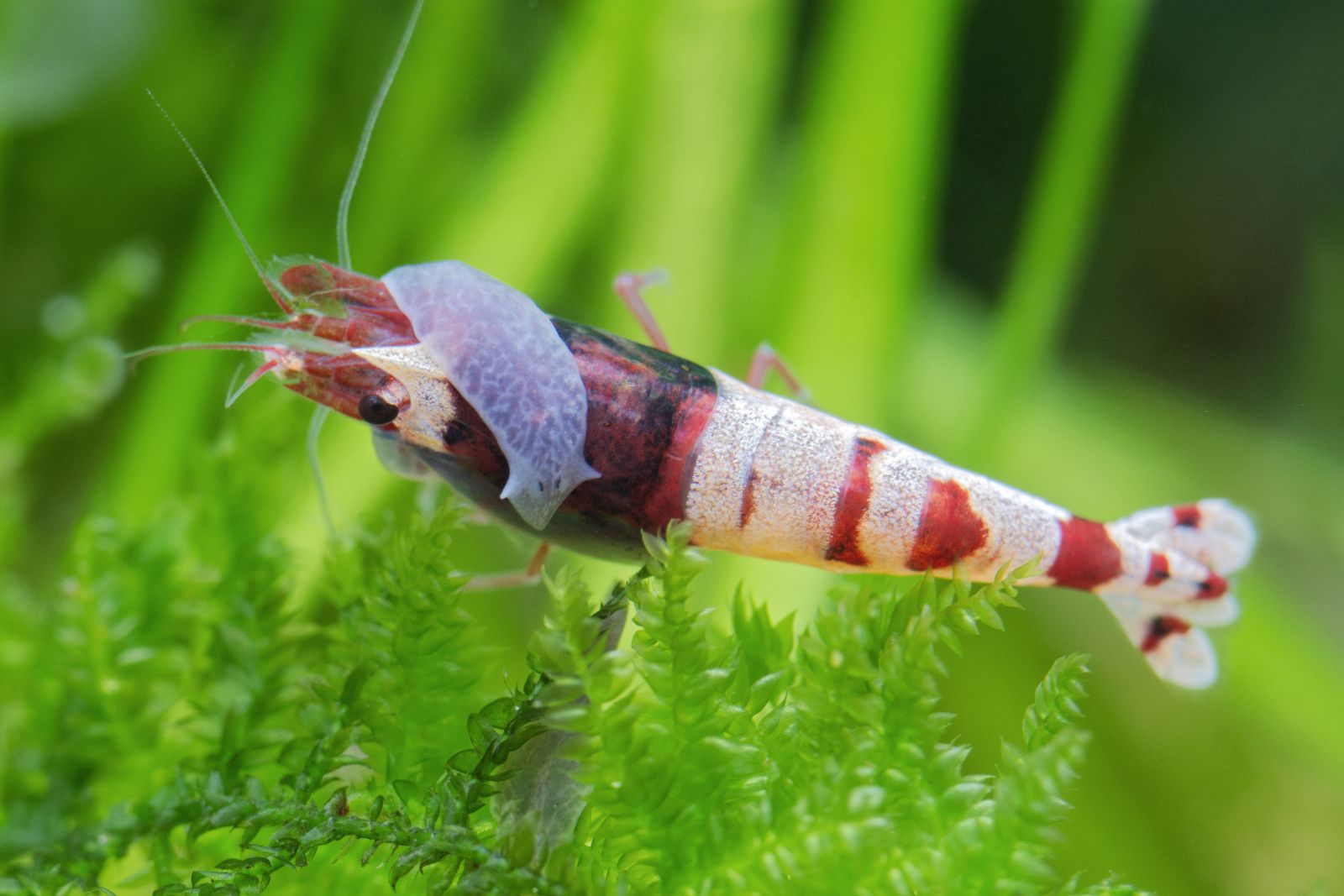
In corresponding amounts, planarian worms can pose a hazard to invertebrates such as crabs, shrimp and snails, but also to fish. Here, the size of the prey is crucial, in this respect juveniles and eggs are especially affected. But also old and sick specimens or freshly skinned shrimp may be attacked. A planarian infestation certainly does not lead to an immediate mass extinction of the entire stock. It is more likely that fewer and fewer young will have a chance to mature and thus the stocking will over-age and decline over time and .
As THE classic aquarium pest, the planarian flatworm belongs to the order Tricladida. Recognizable by its flattened, uncurled body. The most important feature for identification are the two eye spots at the head end. With them, this worm can perceive brightness. In fact, planarians are quite sensitive to light. They are therefore more likely to seek protection in darker areas in the aquarium, such as near the ground or in the filter.

Copyright: Chris Lukhaup.
In the middle of the body, the so-called throat spot can be found, which is usually lighter in colour than the rest of the body. Here its expansible gullet is located, by which the planarian flatworm takes in its food. The stain is usually quite easy to spot. Even with planarians with whitish body color it appears a bit more massive than the rest of the worm. Other typical body colors are brown, reddish or beige and there are also spotted forms. If the worm has eaten something colourful (e.G. a red-blooded Ramshorn Snail), the planarian’s big, dendritic intestine temporarily turns this colour. Starting from the gullet, this Y-shaped intestine extends with a tip to the head and two tips to the tail. The intestine is best visible in transmitted light.
Adult planarians can reach a body length of about 2 cm. Unfortunately, the detection of planarians is extremely difficult, especially in early stages, as they can often be confused with other, harmless worms.
A good sign that you are not dealing with a planarian is, when the worm gets eaten by fish. Planarians wrap themselves in nasty-tasting slime and are therefore very unappealing as food, and there are only very few species of fish that actually eat planarians. The other rather similar-looking worms (most likely Nematodes) on the other hand, are a popular snack.
Often a triangular head is mentioned as a further characteristic of planarians, but some species do not have this and there are also planarians with other head shapes. So the head shape needs to be excluded from the list of defining features. However, one thing is certain: If the worm has a triangular, offset head in the shape of an arrowhead, it’s definitely a classic planarian.
Another help for detection is the touch test. If you tap a planarian lightly with your finger, it contracts to a point and stays in place, such as the pane of your aquarium. Other worms tend not to show this behavior, stay stretched long, or fall off the pane when touched. Note: You should do this very carefully and do not squash the planarian, as new ones can develop from their remains.

The movement of a planarian and other flatworms is sliding, so in principle, as it is known from snails. A caterpillar-like back and forth in the movement is more of a trait for a leech or for a harmless little oligocheata or a common worm. Another distinguishing feature: Unlike leeches and oligocheata, planarians can not swim. If you (carefully) peel them from the pane, they sink to the ground.
Similar to other pests, planaria can get into the aquarium via newly purchased material such as aquatic plants or live food. But caution is also necessary with snails, crabs and shrimp, because the parasites can attach to the animals. A carryover can also happen by using a filter or soil from an already infected aquarium.
If you want to be on the save side, purchase In Vitro plants. These plants were cultivated in a sterile environment and 100% pest-, pesticide- and algae-free.
When buying new animals, especially shrimp from the local pet shop, you should carefully inspect the aquarium tanks. If there are planarians in it, you should consider the purchase well.
General precautions, such as quarantining newly acquired animals and plants, as well as disinfecting or avoiding cross-contamination over shared tools like e.G. fishnets when you run more than one tank are useful methods as well to prevent infiltration. When inserting newly acquired animals, as little or at least as little transport water as possible should be added to the aquarium.
Of course, you can try to just collect these harmful voracious worms manually. But this method is not particularly effective, since the majority of the population lives hidden, for example in the substrate. It is muasier to use a planaria trap. In principle, these work like a weir and are set up with bait (for example, a tiny piece of raw meat, a few frozen mosquito larvae or very high-protein food) to catch planaria.

Afterwards the trap is placed in the aquarium. The next morning, some worms should’ve already been trapped. The can be collected from the trap and disposed of. Please don’t just flush them away in the toilet, because some species of planaria common in aquaristics are not domestic here! The animals should be doused with boiling water to kill them quickly and efficiently. With more bait, this procedure can be repeated as often as necessary. This measure helps keeping the population under control, but it is very hard to get rid of them completely using this method.
Of course, certain types of fish or shrimp can be put into the aquarium as natural predators to the planaria. Certain loaches like the hovering Zebra Loach Yunnanilus cruciatus or the red-spotted Goby Rhinogobius rubromaculatus are to hunt and eat planaria and also do boxer shrimp such as Macrobrachium peguense. The use of such animals only as a means to an end should be well considered, though, because the housing conditions must be appropriate for the respective species. A socialization with, for example, dwarf shrimp is not possible with some species, as these are then regarded as prey.
Here, too, predators only help to keep the planarian population in check. The worms will not be completely eradicated, as there are always enough of them left to hide in the substrate and keep breeding.
Much more promising is the treatment with a deworming agent such as Flubenol or Panacur. When used correctly, it is possible to get an aquarium completely free of planarians again. Both are prescription drugs, which can be obtained from a veterinarian. Flubenol contains the active substance flubendazole, while Panacur contains fenbendazole. Both drugs have a similar mode of action. Due to disruption of the metabolism or the digestive system the planarians will eventually starve. Treatment with either medication should be repeated after approximately two weeks as they have no effect on planarian eggs. Thus, at the end of the "breeding season" newly hatched planaria are directly killed.
Unfortunately, both Flubenol and Panacur have a negative impact on the ecosystem in the aquarium. Flubenol kills all types of snails in the aquarium and the active substance is stored in the substrate for several months. Snails can only be re-introduced into the tank after a very, very long time. Panacur harms mostly snails like Neritina and Clithons. Red rimmed Melania, staghorn- and Physidae seem to be more likely to survive a treatment.. Again, the active ingredient remains in the substrate and thus inhibits a restocking in the near future. If Panacur is overdosed, it can also lead to deformities and reproductive disorders in shrimp.
Header Picture Copyright: Chris Lukhaup.