 How much gravel for my aquarium?
When setting up an aquarium, you already have to calculate the required amount of substrate during planning so that you can buy the right amount. If it is about soil substrate, you can simply use our soil calculator. How to do this for gravel and sand is what we explain to you in this article.
Calculating the volume
In principle, you have to calculate the matching volume of the required amount of substrate. Conveniently, soil substrates and also the substrate fertilizers for these active aquarium substrates are already sold in amounts in liters. Sand and gravel substrates, however, are usually packed and sold in kilograms. Here you therefore have to convert.
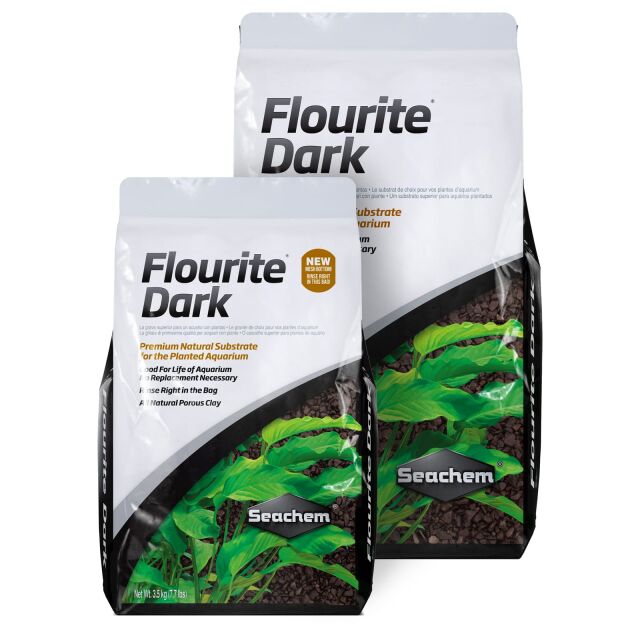
Exception: in its product descriptions, the manufacturer Seachem also gives the corresponding volume in liters in addition to the package size in kg.
First, however, we need to determine the required substrate volume. For this you need the length and width of the aquarium in cm, and then the desired layer thickness of the substrate. If you multiply these three factors, you get the desired substrate volume. The result divided by 1,000 then gives the number of liters of substrate you need.
This gives the following formula 1:
[aquarium length in cm] x [aquarium width in cm] x [planned substrate layer height in cm] / 1,000 = substrate volume in liters
If the substrate is not supposed to be completely level but to rise toward the back, you can also use our soil calculator here to have the required volume calculated. For the substrates gravel and sand, however, a further conversion is necessary afterward.
Grain size matters
Do you actually know the difference between sand and gravel? In part, these substrates consist of the same material but differ in particle size. There is in fact a DIN standard that defines gravel as having a grain size of 2 mm to 63 mm. There is also a further, finer classification into coarse gravel, medium gravel and fine gravel. A grain size below 2 mm therefore counts as sand.
For calculating the amount of substrate needed for the aquarium, it is important to know which grain size, or at least which grain size range, the desired substrate has. A smaller grain size has fewer voids containing air, which is, after all, lighter than the substrate. Consequently, sand in the same package size in kilograms has less volume than the coarser gravel, since its bag contains more air-filled voids. What is decisive here is thus the so-called density, which differs for the various grain sizes. This density then still has to be multiplied by the volume of the substrate from our calculation to obtain the required amount in kilograms.
Formula 2: [desired substrate volume in liters] x [density] = required amount of substrate in kg:
- Sand with a grain size of approx. 0.5 mm – 1.9 mm has a density of 1.9 kg/l
- Fine gravel with a grain size of approx. 2 mm – 3 mm has a density of 1.7 kg/l
- Gravel with a grain size of approx. 4 mm – 6 mm has a density of 1.5 kg/l
A calculation example:
An aquarium with an edge length of 60 cm and a depth of 30 cm is to be fitted with a substrate layer height of 5 cm. Let us now apply the first formula: 60 x 30 x 5 / 1,000 = 9 liters of substrate.
Fine sand is to be used as the substrate. According to the table, it has a density of 1.9 kg/l. Now we apply the second formula: 9 * 1.9 = 17.1 kg. So we need approx. 17 kg of sand for our project.