We use cookies to offer you an optimal shopping experience. These cookies can be grouped into categories. The necessary ones are essential for your purchase. Functional services enable additional content such as videos and maps. With further cookies we produce anonymized statistics. Others serve primarily marketing purposes and are used for the personalization of advertising. These cookies are used by 11 Services used in the shop. You can decide for yourself which cookies you want to allow.
We store your choice on your device (“local storage”) and ask you again after 12 months at the latest. You can change it at any time under “Cookie Preferences” in the footer. You can find details on cookie lifetimes and necessary cookies in our privacy policy.
These services are required to run the shop and for your purchase and cannot be switched off.
Strictly necessary cookies enable basic functions and are required for the website to work properly.
Description:
Shop functions: Essential Shop functions This includes: JTLSHOP (cookie, until you close the browser; keeps your session, the cart and your login), consent (browser storage; remembers your cookie choice, 12 months at most, during the session also in session storage), has_starting_point, cur_product_id and product_page_visits (session storage; navigation between products) as well as aquasabi-search-index-last-url, aquasabi-search-index-results and aquasabi-search-index-data (session storage; search results and lists when paging).
easyVision: easyVision lets website visitors customize the display – e.g. by adjusting contrast, font size, line and letter spacing, color rendering, a blue light filter or by disabling animations. Developed and hosted in Germany, the service is GDPR-compliant and supports statutory accessibility requirements (BFSG) from 2025. The service loads its scripts from cdn.sitecockpit.com and stores your settings (easy-vision-*) in your browser storage (no cookies).
Reviews: aquasabi_guid (cookie, 12 months) is only set when you click “Helpful” under a review. It stores a random ID so that the same person cannot count a review as helpful more than once.
Sorting and view: aquaSort and aquaDisplayType (cookies, 90 days) store the sorting or view (gallery or list) that you choose in a product list. They are only set when you choose a sorting or view.
Amazon Pay: Payment processing with Amazon Pay.
The service provider is Amazon Payments Europe S.C.A. Where Amazon Pay is offered (e.g. in the cart and at the checkout), the shop loads scripts and images from static-eu.payments-amazon.com, payments-eu.amazon.com and m.media-amazon.com and sets cookies (language, ledgerCurrency, apay-session-set). You can find out more in the privacy policy at https://www.amazon.de/gp/help/customer/display.html?nodeId=GRFTMVHP4HXMESSP
PayPal: Payment processing with PayPal.
The service provider is PayPal (Europe) S.à r.l. et Cie, S.C.A. Where PayPal is offered (e.g. in the cart and at the checkout), the shop loads scripts from www.paypal.com; for invoice payment via PayPal, c.paypal.com is added for fraud prevention. PayPal stores an entry in your browser storage (__paypal_storage__), and the shop remembers the chosen PayPal payment method in session storage (chosenPPCPaymentOption). You can find out more in the privacy policy at https://www.paypal.com/en/legalhub/paypal/privacy-full
Sofortüberweisung: On the confirmation page after an order with this payment method the shop loads a Klarna logo from x.klarnacdn.net.
Additional functions such as embedded videos and maps, spam protection in forms or the rating badge. Data is transferred to the respective provider when they load.
Show Youtube Videos
Description:
Displaying videos
Processing company:
Google Ireland Limited, Google Building Gordon House, 4 Barrow St, Dublin, D04 E5W5, Ireland
To submit forms on this page, you need to consent to the transfer of data and storage of third-party cookies by Google.
With your consent, reCAPTCHA, a Google service to avoid spam messages via contact forms, will be embedded.
This service allows us to provide our customers with a safe way to contact us via online forms. At the same time, the service prevents spam bots from compromising our services.
After you gave your permission, you might be asked to answer a security prompt to send the form.
If you do not consent, unfortunately you cannot use the form. Please contact us in a different way.
Helps us understand how the shop is used so that we can improve it.
We measure which pages and products are viewed and how visitors move through the shop. Google Analytics sets cookies (_ga, _ga_*) and sends usage data to Google.
Description:
Audience measurement and analysis of how the shop is used
Measures our advertising and enables personalised advertising on other sites.
We measure whether an ad on Facebook or Instagram led to a purchase and show visitors relevant ads again. Cookies are set for this: _fbp and _fbc (Meta) and as_fbclid (ours, 30 days; remembers the ID of the ad click). Meta receives data about your actions in the shop (e.g. product views, cart, purchase), your IP address and browser information; for a purchase our server may also send them directly to Meta (Conversions API). More in our privacy policy (retargeting/remarketing and conversion tracking).
Description:
Measure advertising success and show relevant ads again (Facebook, Instagram)
We measure whether an ad on TikTok led to a purchase. Cookies are set for this: _ttp, ttclid and _tt_* (TikTok) and as_ttclid (ours, 30 days; remembers the ID of the ad click). TikTok receives data about your actions in the shop (e.g. product views, cart, purchase), your IP address and browser information; for a purchase our server may also send them directly to TikTok (Events API). More in our privacy policy (retargeting/remarketing and conversion tracking).
We measure whether an ad in ChatGPT led to a purchase. Cookies are set for this: __oppref and __obref (OpenAI) and as_oppref (ours, 30 days; remembers the ID of the ad click). OpenAI receives data about your actions in the shop (e.g. product views, cart, purchase), your IP address and browser information; for a purchase our server may also send them directly to OpenAI (Conversions API). Data may be transmitted to OpenAI OpCo, LLC (USA). More in our privacy policy (retargeting/remarketing and conversion tracking).
Description:
Measure the success of ads in ChatGPT
Processing company:
OpenAI Ireland Limited, 1st Floor, The Liffey Trust Centre, 117-126 Sheriff Street Upper, Dublin 1, D01 YC43, Irland
We measure whether an ad led to a purchase and show visitors relevant ads again. Google Ads sets cookies (e.g. _gcl_*) and receives purchase data, where applicable in hashed form (SHA-256).
Description:
Measure advertising success and show relevant ads again (remarketing)
We use cookies that are essential for payment processing through our partners. Please select which payment providers you would like to use.
In order to unlock offers for extended payment options, in particular express checkout and payment in instalments, we require your consent to the data transfer and storage of third-party cookies of the payment provider PayPal. This allows us to also offer you express checkout and payment by instalments. Without your consent, only the technically necessary data transfer to PayPal will take place, but you will then not be able to use the express checkout or extended offers for payment by instalments on this site.
Description:
Using express checkout and Displaying offers for payment in instalments for individual items or your entire purchase.
Your consent ID:With this randomly generated number we can show on request what you selected. It contains no information about you.
Data privacy settings
Would you like to see these contents? Activate the desired contents for one session only or allow the website to remember these settings. Once you have given your consent, the third-party data can be loaded. For this, third-party cookies might be stored on your device. You can change these settings at any time (footer: “Cookie Preferences”). For further details, please see the Privacy notice.
At some point the time comes: an aquarium has to be emptied. There can be several reasons for this, such as a move, a redesign or even giving up an aquarium and the hobby. The reason why an aquarium has to be emptied is not that decisive; here we show you the best way to go about emptying the tank.
Planning
As a rule, an aquarium is still in full operation. That is to say, all equipment such as filter, heater, light and possibly the CO2 system is still running, and the stock is in the aquarium, as are the aquatic plants. The substrate and decoration are also still in the tank. It is now important to proceed step by step, so that it is as stress-free a time as possible, above all for the inhabitants.
Switching off the equipment
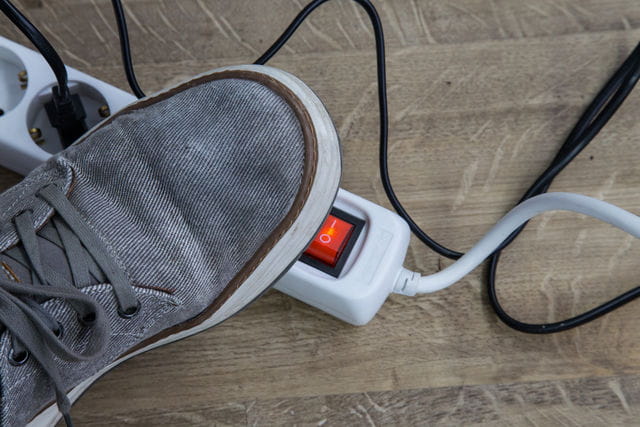
Since the water level in particular is going to be lowered, the first thing to do is to switch off connected equipment so that no malfunctions occur. This includes in particular the heater of an aquarium and the filter equipment or other pumps. You can also switch off the CO2 system and close the cylinder valve. Other equipment such as UV-C clarifiers, dosing pumps or sterilizers can be switched off now. The aquarium lighting, however, could still be useful for catching animals and working in the aquarium so that you can see enough. It can therefore stay switched on. However, quite a bit of room to move above the tank is necessary. The aquarist should therefore make space here and, for example, hang pendant lamps considerably higher. If you have several clip-on lights, all but one can be removed here. It is advisable to push the lamp far to the back to get as much room as possible. Lamps may also have to be removed completely for a while. An alternative would then be to set up a small work light outside the aquarium.
Catching the stock
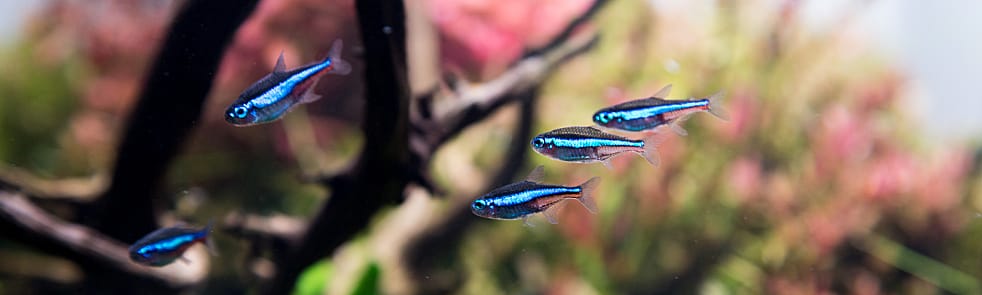
Catching the aquarium inhabitants is certainly the undertaking that demands the most time and patience. Of course, it depends very much on what kind of animals are in the aquarium. You can proceed quite well step by step and first catch the creatures that are very easy to catch. You can start, for example, with the freshwater snails that you see right at first glance. Apart from those, there are certainly still a few specimens hidden in the aquarium that you will come across later. If snails are on a glass pane, it is best to pull them off upward along the pane or try to loosen them from the pane by gently twisting them back and forth.
You can also already catch the fish species that are not shy and are bold. This includes slow and larger fish that easily end up in the net. Animals that hide quickly or disappear into the thicket can be caught better later.
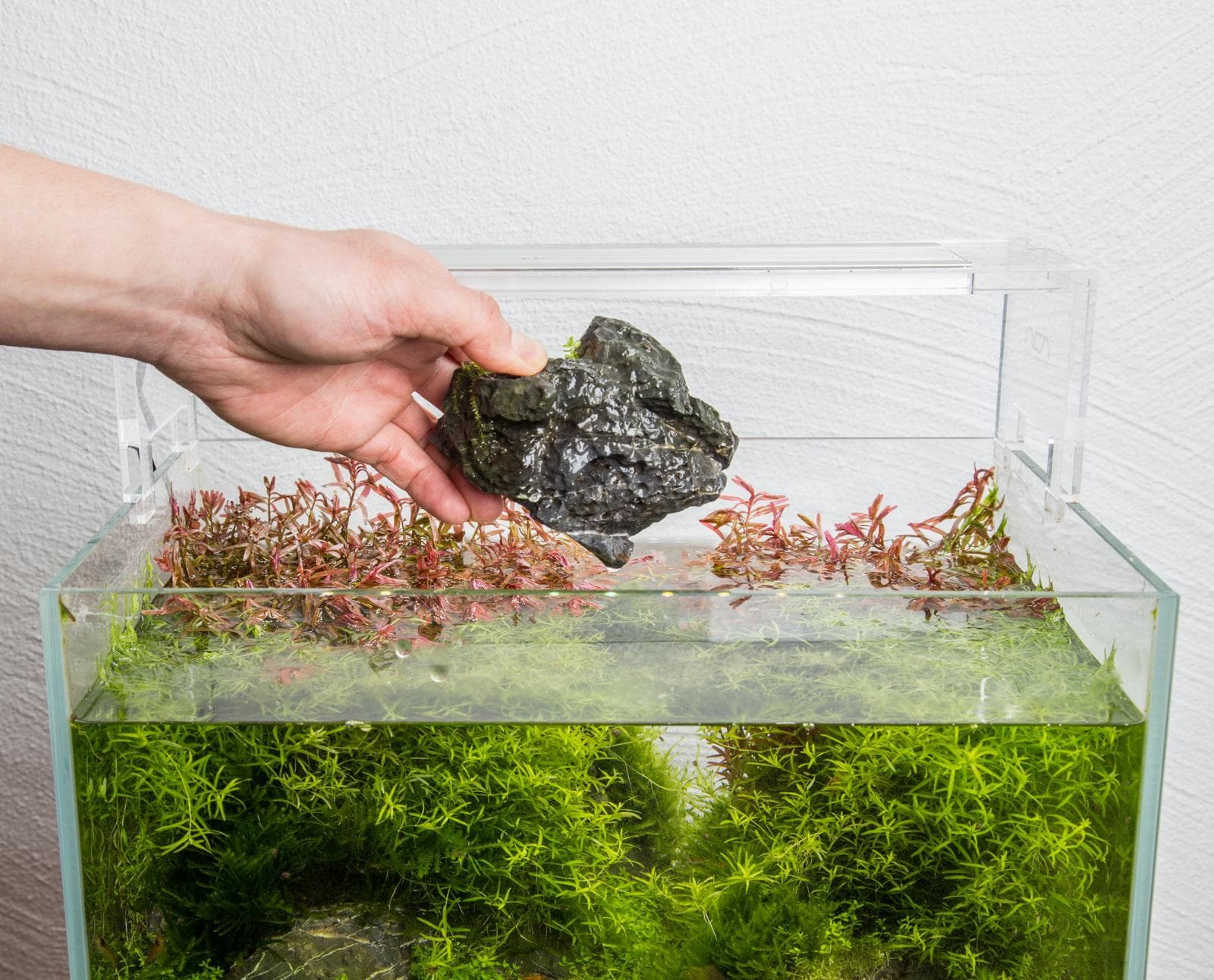
Removing the hardscape
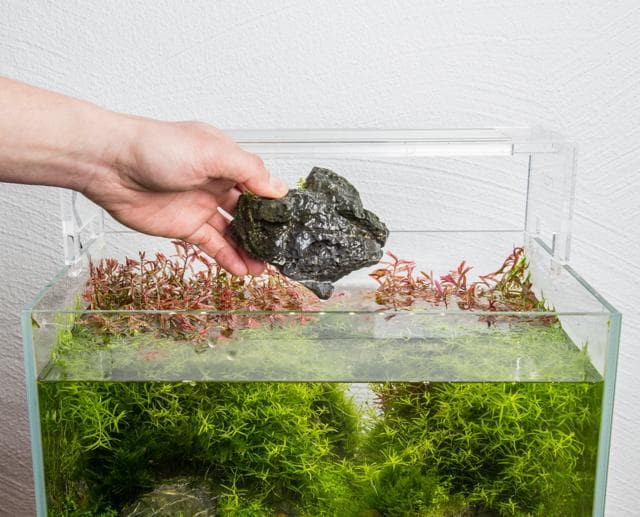
To gradually take away the cover from the shy animals, a good deal of planting and decoration can be removed little by little. This includes primarily connected hardscape structures made of stones, driftwood and attached epiphytes and mosses. Loose stones and driftwood can also be removed. When taking out the hardscape, it should be checked carefully for snails clinging to it. They can also hold on very well hidden. Sometimes, after most of the interior has been removed, you can try another round of catching the animals. Often only the species that live in very large numbers in the substrate zone (such as dwarf shrimp) and those that now seek their hiding place in the plants remain. If you then go on to remove aquatic plants along with their roots, you should proceed very carefully so that large areas of substrate are not set in motion abruptly, burying animals beneath them or causing startled reactions. If you lift such a plant cushion to the water surface, it is advisable to shake it off well so as not to accidentally remove animals hidden in it or clinging to it. A good trick otherwise is to dip the plant cushion straight back into the water once more after taking it out. Often the creatures in it then let go and swim back into deeper water zones.
Removing the aquatic plants
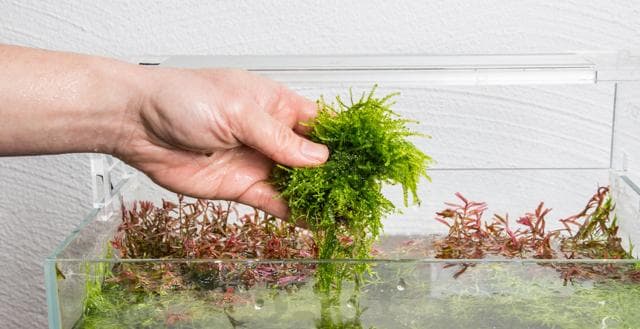
At the latest now, with the removal of aquarium plants, larger amounts of detritus are very likely to be stirred up as well, which clouds the view heavily. Catching animals now becomes considerably more difficult. On the one hand, you should practice patience here and wait until the detritus has settled and the view has cleared again. On the other hand, the situation can now be used to siphon off some water (together with detritus). That clears the view a little, and in addition you are already removing some water (which is our main goal after all). Furthermore, the room for the fish to move is also restricted, which likewise makes catching them easier.
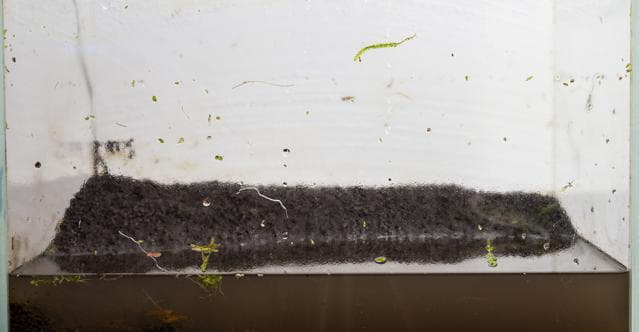
Once the hardscape and planting have been largely removed and the water level lowered considerably, the remaining animals have only little cover left. It is then quite easy to catch the remaining specimens. By rearranging the substrate, you can now restrict the remaining water zone even further by layering the substrate higher at the back and very low at the front. In aquascapes or planted aquariums this is often already the case anyway. You can now carefully lower the water level so far that the substrate at the back already sticks out of the water while enough water is still present at the front. When draining the water, you should proceed very carefully so that no animals suddenly end up high and dry. For siphoning off the water, it is worth fitting the end of the hose with a filter guard so that no animals are sucked in.
Netting the animals
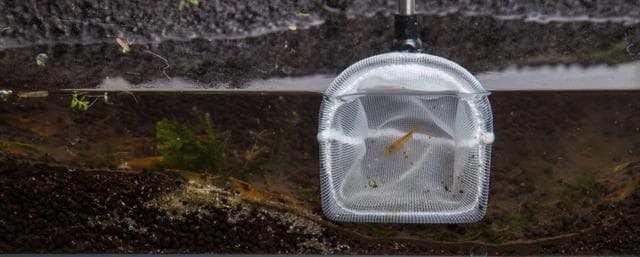
If the catching efforts keep stirring up detritus and thereby limiting visibility, it is worth taking small breaks in between until the view is clear again. With some patience and a few catching rounds, it should be possible to catch the stock completely this way. By the way: you will be amazed at how many dwarf shrimp you have found. Netting them will also be the most work in the end if you also want to catch juveniles and baby shrimp. For this it is best to use a really fine shrimp net.
Removing the substrate
Once the stock has been completely removed from the aquarium, the next step is to get the remaining substrate out of the tank. There are, in principle, two approaches for getting the substrate out well.
Siphoning off the substrate
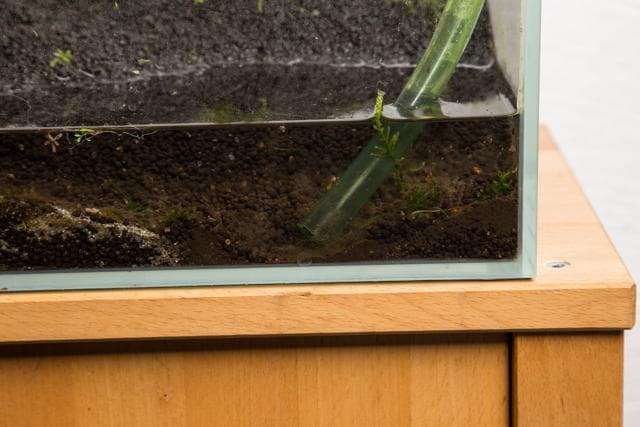
A fairly glass-friendly option would be to siphon off the substrate. This is particularly well suited to smaller aquariums filled with softer and finer substrate (that is, soil or sand). Here the substrate can simply be siphoned off with a hose. The prerequisite, of course, is that enough residual water remains in the tank for this. If necessary, you can otherwise pour some (waste) water back in so that the flow is maintained. The substrate is then simply emptied into a bucket.
Removing the substrate by hand
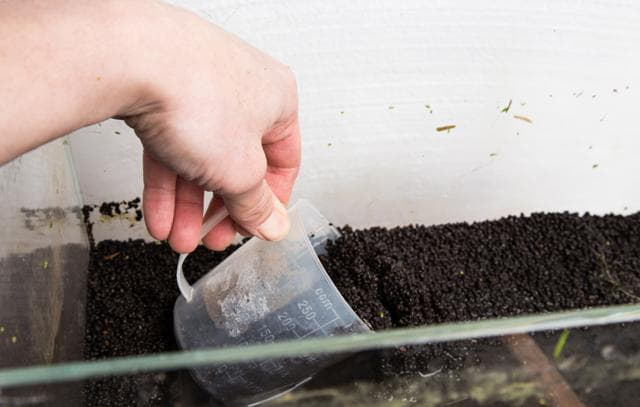
The classic option otherwise would be to scoop the substrate out by hand after lowering the water level as far as possible. Smaller containers can also be used for this. Since you often shovel along the glass panes, contact with the substrate can sometimes cause scratches on the glass. You should therefore proceed very carefully here. Soil is relatively soft, but with gravel and sand the risk is higher, since the particles are harder and firmer.
Cleaning the aquarium
Once the tank is almost completely emptied, the cleaning work can now begin. We have described how to do this in more detail in this article.
