
We use cookies to offer you an optimal shopping experience. These cookies can be grouped into categories. The necessary ones are essential for your purchase. Functional services enable additional content such as videos and maps. With further cookies we produce anonymized statistics. Others serve primarily marketing purposes and are used for the personalization of advertising. These cookies are used by 11 Services used in the shop. You can decide for yourself which cookies you want to allow.
We store your choice on your device (“local storage”) and ask you again after 12 months at the latest. You can change it at any time under “Cookie Preferences” in the footer. You can find details on cookie lifetimes and necessary cookies in our privacy policy.
These services are required to run the shop and for your purchase and cannot be switched off.
Strictly necessary cookies enable basic functions and are required for the website to work properly.
Description:
Shop functions: Essential Shop functions This includes: JTLSHOP (cookie, until you close the browser; keeps your session, the cart and your login), consent (browser storage; remembers your cookie choice, 12 months at most, during the session also in session storage), has_starting_point, cur_product_id and product_page_visits (session storage; navigation between products) as well as aquasabi-search-index-last-url, aquasabi-search-index-results and aquasabi-search-index-data (session storage; search results and lists when paging).
easyVision: easyVision lets website visitors customize the display – e.g. by adjusting contrast, font size, line and letter spacing, color rendering, a blue light filter or by disabling animations. Developed and hosted in Germany, the service is GDPR-compliant and supports statutory accessibility requirements (BFSG) from 2025. The service loads its scripts from cdn.sitecockpit.com and stores your settings (easy-vision-*) in your browser storage (no cookies).
Reviews: aquasabi_guid (cookie, 12 months) is only set when you click “Helpful” under a review. It stores a random ID so that the same person cannot count a review as helpful more than once.
Sorting and view: aquaSort and aquaDisplayType (cookies, 90 days) store the sorting or view (gallery or list) that you choose in a product list. They are only set when you choose a sorting or view.
Amazon Pay: Payment processing with Amazon Pay.
The service provider is Amazon Payments Europe S.C.A. Where Amazon Pay is offered (e.g. in the cart and at the checkout), the shop loads scripts and images from static-eu.payments-amazon.com, payments-eu.amazon.com and m.media-amazon.com and sets cookies (language, ledgerCurrency, apay-session-set). You can find out more in the privacy policy at https://www.amazon.de/gp/help/customer/display.html?nodeId=GRFTMVHP4HXMESSP
PayPal: Payment processing with PayPal.
The service provider is PayPal (Europe) S.à r.l. et Cie, S.C.A. Where PayPal is offered (e.g. in the cart and at the checkout), the shop loads scripts from www.paypal.com; for invoice payment via PayPal, c.paypal.com is added for fraud prevention. PayPal stores an entry in your browser storage (__paypal_storage__), and the shop remembers the chosen PayPal payment method in session storage (chosenPPCPaymentOption). You can find out more in the privacy policy at https://www.paypal.com/en/legalhub/paypal/privacy-full
Sofortüberweisung: On the confirmation page after an order with this payment method the shop loads a Klarna logo from x.klarnacdn.net.
Additional functions such as embedded videos and maps, spam protection in forms or the rating badge. Data is transferred to the respective provider when they load.
Show Youtube Videos
Description:
Displaying videos
Processing company:
Google Ireland Limited, Google Building Gordon House, 4 Barrow St, Dublin, D04 E5W5, Ireland
Helps us understand how the shop is used so that we can improve it.
We measure which pages and products are viewed and how visitors move through the shop. Google Analytics sets cookies (_ga, _ga_*) and sends usage data to Google.
Description:
Audience measurement and analysis of how the shop is used
Measures our advertising and enables personalised advertising on other sites.
We measure whether an ad on Facebook or Instagram led to a purchase and show visitors relevant ads again. Cookies are set for this: _fbp and _fbc (Meta) and as_fbclid (ours, 30 days; remembers the ID of the ad click). Meta receives data about your actions in the shop (e.g. product views, cart, purchase), your IP address and browser information; for a purchase our server may also send them directly to Meta (Conversions API). More in our privacy policy (retargeting/remarketing and conversion tracking).
Description:
Measure advertising success and show relevant ads again (Facebook, Instagram)
We measure whether an ad on TikTok led to a purchase. Cookies are set for this: _ttp, ttclid and _tt_* (TikTok) and as_ttclid (ours, 30 days; remembers the ID of the ad click). TikTok receives data about your actions in the shop (e.g. product views, cart, purchase), your IP address and browser information; for a purchase our server may also send them directly to TikTok (Events API). More in our privacy policy (retargeting/remarketing and conversion tracking).
We measure whether an ad in ChatGPT led to a purchase. Cookies are set for this: __oppref and __obref (OpenAI) and as_oppref (ours, 30 days; remembers the ID of the ad click). OpenAI receives data about your actions in the shop (e.g. product views, cart, purchase), your IP address and browser information; for a purchase our server may also send them directly to OpenAI (Conversions API). Data may be transmitted to OpenAI OpCo, LLC (USA). More in our privacy policy (retargeting/remarketing and conversion tracking).
Description:
Measure the success of ads in ChatGPT
Processing company:
OpenAI Ireland Limited, 1st Floor, The Liffey Trust Centre, 117-126 Sheriff Street Upper, Dublin 1, D01 YC43, Irland
We measure whether an ad led to a purchase and show visitors relevant ads again. Google Ads sets cookies (e.g. _gcl_*) and receives purchase data, where applicable in hashed form (SHA-256).
Description:
Measure advertising success and show relevant ads again (remarketing)
We use cookies that are essential for payment processing through our partners. Please select which payment providers you would like to use.
In order to unlock offers for extended payment options, in particular express checkout and payment in instalments, we require your consent to the data transfer and storage of third-party cookies of the payment provider PayPal. This allows us to also offer you express checkout and payment by instalments. Without your consent, only the technically necessary data transfer to PayPal will take place, but you will then not be able to use the express checkout or extended offers for payment by instalments on this site.
Description:
Using express checkout and Displaying offers for payment in instalments for individual items or your entire purchase.
Your consent ID:With this randomly generated number we can show on request what you selected. It contains no information about you.
Data privacy settings
Would you like to see these contents? Activate the desired contents for one session only or allow the website to remember these settings. Once you have given your consent, the third-party data can be loaded. For this, third-party cookies might be stored on your device. You can change these settings at any time (footer: “Cookie Preferences”). For further details, please see the Privacy notice.
For some, they are a plague, for the others a welcome enrichment in the aquarium. Snails are always a hot topic in aquaristics. Here we explain the advantages and disadvantages of keeping snails in aquariums.
Advantages
If one regards an aquarium as an independent ecological system, snails (and also other invertebrates such as shrimps) cover a useful, almost irreplaceable function. They do not exclusively eat biofilms and growths - and are therefore important algivores - but they also eat all the “dirt” that’s accumulating in your tank. More specifically sludge, fish dung, dead plant parts, carcasses and food leftovers. All of these things contain organic substances that - if not utilized -increase the water load and also the number of bacteria in the water. Snails eat the organic garbage. As so-called consumers, they process food leftovers and pass them down the food chain. Finally, bacteria and other microorganisms - the decomposers - break up the remnants into their mineral constituents.
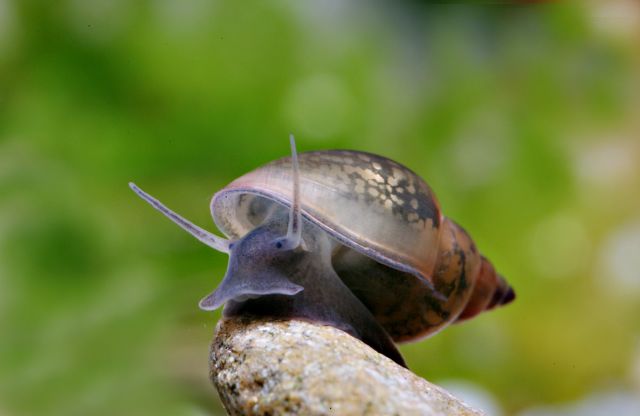
An aquarium containing snails is therefore ecologically a much more stable system and the overall impression usually much cleaner. Typical species that are more common in aquariums are bladder snails (see photo), ramshorn snails, and Malaysian trumpet snails. They are often introduced when purchasing new aquatic plants.
Disadvantages
Many aquarium enthusiasts, however, perceive snails as optically unpleasant, especially when it comes to a massive increase in their population - a snail plague. One has to keep in mind, that explosive growth always has to do with the framework conditions. If the snails find plenty of food, this will reflect in their population density. Very often snail plagues come up during the cycling phase of an aquarium. During start-up, it always comes to growth peaks in various species of algae, which are excellent snail food - again directly noticeable in the propagation of the snails. As a rule, this will even out later: Through a lower food supply and food competitors, the population goes back to normal.
In aquariums with a dense fish stock, and accordingly intense feeding, the snail population can be high due to the high feed intake. If the invertebrates get out of hand, the aquarium owner should definitely reconsider his feeding behavior.
Depending on the type of snail present in the aquarium, it may happen, that some plants may get nibbled at. Some apple snail types (e.g. Marisa cornuarietis pictured above) are a typical example. Up to a certain degree, those snails can be kept from eating your aquatic plants by feeding them vegetables (peeled, blanched or dried) or special food with a high vegetable content. But you can never rule out entirely that the snails won’t just eat particularly delicate and tasty plants.
Avoiding the introduction of snails
As aquarium snails are particularly often introduced as stowaways in aquatic plants, this problem can be solved elegantly by purchasing in vitro products. Here, the plants are cultivated in sterile cups, they are thus free of snails, other parasites, foreign plants, algae and pathogens.
Another option for prevention is a classic quarantine. Newly purchased or privately traded aquatic plants first enter a separate quarantine aquarium. Only if an infestation with snails or their eggs can be ruled out, they can be planted into the show aquarium. As a rule, snail eggs hatch after about 7-14 days, so the quarantine should be carried out for at least three to four weeks. Freshly hatched snails are very small so you should give them some time to grow so they can be seen better.
Some aquarists treat newly purchased aquarium plants with a short bath in mineral water or in an alum solution. Any adhering snails are stunned or killed. It is important to observe the relevant safety regulations when handling chemicals. Also, treated plants should be thoroughly rinsed before being placed in the aquarium. Snail eggs aren’t harmed by these short baths, so it is advised to grant a quarantine period of two weeks after such a treatment and then treat them again, killing off any freshly hatched snails on the second pass.
Countermeasures
In case of an unwanted increase in snail population in the aquarium, the aquarist should first critically evaluate his feeding habits. Snail plagues do not come out of the blue, snail plagues are caused by an overabundance of food. In addition to measures such as feeding less or higher-quality feed and removing dead plants, there are a lot of options for reducing the amount of snails in the aquarium. Please keep in mind, however, that snail infestations always have a cause. If this cause (too much food) is not turned off, either the snails come back or you bring other problems such as excessive algae growth into your aquarium.
Individual snails can be picked up quite simply by hand. It is a bit more effective if you first place bait (such as a food tab) in a certain place. After a while, the bait lures a larger number of animals together which can be easily collected, without having to search for them everywhere in the aquarium. A snail trap works according to a similar principle, and is also equipped with bait. After a few hours the trap and captured snails are removed from the aquarium in one go.
Furthermore, stocking the tank with predators is an option. However, this step should be well considered, as these animals also have certain housing requirements that must be met. Pufferfish are often recommended as they feed on snails. It should be remembered, however, that these animals are food specialists. They can get quite big, and of course puffer fish have to be kept feeding snails after the slug infestation has been contained. If this is not the case, puffer fish can become quite aggressive towards other aquarium occupants and attack shrimp, plucking the eyes out of smaller fish, or starve to death due to lack of dental wear. Another predator: The Clea helena preys on other species of snails and their young. But also carrion, worms or other protein-containing food are part of their diet. It should be remembered that one often just replaces one pest with another: as is the fashion with snails, Clea helena reproduces exceptionally well when a high amount of food is available. It would actually be better and more sustainable to get to the bottom of the cause and eliminate it instead of using snail eaters.
Particularly useful snails for a plant aquarium
If you want to avoid an uncontrolled mass increase, but still keep useful snails in the aquarium, there are quite a few suitable species that can not reproduce in a freshwater aquarium. Among these are Clithons sp., Neritina and Vittina.
Clithon diadema
For successful propagation, these species need brackish water. From time to time you can see white egg cocoons attached to the panes or decoration. Although larvae hatch from these, they do not develop into snails due to the water conditions in a normal aquarium. Clithons and Neritina are excellent against algae coverings. brown algae, spot algae and other green algae coats on stones, driftwood and the aquarium’s panes are eaten by these animals in a very effective way. In this respect, it is highly recommended to have a few of these guys as a cleaning crew in your aquarium. For stocking density, we recommend the rule of thumb of one snail per 10 liters of water volume.