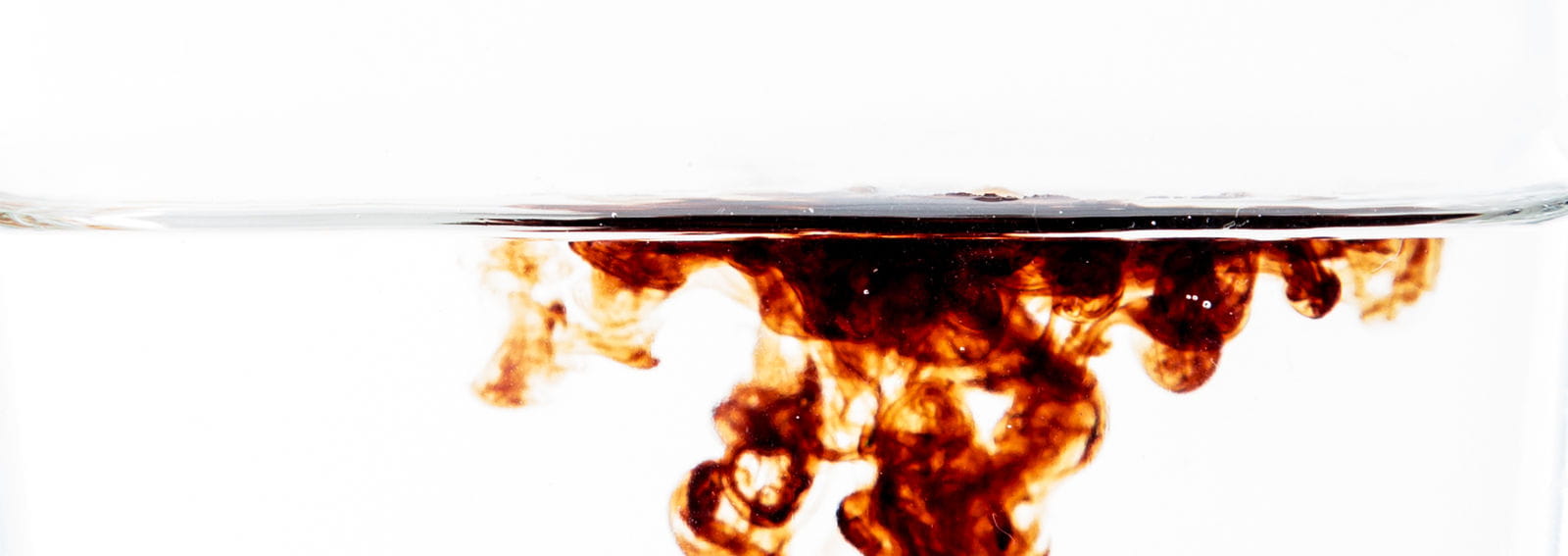
Humic substances in the aquarium

By Aram Schneider Published Updated
Translated from German with AI assistance and reviewed by our editors.
Humic substances act as supporting elements for fish, invertebrates and plants alike in an aquarium. In fact, the importance of humic substances in the aquarium hobby is still rather underestimated, and many people associate them simply with annoying brown-colored water. In this article of our Aquascaping Wiki we explain what these humic substances are all about.
Definition of humic substances
Humic substances are, first of all, components of humus, which is the entire organic, decomposing matter of the soil. The microorganisms living in it constantly transform the components of humus and in this way keep decomposing it further. As a component of this soil, humic substances are various complex macromolecules. The structure of such a molecular complex is not uniform and sometimes even changes depending on location and season. In their basic structure, humic substance molecules consist of a core (often made up of furan, benzene, pyrrole, pyridine, naphthalene, indole or quinoline), bridges (these often contain carbon, oxygen or nitrogen), and side groups (mostly amino, carboxy, methoxy, carbonyl and hydroxy groups).
In general, the components of humus, i.e. the humic substances, can be divided into humins, fulvic acids and humic acids.
Humic substances occur practically everywhere in nature and are not only present in virtually every ecosystem (on land or in water) but play an important role there. This in turn means that living creatures such as fish, shrimp, snails and also the plants that we want to keep in our aquarium have already become accustomed to humic substances in their original habitats and have learned to "use" them.
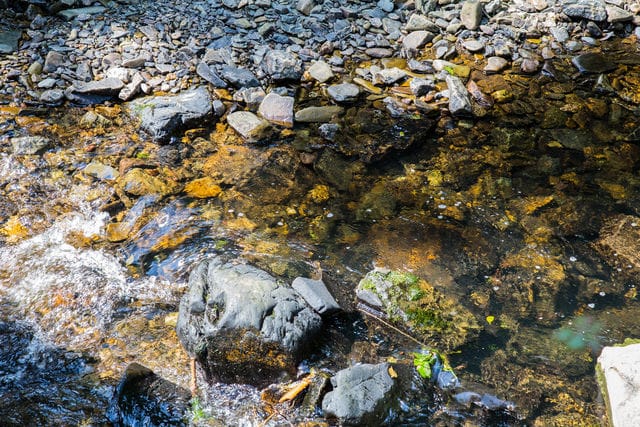
Humic substances in tap water
In our drinking water, i.e. tap water, humic substances are rather undesirable (for humans), so they are filtered out by drinking water treatment. If you use tap water for your aquariums, it therefore contains no humic substances. Likewise, when using demineralized water (for example from a reverse osmosis system) and remineralizing salts, no humic substances get into the aquarium. If the aquarist wants to take advantage of the benefits of humic substances, they must therefore be added using appropriate products.
Benefits of humic substances in the aquarium hobby
As is now known, humic substances in aquarium water have both direct and indirect effects on the inhabitants of the aquarium. While for a long time it was unclear what effects (especially direct ones) humic substances have on living organisms, these are now scientifically proven.
In the wild, humic substances play a very important role in making conditions that are hostile to life usable for aquatic organisms in the first place. Let's take very acidic and soft waters such as the Rio Negro as an example. The water here is very poor in minerals and sometimes has a pH value of only 3 or 4. In such an environment, animals would normally not be able to survive at all, or only with great difficulty. Only through the use of humic substances are the organisms in such waters able to accumulate enough vital minerals, such as calcium for building bones. For this reason, humic substances are even vital for survival in the aquarium when keeping animals from such blackwater habitats, since they have adapted very strongly to their presence and use.
Antibacterial effect of humic substances
Another reason why humic substances have long been used in fish breeding is their antibacterial and fungicidal effect. This prevents egg fungus, and the adult animals also benefit from a cleaner environment with fewer germs. The likelihood of an infectious disease caused by fungal infestation also decreases when humic substances are used. This is achieved because these substances form a kind of protective film both on the skin and in the digestive tract of the animals. The docking sites for pathogens are occupied by humic substances, so that fewer germs have the chance to enter an organism.
Improved healing process
If a disease nevertheless occurs among the aquarium inhabitants (such as fin rot, ich or mold infestation), humic substances can support the healing process. They have an anti-inflammatory effect, stimulate mucus production in fish and can even stop or slow bleeding. In the gastrointestinal tract, the toxins produced by pathogens are bound and the multiplication of the pathogens is curbed. Far more effective, however, is the preventive use of humic substances in the aquarium, so that an acute disease outbreak does not occur in the first place.
Strengthening the immune system
Humic substances improve the immune system of aquarium animals. Through the presence of humic substances, the organisms are put into a mild state of chemical stress. However, similar to a vaccination in mammals, this has an entirely positive effect: the immune system is challenged and thereby strengthened. As a result, the animals can develop multiple stress resistances, some of which can extend lifespan. Studies on the nematode Caenorhabditis elegans, for example, have shown this. Some studies also showed positive effects of humic substances on the fertility and growth of organisms. This has been confirmed by experiments with the green swordtail Xiphophorus helleri, in which juveniles and also embryos showed improved growth when a product containing humic substances was added[1]. In other fish species as well, such as Perca flavescens, a better hatching rate was demonstrated with a higher content of humic substances in the water[2].
Promoting digestion
In an animal's gut, humic substances are able to bind poisons and heavy metals found there. This supports the animal's intestinal flora and aids digestion. The protective film on the intestinal wall that forms thanks to humic substances repels chemical and microbial irritants. With a healthy gastrointestinal tract, food can be broken down and absorbed optimally.
Reducing stress
As already explained in the section "Strengthening the immune system", humic substances put organisms into a minimal state of chemical stress, causing them to react with the corresponding defense mechanisms. Similar to a vaccination, this has the effect that the animals are much better prepared for a real stress situation. In this way, multiple stress resistances can develop, which in turn produce hardier and more stable animals.
More general effects of humic substances in the aquarium
Humic substances also have positive effects on the water parameters in aquariums. They act as a natural buffer and in this way stabilize the pH value. In very soft water with extremely low carbonate hardness, a pH crash is thus avoided.
For aquatic plants, humic substances are also beneficial for growth and nutrient uptake. They act as a natural chelator and thereby increase the availability of important nutrient elements such as iron and copper. Thanks to the improved mineralization and decomposition processes in the substrate caused by the presence of humic substances, macronutrients such as nitrogen and phosphorus are also more readily available. In addition, humic substances can act as cation exchangers, which optimizes the availability and exchange of cations and thus of nutrients such as potassium, calcium and magnesium.
How do you add humic substances to the aquarium?

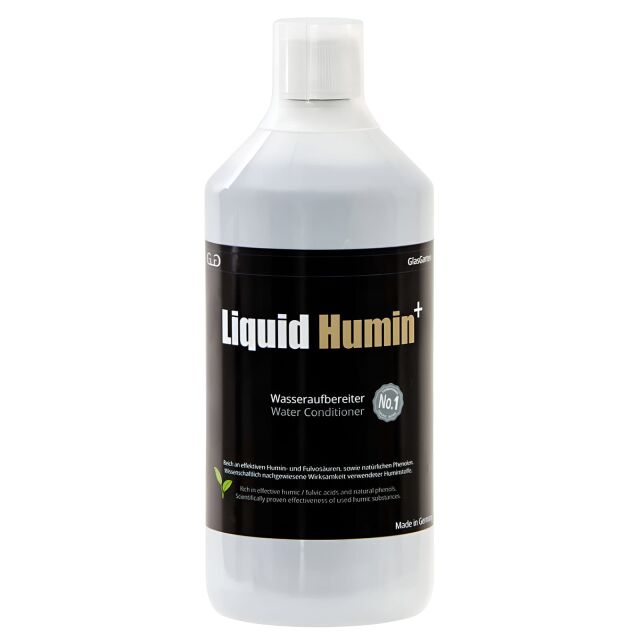
There are plenty of (natural) products for the aquarium hobby that can supply humic substances. Especially popular in aquariums with shrimp or crayfish are alder cones, Indian almond leaf products or various kinds of leaves. Here, however, the concentration of humic substances is not particularly high, so the products should be renewed or replaced regularly. Considerably more productive are corresponding liquid products, which contain concentrated humic substances across the full spectrum. These are added weekly as a care product for water care in the aquarium, ideally after the water change.
Some soil substrates also contain at least some humic substances, such as Environment Soil, which contains fulvic acids. In the long term, however, adding humic substances with a liquid product such as Liquid Humin+ is also more consistent, predictable and productive here.
Brown water caused by humic substances
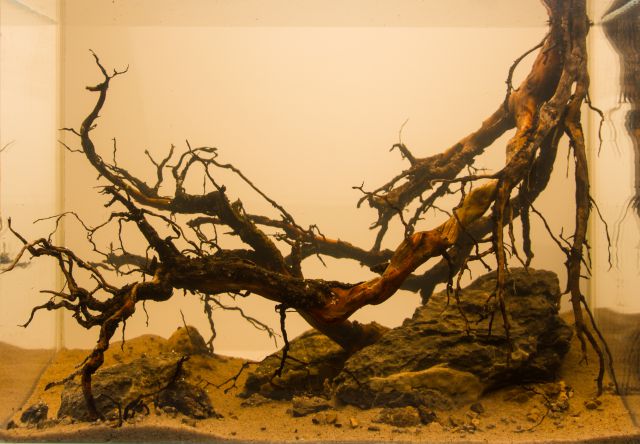
As is well known, humic substances tint the water in the aquarium brownish. In some cases this is even desirable, for instance when the aquarist wants to create a blackwater biotope with parameters as close to nature as possible. For organisms that come from habitats very rich in humic substances, the presence of these elements is sometimes vital, since they are very strongly adapted to humic substances.
If you want to use the benefits of humic substances for your community tank, aquascape, planted aquarium or other variants of the aquarium hobby but would rather keep the water clear, you can rest assured. Even a small dose of a humin product that does not tint the water so noticeably brown is already an enrichment and a sensible care additive for the inhabitants of the aquarium.
References:
1. Steinberg/Menzel Huminstoffe - totes Material höchst aktiv. Studien über lebenswichtige braune Geopolymere in Aquaristik Fachmagazin Nr. 206 April/Mai 2009 ISSN 1437-4854
2. Bertolo, A. & Magnan, P. (2007): Logging-induced variations in dissolved organic carbon affect yellow perch (Perca flavescens) recruitment in Canadian Shield Lakes. Can. J. Fish Aqu. Sci. 64: 181-186