 Infusoria as a fine live food
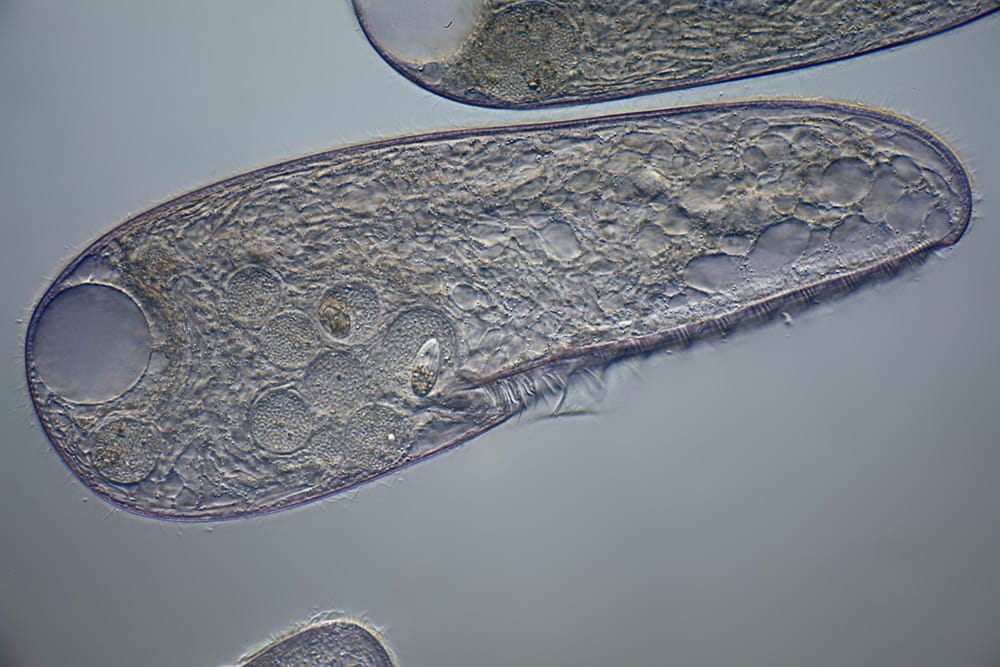
Image rights for the header photo: Frank Fox via Wikimedia Commons, source credit, license: CC BY SA 3.0 DE. The photo shows a ciliate.
Infusoria are a mixture of single-celled and small multicellular organisms, also called protists, which are well suited to feeding tiny fish larvae because of their small size. Infusoria are not a firmly defined species; the term refers to a mixture of different microorganisms that appear in an infusion (Latin infusum) of hay etc. They include flagellates, amoebas, ciliates such as rotifers or paramecia, and many others.
Some infusoria can even be perceived with the naked eye if you look closely. These tiny whitish dots appear in clouds when the nutrient density in the medium is high and the infusoria can therefore multiply well.
Infusoria reproduce asexually by division. If they find plenty of nutrients and the water temperature is in a range that suits them, cell divisions take place several times a day. The mix of species among the infusoria can shift when conditions change.
Infusoria move through the water in suspension. The ciliates and flagellates among them are skilled swimmers, while others such as amoebas tend to crawl.
Infusoria as rearing food for fish larvae
Infusoria are the perfect starter food for fish larvae that are too small to handle artemia nauplii. But nano fish, too, are enthusiastic infusoria eaters. Infusoria bring all the nutrients that the little ones need. In nature, too, infusoria act as a first food for small fish larvae and also for small fish.
These infusoria are also present in an established aquarium in more or less high densities. There they feed on even smaller microorganisms such as bacteria and yeasts. By the way, if you see clouds of infusoria in the aquarium, this is a warning sign pointing to a high bacteria density in the aquarium water! Here you should urgently change water and improve aquarium hygiene.
If you only raise a few fish larvae, they usually find enough infusoria in the aquarium, even without deliberate supplemental feeding. If you breed fish in larger numbers, however, or keep them in a recently set-up rearing tank, you have to supplement their food. An infusoria culture is practically a must if you breed fish species with very small larvae.
How do you get infusoria?
You can get a starter culture of infusoria either from specialist retailers - for example Hobby Protogen - or from other aquarists.
A hay infusion is also a way to grow infusoria. For this, you put aged tap water (not aquarium water, so that possible pathogens are not passed on) into a container of about 3-5 liters and simply add a handful of hay or finely chopped organic banana peel. After 4-5 days in a warm place, you should already see fine whitish clouds of microorganisms. The culture can be fed further with a few drops of evaporated milk. This culture can smell a bit. The smell is less strong if you run the culture extensively and only feed it with banana peel instead of evaporated milk.
Multiplying infusoria
You can split a well-running infusoria culture between two larger glasses and top them up with aged water that has been boiled beforehand.
Feeding infusoria
Infusoria feed on single-celled organisms such as bacteria, yeasts and other small microorganisms. You can either feed them directly with slurried dry yeast or promote the growth of bacteria. This is done either through simple and multiple sugars in the hay or in the banana peels, or by adding a few drops of evaporated milk.
An extensively fed culture is maintained as follows: every two weeks you add one or more small pieces of organic banana peel, small dried apple pieces or other sugary dried pieces of fruit. Their nutrient content is already enough to stimulate the growth of bacteria in the infusoria culture and thus supply the infusoria with food.
Feeding infusoria to fish
Harvesting the truly tiny infusoria is a bit tricky because you should avoid introducing water from the quite heavily bacteria-laden culture into the aquarium with the juvenile fish. The single-celled organisms can be strained out with a fine sieve with a mesh size of 20-35 µm at most. Before feeding, they are briefly rinsed under running water. Another method is to fill the culture into a bottle with a narrow neck for harvesting the infusoria. The water should come up to half the bottle neck. The neck is then loosely plugged with some cotton wool. You pour cold boiled water over the cotton wool. Over time, a lack of oxygen develops in the bottle, and the infusoria gradually migrate upward through the cotton wool, where you can remove them with a syringe without a needle. The bottle method does take a while and requires some patience, however.