 Microworms / banana worms / Walter worms as live food
Source and copyright of the header photo: Stug.stug (talk) - Own work via Wiki Commons, license: CC BY-SA 3.0, source credit.
Microworms, banana worms and the so-called Walter worms (named after their discoverer Helmut Walter, who isolated them from a grindal worm culture), also known as mini microworms, belong to the nematodes (roundworms). They are close relatives of vinegar eels. Microworms have been identified as Panagrellus redivivus and banana worms, originally isolated from garden soil in the USA, as Helicotylenchus multicinctus; in aquarium practice, however, the worms are very hard to tell apart and are therefore sold by many suppliers as a single culture. Some sources refer to Walter worms as Panagrellus silusioides, while others speak of a species that has not yet been identified.
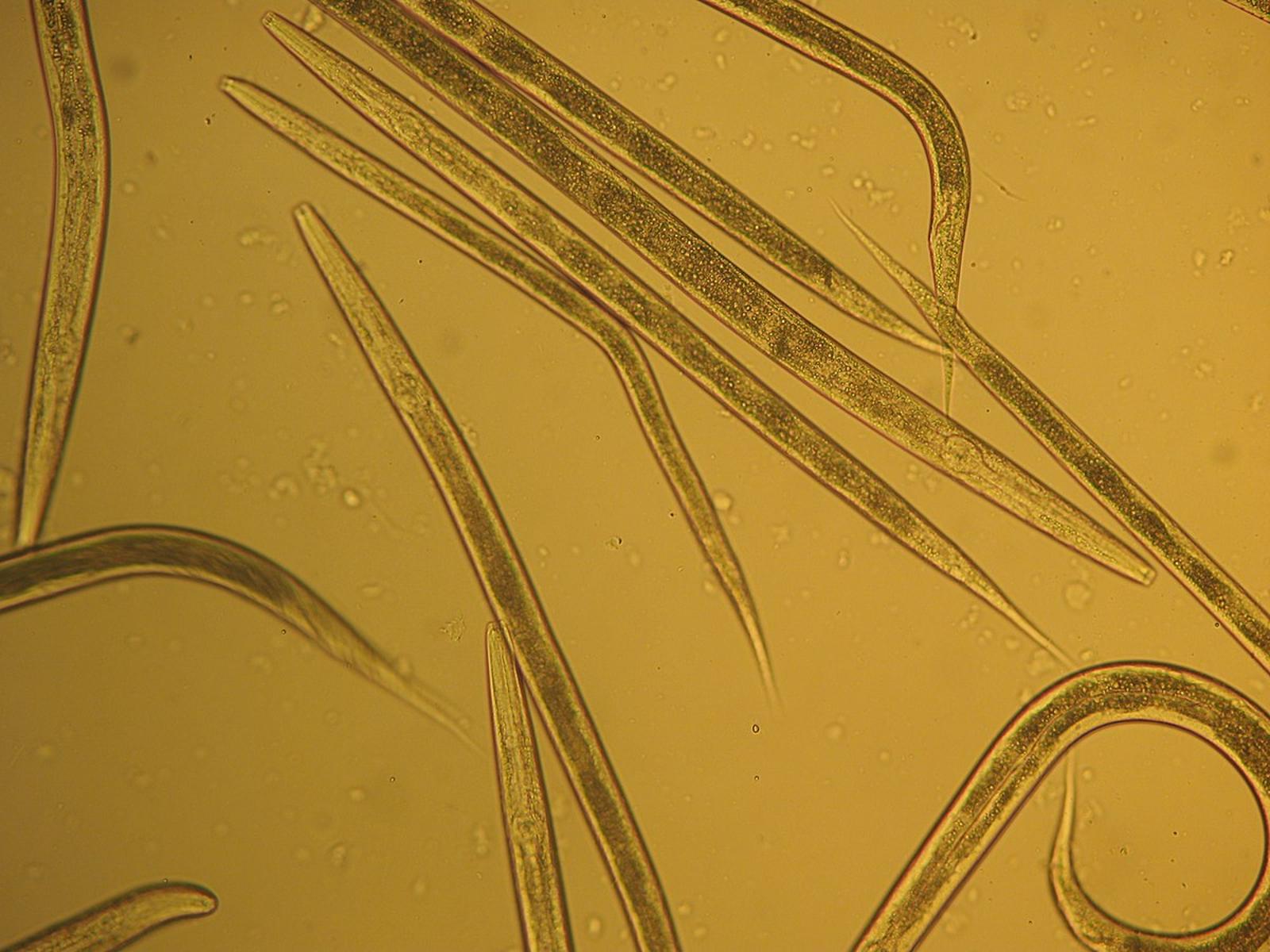
Nematodes are unsegmented worms, meaning they have no segments. The color of microworms, mini microworms and banana worms is whitish to slightly cream-colored. Their body is round in cross-section, and under the microscope you can see tapered body ends. The worms breathe through their skin and do not last long underwater. They are cultured in air on a moist substrate.
On average, the little worms only grow about 1-2 mm long, which makes them a perfect live food for raising fry and for nano fish. Walter worms are said to stay even smaller and to survive longer underwater. The worms sink straight to the bottom in water and are therefore also a well-suited protein source for shrimp, young crayfish, dwarf crayfish and snails in the aquarium.
With microworms and Walter worms, the females give birth to live young, whereas banana worms reproduce via eggs. All these worms are bisexual and reproduce only sexually, not by division. Reproduction and development are incredibly fast under good conditions.
Microworms, banana worms and Walter worms are not good swimmers and sink quite quickly in water. On the substrate they move in a wriggling, crawling manner.
Microworms, banana worms and Walter worms as live food
The very fine microworms and banana worms are a well-suited starter food for small fish larvae. The even smaller Walter worms are particularly suitable for the really small larvae, for example of dwarf rasboras or Boraras species. Fresh microworms have a protein content of 10% and a fat content of just under 5%, so they are a very nutritious food that you should not feed exclusively to adult fish. However, it is precisely this high nutrient content that makes them the perfect food for fast-growing juvenile fish.
Buying microworms, banana worms and Walter worms
Many ambitious breeders gladly share a culture of the worms, and you can also buy microworm cultures in stores. Of course, you could also isolate nematodes from garden soil and keep culturing them, but it would be a great coincidence if you caught exactly this kind of worm - a rather uncertain business. Since microworms multiply very well, however, it is not difficult to get a starter culture.
Culturing and feeding microworms, banana worms and Walter worms
Microworms, banana worms and Walter worms are easy to culture and feed - the substrate they are kept on is at the same time their food. The easiest culture is in oatmeal porridge. For this, fine rolled oats or oat flour are boiled in water. Let it cool and put it into a tightly closable container together with the starter culture. The worms multiply on the substrate and climb up the walls of the container when the culture is "ripe". There you can remove them with a brush.
The classic culture is boiled not with water but with milk - this can, however, lead to an undesirably strong smell. The cultures with water work just as well and do not smell quite as unpleasant. If you want the worms to really step on the gas when reproducing, mix some slurried dry yeast into the cooled substrate.
Microworms, Walter worms and banana worms are also bred on unsalted mashed potatoes, soaked toast, breadcrumbs, soaked bread rolls, baby cereal and so on. These substrates all work excellently, too.
If the culture slows down or starts to smell distinctly sour, it is split and topped up with fresh substrate. Depending on size, type of substrate and outside temperature, the lifespan of a microworm culture is approximately 7-14 days before you have to make a new one.
There are breeders who keep their microworm cultures in the refrigerator and simply let the containers stand at room temperature for an hour before feeding. Then the odor nuisance is considerably lower and the cultures last longer, but they are also not as productive.
Feeding microworms, banana worms and Walter worms to fish
In closed containers, the worms climb up the walls of the container and can be wiped off from there very easily with a brush. Over time, the substrate develops a rich bacterial fauna and therefore must under no circumstances get into the aquarium. Before feeding to sensitive fish larvae, you should definitely rinse the microworms, banana worms and Walter worms thoroughly in a suitable fine sieve under running water. Alternatively, you can put the harvested worms into a glass of water. They sink straight down, while bacteria and yeasts stay suspended in the water. The water is then poured off, and the sediment of then relatively clean worms can be fed.