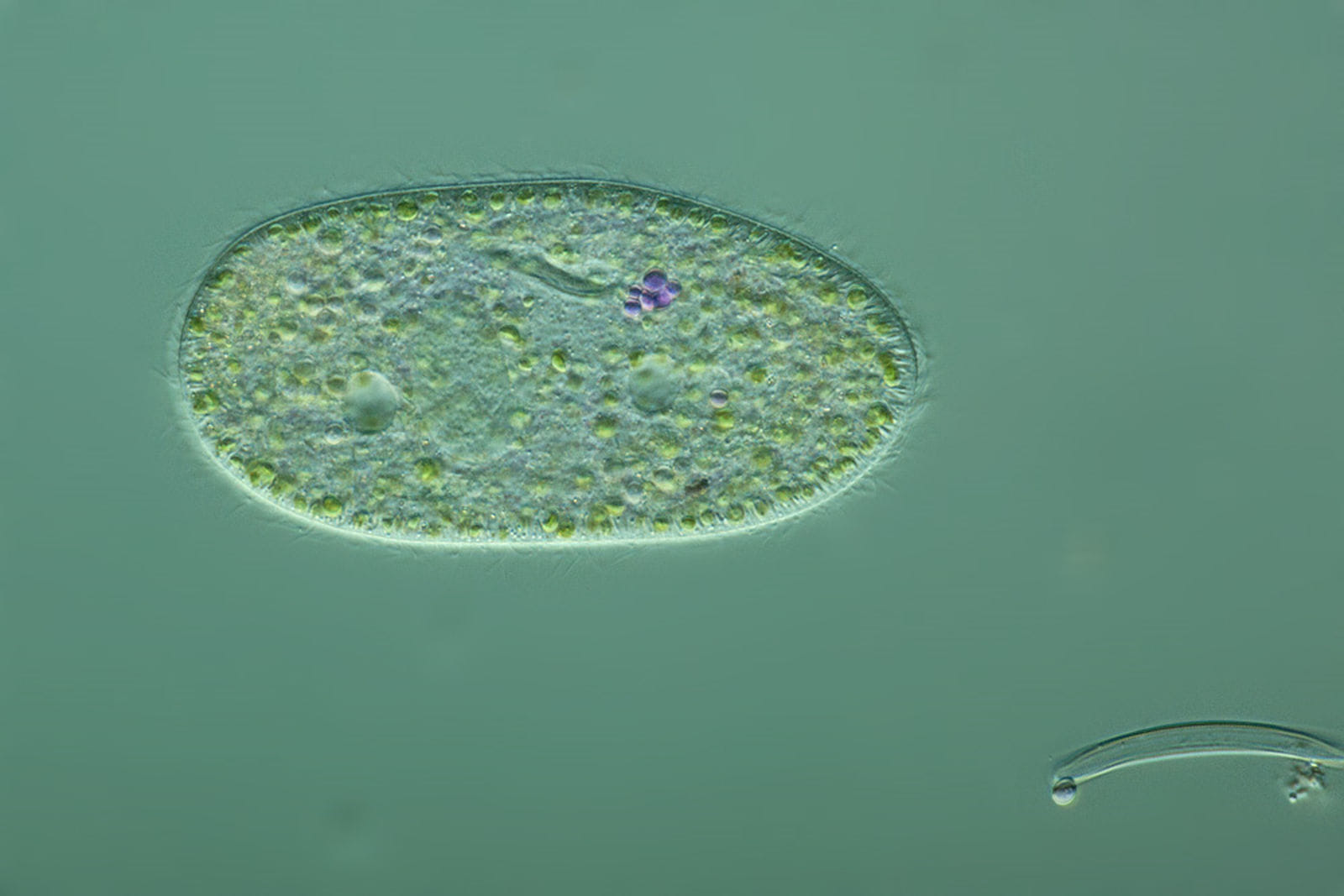
 Paramecia as a fine live food
Source and copyright of the header photo: Frank Fox - Own work, license: CC BY-SA 3.0 DE.
Paramecia are free-swimming single-celled organisms, or protists, that occur in freshwater worldwide. Only very few species also live in brackish water or saltwater. Paramecia are in some cases even visible to the naked eye as tiny pale dots and are therefore among the largest single-celled organisms, or ciliates. Under the microscope, their elongated, typically slipper-like shape stands out.
Paramecia reproduce by cell division. Under good conditions they can divide up to seven times a day. More rarely, sexual reproduction occurs, in which the micronuclei are exchanged and the genetic information is thereby mixed. This happens mainly when environmental conditions deteriorate.
Paramecia are skilled, surprisingly coordinated swimmers that are very fast in relation to their size. To the observer, the movement nevertheless appears rather slow. They beat their tiny hairs (cilia) and thereby maneuver through the water. Paramecia always swim toward the water surface.
Paramecia as rearing food for fish larvae
Paramecia are a perfect starter food for very small fish larvae that, because of their tiny mouths, cannot yet eat artemia nauplii or microworms. They contain all the nutrients the little ones need at this early stage, in perfect balance. In nature, too, paramecia are a popular first food for small fish larvae.
In an established aquarium, a few fish larvae usually find enough paramecia, but in targeted breeding and in a rearing tank you have to supplement them. A paramecia culture is therefore practically a must if you want to breed fish with very small larvae.
How do you get paramecia?
You can either buy a paramecia starter culture from a specialist retailer or get one from fellow aquarists.
With a little luck, you can also obtain a culture yourself from aquarium water or pond water. To do this, simply put the water together with some detritus (mulm) into a large glass and top it up with aged water. Then the culture is fed with a few drops of evaporated milk. Caution: with this method it is quite possible that you will not get a pure paramecia culture, but that other infusoria and ciliates are present as well. If necessary, you should use a microscope to determine which single-celled organisms they are - not all of them are suitable for feeding juvenile fish. A tested starter culture from a specialist retailer or breeder is safer.
Multiplying paramecia
The ongoing paramecia culture is also kept in larger glasses with aged, boiled water (not with aquarium water, to avoid transmitting diseases). Feed again when the water is clear again. Room temperature is sufficient, and light is not strictly necessary. The culture can smell a bit musty. The smell is reduced in extensively run cultures that are fed only with (a little) banana peel etc. The paramecia are recognizable as tiny floating pale dots.
Feeding paramecia
Paramecia feed on single-celled bacteria and other microorganisms such as yeasts. You can either feed them with slurried dry yeast or promote the growth of bacteria in the culture by adding one or two drops of evaporated milk, thereby feeding the paramecia indirectly. An extensive culture works well with banana peels. Here, small pieces of organic banana peel, dried apple pieces or other sugar- or starch-containing pieces of fruit or vegetables are added every two weeks. Because of the nutrient content of these additions, bacteria also multiply in the culture, and the paramecia then feed on them.
Feeding paramecia to fish
Harvesting paramecia is not entirely easy, since you do not want to bring the heavily bacteria-laden culture into the aquarium. You can either sieve out the single-celled organisms with a very fine-meshed sieve with a mesh size of 20-35 µm and briefly rinse them under running water before feeding, or you fill the culture into a bottle with a somewhat narrower neck, in such a way that the water stands at about the middle of the bottle neck. Then you loosely plug the neck with cotton wool and pour clear, boiled, clean water on top. The paramecia migrate through the cotton wool, which holds back the germs. They can be removed from the clear water above the plug with the help of a syringe without a needle.