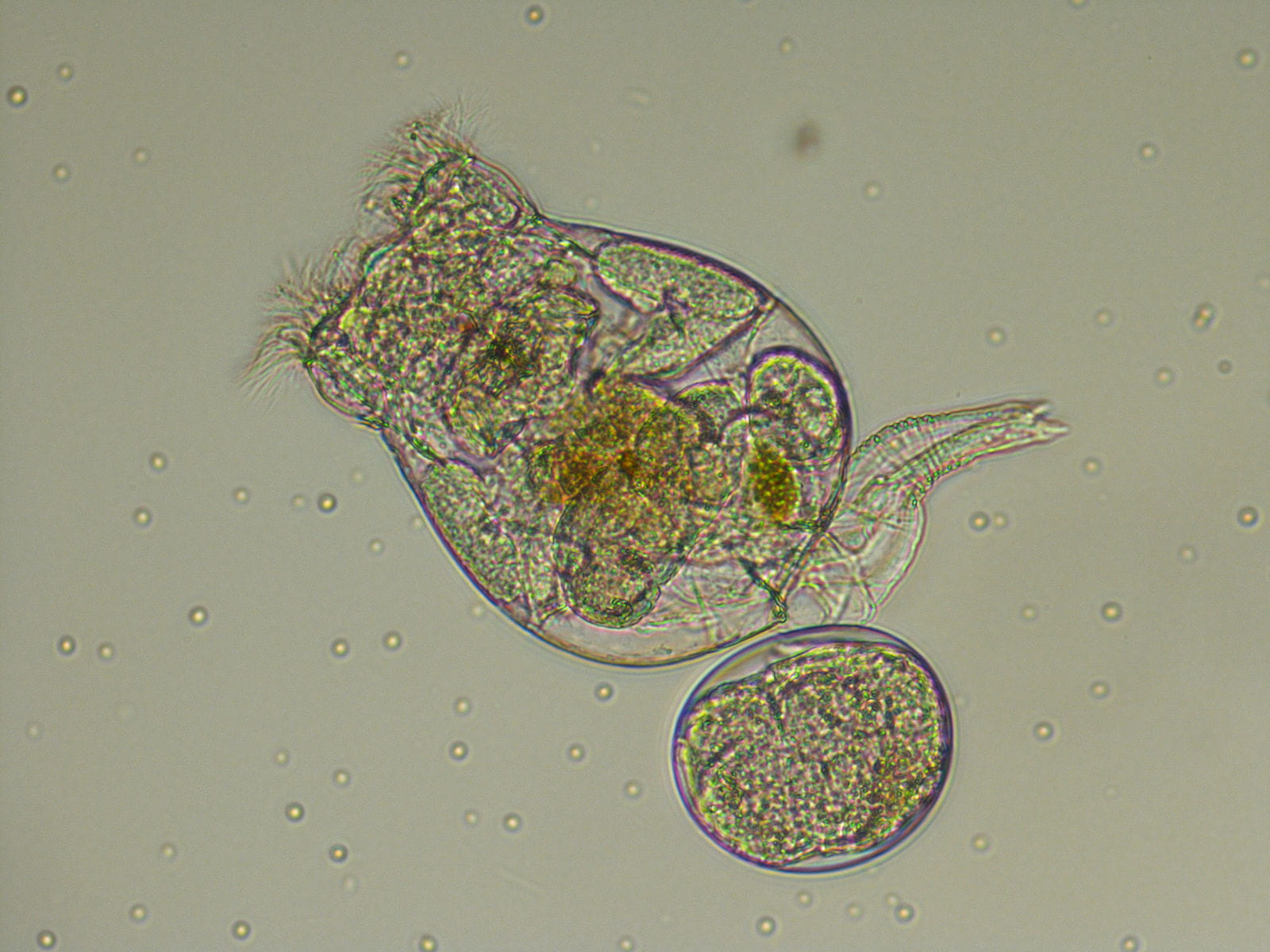
 Saltwater rotifers (Brachionus) as live food
Source and copyright of the header photo: Sofdrakou - Own work, license: CC BY 4.0.
Rotifers, which occur in freshwater as well as in brackish water and saltwater, are with a body length of only 1-3 mm the smallest animals among the multicellular organisms. They have cilia with which they can move through the water in suspension.
The species Brachionus plicatilis, which is frequently used in fish breeding, is found in nature mainly in saline inland lakes and in areas with brackish water. The species is very tolerant of fluctuations in salinity. The ideal is 20 to 40 g of salt per liter of water.
The advantage of feeding live food that lives in saltwater is obvious: you will definitely not bring in freshwater parasites with it.
Brachionus plicatilis reproduces mainly parthenogenetically, that is, by virgin birth. The cultures are therefore entirely female, and the genetic material is passed on unchanged to the daughter animals. Only when conditions deteriorate do males also hatch in this Brachionus species, and sexual reproduction by resting eggs takes place.
Brachionus as live food for fish larvae and shrimp
Because of their small size (and their very soft shell), rotifers are a perfect live food for raising the tiniest fish larvae in freshwater and saltwater, which would still be overwhelmed by artemia nauplii in terms of size. Shrimp also like to eat rotifers.
In themselves, the rotifers Brachionus plicatilis are very low in nutrients, but because of their structure they practically act as carriers for nutrients. They can be enriched very well with high-quality phytoplankton or with additives such as INVE Selco S. parkle. Since they are non-selective filter feeders, you can even administer medication to the fish larvae this way. Rotifers alone do not contain enough nutrients.
If you want to feed Brachionus to juvenile fish in a freshwater aquarium, you should work with a lower salinity from the start to prevent the rotifers from dying when fed. Brachionus grow larger the lower the salt concentration is. It should not be less than 15 g/l, however.
Buying rotifers
The rotifers Brachionus plicatilis are found practically nowhere in nature here, so it is advisable to get a starter culture from fellow aquarists or to buy or order it from a specialist retailer.
Feeding Brachionus plicatilis
Brachionus are non-selective filter feeders that eat microorganisms: bacteria, single-celled algae, dry yeast ... Besides slurried dry yeast, they can also be multiplied very well with the marine alga Nannochloropsis salina. INVE Selco S. parkle can also be used for the general feeding of the rotifers, not just for enrichment. If you want to enrich them deliberately, add the respective products approx. 20 minutes before feeding.
Culturing Brachionus properly
Brachionus plicatilis multiply very well in slightly brackish water up to saltwater with the density of seawater, that is, from 15 to approx. 35 or 40 g/l. A breeding tank of 12 l or more is recommended so that the culture runs well.
The salinity of the starter culture is measured before the culture is added to the breeding tank (a hydrometer is best used for this). The density of the water in the breeding tank is then adjusted to this density, because the rotifers do not tolerate strong fluctuations in salinity. If you want to reduce the density, this should be done very slowly and over a longer period of time. Temperature fluctuations should also be avoided as much as possible. A heater is not necessary in the Brachionus breeding tank.
From time to time the culture should be cleaned so that no Euplotes (ciliates) can accumulate, which can severely damage the Brachionus culture.
Feeding Brachionus
The rotifers are sieved out with a suitable sieve with a mesh size of approx. 50 µm. This way no saltwater from the breeding tank reaches the fish larvae.