
We use cookies to offer you an optimal shopping experience. These cookies can be grouped into categories. The necessary ones are essential for your purchase. Functional services enable additional content such as videos and maps. With further cookies we produce anonymized statistics. Others serve primarily marketing purposes and are used for the personalization of advertising. These cookies are used by 11 Services used in the shop. You can decide for yourself which cookies you want to allow.
We store your choice on your device (“local storage”) and ask you again after 12 months at the latest. You can change it at any time under “Cookie Preferences” in the footer. You can find details on cookie lifetimes and necessary cookies in our privacy policy.
These services are required to run the shop and for your purchase and cannot be switched off.
Strictly necessary cookies enable basic functions and are required for the website to work properly.
Description:
Shop functions: Essential Shop functions This includes: JTLSHOP (cookie, until you close the browser; keeps your session, the cart and your login), consent (browser storage; remembers your cookie choice, 12 months at most, during the session also in session storage), has_starting_point, cur_product_id and product_page_visits (session storage; navigation between products) as well as aquasabi-search-index-last-url, aquasabi-search-index-results and aquasabi-search-index-data (session storage; search results and lists when paging).
easyVision: easyVision lets website visitors customize the display – e.g. by adjusting contrast, font size, line and letter spacing, color rendering, a blue light filter or by disabling animations. Developed and hosted in Germany, the service is GDPR-compliant and supports statutory accessibility requirements (BFSG) from 2025. The service loads its scripts from cdn.sitecockpit.com and stores your settings (easy-vision-*) in your browser storage (no cookies).
Reviews: aquasabi_guid (cookie, 12 months) is only set when you click “Helpful” under a review. It stores a random ID so that the same person cannot count a review as helpful more than once.
Sorting and view: aquaSort and aquaDisplayType (cookies, 90 days) store the sorting or view (gallery or list) that you choose in a product list. They are only set when you choose a sorting or view.
Amazon Pay: Payment processing with Amazon Pay.
The service provider is Amazon Payments Europe S.C.A. Where Amazon Pay is offered (e.g. in the cart and at the checkout), the shop loads scripts and images from static-eu.payments-amazon.com, payments-eu.amazon.com and m.media-amazon.com and sets cookies (language, ledgerCurrency, apay-session-set). You can find out more in the privacy policy at https://www.amazon.de/gp/help/customer/display.html?nodeId=GRFTMVHP4HXMESSP
PayPal: Payment processing with PayPal.
The service provider is PayPal (Europe) S.à r.l. et Cie, S.C.A. Where PayPal is offered (e.g. in the cart and at the checkout), the shop loads scripts from www.paypal.com; for invoice payment via PayPal, c.paypal.com is added for fraud prevention. PayPal stores an entry in your browser storage (__paypal_storage__), and the shop remembers the chosen PayPal payment method in session storage (chosenPPCPaymentOption). You can find out more in the privacy policy at https://www.paypal.com/en/legalhub/paypal/privacy-full
Sofortüberweisung: On the confirmation page after an order with this payment method the shop loads a Klarna logo from x.klarnacdn.net.
Additional functions such as embedded videos and maps, spam protection in forms or the rating badge. Data is transferred to the respective provider when they load.
Show Youtube Videos
Description:
Displaying videos
Processing company:
Google Ireland Limited, Google Building Gordon House, 4 Barrow St, Dublin, D04 E5W5, Ireland
To submit forms on this page, you need to consent to the transfer of data and storage of third-party cookies by Google.
With your consent, reCAPTCHA, a Google service to avoid spam messages via contact forms, will be embedded.
This service allows us to provide our customers with a safe way to contact us via online forms. At the same time, the service prevents spam bots from compromising our services.
After you gave your permission, you might be asked to answer a security prompt to send the form.
If you do not consent, unfortunately you cannot use the form. Please contact us in a different way.
Helps us understand how the shop is used so that we can improve it.
We measure which pages and products are viewed and how visitors move through the shop. Google Analytics sets cookies (_ga, _ga_*) and sends usage data to Google.
Description:
Audience measurement and analysis of how the shop is used
Measures our advertising and enables personalised advertising on other sites.
We measure whether an ad on Facebook or Instagram led to a purchase and show visitors relevant ads again. Cookies are set for this: _fbp and _fbc (Meta) and as_fbclid (ours, 30 days; remembers the ID of the ad click). Meta receives data about your actions in the shop (e.g. product views, cart, purchase), your IP address and browser information; for a purchase our server may also send them directly to Meta (Conversions API). More in our privacy policy (retargeting/remarketing and conversion tracking).
Description:
Measure advertising success and show relevant ads again (Facebook, Instagram)
We measure whether an ad on TikTok led to a purchase. Cookies are set for this: _ttp, ttclid and _tt_* (TikTok) and as_ttclid (ours, 30 days; remembers the ID of the ad click). TikTok receives data about your actions in the shop (e.g. product views, cart, purchase), your IP address and browser information; for a purchase our server may also send them directly to TikTok (Events API). More in our privacy policy (retargeting/remarketing and conversion tracking).
We measure whether an ad in ChatGPT led to a purchase. Cookies are set for this: __oppref and __obref (OpenAI) and as_oppref (ours, 30 days; remembers the ID of the ad click). OpenAI receives data about your actions in the shop (e.g. product views, cart, purchase), your IP address and browser information; for a purchase our server may also send them directly to OpenAI (Conversions API). Data may be transmitted to OpenAI OpCo, LLC (USA). More in our privacy policy (retargeting/remarketing and conversion tracking).
Description:
Measure the success of ads in ChatGPT
Processing company:
OpenAI Ireland Limited, 1st Floor, The Liffey Trust Centre, 117-126 Sheriff Street Upper, Dublin 1, D01 YC43, Irland
We measure whether an ad led to a purchase and show visitors relevant ads again. Google Ads sets cookies (e.g. _gcl_*) and receives purchase data, where applicable in hashed form (SHA-256).
Description:
Measure advertising success and show relevant ads again (remarketing)
We use cookies that are essential for payment processing through our partners. Please select which payment providers you would like to use.
In order to unlock offers for extended payment options, in particular express checkout and payment in instalments, we require your consent to the data transfer and storage of third-party cookies of the payment provider PayPal. This allows us to also offer you express checkout and payment by instalments. Without your consent, only the technically necessary data transfer to PayPal will take place, but you will then not be able to use the express checkout or extended offers for payment by instalments on this site.
Description:
Using express checkout and Displaying offers for payment in instalments for individual items or your entire purchase.
Your consent ID:With this randomly generated number we can show on request what you selected. It contains no information about you.
Data privacy settings
Would you like to see these contents? Activate the desired contents for one session only or allow the website to remember these settings. Once you have given your consent, the third-party data can be loaded. For this, third-party cookies might be stored on your device. You can change these settings at any time (footer: “Cookie Preferences”). For further details, please see the Privacy notice.
In contrast to the Nature Aquarium or aquascaping, the Dutch aquarium follows a path of its own when it comes to designing an aquarium with aquatic plants. We present what this special type of planted aquarium is all about in more detail in our article here.
The history of the Dutch aquarium
The "Dutch style", or Dutch aquarium, is a particular style in planted aquarium keeping that has its origins in the 1960s and 1970s. Typical are not only the layout design in the aquarium but also certain components in the aquarium equipment and furnishings used. Typical for that era, for example, were rustic wood paneling around the tank, which made the aquarium match the living room furniture. While the aquarium hobby had until then put its focus more on keeping fish, the Dutch style focused more on the subject of successfully keeping aquatic plants in an aquarium. Technical achievements that had hardly played a role up to that point can be traced back to the development of Dutch aquariums, such as suitable, high-intensity aquarium lighting, carbon fertilization with CO2 and the regular supply of important nutrients with liquid fertilizers and substrate fertilizers.
As a style, Dutch planted aquariums are considerably older in the aquarium hobby than the Nature Aquarium style founded by Takashi Amano and aquascaping itself, and these planted aquariums are still very popular.
Characteristics of the Dutch aquarium
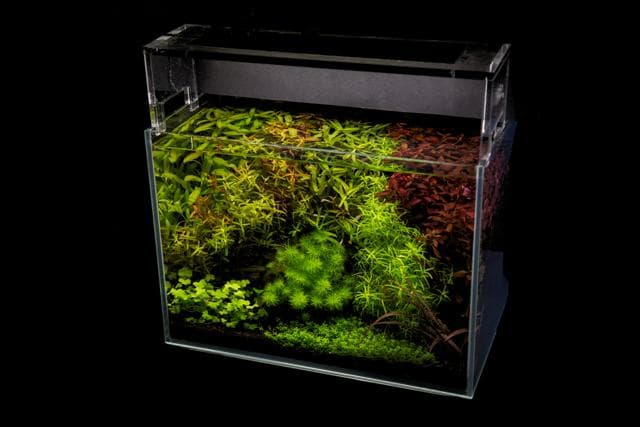
A Dutch aquarium looks less natural than a Nature Aquarium; you could rather compare it to an artificially laid-out flower bed. That does not actually have to be a bad thing; the approach and the aesthetics are just completely different. For Dutch aquariums there are certain design rules, which are meant to be followed but which can be interpreted more or less strictly. Anyone who wants to take part in a competition for Dutch aquariums, however, should know and observe the necessary rules. As early as 1956, certain guidelines were laid down by the Dutch Society for Aquarists (NBAT). They state that only one plant species may be used per 10 centimeters of edge length, and that it may not be repeated anywhere else.
The aquatic plants used are chosen primarily by size, color and leaf shape. The overall layout should radiate harmony, but also show variety and clear structures through plant groups that stand out from one another. These are planted in the plant rows typical of Dutch aquariums, which are also called Leiden streets.
The aquarium plants are arranged in diagonal lines, rising toward the back according to size, which is meant to support the spatial depth effect in the design. The individual plant groups are clearly set apart from one another (by small spaces kept free in between) and do not grow densely against or even into each other.

Freshly planted top cuttings following the principle of the Dutch aquarium, with clearly visible gaps between the groups.
Neighboring plant groups should differ as much as possible in leaf shape and coloring. The side and rear glass panes of the aquarium should, where possible, not be visible but concealed as well as possible by the aquatic plants. In some cases, moss backgrounds are also used to conceal the back. Every now and then, however, a small section with a view of the back wall is left free, acting like a vanishing point for the eye - even though in principle this goes against the strict NBAT rules.
When placing plants and creating depth and contrast, the golden ratio plays a major role in the Dutch aquarium as well. Here, for example, particularly intensely red plants with prominent leaf size can create focal points at suitable spots.
Hardscape in the Dutch aquarium
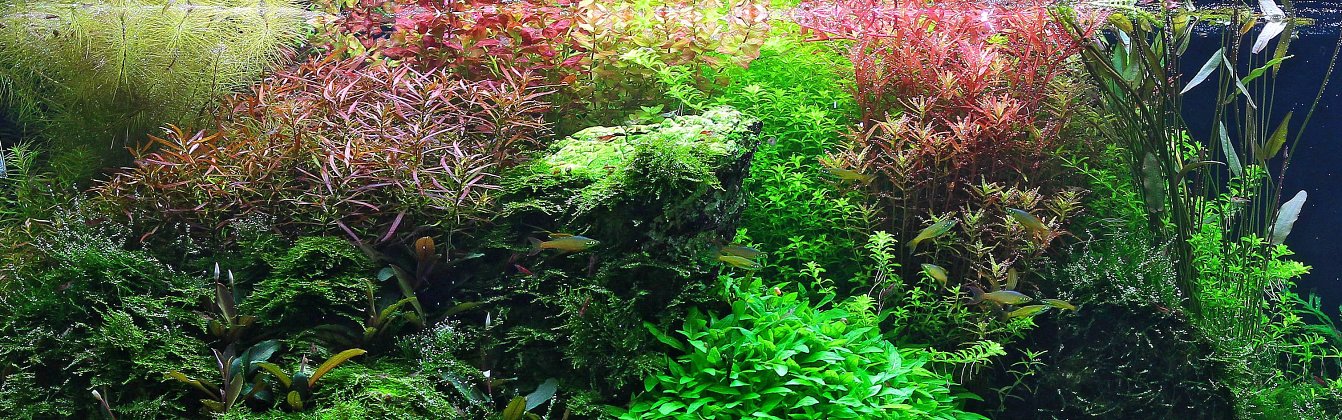
In contrast to Nature Aquariums and aquascapes, the aquatic plants take center stage even more in Dutch aquariums, and decorative materials such as stones or driftwood are used little or not at all. In some cases, the hardscape in this style of planted aquarium keeping merely serves to roughly structure the layout and as a surface for epiphytes and mosses to colonize. Stones and roots are usually largely concealed by aquarium plants or even completely overgrown.
Fish stocking in the Dutch aquarium
Strictly according to the NBAT rules, at least 12 specimens of the same fish species should always be kept together in the aquarium. In Dutch aquariums, the fish stock is rather purist and less colorful and jumbled than in a classic community aquarium. Instead, the focus is on the great effect of a stately school of a schooling fish species, such as many South American tetra species. Here again it becomes clear that in this form of the aquarium hobby, the focus is much more on the aquatic plants: a principle that was later also found again in the Nature Aquarium style and in aquascaping.
Trimming techniques in the Dutch aquarium
Regular trimming and cutting back are of essential importance in a Dutch aquarium. The different plant groups need a clean appearance with clear boundaries from the neighboring groups. It is also important to maintain the height of the aquatic plants, especially in the midground and background of the design. The shoot tips within a group should produce a harmonious overall picture. For this purpose, a special trimming technique is used in which top cuttings of the desired length are cut off and replanted when trimming. The lower, separated shoots are usually pulled out of the substrate and then removed. This trimming method differs clearly from the approach mostly used in aquascaping, in which the lower plant parts are left standing and it is rather the top cuttings that are removed from the aquarium.
Aquatic plants in the Dutch aquarium

Fast-growing stem plants are very often used in a planted aquarium in the Dutch tradition, since this type of aquarium plant offers an extremely wide variety of colors, leaf sizes and growth forms. Nevertheless, Dutch aquarium keeping distinguishes between the three design levels (foreground, midground, background) in the layout, so ground cover plants and slow-growing species are also used for the midground.
Finally, we have put together a short list of popular aquatic plant species for all design zones in the Dutch aquarium.
Foreground:
Ground-covering species are often used in the foreground, although they should spread less by runners so that the plant group can be kept better in check. Species that grow solitarily or stem plants that stay low are therefore popular here. For example:
Stem plants that either grow rather low or are kept at a low level by skillful trimming are also popular for the midground of a Dutch aquarium. Below you will find some examples:
In the background of the Dutch aquarium you can of course draw on the full range and also use many tall and broad-leaved species from the large selection of stem plants. Here you will find some particularly striking species listed.