We use cookies to offer you an optimal shopping experience. These cookies can be grouped into categories. The necessary ones are essential for your purchase. Functional services enable additional content such as videos and maps. With further cookies we produce anonymized statistics. Others serve primarily marketing purposes and are used for the personalization of advertising. These cookies are used by 11 Services used in the shop. You can decide for yourself which cookies you want to allow.
We store your choice on your device (“local storage”) and ask you again after 12 months at the latest. You can change it at any time under “Cookie Preferences” in the footer. You can find details on cookie lifetimes and necessary cookies in our privacy policy.
These services are required to run the shop and for your purchase and cannot be switched off.
Strictly necessary cookies enable basic functions and are required for the website to work properly.
Description:
Shop functions: Essential Shop functions This includes: JTLSHOP (cookie, until you close the browser; keeps your session, the cart and your login), consent (browser storage; remembers your cookie choice, 12 months at most, during the session also in session storage), has_starting_point, cur_product_id and product_page_visits (session storage; navigation between products) as well as aquasabi-search-index-last-url, aquasabi-search-index-results and aquasabi-search-index-data (session storage; search results and lists when paging).
easyVision: easyVision lets website visitors customize the display – e.g. by adjusting contrast, font size, line and letter spacing, color rendering, a blue light filter or by disabling animations. Developed and hosted in Germany, the service is GDPR-compliant and supports statutory accessibility requirements (BFSG) from 2025. The service loads its scripts from cdn.sitecockpit.com and stores your settings (easy-vision-*) in your browser storage (no cookies).
Reviews: aquasabi_guid (cookie, 12 months) is only set when you click “Helpful” under a review. It stores a random ID so that the same person cannot count a review as helpful more than once.
Sorting and view: aquaSort and aquaDisplayType (cookies, 90 days) store the sorting or view (gallery or list) that you choose in a product list. They are only set when you choose a sorting or view.
Amazon Pay: Payment processing with Amazon Pay.
The service provider is Amazon Payments Europe S.C.A. Where Amazon Pay is offered (e.g. in the cart and at the checkout), the shop loads scripts and images from static-eu.payments-amazon.com, payments-eu.amazon.com and m.media-amazon.com and sets cookies (language, ledgerCurrency, apay-session-set). You can find out more in the privacy policy at https://www.amazon.de/gp/help/customer/display.html?nodeId=GRFTMVHP4HXMESSP
PayPal: Payment processing with PayPal.
The service provider is PayPal (Europe) S.à r.l. et Cie, S.C.A. Where PayPal is offered (e.g. in the cart and at the checkout), the shop loads scripts from www.paypal.com; for invoice payment via PayPal, c.paypal.com is added for fraud prevention. PayPal stores an entry in your browser storage (__paypal_storage__), and the shop remembers the chosen PayPal payment method in session storage (chosenPPCPaymentOption). You can find out more in the privacy policy at https://www.paypal.com/en/legalhub/paypal/privacy-full
Sofortüberweisung: On the confirmation page after an order with this payment method the shop loads a Klarna logo from x.klarnacdn.net.
Additional functions such as embedded videos and maps, spam protection in forms or the rating badge. Data is transferred to the respective provider when they load.
Show Youtube Videos
Description:
Displaying videos
Processing company:
Google Ireland Limited, Google Building Gordon House, 4 Barrow St, Dublin, D04 E5W5, Ireland
Helps us understand how the shop is used so that we can improve it.
We measure which pages and products are viewed and how visitors move through the shop. Google Analytics sets cookies (_ga, _ga_*) and sends usage data to Google.
Description:
Audience measurement and analysis of how the shop is used
Measures our advertising and enables personalised advertising on other sites.
We measure whether an ad on Facebook or Instagram led to a purchase and show visitors relevant ads again. Cookies are set for this: _fbp and _fbc (Meta) and as_fbclid (ours, 30 days; remembers the ID of the ad click). Meta receives data about your actions in the shop (e.g. product views, cart, purchase), your IP address and browser information; for a purchase our server may also send them directly to Meta (Conversions API). More in our privacy policy (retargeting/remarketing and conversion tracking).
Description:
Measure advertising success and show relevant ads again (Facebook, Instagram)
We measure whether an ad on TikTok led to a purchase. Cookies are set for this: _ttp, ttclid and _tt_* (TikTok) and as_ttclid (ours, 30 days; remembers the ID of the ad click). TikTok receives data about your actions in the shop (e.g. product views, cart, purchase), your IP address and browser information; for a purchase our server may also send them directly to TikTok (Events API). More in our privacy policy (retargeting/remarketing and conversion tracking).
We measure whether an ad in ChatGPT led to a purchase. Cookies are set for this: __oppref and __obref (OpenAI) and as_oppref (ours, 30 days; remembers the ID of the ad click). OpenAI receives data about your actions in the shop (e.g. product views, cart, purchase), your IP address and browser information; for a purchase our server may also send them directly to OpenAI (Conversions API). Data may be transmitted to OpenAI OpCo, LLC (USA). More in our privacy policy (retargeting/remarketing and conversion tracking).
Description:
Measure the success of ads in ChatGPT
Processing company:
OpenAI Ireland Limited, 1st Floor, The Liffey Trust Centre, 117-126 Sheriff Street Upper, Dublin 1, D01 YC43, Irland
We measure whether an ad led to a purchase and show visitors relevant ads again. Google Ads sets cookies (e.g. _gcl_*) and receives purchase data, where applicable in hashed form (SHA-256).
Description:
Measure advertising success and show relevant ads again (remarketing)
We use cookies that are essential for payment processing through our partners. Please select which payment providers you would like to use.
In order to unlock offers for extended payment options, in particular express checkout and payment in instalments, we require your consent to the data transfer and storage of third-party cookies of the payment provider PayPal. This allows us to also offer you express checkout and payment by instalments. Without your consent, only the technically necessary data transfer to PayPal will take place, but you will then not be able to use the express checkout or extended offers for payment by instalments on this site.
Description:
Using express checkout and Displaying offers for payment in instalments for individual items or your entire purchase.
Your consent ID:With this randomly generated number we can show on request what you selected. It contains no information about you.
Data privacy settings
Would you like to see these contents? Activate the desired contents for one session only or allow the website to remember these settings. Once you have given your consent, the third-party data can be loaded. For this, third-party cookies might be stored on your device. You can change these settings at any time (footer: “Cookie Preferences”). For further details, please see the Privacy notice.
Plants from in-vitro cultivation have some special characteristics, which are mainly due to the way they are cultivated. The special cultivation conditions and the use of growth regulators have an effect on the habitus of the plants, so that their appearance and behaviour sometimes differ strongly from traditionally produced plants. In this article we will go into more detail about the special appearance of in vitro plants.
General information on the habitus of in-vitro plants
The most conspicuous feature of in vitro plants is often the small size of leaves and stems, which is reflected equally on the cellular level in smaller chloroplasts and mitochondria. Since the culture medium provides all necessary nutrients and also complex molecules such as sugars or amino acids, the plant can greatly reduce certain aspects of its metabolism and thus also the size of certain organs. Another factor contributing to this dwarfism is the altered hormonal balance of the in-vitro plants. The phytohormones added to the medium for propagation in early culture stages often have an effect on subsequent culture steps and thus also change the habitus of the plants in the sales cups. This mainly affects the roots as the direct contact to the culture medium, which leads to the fact that some in-vitro plants sometimes develop almost no roots, and others very many. The degree of rooting in a cup is therefore at best an indicator for the propagation method used and allows only limited conclusions about the age of the plants or the storage time of the cup.
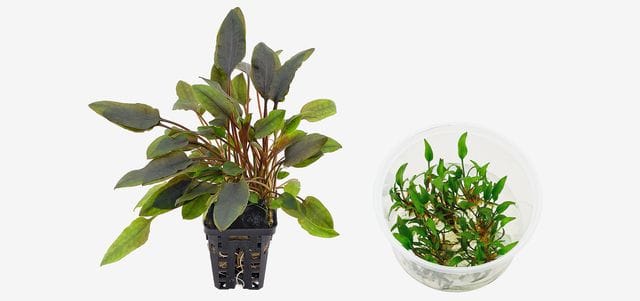
size comparison Cryptocoryne walkeri ‚Lutea‘.
Inside the cups there is only very little or no air exchange, so that the humidity here is always almost 100%. Reinforced cell walls or the wax layer called cuticle on the outside of the leaves, which under normal conditions protect the plant from the weather and predators, are only partially formed here. In vitro plants are therefore generally somewhat more sensitive than emersed specimens.
At the same time, this high humidity means that stem plants in particular often form completely submerged leaves or transitional forms with partially altered colouring already in the cup. This phenomenon can be observed especially directly under the lid of the cups.
Usually, plants require in-vitro cultivation, depending on their natural speed of growth and robustness, a few days to get used to the new conditions in the aquarium. During this time the metabolism of the plants normalizes and the physiological adaptation to the new conditions outside their sterile cup proceeds. This period is characterised by slow to completely stagnant growth, maybe loss of adult leaves, especially in Cryptocorynes and Bucephalandra. Even if such a plant appears to die, this is usually not the case. New leaves, completely adapted to submerged life, will soon start to sprout!
Hyperhydrogenity
Another frequently observed phenomenon is hyperhydrogenity or vitrification.
The tissue of hyperhydrogenous plants appears to be glassy or swollen, affected shoots appear watery and translucent at their surface. Due to chlorophyll degradation and altered protein metabolism, vitrified tissues appear less green than healthy parts of the same plant, grow more compactly and are more fragile.
The occurrence of hyperhydrogenity remains unpredictable, but physiological stress is suspected to be the main trigger for this phenomenon. This can occur, for example, as a result of wounds during routine propagation steps or during transport, or over time as a result of a culture medium that has not been optimally adapted. In most available in-vitro plants, however, the symptoms are most usually caused by the leaves colliding with the lids of their culture cups for a longer time.
This condition results in slower growth and tissue necrosis and is a symptom of physiologically damaged plants. Hyperhydrogenity, however, is reversible, and after careful planting, affected plant parts often produce healthy shoots after some time of submersion.
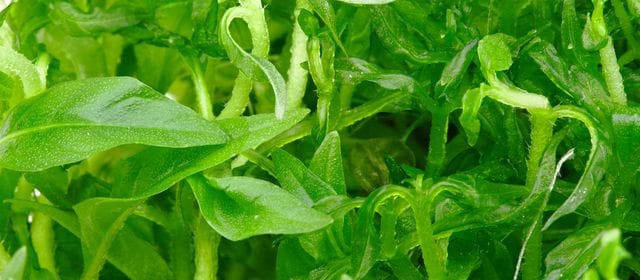
Hyperhydrogenity
Brown or decoloured leaves and shoots
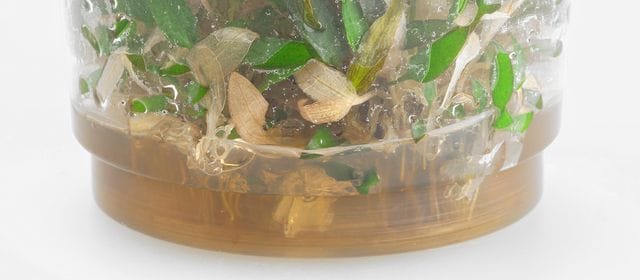
shed Cryptocoryne leaves.
Especially in slow-growing rosette plants such as cryptocorynes, brown or dead leaves are often found in the in vitro cups. This is mainly due to the fact that these slow-growing plants require a longer cultivation time in the cups before the portion is ready for sale. In the progression of regular, natural growth, older leaves are shed. Unlike in nature or in the aquarium, however, the sterile in-vitro conditions lack the microorganisms necessary for the rotting of these leaves, so that they accumulate around the plant over time. Sometimes the culture medium can also get a dark, yellowish-brown tint, since often not all the pigments contained in the leaf can be reabsorbed by the plant.
Even in in vitro cups with a longer standing time, individual brown leaves can sometimes form, while the rest of the plant continues to grow very vigorously and the healthy plant mass increases. In this respect, isolated dead leaves are no cause for complaint if there is still enough healthy plant material left. In the following picture series, you can see how an in-vitro plant develops over a longer period of time inside its sterile cup: In addition to plant growth and the appearance of overaged leaves, discolorations can also be observed in the nutrient medium itself. We cover that topic in more detail in our article "Culture medium of in-vitro plants".
development of an in-vitro plant over time.
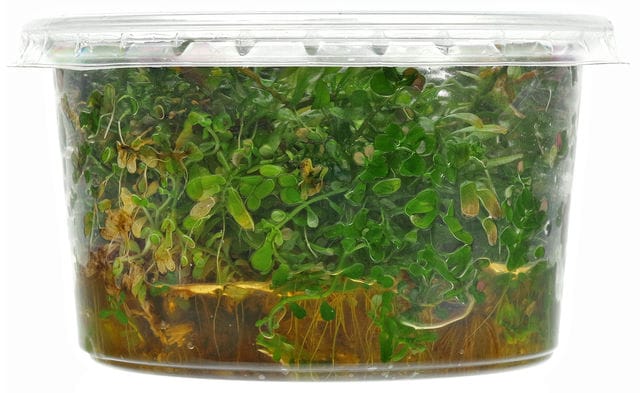
After standing for a longer period, some leaves have turned brown sporadically, while the majority of the plant portion has continued to grow very vigorously.
Stem plants tend to fade in colour from time to time in proximity of the medium - especially with densely packed cups. Due to the dense biomass, light hardly penetrates into the lower areas of the pots, and as a result the chlorophyll is degraded there over time. Affected plant parts appear whitish, and sometimes even leaves can be thrown off in these areas. This phenomenon can be observed increasingly in in-vitro cups with banderoles, as these absorb additional light. After planting into the aquarium, the affected plants quickly form new chlorophyll in the light and continue to grow vitally!
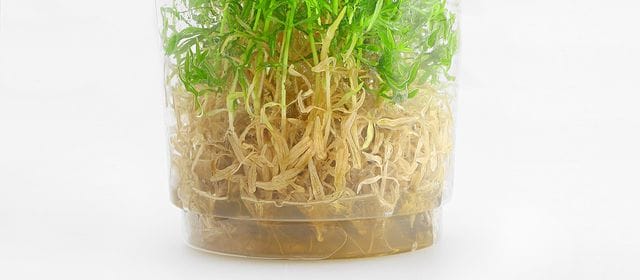
chlorophyll degradation.
Special characteristics of in-vitro mosses
Due to the special conditions inside the in-vitro cups, mosses sometimes show an increased growth of their rhizoids. These root-like adhesive organs can grow out considerably longer here than under normal conditions. As a result, the moss shoot appears brownish, but it is only due to the fact, that the mass of brown cells exceeds that of the chlorophyll-containing cells.
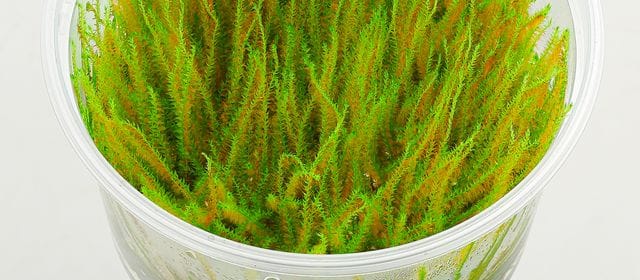
rhizoids.
In some other cases, caused by physiological stress, it may actually occur, that the moss itself actually turns brown. The reason for this is the degradation of the chloroplasts, which subsequently causes the moss to appear yellowish-brown throughout the whole area, although the growth centres of the shoot tips remain green. This change can be observed in mosses pretty often out in the wild as well and is first and foremost a sign of the organism going into a supersustained state. In in-vitro culture, too high temperatures in the cup caused by too much light or sub-optimal nutrient concentrations may be the main causes of such behaviour. Similarly, the medium already provides the necessary nutrients, so that the mosses as simpler organisms are not necessarily dependent on their chlorophyll. Under aquarium conditions, the shoots quickly return to their normal habitus, namely a lush green.