We use cookies to offer you an optimal shopping experience. These cookies can be grouped into categories. The necessary ones are essential for your purchase. Functional services enable additional content such as videos and maps. With further cookies we produce anonymized statistics. Others serve primarily marketing purposes and are used for the personalization of advertising. These cookies are used by 11 Services used in the shop. You can decide for yourself which cookies you want to allow.
We store your choice on your device (“local storage”) and ask you again after 12 months at the latest. You can change it at any time under “Cookie Preferences” in the footer. You can find details on cookie lifetimes and necessary cookies in our privacy policy.
These services are required to run the shop and for your purchase and cannot be switched off.
Strictly necessary cookies enable basic functions and are required for the website to work properly.
Description:
Shop functions: Essential Shop functions This includes: JTLSHOP (cookie, until you close the browser; keeps your session, the cart and your login), consent (browser storage; remembers your cookie choice, 12 months at most, during the session also in session storage), has_starting_point, cur_product_id and product_page_visits (session storage; navigation between products) as well as aquasabi-search-index-last-url, aquasabi-search-index-results and aquasabi-search-index-data (session storage; search results and lists when paging).
easyVision: easyVision lets website visitors customize the display – e.g. by adjusting contrast, font size, line and letter spacing, color rendering, a blue light filter or by disabling animations. Developed and hosted in Germany, the service is GDPR-compliant and supports statutory accessibility requirements (BFSG) from 2025. The service loads its scripts from cdn.sitecockpit.com and stores your settings (easy-vision-*) in your browser storage (no cookies).
Reviews: aquasabi_guid (cookie, 12 months) is only set when you click “Helpful” under a review. It stores a random ID so that the same person cannot count a review as helpful more than once.
Sorting and view: aquaSort and aquaDisplayType (cookies, 90 days) store the sorting or view (gallery or list) that you choose in a product list. They are only set when you choose a sorting or view.
Amazon Pay: Payment processing with Amazon Pay.
The service provider is Amazon Payments Europe S.C.A. Where Amazon Pay is offered (e.g. in the cart and at the checkout), the shop loads scripts and images from static-eu.payments-amazon.com, payments-eu.amazon.com and m.media-amazon.com and sets cookies (language, ledgerCurrency, apay-session-set). You can find out more in the privacy policy at https://www.amazon.de/gp/help/customer/display.html?nodeId=GRFTMVHP4HXMESSP
PayPal: Payment processing with PayPal.
The service provider is PayPal (Europe) S.à r.l. et Cie, S.C.A. Where PayPal is offered (e.g. in the cart and at the checkout), the shop loads scripts from www.paypal.com; for invoice payment via PayPal, c.paypal.com is added for fraud prevention. PayPal stores an entry in your browser storage (__paypal_storage__), and the shop remembers the chosen PayPal payment method in session storage (chosenPPCPaymentOption). You can find out more in the privacy policy at https://www.paypal.com/en/legalhub/paypal/privacy-full
Sofortüberweisung: On the confirmation page after an order with this payment method the shop loads a Klarna logo from x.klarnacdn.net.
Additional functions such as embedded videos and maps, spam protection in forms or the rating badge. Data is transferred to the respective provider when they load.
Show Youtube Videos
Description:
Displaying videos
Processing company:
Google Ireland Limited, Google Building Gordon House, 4 Barrow St, Dublin, D04 E5W5, Ireland
Helps us understand how the shop is used so that we can improve it.
We measure which pages and products are viewed and how visitors move through the shop. Google Analytics sets cookies (_ga, _ga_*) and sends usage data to Google.
Description:
Audience measurement and analysis of how the shop is used
Measures our advertising and enables personalised advertising on other sites.
We measure whether an ad on Facebook or Instagram led to a purchase and show visitors relevant ads again. Cookies are set for this: _fbp and _fbc (Meta) and as_fbclid (ours, 30 days; remembers the ID of the ad click). Meta receives data about your actions in the shop (e.g. product views, cart, purchase), your IP address and browser information; for a purchase our server may also send them directly to Meta (Conversions API). More in our privacy policy (retargeting/remarketing and conversion tracking).
Description:
Measure advertising success and show relevant ads again (Facebook, Instagram)
We measure whether an ad on TikTok led to a purchase. Cookies are set for this: _ttp, ttclid and _tt_* (TikTok) and as_ttclid (ours, 30 days; remembers the ID of the ad click). TikTok receives data about your actions in the shop (e.g. product views, cart, purchase), your IP address and browser information; for a purchase our server may also send them directly to TikTok (Events API). More in our privacy policy (retargeting/remarketing and conversion tracking).
We measure whether an ad in ChatGPT led to a purchase. Cookies are set for this: __oppref and __obref (OpenAI) and as_oppref (ours, 30 days; remembers the ID of the ad click). OpenAI receives data about your actions in the shop (e.g. product views, cart, purchase), your IP address and browser information; for a purchase our server may also send them directly to OpenAI (Conversions API). Data may be transmitted to OpenAI OpCo, LLC (USA). More in our privacy policy (retargeting/remarketing and conversion tracking).
Description:
Measure the success of ads in ChatGPT
Processing company:
OpenAI Ireland Limited, 1st Floor, The Liffey Trust Centre, 117-126 Sheriff Street Upper, Dublin 1, D01 YC43, Irland
We measure whether an ad led to a purchase and show visitors relevant ads again. Google Ads sets cookies (e.g. _gcl_*) and receives purchase data, where applicable in hashed form (SHA-256).
Description:
Measure advertising success and show relevant ads again (remarketing)
We use cookies that are essential for payment processing through our partners. Please select which payment providers you would like to use.
In order to unlock offers for extended payment options, in particular express checkout and payment in instalments, we require your consent to the data transfer and storage of third-party cookies of the payment provider PayPal. This allows us to also offer you express checkout and payment by instalments. Without your consent, only the technically necessary data transfer to PayPal will take place, but you will then not be able to use the express checkout or extended offers for payment by instalments on this site.
Description:
Using express checkout and Displaying offers for payment in instalments for individual items or your entire purchase.
Your consent ID:With this randomly generated number we can show on request what you selected. It contains no information about you.
Data privacy settings
Would you like to see these contents? Activate the desired contents for one session only or allow the website to remember these settings. Once you have given your consent, the third-party data can be loaded. For this, third-party cookies might be stored on your device. You can change these settings at any time (footer: “Cookie Preferences”). For further details, please see the Privacy notice.
In our main article about in-vitro plants we have compiled all important information about in-vitro aquarium plants. In the following article we deepen and explain important details on the nutrient medium of aquatic plants cultivated in-vitro-style.
Intact higher plants can basically grow photoautotrophically. This means that they only need light, water and a sufficient supply of nutrients. Leaves and roots each perform specific metabolic functions that contribute to the growth of the entire organism. In in-vitro culture, depending on the plant species and propagation method, often only individual organs are used for the propagation of the plant, which is why a nutrient medium specially adapted to the plant species must be provided. All nutrient media have in common that they contain not only water but also the macro- and micronutrients, vitamins and phytohormones required for growth.
Liquid and solid media
As a rule, in-vitro plants are cultivated on a solid medium. For this purpose, a solidifying agent such as the gelling agent agar or the thickening agent gellan is added to the nutrient solution.
Agar is obtained from the cell walls of various types of red algae. Since this is a natural product, depending on the degree of purity of the material used, some salt residues may still be present. An agar-based gel retains its strength for a virtually unlimited time, but has a clearly visible whitish haze. The polysaccharide gellan is produced biotechnologically by microorganisms from plant material. The substance has a very high purity due to the manufacturing process, so that corresponding gels appear almost transparent. Due to changes in the pH value of the medium, a gradual liquefaction occurs with long service lives. However, it has no effect on the plants that have already grown inside at this time.
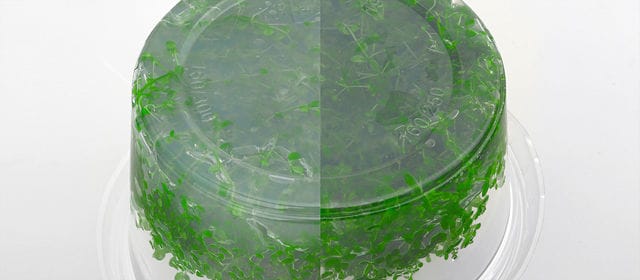
Vergleich Agar (l.) und Gellan (r.).
Both gelling agents are completely harmless to aquarium inhabitants and are also used, for example, in the food industry to solidify soups and jams. Nevertheless, it is advisable to remove the gel thoroughly before planting in vitro plants, as it contains many nutrients and sugars and could contribute to bacterial water turbidity, especially in small aquaria (refer: "Preparing in-vitro plants").
The culture medium consists mainly of water and is therefore always subject to a certain amount of natural evaporation in unsealed pots. Occasionally this can lead to a certain shrinkage of the medium. In such cases, however, the nutrient medium is by no means "used up" or "too old" and usually still contains all the necessary nutrients.
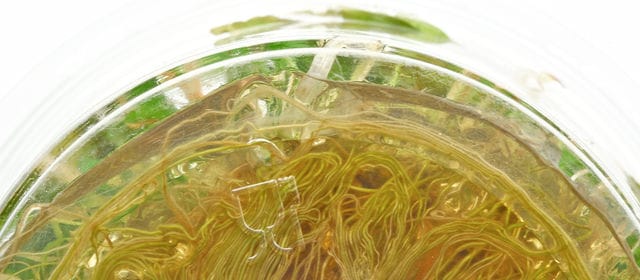
shrunken gel
Instead of shrinkage, a certain liquefaction of the medium may occur over time or during transport. The gelling agents used form a kind of 'sponge' on a molecular level when cooling, which absorbs water. If this structure is disturbed, it can release the bound water again and the medium loses its strength.
Both phenomena are primarily due to technical reasons and are not a quality feature of the plants cultivated on the medium. They can be used in the aquarium without hesitation, regardless of the condition of the medium. After all, the medium should be removed anyway before planting.
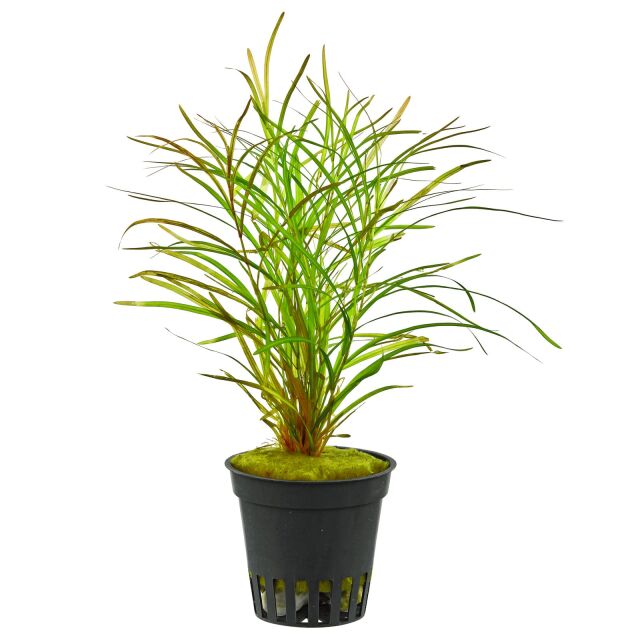
Tropica now largely dispenses with the use of solid culture media in its 1-2-Grow! pots. This has the advantage that the liquid culture medium only has to be poured off and possibly rinsed off briefly. The more time-consuming removal of the solid medium is no longer necessary and the plants can be planted more quickly. These slightly different cultivation conditions can sometimes lead to a habitus in the plants in the 1-2-Grow! pots which is very similar to the submersed form.
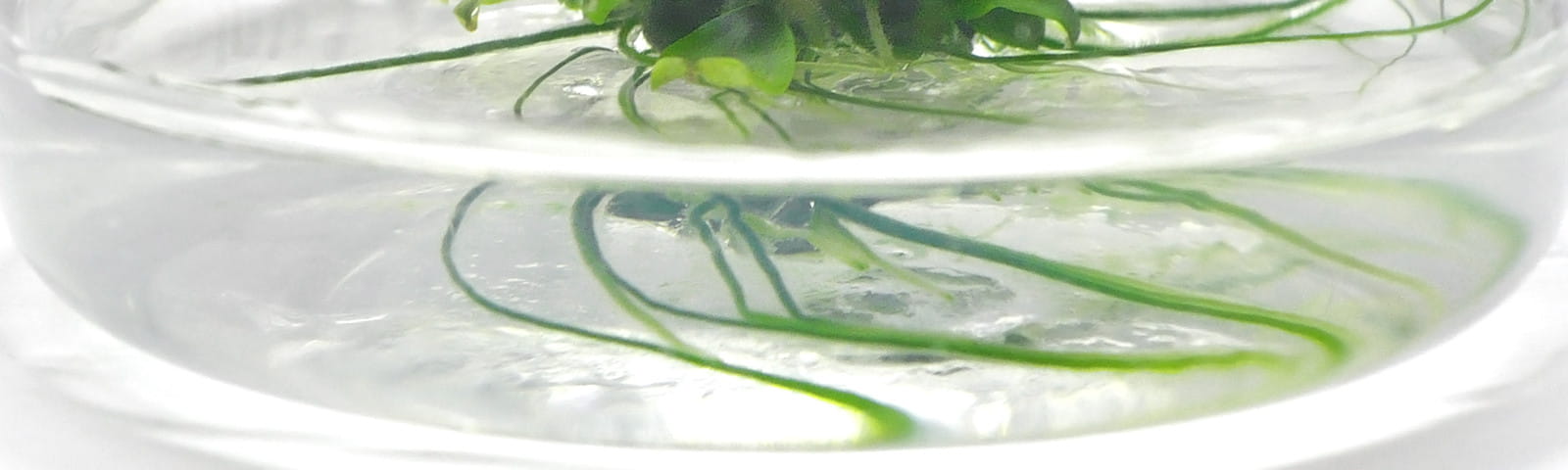
True aquatic plants like Potamogeton gayi are generally cultivated in a liquid medium without the addition of gelling agents, as these cannot survive emers even under in vitro conditions.
Potamogeton gayi in liquid nutrition medium.
Colour of the medium
As already mentioned, the gelling agent used gives the culture medium a characteristic colour, which can range from completely transparent to milky white. The cultivation of certain plants also requires other additives that can change the colour of the gel. One of the most common colouring additives, for example, is activated carbon, which strongly clouds the medium and makes it appear grey to deep black.
However, the most common cause of discoloration of the culture medium is the plants themselves. During growth, these plants transfer various secondary metabolites to the medium via their roots. Small wounds of the plants cannot be avoided during the propagation of in vitro cultures by division and planting of the pots. From these wounds, plant juices and the dyes they contain seep into the nutrient medium. Occasionally, in vitro plants also discard individual older leaves in their pots, which can also release colouring substances into the medium when they decompose. (refer: "Appearance of in vitro plants").
Unlike in nature or in the aquarium, where the microorganisms living in the soil break down the plant excreta or are simply not visible in the dark substrate, the secondary plant substances accumulate over time in the sterile nutrient medium and can thus lead to discoloration. These are completely natural processes. As a rule, such discolorations are absolutely harmless and do not affect the plants.
Here you can see the time course from the bottom of the cup. Gradually discolorations accumulate in the medium.
The most common examples of such discolorations are:
Water hyacinth plants such as Heteranthera zosterifolia or Eichhornia diversifolia produce large amounts of a blue-black pigment from the anthocyanin group. This often makes the culture medium appear deep black.
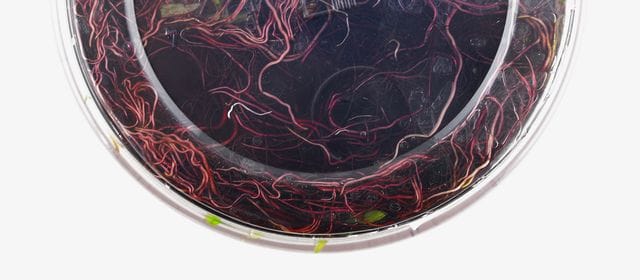
Anthocyanins in Eichhornia diversifolia.
Marsilea crenata have a high carotenoid content. These often lead to a yellowish-orange coloration in the medium.
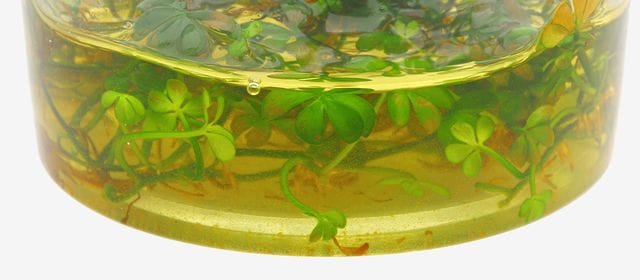
Carotinoids in Marsilea crenata.
Phenolic substances serve the plant, among other things, as messengers and as protection against predators. These substances are highly reactive and, in in-vitro culture, lead to a brownish to black discoloration of the nutrient medium around the root area. This effect occurs especially in Rotala species. In young cultures an excess of such substances can lead to
damage, but this does not pose a risk to the adult plants in their pots.
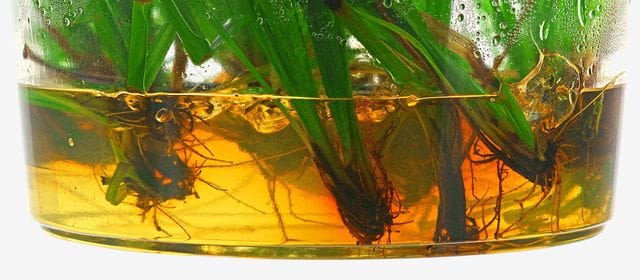
Phenolic excretions in Cyperus helferi.
Discoloured culture medium and rough shipping
In-vitro aquarium plants that have a discoloured nutrient medium for the various reasons explained above and on top of that, have also clearly been shaken back and forth by the parcel shipment, can look particularly horrific. The movement during transit mixes plant material and nutrient gel and compresses the plant matter, usually on one side. The result looks sometimes like an unsightly plant ball mixed with brown culture medium. You can see the difference in the following A/B photo comparison:
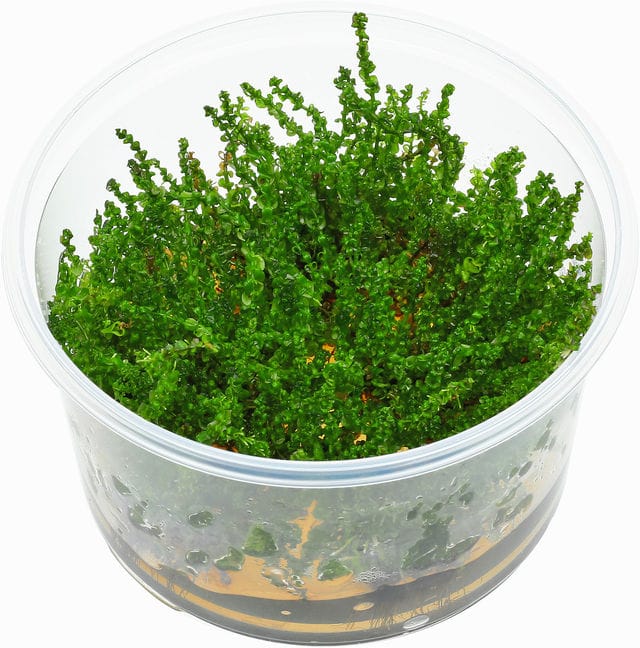
Completely vital looking in-vitro plant with brown nutrient medium before shipment.
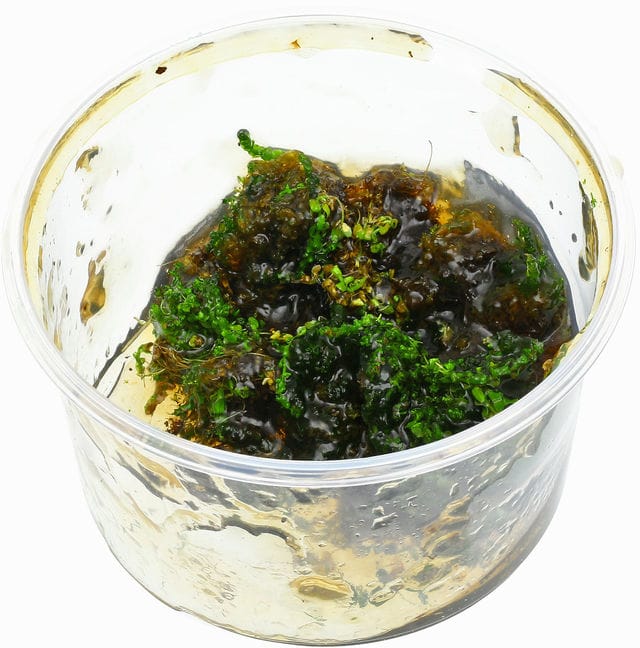
The same plant after a particularly rough shipping route.
Even if the result looks really haggard at first: the plant is still absolutely healthy and neither rotten nor bad. The brown coloration is only caused by the older culture medium in combination with the rough shipping. The in-vitro aquatic plant can therefore be used without trial and error and will grow and thrive well, provided that the nutrient conditions are good. As always, the medium should be thoroughly rinsed before planting. You can find more information about shipping in-vitro goods here.