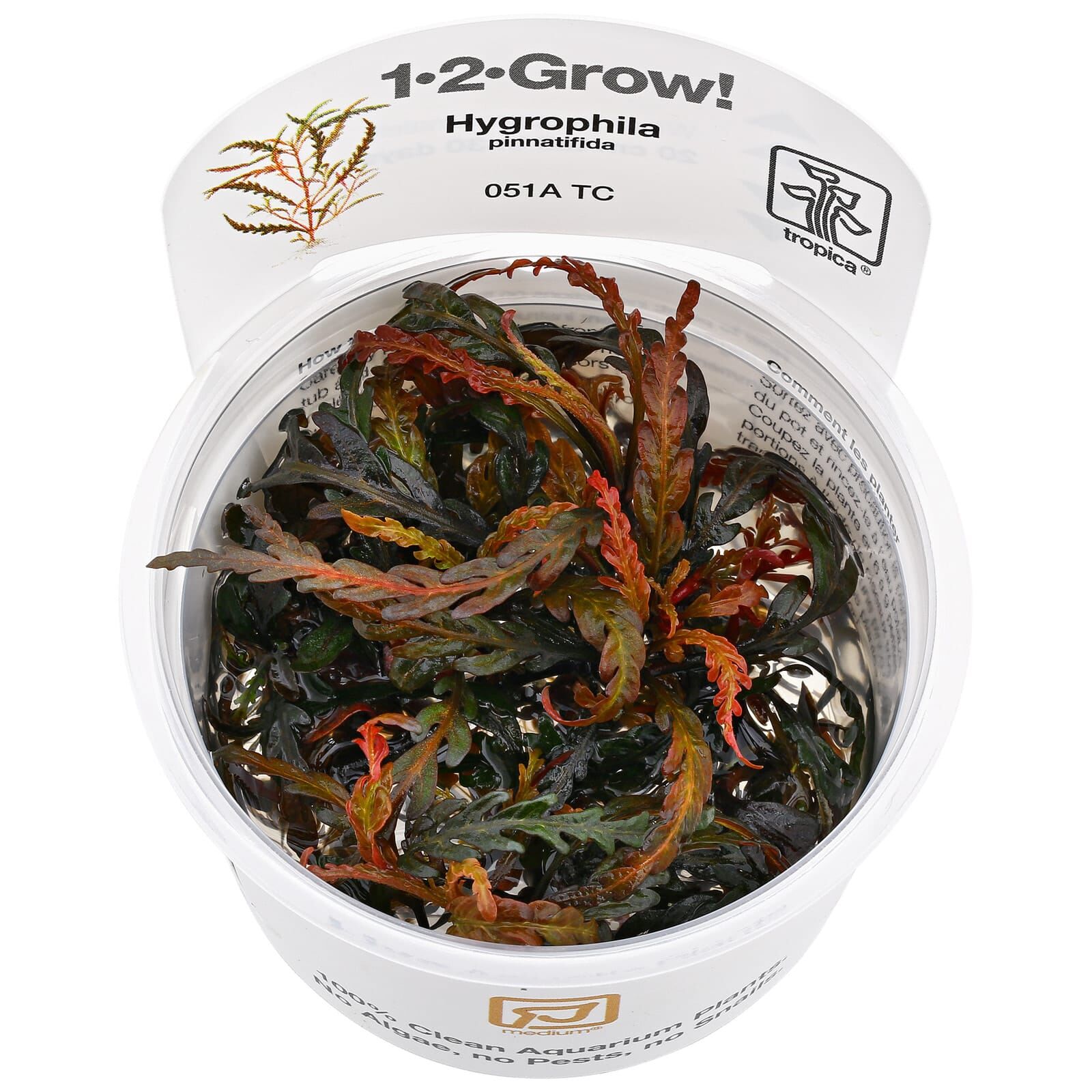
In-vitro aquarium plants
Published
Translated from German with AI assistance and reviewed by our editors.
In addition to plants and potted goods, the so-called in-vitro cultivation of aquarium plants as a salesform and rearing method has established itself as a fixed standard in aquaristics over time. The in-vitro product offers many advantages, but also raises some questions for the aquarist. In this article we would like to deal with the topic in-vitro in more detail.
What is in-vitro cultivation?
The term in vitro is Latin and means "in the glass". From a scientific point of view, this describes any process taking place outside of a living organism (which would be in vivo). For these types of experiments or cultivation, artificial environments are created, e.g. in a petri dish or a test tube.
The in-vitro cultivation of plants means, that individual cells or plant parts are cultivated on nutrient media under sterile, laboratory conditions. By adding certain growth regulators such as phytohormones, new and intact plants can be generated from small pieces and even cells.
These can serve as raw material for further propagation, or they can be delivered to nurseries and customers for further cultivation under regular conditions..
Compared to classical propagation methods, in vitro culture offers various advantages. For example, the propagation rate is significantly higher and the cultures are free of pesticides and undesirable foreign organisms such as parasites, pathogens, snails, planaria, insect larvae, algae and annoying "weeds" such as duckweeds. In-vitro plants are therefore a very good choice, especially for shrimp breeders. These aquarium plants do not need to be watered down or searched for pests. In addition, plants from in vitro cultivation have some special characteristics which should be considered and which are mainly due to the special way of cultivation. We will go into these in more detail below.
Medium used for cultivation
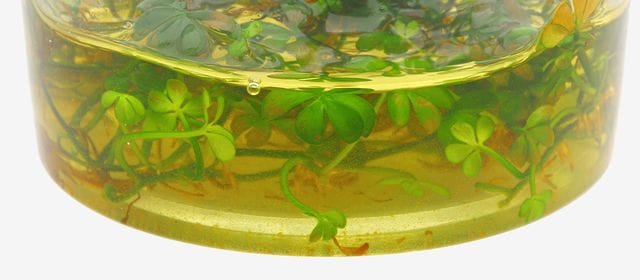
A nutrient medium for in-vitro plants contains all necessary micro- and macro-nutrients, vitamins, phytohormones and water. Depending on the plant species and method of propagation, in-vitro culture of aquatic plants often only requires certain parts or organs. Depending on the type of plant, a special nutrient medium is used. This means that the culture media of different plant species can differ quite greatly.
Depending on the plant species and in-vitro laboratory, the nutrient medium may be available in a slightly firmer, but also more liquid form. In addition, different colourings are possible. The consistency or colour of the culture medium can also change over a longer period of time. However, this has no negative influence on the quality of the aquatic plants cultivated in it. In the article "Culture medium of in-vitro plants" we deepen this topic and report about the most different explanations and changes of the nutrient medium.
Appearance of in vitro plants
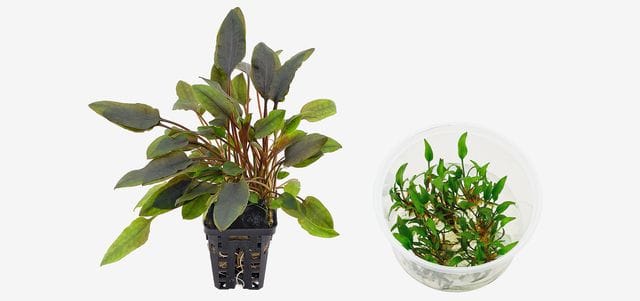
In-vitro aquatic plants usually stand out due to their dwarfish appearance. While leaves and stems are very small, the root system can be disproportionately large - or super tiny. The dwarfish growth is due to the nature and contents of the nutrient medium. In addition to all important nutrients, it also contains sugar or amino acids so that the plant can significantly reduce certain parts of its metabolism and thus also the size of its organs. The hormonal balance of the in-vitro aquarium plants, which is altered by the addition of phytohormones, also contributes to this small growth and the "strange" root growth.
However, this very peculiar habitus of in-vitro plants with extremely small growth and unusual root formation is not an indication of poor quality of the affected plant or even allows conclusions to be had about (too) long storage or the age of the plants. Rather, these are perfectly normal side effects that occur due to the special culture form. These include other phenomena, such as a strangely glassy or swollen appearance due to hyperhydria (excessive water absorption), brown or colourless leaves or an unhealthy appearance, especially in mosses! More information on these topics can be found in the article "Appearance of in-vitro plants".
In vitro plants with mould, fungus or bacteria infestation
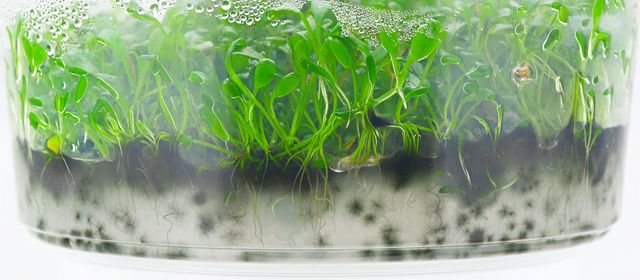
The great advantage of in-vitro cultivation is, that the plants are grown under sterile conditions. Aquarium plants in this form can therefore be sold as free from pesticides, pests, foreign plants, algae spores and germs. However, if an in vitro pot is damaged or opened, for example by improper use, contamination by foreign organisms may occur. These are often moulds, yeasts or bacteria. These find ideal growth conditions in the culture medium and can harm the plants by using up all the nutrients, but also by secreting toxins.
Therefore, when handling in-vitro goods, care must be taken to ensure that the cups remain closed and intact at all times. Once opened, sterile cups should also be completely used up so that no plant remains stay inside the open pot together with the nutrient medium for a longer period of time.
At Aquasabi we pay particular attention when shipping the plants to ensure that the in-vitro cups are properly packed and survive transport as undamaged as possible.
Would you like to know more about such an infestation of in-vitro plants? Then have a look at our article "Contaminations of in-vitro plants" in our Aquascaping Wiki.
Dispatch and storage of plants from in-vitro culture
In vitro plants for the aquarium market are grown in a tightly closed container with the appropriate nutrient medium. As long as this self-contained ecosystem remains intact (no damaged shell or open lid), this form of sale offers many advantages. For the retailer, there is no need for time-consuming relocation and cultivation in a plant sales facility. If in-vitro plants are stored in a cool place (preferably slightly below 20°) and provided with sufficient light for their photosynthesis activity, the in-vitro product can survive in the sterile cups for a longer period of time without much maintenance. How long the in vitro plant lasts depends on the external conditions, but also on the respective plant species. Slow-growing plants such as mosses or cryptocorynes are quite long-lasting in in-vitro culture. The situation is different with typical stem plants, which grow and consume their nutrients quickly. Such plant species should therefore be placed in an aquarium as soon as possible.
Since the sterile cups must remain intact and contain quite loose and light objects (plants and nutrient medium), the dispatch of in-vitro goods is much more difficult than that of conventional plants. We at Aquasabi are aware of this fact and pay special attention to sufficient padding when packing the in-vitro cups. However, turbulent parcel shipping may cause in-vitro cups to open and thus lead to contamination. It is therefore always recommended that the aquarium owner uses the plants within a few days of receiving them and uses them up completely.
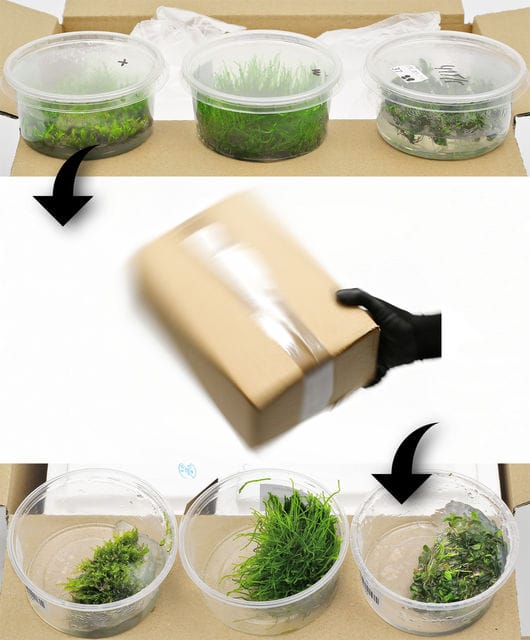
Every purchaser of in vitro plants should also be aware of the following - especially if a purchase is made via an online shop with subsequent parcel delivery: Due to the loose objects and corresponding amount of empty space inside the in-vitro cups, they can be formidably shaken during transport. Due to this it may come to be that nutrient gel and plants mix with one another quite heftily, or however, that the plants grown over the bottom of the cup are squeezed closer together, making the plant portion look considerably smaller. Both cases, however, do not represent a loss of quality of the product, after all, the nutrient gel should be washed off the plants one way or the other. In order to facilitate planting, a plant portion is later loosened up and divided into smaller pieces anyway. (siehe auch "Preparing aquatic plants").
You can find further information about shipping and storage of in-vitro plants here.
Dry Start and Wabi-Kusa with in-vitro plants
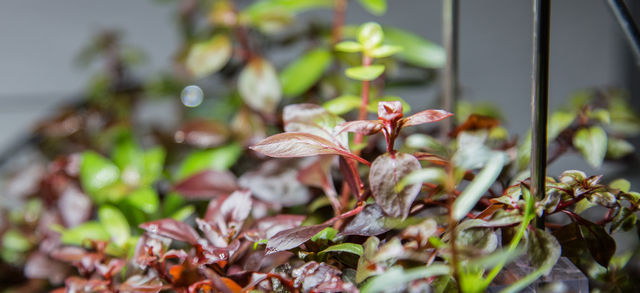
Of course, aquarium plants from in-vitro culture can also be used emersed during a dry start or in a Wabi-Kusa. Most plant species which have been cultivated in-vitro are usually already in their overwater form and can therefore grow well emersed. However, it should be noted that in vitro aquatic plants are accustomed to a very high humidity (constant almost 100%) in the closed environment of their sterile cups. When planting in a different environment, the aquarist should therefore take care to keep the humidity as high as possible in the first few weeks.
Due to the special form of cultivation, in-vitro plants are less robust against mould and bacteria or other external influences. Here emerse potted plants have a clear advantage.
Notwithstanding, a dry start, planting of a Wabi-Kusa or other emerse uses of in-vitro plants are possible. We will now go into the respective framework conditions in more detail.
Dry Start with in-vitro plants
In a so-called dry start, an aquascape is set up and planted as normal with substrate, stones and roots. However, the tank is not flooded immediately afterwards, but covered with e.g. cling film, so that the interior can be kept moist. The plants then continue to grow in their emersed state and can grow roots at rest. How that procedure works in detail is described in this article. Such a dry start is also possible with in-vitro plants if the appropriate framework conditions are created. In the first few weeks, a particularly high level of humidity must be ensured, which can be achieved by spraying the plants and covering them as tighly as possible (with e.g. cling film) during this period. Since in-vitro plants are more sensitive to bacteria and mould infestation, the aquarist should take special care here.
In-vitro plants and Wabi-Kusa
A Wabi-Kusa is another nice way to cultivate emersed aquatic plants further. You don't know what a Wabi-Kusa is? Then click here. Similar to the dry start, the same precautions have to be taken when building a Wabi-Kusa if you want to use in vitro goods. Also in this case you should aim for a particularly high humidity during the first weeks. The glass vessel of the Wabi-Kusa is sealed as airtight as possible with cling film. After a few weeks, when the plants have changed, you can gradually loosen the foil and aim for a reduced humidity.
Further info on Wabi-Kusi can be found in this article in our Aquascaping Wiki.
Preparation of in-vitro plants
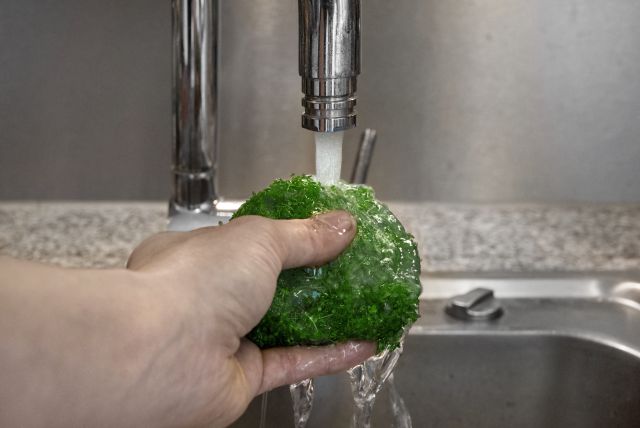
Aquatic plants from in-vitro culture can easily be prepared for aquarium use. In contrast to potted goods, there is no need to pluck the plants out of the rock wool. The most important thing is to remove the nutrient medium, which can be rinsed under slightly tempered, running water or dissolved in a longer water bath without further action.
Depending on the type of plant, it is advisable to divide the contents of the cup into smaller individual plants or portions. This makes planting much easier and the content much more productive in relation to the area planted. This is particularly important for plants that cover the ground.
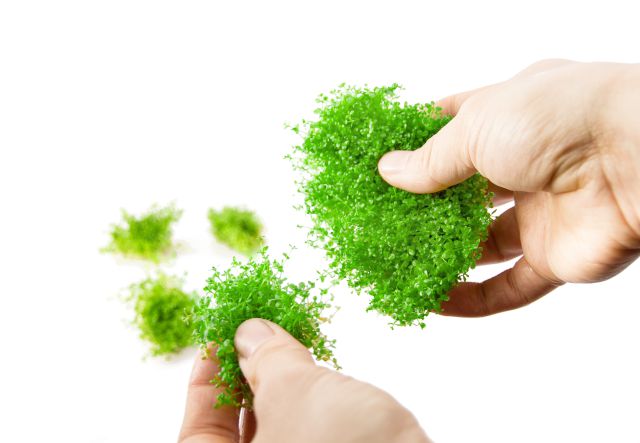
More tips and tricks for planting and preparing in vitro plants can be found in our articles "Preparing in-vitro plants" and "Preparing aquatic plants".
Conclusion, advantages and disadvantages of in-vitro plants
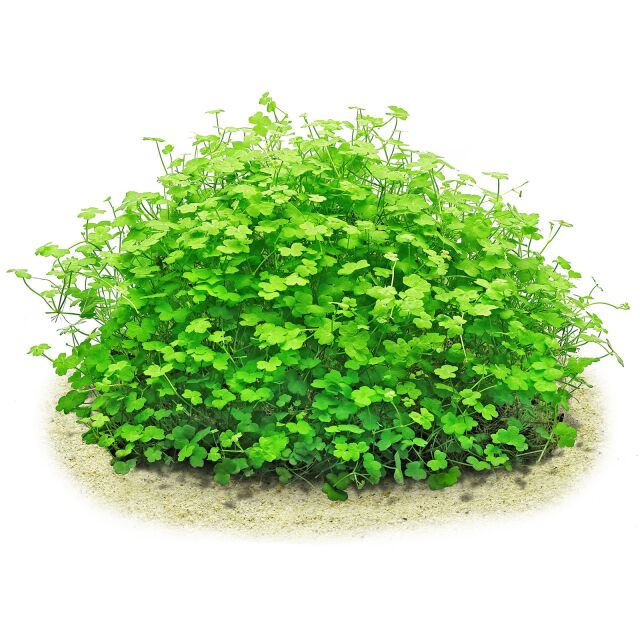
The in vitro cultivation of plants is a very complex subject with many species-specific peculiarities, which cannot be dealt with exhaustively even in an extensive article such as this one. At the end of the culture, when the sales cup is opened to plant the aquarium, only the vitality of the respective plant remains as the decisive criterion. Many conspicuous features of in vitro cups, such as a discoloured culture medium or an unusual habitus of the plants, can be directly explained by the special culture conditions. As a rule, however, these plants can still be used in the aquarium without hesitation.
Plants from in-vitro culture offer many advantages. The freedom from algae, germs, pests and foreign plants is unique and makes the use of these aquatic plants very easy and carefree, especially in aquariums with invertebrates. Finally, pesticides and other substances, which could harm shrimp, are also done away with, and the annoying pre-watering of plants is therefore no longer necessary. We have described further differences between in-vitro and potted plants in this article in more detail.
Sollte die sofortige Verwendung der Pflanzen einmal nicht möglich sein, so können in-vitro-Pflanzen ungeöffnet einige Tage bis zu ihrem Einsatz überdauern. Bevorzugen sollte man für diese kurzzeitige Zwischenlagerung moderates Licht und eine eher kühle Raumtemperatur.
However, the buyer should also be aware of the disadvantages. The customer's satisfaction often fails due to false expectations. If you look at how aquatic plants were sold and used in the time before in-vitro goods and emersed potted plants, you will see that they were usually submerse bundles which did not have to adapt to the conditions under water first. At that time, the "bought as seen" principle still applied a little bit here, one chose something according to optical criteria and the plants continued to grow exactly in this appearance. With emersed potted plants, the novelty was, that the plants had to adapt to being kept under water first. But as a rule, the buyer always received a "good portion" in the form of a pot with lush vegetation. With today's in-vitro products, the difference to traditional bundles is even more extreme, and due to the special form of cultivation, there is sometimes an enormous difference between the appearance and size of the plants at delivery and the appearance of the aquatic plants after a few weeks, when they have completely changed over to their underwater form. This is of course also species-dependent and can therefore be more or less pronounced. Nevertheless, when buying in vitro aquatic plants, you should say goodbye to the expectation that the size and size of the plants will be similar to those of submerged aquarium plants. Rather one should understand in-vitro goods rather as seedlings or young plants, which one must still raise something, before they can unfold their full beauty and abundance.
The physiological characteristics of in vitro plants often lead to a prolonged change in growth after introduction into the aquarium. During this adaptation period, growth stagnates and some plants may even appear to die. Normally, however, the old stems and rhizomes are soon replaced by vital new shoots adapted to submersed growth. All you need here is a little patience!