 Assimilation in Aquarium Plants
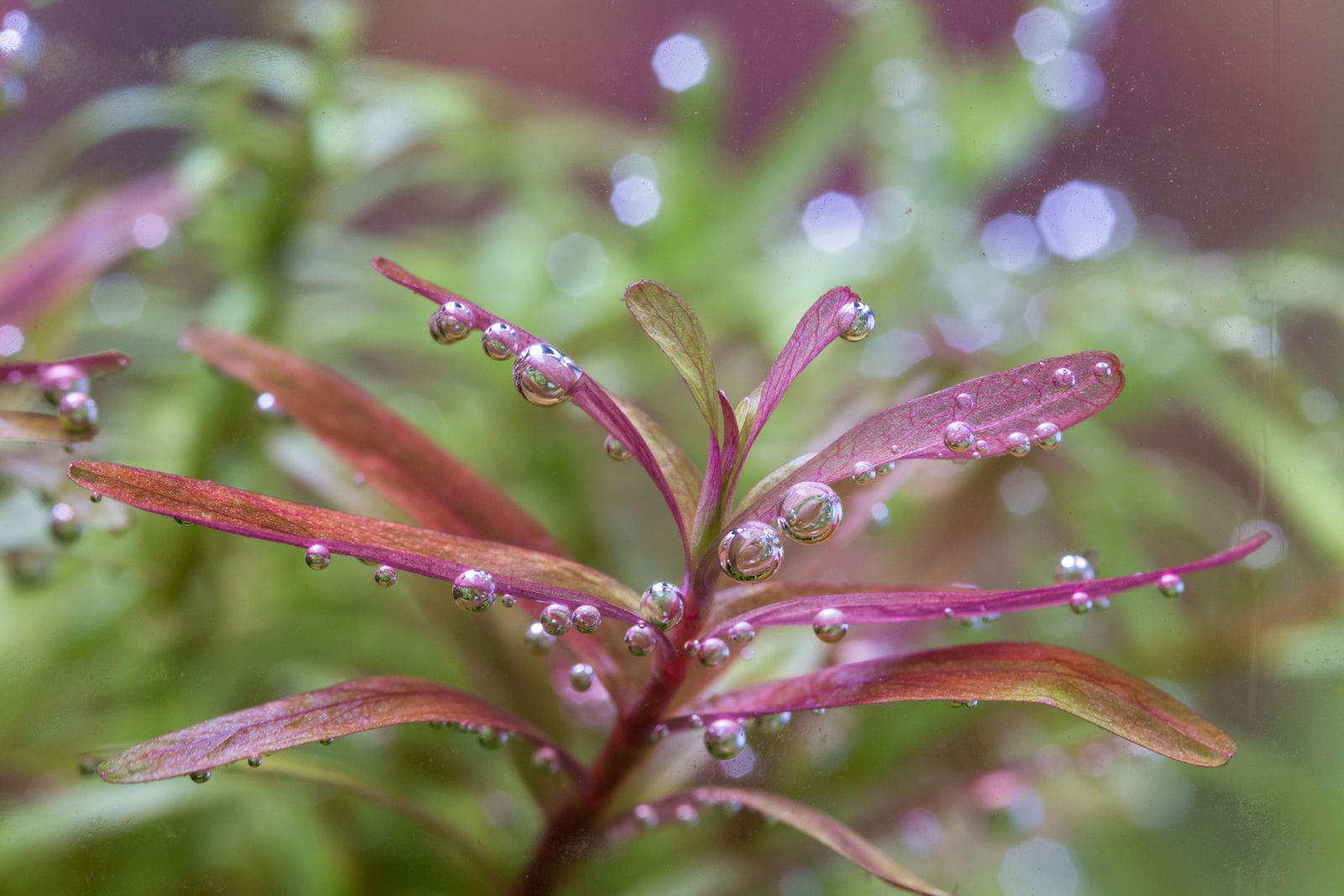
Many planted-tank aquarists can sometimes spot visible gas bubbles on their aquatic plants. In this article, we explain what these are.
If you can rule out that the bubbles are CO2 from a diffuser that has "stuck" to the plant leaves, for example, then these small bubbles are usually simply oxygen that is produced by the aquarium plants as part of photosynthesis.
Photosynthesis is a special form of the assimilation of carbon, which is one of the most important nutrients for plants. With the help of light energy, glucose, for example, is produced here from CO2 and water. Pure oxygen (O2) is created as a by-product. This process is therefore also called oxygenic photosynthesis:
- 6 H2O + 6 CO2→ C6H12O6 + 6 O2
The fact that the oxygen becomes visible in the form of bubbles is related to the oxygen saturation of the water. If more and more O2 is produced throughout the day, at a certain point the water can no longer absorb oxygen in dissolved form. Only a gaseous state is then possible, which shows here in the bubbles. Depending on the light intensity, you can also observe the formation very clearly on the plant leaves, and how the bubbles then rise upward. Often the "aquarium system" needs a little time for this too, and the bubbles only form after a few hours or only toward the evening, because the oxygen saturation then keeps rising over the whole period until the saturation limit is finally reached.
In an aquascape or planted aquarium, for this phenomenon to occur, besides the provision of all important nutrients (micro- and macroelements, carbon), sufficient light must above all be present. Under low-light conditions, exceeding the oxygen saturation limit is rather unlikely. As a rough guideline, a moderate light intensity of around 30 lumens per liter is a good minimum requirement. Values of 45 to 60 lumens per liter increase the chance significantly. Here it is also more likely that bubble formation takes place after only a short wait after switching on the lighting.
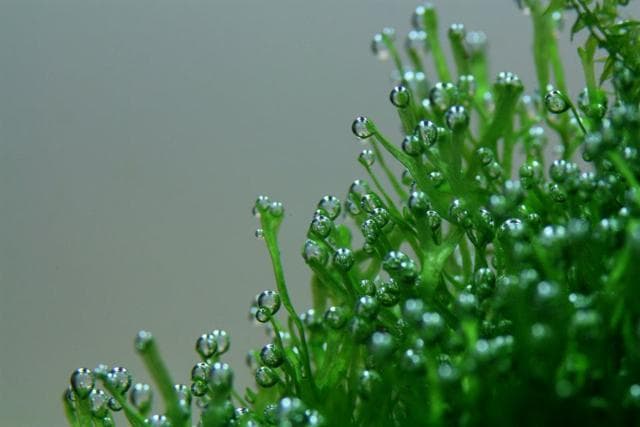
Certain plants tend to form oxygen bubbles more than others. You can observe this well on injured plant parts, for example after trimming. Here the structures are open and the gas can escape unhindered. Aquarium plants with a fast metabolism in particular, which includes above all stem plants but also many ground cover plants, tend very strongly toward visible oxygen production. A prime example is also Riccia fluitans (see picture).
Fish aquarists can also sometimes observe this phenomenon, namely after a water change. Our tap water is heavily enriched with oxygen by the waterworks. If you then add this fresh water to the aquarium in large amounts, the oxygen content rises abruptly and can also exceed the saturation limit. Air bubbles then form as well. This effect is only short-lived, though, until the water has "outgassed". In regular operation, the bubbles are then no longer visible in a fish aquarium.
Aquatic plants that visibly assimilate through the formation of oxygen bubbles are no cause for concern in planted aquariums. Quite the opposite: it is a fairly good proof that the plants' metabolism is working well. Conversely, this means: if a planted aquarium normally produces oxygen bubbles every day and then suddenly no bubble formation is visible, this is often a sign of a disturbed metabolism. The aquarist should then check the nutrient values, since apparently one or more nutrient elements are lacking (see also Liebig's law of the minimum).