Which Aquatic Plants for My Aquarium?

By Aram Schneider Published Updated
Translated from German with AI assistance and reviewed by our editors.
The selection of different aquarium plants is now immense, and newly discovered species are constantly being added that expand the world of the aquarium hobby. Which types of aquatic plants are there, and which suit my aquarium? Many customers ask themselves this and are sometimes a little overwhelmed by the large selection. Here we offer some help.
Division into design layers
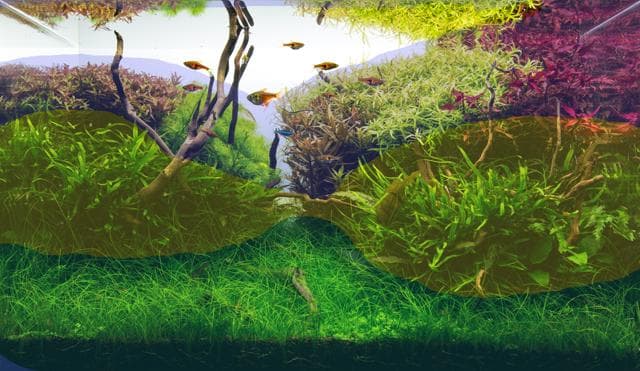
The zones foreground (green), midground (yellow) and background (blue), using this planted aquarium as an example.
Besides a great variety in color and leaf shape, the growth height above all plays a decisive role when choosing aquatic plants. In aquarium design, there are basically three design layers: the background, midground and foreground. Low-growing species and ground cover plants are used in the front area of an aquarium. At the back, along the rear pane, you preferably use tall-growing species such as fast-growing stem plants. Thanks to their rapid growth, they often cover the entire rear pane within a short time and then grow up to the water surface. They also serve as suitable hiding places and retreats for the inhabitants of the aquarium. The layer between the foreground and the background is the so-called midground. Slow-growing plants that only reach a medium height are often used here. Since decorative items such as stones and driftwood are usually also placed in this area, they can be greened well with epiphytes and mosses.
While the design layers refer to areas across the depth of the aquarium, you can also consider the different water zones. After all, an aquarium is a three-dimensional object. The water zones refer to the areas arranged along the height of an aquarium. Besides the bottom zone, there is the area near the water surface and, in between, the middle water zone. While the area around the substrate includes low-growing plants such as ground cover plants, and the middle water zone accordingly includes medium-growing species equivalent to the midground, the upper water zone still offers room for floating aquatic plants, known as floating plants.
Of course, our shop offers its own categories for each of the different layers, so you can search very specifically for particular plants for, for example, the background of an aquarium.
Searching for aquatic plants in the Aquasabi shop
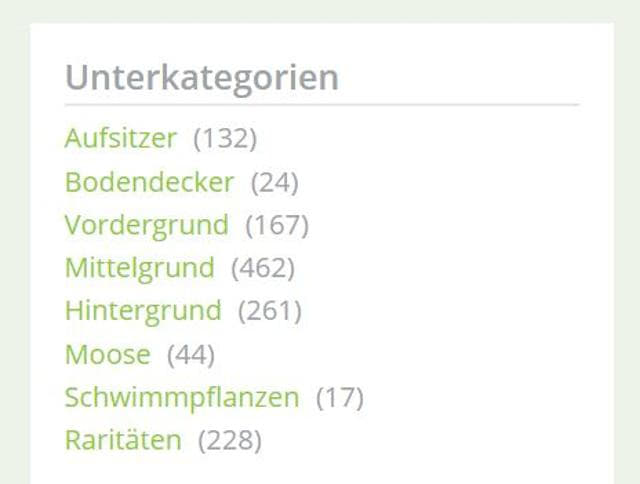
Our "Aquatic Plants" section first consists of various subcategories that pick up the topics of the design layers and water zones described above. In addition, there are further categories for, for example, "Rarities".
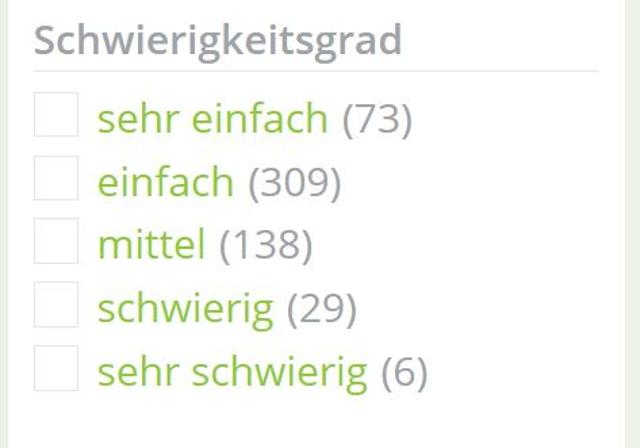
For a more precise search, various filters are available to the user on the left-hand side, such as the origin or the delivery form of the plant. For us, of course, the "Difficulty level" filter is now very decisive.
Roughly speaking, there are the difficulty levels "easy", "medium" and "difficult", with "easy" and "difficult" having a more detailed subdivision. In general, though, the main difficulty levels are enough to assign plants to a certain group. Now it is basically a matter of finding suitable aquarium plants for your individual aquarium setup at home. We also classify the technical conditions into three categories, each matching the difficulty levels of the aquatic plants.
Clarifying the technical requirements
Aquatic plants have partly very different needs. There are, for example, demanding stem plants in great shades of red, which however also need sufficient light, a CO2 supply and balanced liquid fertilization. On the other hand, there are also very simple, robust and easy-care aquarium plants that do well without a CO2 system and with only a very sparse nutrient supply. Between these two extremes, there are also various gradations.
To be able to search for suitable aquatic plants, it is first important to classify the technical conditions of your aquarium. These include the aquarium lighting, the presence of a CO2 system and the way the aquarium plants are fed (for example via liquid fertilizer and/or via a nutrient-rich substrate). Roughly estimated, such a technical aquarium setup can then be classified into three categories:
- low
- medium
- high
It is important to match the demands of the aquatic plants with the technical conditions of the aquarium. Only then can a kind of balance and a healthily growing ecosystem be achieved. After all, what good is the greatest high-intensity light if you only keep three slow-growing plants under it? Such a combination often ends in a green algae disaster. The other way around, demanding stem plants often do not cope well in an aquarium with weak lighting and no CO2 and die off after a certain time. Frustration is then guaranteed.
In principle, any type of aquarium can be greened in a very pretty way, but the equipment and the plants' requirements have to fit together. Then the aquarist has a lot of fun with their hobby.
We now roughly classify different aquarium settings into three categories. The decisive factor is above all the brightness of the aquarium lighting, which for LEDs is usually expressed in the unit lumens. Relative to the number of liters of the aquarium, this gives a value in lumens per liter. We explained the calculation procedure in more detail here.
The low category
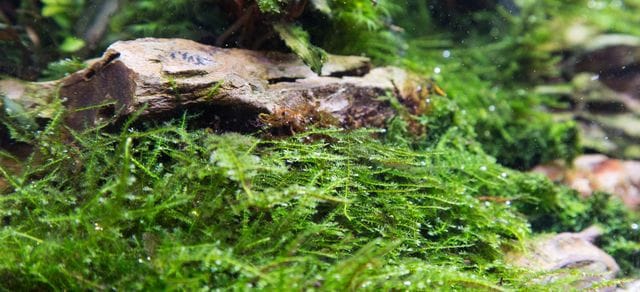
If an LED lighting provides around 10 to 20 lumens per liter, the aquarium falls into the low category. Shade plants such as mosses, ferns, but also water trumpets, anubias or Echinodorus are especially suitable for this type of lighting. CO2 fertilization may be present, but does not necessarily have to be. If there is no CO2 system, we recommend primarily choosing aquatic plants with the difficulty level "very easy". If there is carbon fertilization after all, aquarium plants with the difficulty level "easy" can also be chosen. The choice of substrate does not play a big role here.
For plants that fit into this category, liquid fertilization is certainly beneficial so that enough micronutrients (iron and other trace elements) and macronutrients (NPK) are available. Sometimes, however, a very light fertilization, for example only weekly, is already sufficient here. Root-feeding plants such as cryptocorynes also appreciate fertilizer balls, so they can take up nutrients via the substrate.
The medium category
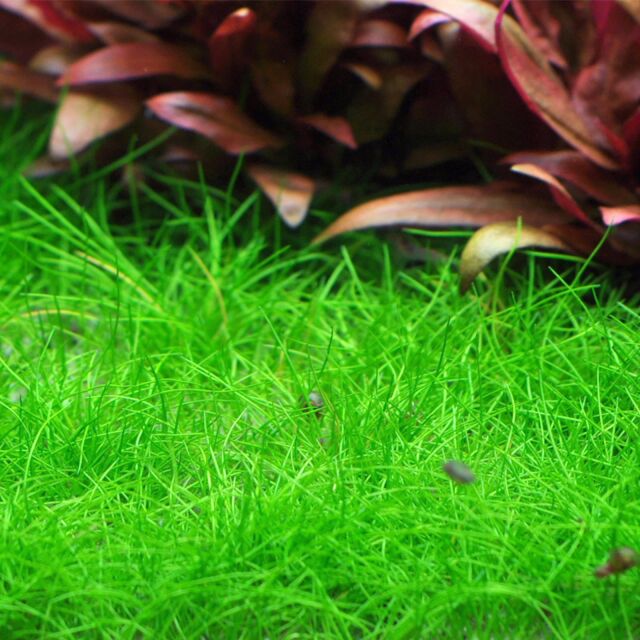
The medium category would cover a range of about 20 to roughly 45 lumens per liter. A CO2 system should definitely be present to match such aquarium lighting so that no nutrient imbalance arises. Adding micro- and macronutrients via liquid fertilizer should also be a given in this case. A nutrient-rich substrate is not a must, but can certainly support the plants in this category in their growth.
Depending on the brightness of the lighting, it is also already possible here to use low-growing ground cover plants and even some stem plants that turn red. In the shop, aquarium plants from the search category "medium" are therefore recommended for this type of setup.
The high category
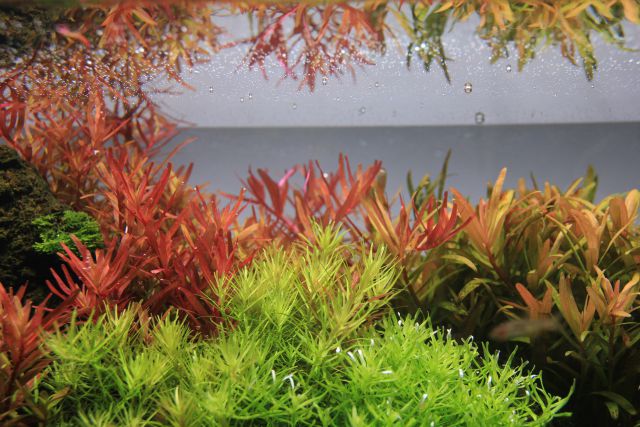
If at least 45 - 60 lumens per liter are present, you can classify your aquarium setup in the high category. A carbon supply via CO2 is an absolute must here, as is a sufficient supply of micro- and macronutrients via liquid fertilization. The nitrogen demand in particular in such aquariums is very high; here GH Boost N as a pure nitrate fertilizer is a good option. As support, a nutrient-rich soil substrate should preferably be used for such an aquarium. This way the aquatic plants are also supplied optimally via the roots.
If these conditions are met, the aquarist can draw on the full range and also choose demanding aquatic plants. Red aquarium plants can then also be kept very well. To achieve a correspondingly fast metabolism, many fast-growing stem plants and ground cover plants should be used in such a setup.
Creating the plant list
Once the aquarium setup and the associated difficulty level of the aquatic plants have been clarified, you can now go looking in the shop for plant suggestions. First, the aquarist can pick out aquarium plants that they simply like. Note: many of the product pictures are photos of the plants in the emersed state. Since their appearance underwater looks significantly different again, you should above all look at the pictures of the aquarium plants in the submersed state.
You should sort your selection roughly in advance and, in doing so, refer again to the three design layers: foreground, midground and background.
How much space is available here is of course very individual for each aquarium and depends on various factors. Above all, the type and mass of the hardscape used is decisive here. If quite a lot of decorative items such as stones or driftwood were used, this of course offers less area for root-forming plants. Less space is then available for the classic plants of the foreground, midground and background layers. On the other hand, hardscape can be greened well with epiphytes and mosses.
For now, the plant list is only about collecting suggestions. Not all the different plant species on this list have to be used. Sometimes it actually looks more attractive if you use a larger amount of one plant species or have it appear in different places in the aquarium layout. Especially for the foreground, it is recommended to use only one (or at most two) species of ground cover plants.
It also does no harm to repeat certain leaf shapes across all design layers and species (for example roundish leaves). This creates a very harmonious impression. Red plants or specimens that are otherwise very eye-catching can be used splendidly as accents or effects. Their number can therefore be somewhat sparse; instead you use them as eye-catchers only at certain spots (focal points).
Creating a planting plan
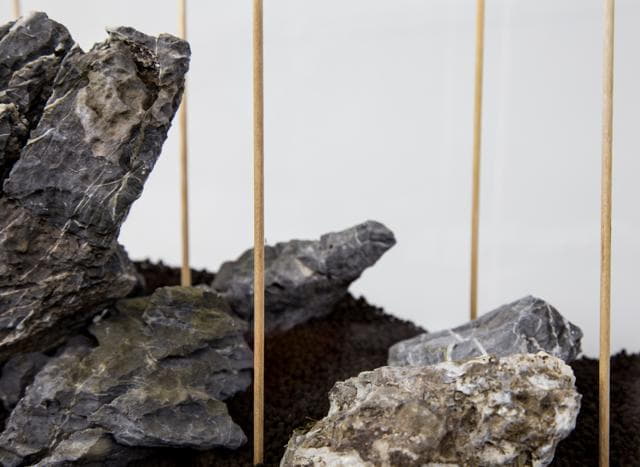
To roughly estimate the available space, drawing up a so-called planting plan is a good help. With the plant preselection you have already made, the point now is to see where and how much space is available to the aquatic plants. First, it is a matter of getting an overview of the free areas. A great aid is, for example, to use small wooden sticks to mark off free areas for the background, midground and foreground. This way, the areas to be planted for the different design layers can be well visualized and then calculated or estimated roughly.
For your favorites from the plant list you have already created, you now look for certain places. For this, the most popular plants should be planned in first. Areas that are still free can then be filled with further alternatives from the plant list. Different leaf shapes and colors can each provide pretty contrasts and variety.
A special role in this kind of calculation is played by epiphytes and mosses, since they are not basically planted on a free area. Instead, they take up space on hardscape, that is, stones, driftwood and other decorative items. But here too you can use a rough rule of thumb (literally, a "fist rule"): to green a stone or a piece of driftwood the size of a human fist, roughly one potted plant or one small in-vitro cup is enough.
How many plants do you get from one pot?
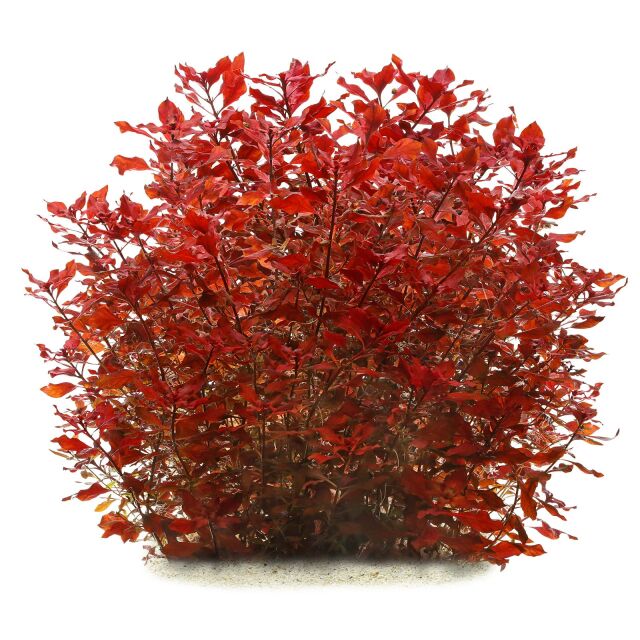
To match a number of plants to the now-free areas in the aquarium, you can use a very rough rule of thumb: the contents of one potted plant or one small in-vitro cup are roughly enough to plant an area of 10 x 10 cm. An XL cup offers about 1.5 to 2 times the amount. Please note that these are only very rough guidelines that can vary individually and, above all, seasonally.
With the plant species and approximate quantities now determined, shopping is much easier than going about it completely without a plan. Finally, one more tip: if budget does not play a major role, rather plan for somewhat more plants if you are unsure about certain quantities. An aquarium that is very lushly planted from the start also means that it is in a much better biological balance from the beginning than if only very few plants are present. Having more aquatic plants in the aquarium also means increased metabolism, so there is stronger competition, above all against algae, right at the start. Heavily planted aquariums, in our experience, get through the cycling phase much more smoothly.