 Interview with André Franken
André Franken, a young aquarium designer from Germany, is someone who stands out for his great passion for the topic of aquascaping. He creates aquascapes at a very high level and manages time and again to bring his layouts to the point with great final shots.
This is also evident from his very successful participation in national and international aquascaping contests such as the IAPLC. He is one of the few Germans who have achieved such a high ranking in this competition that they were invited to the award ceremony in Japan. Nevertheless, André is a very down-to-earth and likeable person who prefers to stay in the background. We are all the more pleased that André Franken (AF) has agreed to answer the questions of our author Aram Schneider (AS). For this he has provided us with two of his works, which we will present in more detail in this article.
Introduction and questions about the layout "..." by André Franken
AS: "What was the idea behind this layout, what inspired you?"
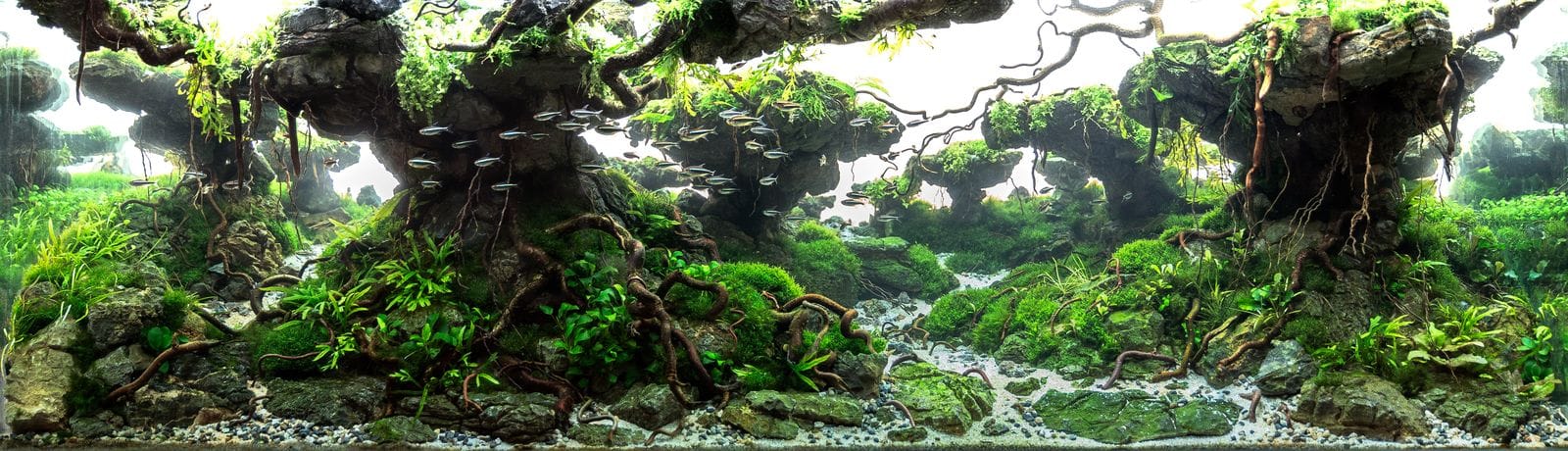
AF: "The idea behind a layout is always a bit of a thing in hindsight: I think I originally wanted to build a kind of collapsed cave. Did I succeed? Probably not. But that is not bad at all, since ideas constantly change during implementation and in the end something comes out that you never planned like that. The main thing is that the layout tells a story afterward. Most viewers will probably see a forest of trees with trunks made of stone in this aquarium. Trees with stone trunks would actually have been a pretty good idea for a Nature Aquarium ;)"
AS: "Which materials (hardscape, substrate, aquatic plants) did you use?"
AF: "The stones are black pagoda stone and the substrate is ADA Aquasoil Amazonia. I used the following plants: Anubias barteri var. nana 'Petite', Bolbitis heudelotii, Bucephalandra sp. 'Wavy Green', Bucephalandra sp. "Kedagang", Bucephalandra sp. "Theia Green", Cryptocoryne wendtii 'Tropica', Fissidens fontanus, Helanthium tenellum, Hemianthus callitrichoides "Cuba", Marsilea hirsuta, Micranthemum sp. "Montecarlo-3", Microsorum pteropus "Orange Narrow", Microsorum pteropus 'Narrow', Microsorum pteropus 'Trident', Pilotrichaceae sp., Riccardia sp."
AS: "What was your fertilization plan for this aquascape?"
AF: "I always fertilize quite richly. I add nitrate in the form of potassium nitrate and magnesium nitrate, and phosphate in the form of potassium phosphate. On top of that comes a micro fertilizer for the trace elements."
AS: "Many vanishing points can be seen in the layout, and objects in the background that get smaller and smaller. This creates enormous spatial depth. How important is the sense of depth in the aquarium to you?"
AF: "Depth effect in the aquarium is very important, in order to give the aquarium depth in the figurative sense as well ;) It is also irrelevant whether it is a diorama or a more classic Nature Aquarium. Through spatial depth, the aquarium feels like a three-dimensional space in a photo, which in my eyes is important for the viewer to be able to engage with the story the aquarium tells. On the other hand, I also simply enjoy playing with the depth effect and crafting a small world in the glass."
AS: "How many photos were needed until the fish were in this schooling position?"
AF: "With this aquarium it actually went relatively quickly. But sometimes you really do need a few hundred photos until you have the fish where you would like them. Fortunately, in times of digital photography that is no longer a problem. It is all the more impressive, though, when you think about how hard it was in the early days of the Nature Aquarium to take photos of the aquariums using analog photography."
AS: "You mainly used slow-growing plants here. Why?"
AF: "In general, slow-growing plants of course make the aquarium easier to care for and perhaps also a bit more predictable. In this layout, however, I actually used the slow-growing and low plants more for design reasons, to bring out the structure of the stones."
AS: "To what extent did the water-hardening effect of the stones make itself felt?"
AF: "Not at all, since I never measure my water parameters :) It is true, of course, that the stones will probably have hardened the water significantly. But if fish and plants are chosen that do not necessarily need soft water, such hardening is generally not a real problem."
Introduction and questions about the layout "..." by André Franken
AS: "I assume this is a Dennerle Scaper's Tank?"
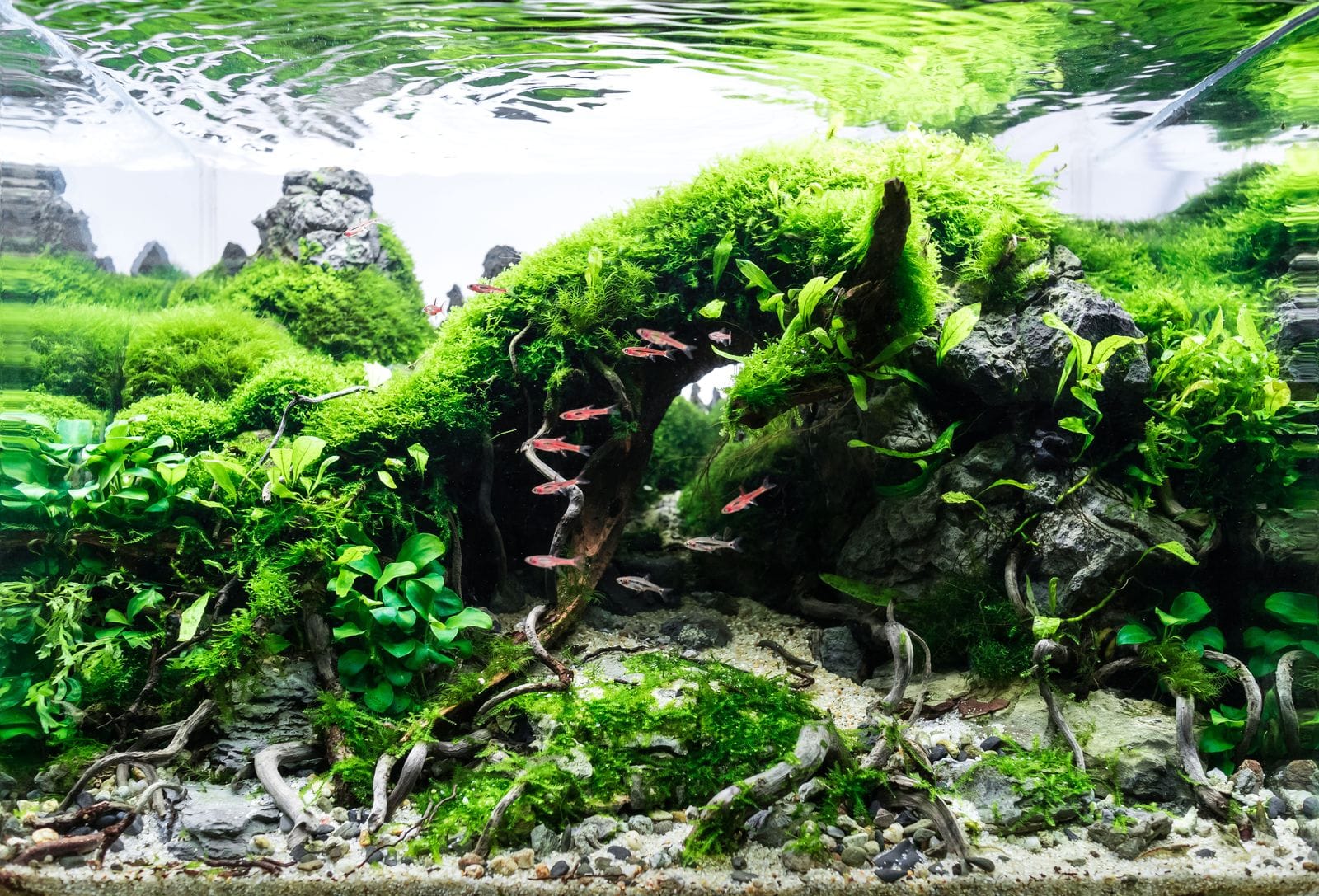
AF: "Yes, exactly, this is a 35 Scaper's Tank."
AS: "What do you do to keep the sand as clean as in this photo?"
AF: "Caring for the sand is part of the weekly maintenance of the aquarium: that means dirt is vacuumed off regularly, and the sand that trickles forward over time is pushed back to the rear areas of the aquarium. From time to time I also replace part of the sand."
AS: "What are those small roots in the foreground of the aquarium? How did you attach them?"
AF: "In this aquarium I used branches of a corkscrew hazel and glued them to the stones with JBL Haru."
AS: "How do you trim mosses?"
AF :"With scissors :) Preferably, especially in small aquariums, with high-quality spring scissors."
AS: "In the front area you can see a row of small pebbles on the sand, which provides added variety of detail. How important are details in aquascaping to you?"
AF: "Details are similar to depth effect. Details are also very important to me, primarily because I have great fun playing with small stones and roots. But of course, details also help make the story that is told more plausible."
Interview with André Franken
AS: "How and when did you start the aquascaping hobby?"
AF: "I started real aquascaping about six years ago. But I had already been very interested in aquatic plants and their care a few years before. At that time, however, I placed rather less value on composition. I think I began to take an interest in plants when at some point there was no more room for new fish. After all, there is always still a place somewhere for one plant or another. I probably came to aquascaping through my general interest in Japanese culture and Japanese gardens on the one hand and my enthusiasm for nature and the connections in nature on the other."
AS: "You have now also recently become a juror in an aquascaping competition for the first time. What is it like for you to be on the other side for once?"
AF: "Yes exactly, that was a very exciting experience! As you say, I had previously only experienced contests from the participant side. I have always regarded such competitions as a very valuable side of our hobby. For one thing, the upcoming participation in a competition motivates every participant to get the best possible out of their aquarium and to present the aquarium in the best possible way. Sometimes it is only then that it comes to light how wonderfully an aquarium has really turned out and what potential lies in the respective layout. For another, such competitions offer an excellent opportunity to present your work to an audience, and with it a great opportunity for interaction and inspiration - and that completely regardless of the ranking achieved, which ultimately becomes quite incidental. But back to the jury's view: it is actually only from this perspective that you recognize the power of the first impression and how incidental some details are that you consider extremely important from the participant's perspective; what is important is that a layout tells a story that is convincing in the end. If that is the case, it is totally irrelevant whether the newest red or even redder plant was used or whether the most beautiful stone was positioned just as the golden ratio supposedly dictates."
AS: "If you had to choose between a beautiful stone and a beautiful aquatic plant, which would you take?"
AF: "That is actually a good question. I would take whatever a story can be told around (how important stories are to me has probably become noticeable by now; I hope I am not annoying anyone with it yet :) ). That can be a fish, a stone or also a plant. As a rule, though, I would probably decide on the stone. Although: a (single) stone (usually) does not make an Iwagumi yet. That would speak for the plant, which could be propagated ;)"
Image source for all photos in the article: André Franken