 Interview with Andreas Ruppert-Flerlage
Andreas Ruppert-Flerlage is certainly one of the best German aquascapers. Closely rooted in and networked with the community of the aquascaping portal Flowgrow.de, where he has also been active as a moderator for some years, he took his first steps from there in 2010. Meanwhile, Andy runs his own blog called Glaskastenkunst.de and is a fixed part of the German aquascaping scene. He has been, and still is, very successful in national and international competitions. Even as a judge for contests such as the Nordic Scapers Hardscape Challenge (NSHC), Andy is a sought-after expert.
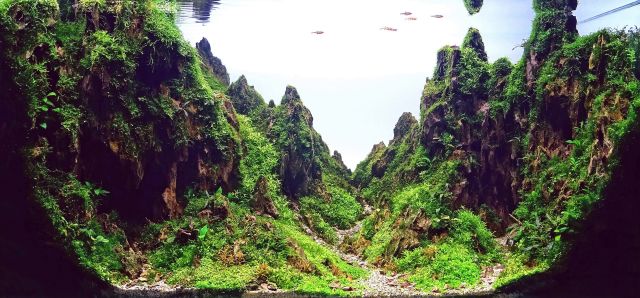
Renowned companies from the aquarium sector such as Aqua Rebell, Aquasabi or Dennerle have also taken notice of his design skills and support him actively as sponsors or hire him as an aquarium designer for display tanks at trade fairs or for media features.
Aram Schneider (AS) on Andreas Ruppert-Flerlage (ARF):
"Andreas Ruppert-Flerlage has an incomparable style and shows outstanding quality in the design of aquarium layouts. I would highlight the creation of stone designs in the aquarium (Iwagumi) as his specialty. Like no one else, he knows how to create a special naturalness, drama and harmonious flow with elements made of stones. His works captivate with their richness of detail and have a fantastic spatial depth. He is one of the few aquascapers in Germany who know how to place the main accent particularly skillfully on a harmonious overall picture and on a good balance between hardscape and aquatic plants. And he does this not only when setting up a new aquarium, but above all also by keeping to a consistent line right up to the climax of a layout (final shot). As a viewer, you tend to know these standards and attitudes more from Asian artists."
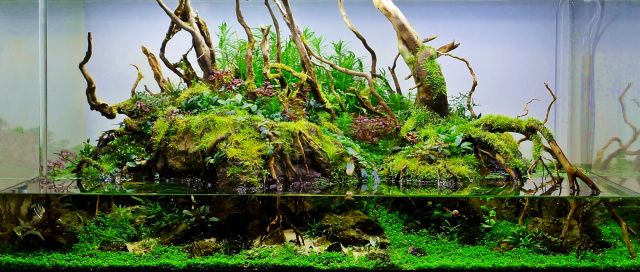
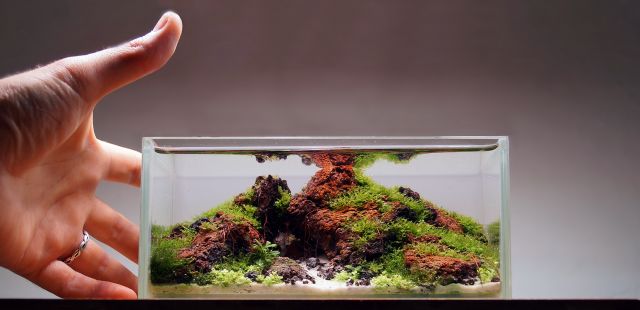
Another specialty of Andreas is the design of aqua-terrariums, also called paludariums. Long before the trend of Wabi-Kusa, which have become popular in recent years, Andy was already working on cultivating emersed aquatic plants and designing paludarium layouts according to aquascaping principles. You can learn more about this in the following interview, among other places."
The interview
AS: "What are your influences, where do you get your inspiration and ideas? Which artists have influenced you? "
(ARF): "There are very many, very beautiful layouts, and certainly one or another of them has inspired me to ideas of my own. But mostly I try to do my own thing. Almost all my inspiration I take directly from nature, from nature documentaries or photographs. Traveling and diving are very helpful for finding inspiration. I have already ended up in many beautiful areas all over the world, for example the vastness of Australia or the jungles of Indonesia. In these areas there are numerous primeval and rain forests, steep and rugged coasts, rocky and mountainous landscapes. Those are ideal sources of inspiration. But in Germany, too, there is more than enough inspiration for aquascaping and terrascaping, sometimes already in the forest or park around the corner."
AS: "You had been working with the topic of paludariums for a long time before Wabi-Kusas became known. What is special about aqua-terrariums for you?"
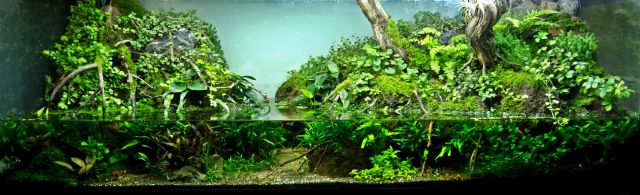
(ARF): "Well, my first paludarium was born back then more out of necessity. Looking back, I have to say that it was one of the best coincidences that could have happened to me in this hobby. The combination of emersed and submersed plant culture within one layout suddenly offered very diverse new possibilities. At that time I was still far from as experienced in terms of plant care as I am today, but the paludarium was supposed to look as beautiful as possible. So I was more or less forced to deal with it, especially since some of the plants I kept emersed died at first. It was tedious, but I can only recommend that everyone try something like this once. With the help of a paludarium, you get to know your aquarium plants in a completely new way, there are many new design and development possibilities for the layout, and it is simply fun. Once you get the hang of it and develop a feeling for the balance in a paludarium, it is also much easier to maintain than an aquarium."
AS: "What is your fertilization concept? "
(ARF): "To be honest, I do not follow a fixed fertilization concept. I add fertilizer to the tank by feel, according to plant growth. If you had to compare my way of fertilizing with a known concept, it would probably most closely resemble the Estimative Index. All nutrients are present in my tanks, CO2 and NO3 rich, the other nutrients leaner. This way of fertilizing is convenient and easy to implement."
AS: "What is your favorite material, for example, which types of stone and aquatic plants? "
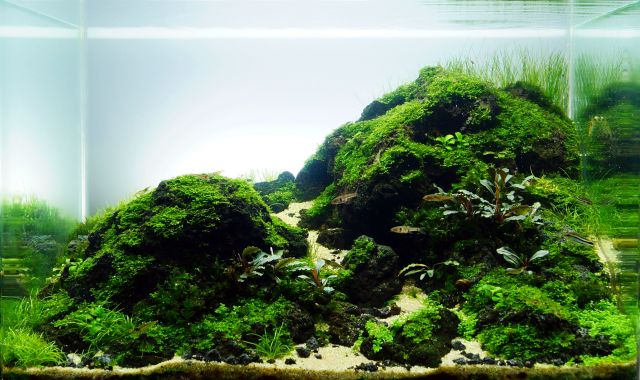
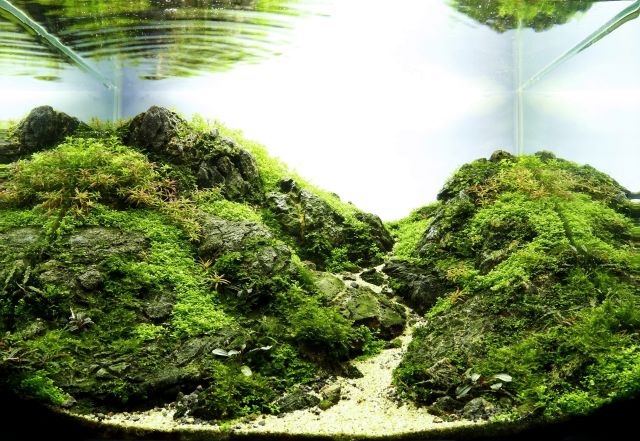
(ARF): "Stone, stone and more stone. Stones are the basis of almost all my layouts. I prefer rugged, natural-looking rock such as e.g. black pagoda, Seiryu or Frodo, but also dragon stone and dragon rock. My favorite plants are mosses, because they form a good basis for a natural-looking layout, especially in aquascaping."
AS: "How long have you been in the hobby? "
(ARF): "I started with the aquarium hobby in 2006 in the field of biotope aquariums. Around 2008/09 I set up my first very plant-heavy aquarium and worked myself more deeply into planted aquariums. At the beginning of 2010, I set up the paludarium mentioned before. At about that time I also dealt properly with aquascaping for the first time and was in love with it from the first moment."
AS: "What are your greatest successes in competitions? "
(ARF): "By now quite a bit has come together, although I do not count only prizes in competitions as success. I count the reports and layouts of mine in Dennerle's Aquascaping Guide and in the Dennerle Plant Guide 2017/18 among my greatest successes. In terms of competitions, I can count many larger and smaller successes, but personally I attribute the highest value to these: I was able to win the live competition "The Art of the Planted Aquarium" twice in the Nano class, at the AGA Contest I took 1st place once and 3rd place twice in different categories, and at the EAPLC I took 2nd place in the Wabi Kusa category. What I am also very happy about are my placements at the IAPLC. Of a total of five entries, three landed in the Top 200 and one in the Top 100."
AS: "If you had to choose between a beautiful stone and a beautiful aquatic plant, which would you take? "
(ARF): "Clearly hardscape, especially stone. Of course, plants are actually the central element in an aquascape, without them it does not work. But with really good hardscape you can shape landscapes that you cannot achieve with the most beautiful plant alone. And with such a hardscape, the choice of plants is, I do not want to say irrelevant, but still very broad. It does not necessarily have to be the most beautiful plant to conjure up a really good aquascape.
AS: "Thank you very much for the interview, Andy!"
Copyright for all photos in the article: Andreas Ruppert-Flerlage - Glaskastenkunst