 Keeping vampire crabs
Header photo: Copyright by Chris Lukhaup.
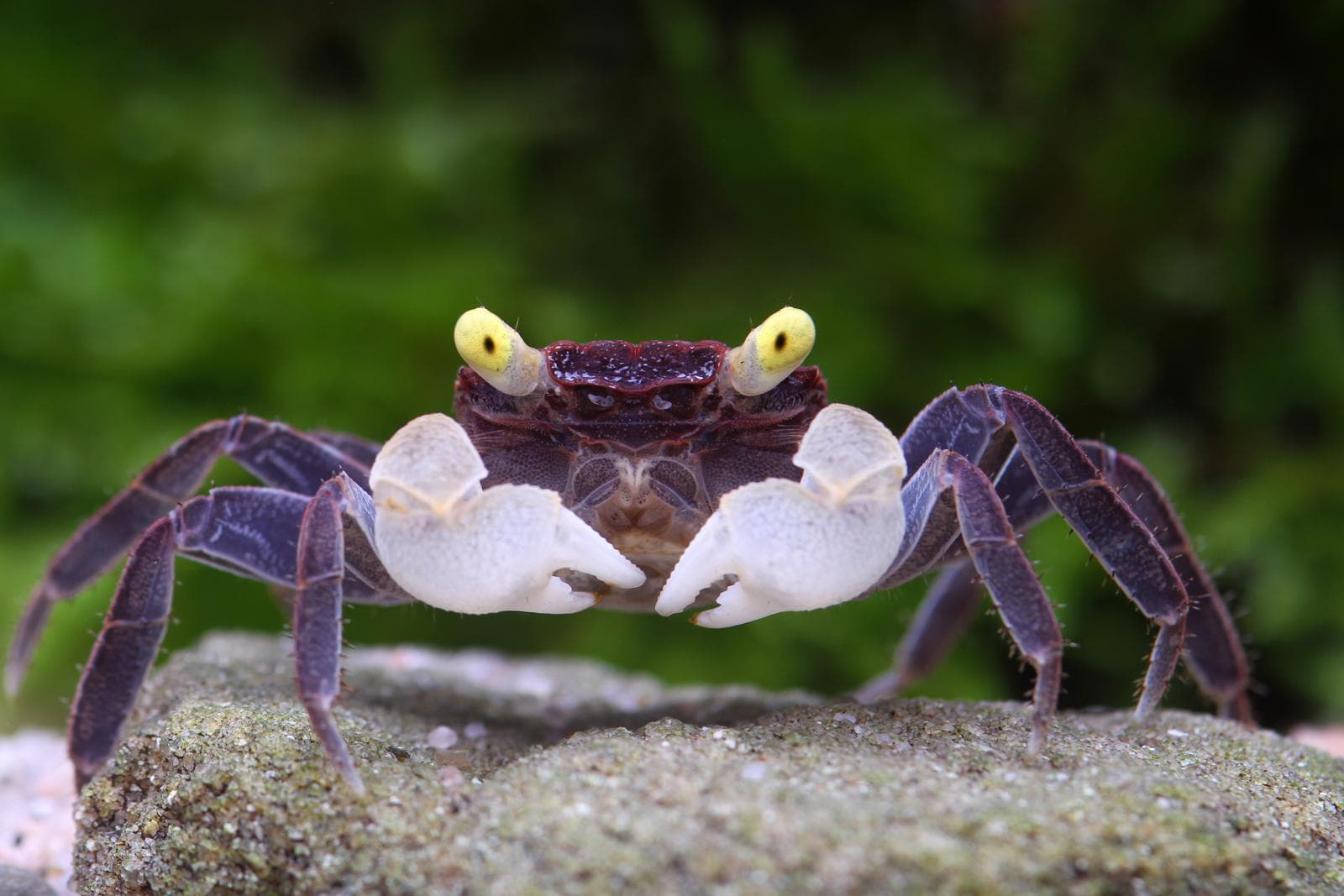
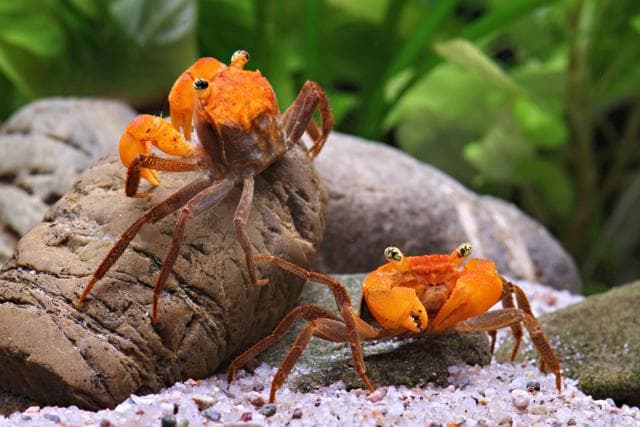
Vampire crabs are small semi-terrestrial crabs that occur in Indonesia on the island of Sulawesi. They belong to the genus Geosesarma and stay quite small, with a final size of 6 cm at most. The little crabs are very popular because of their striking coloration. There are now many different locality variants that differ in their coloring. In nature, vampire crabs live close to freshwater bodies but otherwise spend a lot of time on land and in some cases even climb tree trunks. High humidity is important for their survival.
Keeping conditions
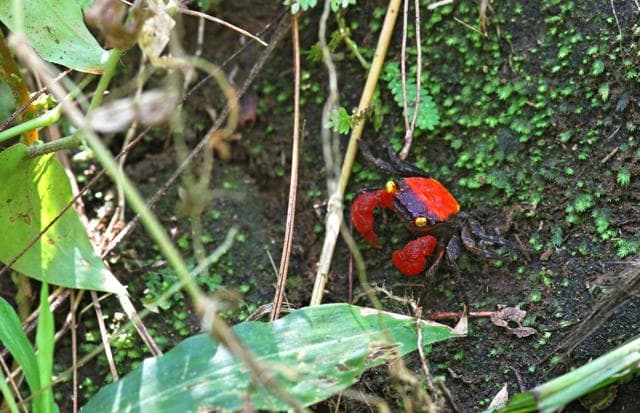
Vampire crab in its habitat. Copyright by Chris Lukhaup.
Vampire crabs are very social animals and should therefore preferably be kept in a group. For 5 to 6 animals, aqua-terrariums with an edge length of 60 cm are recommended. In addition, a depth of 30 to 40 cm should be available. For a single pair of these crabs, a tank with a footprint of 40 x 30 cm is sometimes sufficient.
A water section should be present but does not need to be particularly large. A depth of 3-5 cm is sufficient. Since the crabs can drown, a maximum depth of 6 cm must be observed. A gentle bank slope is likewise recommended as an entry and exit aid, or else flat stones in the water as a climbing aid. The humidity should be between 80 and 90 %. With sufficient humidity, a bowl filled with water is sometimes enough. A suitable temperature for vampire crabs is between 24 and 28 °C. With regard to water parameters, there is a wider tolerance range. The pH value can be between 6.5 – 8, and the general hardness between 10°– 20° dGH.
An aqua-terrarium that closes tightly is ideal for these little crawlers. It should definitely be escape-proof, because vampire crabs are very good climbers and can escape through the smallest gap. Since the animals spend most of their time on land, the land section of the aqua-terrarium should be correspondingly large. There should be enough hiding places and retreats on land. These can be, for example, clay tubes, caves or structures made of stones and driftwood. They are also often used as climbing aids. Peat or bark mulch is very well suited as a substrate for the land section.
Planting
The aqua-terrarium for vampire crabs can be planted nicely in both the water section and the land section. Although the crabs theoretically eat plant-based food, as a rule they do not go after the plants in their home. Especially if you also add rather hard-leaved species such as bromeliads and Anubias, the risk of an attack is very low. A very pretty terrascape can therefore be set up with vampire crabs.
In general, all plants, especially the aquatic plants, should be rinsed well before planting so that no pollutants or excess fertilizers cling to them that could otherwise harm the invertebrates. If you want to play it safe, you can fall back on the "in vitro" form of sale.
With the terrarium plants for the land section, make sure they are suited to a high humidity of 80 to 90 %. This applies to most species suitable for rainforest terrariums, such as bromeliads, jewel orchids, but also some tillandsias.
Keeping with other animals
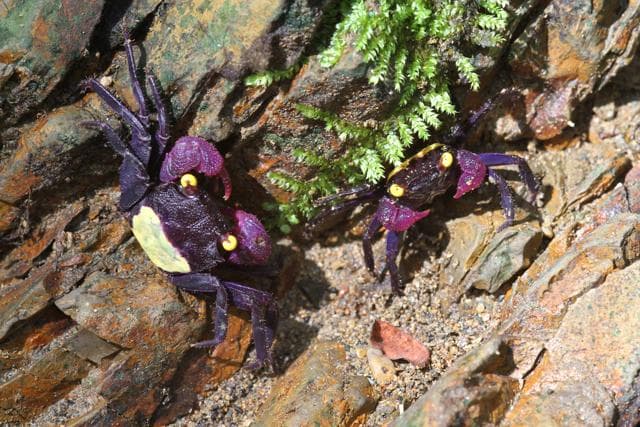
A pair of vampire crabs. Copyright by Chris Lukhaup.
Vampire crabs should be kept in a species tank. Small fish are not suitable as tank mates, since they can end up as food. Snails living in the water are quite readily eaten by the crabs, and dwarf shrimp can also be regarded as food. Here it is advisable to use at least quickly multiplying species (Neocaridina).
If it is to be fish, armored catfish are rather to be recommended as tank mates. Basically, vampire crabs behave quite peacefully, especially among their own kind. There should, however, be enough hiding places and retreats.
Feeding vampire crabs
Vampire crabs are basically omnivores. They therefore readily accept plant-based food, but even more so meat-based food. For the latter, some live food in the form of small snails, worms or freshwater amphipods may also be given now and then.
Copyright by Chris Lukhaup.
Otherwise, common food tablets, various types of frozen food, but also finely chopped vegetables and fruit are accepted. The diet may well be varied. A calcium source, for example in the form of a cuttlebone, is also important. This ensures that the crabs take in enough minerals and can molt and grow healthily. This is conducive to a long life for these little crawlers, which can live to be up to four years old.
Breeding
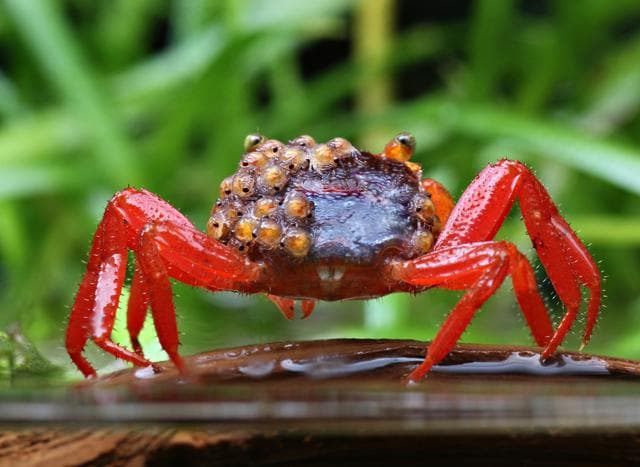
Vampire crab with offspring. Copyright by Chris Lukhaup.
Geosesarma belong to the specialized reproductive type. Male animals can be distinguished quite well from females by their clearly narrower abdominal flap. For successful reproduction, enough hiding places in the aqua-terrarium are important. The females then occupy a suitable cave for brood care. Only when the young are fully developed do the animals leave their shelter. The little offspring are only a few millimeters in size and brownish in color. Since vampire crabs can be cannibalistic, it is important to protect the young well from the parents. It is advisable to raise the baby crabs separately from the adult animals and to feed them in a targeted way. Plenty of hiding places and protein-rich food are a good help here.
All photos in this article: Copyright by Chris Lukhaup.