Parasites and commensals on shrimp in the aquarium
Published
Translated from German with AI assistance and reviewed by our editors.
In nature as well as in the aquarium, the shell of shrimp is a habitat in which a surprising number of microorganisms, single-celled and multicellular organisms find a home. They feed on suspended particles and detritus from the water, stirred-up food leftovers, algae coatings that also grow on the shrimp, other microorganisms and fungi, and so on. During molting, the organisms are shed together with the old skin and then immediately look for a new host. There are only a few species that live parasitically and actively damage or weaken the shrimp. Most of the little creatures on the shrimp, by contrast, are harmless epibionts and commensals that merely use the shell as a surface to sit on, let the shrimp comfortably carry them to new regions, and exploit its somewhat untidy feeding habits to grab the tiniest food particles. In the following we cover the most common organisms that sit on shrimp.
Vorticella (bell animalcules) and Stentor (trumpet animalcules)
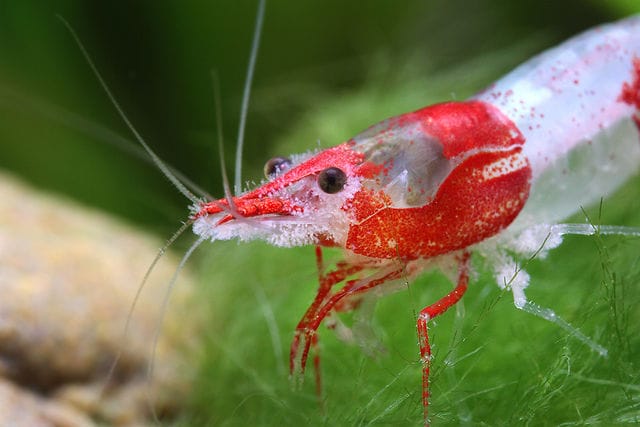
Vorticella on shrimp - Copyright by Chris Lukhaup
Bell animalcules (Vorticellidae) and trumpet animalcules (Stentoridae) are not very closely related, but they closely resemble each other in structure. Both are ciliated single-celled organisms (ciliates), and depending on the species they can also form colonies. In the aquarium they occur not only on shrimp shells but also like to sit on snail shells, the aquarium glass and even on plants. Especially during the cycling time of the aquarium, bell animalcules or trumpet animalcules (or both) can form in greater numbers, because they feed mainly on bacteria in the open water, and during the cycling phase a higher germ density in the water can increasingly occur. Vorticellidae and Stentoridae can even - although rather rarely - settle on the soft mucous membrane of fish and also on worms. An infestation with these single-celled organisms looks like a mold infestation with whitish, very short little hairs, and larger colonies look cloud-like. If you look closely, you can see white dots in the clouds.
Bell animalcules and trumpet animalcules consist of a bell- or trumpet-shaped body with a feeding opening, surrounded by cilia, with the help of which Vorticellidae and Stentoridae swirl bacteria and other single-celled organisms into their gullet. This body sits on a thin stalk that is attached to the substrate with an adhesive disc. In fish, this adhesive disc can damage the mucous membrane, which can lead to secondary infections by fungi or bacteria. It does not harm crustaceans, snails and plants, however.
The single-celled organisms can move by swimming. To do so, they detach their adhesive disc from the substrate and beat their cilia. They are not fast, however.
Is action needed, and what can you do about an infestation?
Yes and no. On fish, bell animalcules and trumpet animalcules are certainly a problem because they damage the mucous membrane, which promotes secondary infections. A heavy infestation should definitely be treated - this is done as with ich, using a combination of formaldehyde and malachite green. Mostly weakened fish are affected, so you should also consider improving the living conditions in the aquarium and make sure to lower the germ density in the aquarium water.
The same applies when bell animalcules or trumpet animalcules sit on shrimp and crayfish, the plants or hardscape and the glass: they are a sign of an increased germ density in the water or of an increased bacterial infestation of the shell, and you should do something about that - not about the bell animalcules or trumpet animalcules themselves, because ultimately they are only symptoms. If the cause (the germ infestation) disappears, the symptom disappears too. To do this, you should mainly check feeding and really give only as much as is eaten within a few hours. It can also help to vacuum the substrate thoroughly or even stir through it, remove plant remains and carry out regular water changes. A UV-C clarifier can also be helpful in reducing the germ density in the aquarium. If bell animalcules appear in large numbers during the cycling phase, this is quite normal. They will disappear again as soon as the aquarium biology has settled and the germ density returns to a normal level. In a still unstocked aquarium there is therefore no need for action; here you can simply sit the phenomenon out.
Parasitic shrimp alga, wrongly called "systemic mycosis"
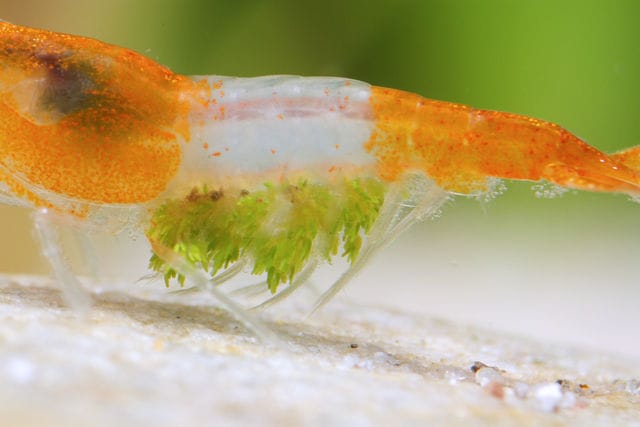
Shrimp infested with the shrimp alga - Copyright by Chris Lukhaup
This alga (Cladogonium ogishimae) contains no chlorophyll and feeds parasitically on the body fluids of shrimp. It is quite unspecific in its choice of host. Even though it is often seen in the aquarium hobby under the abdomen of (usually recently imported) Neocaridina shrimp, it also occurs, for example, in bee shrimp and Macrobrachium. The only parts of the alga that still contain chlorophyll are the spores, which in an advanced state can be seen as light yellow-green to dark green shaggy appendages under the shrimp's pleon. At first glance you could confuse them with eggs, but the structures are less even and considerably finer. The parasitic alga penetrates the shrimp's muscle tissue with its rhizoid and uses the animal's body fluids to feed. The spore capsules eventually fall off when they are ripe and then lie on the bottom. If a shrimp takes up spores, the next infestation is preprogrammed.
The alga was first thought to be a fungus, which is why many sources still speak of a so-called systemic mycosis. A short time later the organism Ellobiopsidae was brought into play, but this description did not fit 100% either. More recent studies showed that the organism corresponds to the alga Cladogonium ogishimae, which was already described from Japan in 1971. It is therefore by no means a fungus, which explains why fungicides do not work.
Is action needed, and what can you do about an infestation?
The parasitic shrimp alga is an opportunistic parasite that becomes acute when the animals' immune system is impaired, in particular through poor water parameters, import, improper keeping or other stress. It is not immediately fatal, even though the parasitic lifestyle of the alga of course stresses the animal. Female shrimp no longer carry eggs when infested.
Trials in the USA have shown that feeding food soaked in malachite green can fight the alga - malachite green in the water, by contrast, does not reach the inner structures that lie protected from environmental influences under the shell. Unfortunately, feeding malachite green in the aquarium hobby is prohibited in the EU, so this is not a recommendable approach. The food manufacturer Tima has developed a food with the shrimp paste Balance that can lay a barrier between alga and rhizoid and thus cut off its supply. This food is definitely well suited as support.
It is also important and sensible to vacuum the substrate regularly with a detritus vacuum that suits the aquarium size, so that the shed spores can be removed from the aquarium. The targeted addition of humic substances can also have a supportive effect. Very heavily infested animals should be separated and treated in quarantine. Please nevertheless always treat the aquarium with the apparently unaffected animals as well - the shrimp alga in the tissue is transparent in the early stage and really very hard to spot. If you see the green fuzz on the swimmerets, the infestation is already very far advanced. In general, the shrimp's rudimentary immune system should be supported by keeping the germ count in the water as low as possible, sufficiently large and frequent water changes and high-quality food.
Flukes or Scutariella
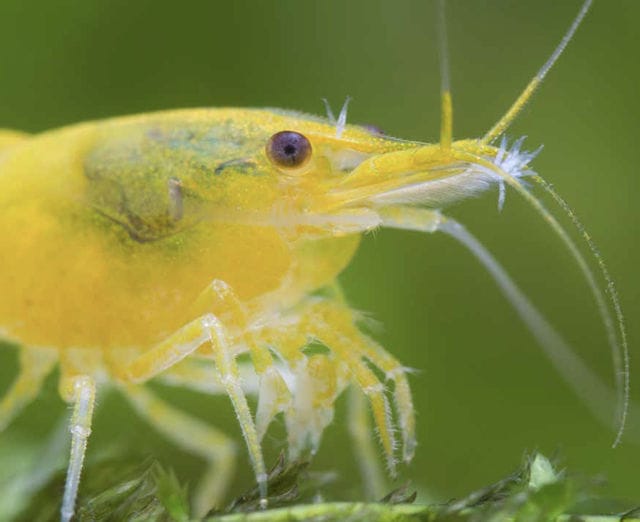
Neocaridina with fluke infestation - Copyright by Chris Lukhaup
Some shrimp of the genus Neocaridina show white hitchhikers up to 2 mm long in the aquarium, mostly on the rostrum, and now and then also between the legs. In variants with a transparent shell, such as poorly colored Red Fire or Sakuras, Yellows, White Pearls, Blue Jellys and so on, you can see white dots in the area of the gill chamber (practically the shrimp's "cheeks") that sit on the inside of the shell. These are generally Scutariella, or flukes / gill worms. Most species of the genus Scutariella are harmless hitchhikers that eat the finest food particles in the water and take advantage of shrimp's somewhat untidy way of eating. A few species live parasitically and suck blood from the gills. A light fluke infestation does not harm the shrimp but can be a sign of stress. Scutariella belong to the flatworms and are whitish. Their body splits into two short lobes at the upper end, which can be seen well with a good magnifier. Unlike bell animalcules, flukes are more intensely colored; here you can see a distinct white "beard", not a cloud-like, rather fuzzy structure.
Is action needed, and what can you do about an infestation?
Flukes do not kill the shrimp, so as a shrimp keeper you can stay relaxed. While many authors refer to Tremazol with the active ingredient praziquantel, which is no longer freely available in pet stores, or to the prescription-only dewormer Panacur, a simple treatment with table salt has proven just as effective or even more effective, because the flukes on shrimp have developed resistance to the dewormers with alarming speed and can therefore no longer be removed with one hundred percent reliability.
A salt treatment against flukes can be carried out in two ways: once in the aquarium (recommended if several shrimp are affected) and once as a dip or salt bath (for individual animals with fluke infestation).
For a salt treatment in the aquarium, you add 3-5 g of pure sodium chloride (i.e. table salt) in food quality without additives such as anti-caking agents or fluoride and iodine per liter of aquarium water to your tank. Caution: some aquarium fish do not tolerate salt well. This amount generally does not harm the plants. The harder your water is, the closer you should get to the upper value. In soft water you only need 3 g of salt. Raising the temperature to approx. 25-28 °C is additionally helpful. Because of the oxygen supply, you should additionally aerate the aquarium here or use an oxydator. You can continue the salt treatment over several weeks until no more flukes can be seen on your shrimp.
As long as you carry out the salt treatment in the aquarium, you change water as usual on your schedule and add new salt corresponding to the amount of water removed so that the concentration in the aquarium is roughly maintained. When the treatment has been completed successfully, you simply continue your water changes on schedule as usual and add no new salt. Gradually the salt is thus carried out of the aquarium water.
If problems occur during the salt treatment, for example through contaminated salt or intolerances in your aquarium inhabitants, you immediately change at least 60-80% of the water and stop dosing.
If only a few animals have a visible infestation with flukes or there are salt-sensitive tank mates in the aquarium, the shrimp are treated separately in a salt bath (dip). For this, you put aquarium water into a separate container and add 2-3 teaspoons of pure table salt per liter of water. The affected shrimp are bathed here for approx. 10-20 minutes. Please watch them the whole time and, if necessary, take them out immediately if they show problems such as tipping over, tumbling or darting around uncontrollably. The flukes let go in the salt bath, and you can then see them on the bottom of the container. Since the salt bath does not seem to affect the worms' eggs in the gill chamber, you have to repeat it after a week and, if necessary, once more, again at one-week intervals. After the salt bath, the shrimp can be released straight back into the aquarium.
Copyright of the photos: Chris Lukhaup.