We use cookies to offer you an optimal shopping experience. These cookies can be grouped into categories. The necessary ones are essential for your purchase. Functional services enable additional content such as videos and maps. With further cookies we produce anonymized statistics. Others serve primarily marketing purposes and are used for the personalization of advertising. These cookies are used by 11 Services used in the shop. You can decide for yourself which cookies you want to allow.
We store your choice on your device (“local storage”) and ask you again after 12 months at the latest. You can change it at any time under “Cookie Preferences” in the footer. You can find details on cookie lifetimes and necessary cookies in our privacy policy.
These services are required to run the shop and for your purchase and cannot be switched off.
Strictly necessary cookies enable basic functions and are required for the website to work properly.
Description:
Shop functions: Essential Shop functions This includes: JTLSHOP (cookie, until you close the browser; keeps your session, the cart and your login), consent (browser storage; remembers your cookie choice, 12 months at most, during the session also in session storage), has_starting_point, cur_product_id and product_page_visits (session storage; navigation between products) as well as aquasabi-search-index-last-url, aquasabi-search-index-results and aquasabi-search-index-data (session storage; search results and lists when paging).
easyVision: easyVision lets website visitors customize the display – e.g. by adjusting contrast, font size, line and letter spacing, color rendering, a blue light filter or by disabling animations. Developed and hosted in Germany, the service is GDPR-compliant and supports statutory accessibility requirements (BFSG) from 2025. The service loads its scripts from cdn.sitecockpit.com and stores your settings (easy-vision-*) in your browser storage (no cookies).
Reviews: aquasabi_guid (cookie, 12 months) is only set when you click “Helpful” under a review. It stores a random ID so that the same person cannot count a review as helpful more than once.
Sorting and view: aquaSort and aquaDisplayType (cookies, 90 days) store the sorting or view (gallery or list) that you choose in a product list. They are only set when you choose a sorting or view.
Amazon Pay: Payment processing with Amazon Pay.
The service provider is Amazon Payments Europe S.C.A. Where Amazon Pay is offered (e.g. in the cart and at the checkout), the shop loads scripts and images from static-eu.payments-amazon.com, payments-eu.amazon.com and m.media-amazon.com and sets cookies (language, ledgerCurrency, apay-session-set). You can find out more in the privacy policy at https://www.amazon.de/gp/help/customer/display.html?nodeId=GRFTMVHP4HXMESSP
PayPal: Payment processing with PayPal.
The service provider is PayPal (Europe) S.à r.l. et Cie, S.C.A. Where PayPal is offered (e.g. in the cart and at the checkout), the shop loads scripts from www.paypal.com; for invoice payment via PayPal, c.paypal.com is added for fraud prevention. PayPal stores an entry in your browser storage (__paypal_storage__), and the shop remembers the chosen PayPal payment method in session storage (chosenPPCPaymentOption). You can find out more in the privacy policy at https://www.paypal.com/en/legalhub/paypal/privacy-full
Sofortüberweisung: On the confirmation page after an order with this payment method the shop loads a Klarna logo from x.klarnacdn.net.
Additional functions such as embedded videos and maps, spam protection in forms or the rating badge. Data is transferred to the respective provider when they load.
Show Youtube Videos
Description:
Displaying videos
Processing company:
Google Ireland Limited, Google Building Gordon House, 4 Barrow St, Dublin, D04 E5W5, Ireland
To submit forms on this page, you need to consent to the transfer of data and storage of third-party cookies by Google.
With your consent, reCAPTCHA, a Google service to avoid spam messages via contact forms, will be embedded.
This service allows us to provide our customers with a safe way to contact us via online forms. At the same time, the service prevents spam bots from compromising our services.
After you gave your permission, you might be asked to answer a security prompt to send the form.
If you do not consent, unfortunately you cannot use the form. Please contact us in a different way.
Helps us understand how the shop is used so that we can improve it.
We measure which pages and products are viewed and how visitors move through the shop. Google Analytics sets cookies (_ga, _ga_*) and sends usage data to Google.
Description:
Audience measurement and analysis of how the shop is used
Measures our advertising and enables personalised advertising on other sites.
We measure whether an ad on Facebook or Instagram led to a purchase and show visitors relevant ads again. Cookies are set for this: _fbp and _fbc (Meta) and as_fbclid (ours, 30 days; remembers the ID of the ad click). Meta receives data about your actions in the shop (e.g. product views, cart, purchase), your IP address and browser information; for a purchase our server may also send them directly to Meta (Conversions API). More in our privacy policy (retargeting/remarketing and conversion tracking).
Description:
Measure advertising success and show relevant ads again (Facebook, Instagram)
We measure whether an ad on TikTok led to a purchase. Cookies are set for this: _ttp, ttclid and _tt_* (TikTok) and as_ttclid (ours, 30 days; remembers the ID of the ad click). TikTok receives data about your actions in the shop (e.g. product views, cart, purchase), your IP address and browser information; for a purchase our server may also send them directly to TikTok (Events API). More in our privacy policy (retargeting/remarketing and conversion tracking).
We measure whether an ad in ChatGPT led to a purchase. Cookies are set for this: __oppref and __obref (OpenAI) and as_oppref (ours, 30 days; remembers the ID of the ad click). OpenAI receives data about your actions in the shop (e.g. product views, cart, purchase), your IP address and browser information; for a purchase our server may also send them directly to OpenAI (Conversions API). Data may be transmitted to OpenAI OpCo, LLC (USA). More in our privacy policy (retargeting/remarketing and conversion tracking).
Description:
Measure the success of ads in ChatGPT
Processing company:
OpenAI Ireland Limited, 1st Floor, The Liffey Trust Centre, 117-126 Sheriff Street Upper, Dublin 1, D01 YC43, Irland
We measure whether an ad led to a purchase and show visitors relevant ads again. Google Ads sets cookies (e.g. _gcl_*) and receives purchase data, where applicable in hashed form (SHA-256).
Description:
Measure advertising success and show relevant ads again (remarketing)
We use cookies that are essential for payment processing through our partners. Please select which payment providers you would like to use.
In order to unlock offers for extended payment options, in particular express checkout and payment in instalments, we require your consent to the data transfer and storage of third-party cookies of the payment provider PayPal. This allows us to also offer you express checkout and payment by instalments. Without your consent, only the technically necessary data transfer to PayPal will take place, but you will then not be able to use the express checkout or extended offers for payment by instalments on this site.
Description:
Using express checkout and Displaying offers for payment in instalments for individual items or your entire purchase.
Your consent ID:With this randomly generated number we can show on request what you selected. It contains no information about you.
Data privacy settings
Would you like to see these contents? Activate the desired contents for one session only or allow the website to remember these settings. Once you have given your consent, the third-party data can be loaded. For this, third-party cookies might be stored on your device. You can change these settings at any time (footer: “Cookie Preferences”). For further details, please see the Privacy notice.
How long should an aquarium be lit? This is a very fundamental question in which the interests of the aquarium owner meet the needs of the animals and plants in the aquarium. Here we show you the most common options.
Naturally, an aquarium owner wants to be able to view and enjoy his or her aquarium as fully as possible at any time. You achieve this with the longest possible lighting period. However, the animals and aquatic plants in this ecosystem also have needs and requirements regarding the light situation. You should meet these for the well-being of the inhabitants in order to enjoy your aquarium for as long as possible.
Taking nature as a guide
In this respect, it does no harm to take our cue from the conditions in nature when it comes to the lighting period. A typical day in the tropics usually comprises a light phase of about 12 hours, during which the intensity increases from the morning, peaks at midday and decreases again toward evening. This near-natural daylight rhythm can also be transferred as a first guideline to lighting in the aquarium hobby. These days, energy-saving LED lamps are preferably used. For the dimming and twilight phases, we recommend using an LED controller with which you can program the intensity of the lighting as a daylight curve. This creates near-natural light phases that also blend into one another very softly and gently. Switching the aquarium lamp on and off abruptly can sometimes cause stress reactions in the animals. Especially in open tanks, there is a particularly high risk of fish even jumping out of the aquarium in panic.
Atmospheric lighting effects, such as playing with light colors, moonlight and sunrise glow, can also be implemented with such a controller and suitable lighting. These effects are not strictly necessary and in part go beyond the role of a purely functional light source, but they are certainly justified for creating different lighting moods for the viewer of an aquarium (and its inhabitants).
Planted aquarium
In an aquarium or aquascape with a focus on aquatic plants, lighting naturally plays a special role. Plants need light for their metabolism as part of photosynthesis, and it is therefore to be regarded, so to speak, as a "nutrient". Certain relationships between light intensity and the availability of CO2 in the aquarium water must be taken into account. Plant growth is only possible when a so-called compensation point is reached, at which a certain minimum amount of light and carbon dioxide are available. These compensation points are not the same for all aquatic plants but depend strongly on the species. This is also why the trade in the aquarium sector divides aquarium plants into different categories, such as "low-light plants / shade plants", which need significantly less light. These include, for example, mosses and ferns. Typical stem plants as "high-light plants / sun plants", on the other hand, often have a higher light requirement. In between there is another category for the aquarium plants that get by with medium light.
Dependence of the photosynthesis rate in shade plants and sun plants on light intensity. Image author: Yikrazuul - Own work, license: CC BY-SA 3.0.
If you look at the framework conditions of Takashi Amano's Nature Aquariums, a maximum lighting time of 10 hours emerges for such a planted aquarium. In an aquarium layout with many stem plants, moderate to strong light intensity and a corresponding photosynthetic activity, you can observe after a certain number of hours that the plants at some point "close their heads". The foliage closes up, as if the aquatic plants were preparing for the dark night phase. The maximum of photosynthetic activity has been reached, and there is no further demand. In such aquariums, this point is often reached after 8 to 10 hours. It is therefore advisable here to adapt the duration of the aquarium lighting to this reaction of the plants. A period of 12 hours usually makes no sense in these cases, as it would only challenge the plants' metabolism unnecessarily.
In planted aquariums with good framework conditions and, above all, appropriate lighting, the photosynthetic activity of the aquatic plants can also be observed well during the day. After a certain time, the oxygen content in the water is so saturated that visible oxygen bubbles produced by the plants appear on the leaves and stems. This effect often occurs just a few hours after the start of the lighting period.
Lighting period & light intensity
The lighting period only indicates the pure time window in which an aquarium lamp is switched on. How strongly this lamp emits light is initially not related to it. That is determined by the light intensity of a lighting system. In aquarium practice, for LED lamps this is equated with the emitted luminous flux in the unit lumens. We have explained in this article which values define weak, moderate and strong light.
Sometimes you can try to make up for insufficient light intensity with longer lighting phases to get better plant growth. In itself this is not a bad plan, but as we mentioned above, plants do not grow if the compensation point of the respective plant species is not reached. Unfortunately, with an extended light phase and weak lighting, this point sometimes still cannot be reached. In these cases, the only thing that helps is either upgrading the lighting (and increasing the associated consumption of CO2, micronutrients and macronutrients) or adapting the plant species to the respective light and nutrient conditions.
Lighting time during the cycling phase of an aquarium
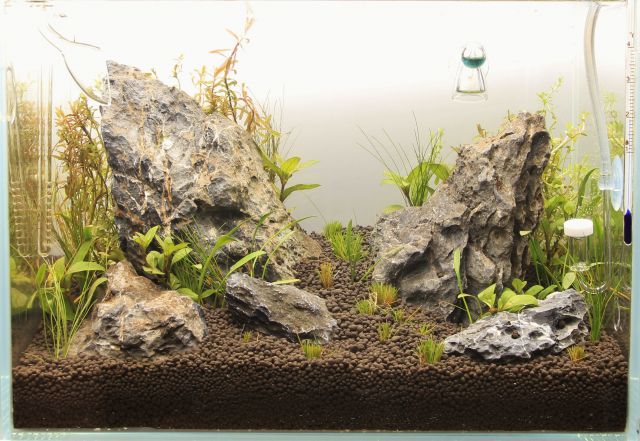
When an aquarium has only just been set up and newly planted, the ecological system is still quite sensitive in the so-called cycling phase. The aquatic plants still have to get used to their new environment, and some have to switch from emersed to submersed growth. This process also affects their metabolism. It is therefore advisable to limit the lighting period of a planted aquarium with moderate or high light intensity to only 6 hours in the beginning. After about 2 to 3 weeks, the lighting time can be increased somewhat, for example to 7 hours a day. After that, the aquarium owner can extend the light phase by one hour each week until the desired target time is reached. The prerequisite is that the aquarium stabilizes, plant growth becomes established and an unwanted, massive spread of algae does not occur. If this is not the case and, for example, there is a heavy algae infestation, the lighting time should stay at one level and not be increased further.