We use cookies to offer you an optimal shopping experience. These cookies can be grouped into categories. The necessary ones are essential for your purchase. Functional services enable additional content such as videos and maps. With further cookies we produce anonymized statistics. Others serve primarily marketing purposes and are used for the personalization of advertising. These cookies are used by 11 Services used in the shop. You can decide for yourself which cookies you want to allow.
We store your choice on your device (“local storage”) and ask you again after 12 months at the latest. You can change it at any time under “Cookie Preferences” in the footer. You can find details on cookie lifetimes and necessary cookies in our privacy policy.
These services are required to run the shop and for your purchase and cannot be switched off.
Strictly necessary cookies enable basic functions and are required for the website to work properly.
Shop functions: Essential Shop functions This includes: JTLSHOP (cookie, until you close the browser; keeps your session, the cart and your login), consent (browser storage; remembers your cookie choice, 12 months at most, during the session also in session storage), has_starting_point, cur_product_id and product_page_visits (session storage; navigation between products) as well as aquasabi-search-index-last-url, aquasabi-search-index-results and aquasabi-search-index-data (session storage; search results and lists when paging). easyVision: easyVision lets website visitors customize the display – e.g. by adjusting contrast, font size, line and letter spacing, color rendering, a blue light filter or by disabling animations. Developed and hosted in Germany, the service is GDPR-compliant and supports statutory accessibility requirements (BFSG) from 2025. The service loads its scripts from cdn.sitecockpit.com and stores your settings (easy-vision-*) in your browser storage (no cookies). Reviews: aquasabi_guid (cookie, 12 months) is only set when you click “Helpful” under a review. It stores a random ID so that the same person cannot count a review as helpful more than once. Sorting and view: aquaSort and aquaDisplayType (cookies, 90 days) store the sorting or view (gallery or list) that you choose in a product list. They are only set when you choose a sorting or view. Amazon Pay: Payment processing with Amazon Pay. The service provider is Amazon Payments Europe S.C.A. Where Amazon Pay is offered (e.g. in the cart and at the checkout), the shop loads scripts and images from static-eu.payments-amazon.com, payments-eu.amazon.com and m.media-amazon.com and sets cookies (language, ledgerCurrency, apay-session-set). You can find out more in the privacy policy at https://www.amazon.de/gp/help/customer/display.html?nodeId=GRFTMVHP4HXMESSP PayPal: Payment processing with PayPal. The service provider is PayPal (Europe) S.à r.l. et Cie, S.C.A. Where PayPal is offered (e.g. in the cart and at the checkout), the shop loads scripts from www.paypal.com; for invoice payment via PayPal, c.paypal.com is added for fraud prevention. PayPal stores an entry in your browser storage (__paypal_storage__), and the shop remembers the chosen PayPal payment method in session storage (chosenPPCPaymentOption). You can find out more in the privacy policy at https://www.paypal.com/en/legalhub/paypal/privacy-full Sofortüberweisung: On the confirmation page after an order with this payment method the shop loads a Klarna logo from x.klarnacdn.net.
Additional functions such as embedded videos and maps, spam protection in forms or the rating badge. Data is transferred to the respective provider when they load.
Show Youtube Videos
Displaying videos
Processing company:Google Ireland Limited, Google Building Gordon House, 4 Barrow St, Dublin, D04 E5W5, Ireland
Terms of use: https://policies.google.com/privacyShow Shopauskunft Rating-Badge
Used to provide the services of shopauskunft.de.
Processing company:Händlerbund Management AG
Terms of use: https://www.shopauskunft.de/datenschutzIntegration of Google Maps services
Performance measurement; Providing personalized services, including content and ads; Providing our services
Processing company:Google Ireland Limited
Terms of use: https://policies.google.com/privacy?hl=enTo submit forms on this page, you need to consent to the transfer of data and storage of third-party cookies by Google. With your consent, reCAPTCHA, a Google service to avoid spam messages via contact forms, will be embedded. This service allows us to provide our customers with a safe way to contact us via online forms. At the same time, the service prevents spam bots from compromising our services. After you gave your permission, you might be asked to answer a security prompt to send the form. If you do not consent, unfortunately you cannot use the form. Please contact us in a different way.
Stopping spam bots
Processing company:Google Inc.
Terms of use: https://policies.google.com/privacyHelps us understand how the shop is used so that we can improve it.
We measure which pages and products are viewed and how visitors move through the shop. Google Analytics sets cookies (_ga, _ga_*) and sends usage data to Google.
Audience measurement and analysis of how the shop is used
Processing company:Google Ireland Limited
Terms of use: https://policies.google.com/privacy?hl=enMeasures our advertising and enables personalised advertising on other sites.
We measure whether an ad on Facebook or Instagram led to a purchase and show visitors relevant ads again. Cookies are set for this: _fbp and _fbc (Meta) and as_fbclid (ours, 30 days; remembers the ID of the ad click). Meta receives data about your actions in the shop (e.g. product views, cart, purchase), your IP address and browser information; for a purchase our server may also send them directly to Meta (Conversions API). More in our privacy policy (retargeting/remarketing and conversion tracking).
Measure advertising success and show relevant ads again (Facebook, Instagram)
Processing company:Meta Platforms Ireland Limited, Merrion Road, Dublin 4, D04 X2K5, Irland
Terms of use: https://www.facebook.com/privacy/policy/We measure whether an ad on TikTok led to a purchase. Cookies are set for this: _ttp, ttclid and _tt_* (TikTok) and as_ttclid (ours, 30 days; remembers the ID of the ad click). TikTok receives data about your actions in the shop (e.g. product views, cart, purchase), your IP address and browser information; for a purchase our server may also send them directly to TikTok (Events API). More in our privacy policy (retargeting/remarketing and conversion tracking).
Measure the success of ads on TikTok
Processing company:TikTok Technology Limited, 10 Earlsfort Terrace, Dublin, D02 T380, Irland
Terms of use: https://www.tiktok.com/legal/page/eea/privacy-policy/enWe measure whether an ad in ChatGPT led to a purchase. Cookies are set for this: __oppref and __obref (OpenAI) and as_oppref (ours, 30 days; remembers the ID of the ad click). OpenAI receives data about your actions in the shop (e.g. product views, cart, purchase), your IP address and browser information; for a purchase our server may also send them directly to OpenAI (Conversions API). Data may be transmitted to OpenAI OpCo, LLC (USA). More in our privacy policy (retargeting/remarketing and conversion tracking).
Measure the success of ads in ChatGPT
Processing company:OpenAI Ireland Limited, 1st Floor, The Liffey Trust Centre, 117-126 Sheriff Street Upper, Dublin 1, D01 YC43, Irland
Terms of use: https://openai.com/policies/eu-privacy-policy/We measure whether an ad led to a purchase and show visitors relevant ads again. Google Ads sets cookies (e.g. _gcl_*) and receives purchase data, where applicable in hashed form (SHA-256).
Measure advertising success and show relevant ads again (remarketing)
Processing company:Google Ireland Limited
Terms of use: https://policies.google.com/privacy?hl=enWe use cookies that are essential for payment processing through our partners. Please select which payment providers you would like to use.
In order to unlock offers for extended payment options, in particular express checkout and payment in instalments, we require your consent to the data transfer and storage of third-party cookies of the payment provider PayPal. This allows us to also offer you express checkout and payment by instalments. Without your consent, only the technically necessary data transfer to PayPal will take place, but you will then not be able to use the express checkout or extended offers for payment by instalments on this site.
Using express checkout and Displaying offers for payment in instalments for individual items or your entire purchase.
Processing company:PayPal
Terms of use: https://www.paypal.com/de/webapps/mpp/ua/privacy-full?locale.x=en-GB
Your consent ID:
With this randomly generated number we can show on request what you selected. It contains no information about you.
Would you like to see these contents? Activate the desired contents for one session only or allow the website to remember these settings. Once you have given your consent, the third-party data can be loaded. For this, third-party cookies might be stored on your device. You can change these settings at any time (footer: “Cookie Preferences”). For further details, please see the Privacy notice.
By Aram Schneider Published Updated
Translated from German with AI assistance and reviewed by our editors.
Contents
In our basics series Fertilizing a planted aquarium, part 1, 2 and 3, we have already provided a lot of information about the right fertilization of aquarium plants. Aren't too many nutrients removed that way? Do I have to fertilize my fresh water? We answer all these questions in this article.
We have already covered the topic of water changes in a separate article (see here). In short: while many natural waters have a constant supply of fresh water, in the aquarium ecosystem humans have to help out and regularly replace part of the water. This removes water-polluting elements and adds new, unpolluted water. This includes not only end products of organic waste such as nitrate and phosphate, but also, for example, proteins that hardly break down in the aquarium, if at all, and harmful microorganisms (pathogenic germs). A water change also influences the nutrient supply for aquatic plants. Certain nutrients that have accumulated in excess are reduced, and some missing or lacking elements can be added again through the fresh water.
With a planted aquarium, the question is somewhat in the air: why should you pour expensive fertilizer into the water only to remove it again with the water change?
Of course, a water change also removes nutrients. Speaking of a waste of fertilizer here would be a one-sided view of things, however. A water change also has advantages: the fresh water supply alone revitalizes the aquarium with unpolluted water; as already mentioned, organic contaminants are removed and the germ load is reduced. In terms of nutrient balance, a water change can also be understood as a kind of reset that removes nutrient spikes and restores moderate conditions. In practice, there are basically two fundamentally different approaches to handling fertilization and water changes. If you want to be economical with your fertilizers, you can determine the water values precisely by testing shortly before the water change and then calculate the fertilizer dosage so that any gaps are closed and hardly any nutrient losses occur (see the chapter "The fertilization concept with fresh water fertilization" further below). If you prefer things a little more convenient and uncomplicated, with significantly less time spent, "The fertilization concept without fresh water fertilization" is recommended. We now present both variants below.
The aim here is constant nutrient values in the aquarium. You start from the nutrient levels already present in the old water and the fresh water, and fertilize the fresh water added at the water change only as far as needed to close nutrient gaps.
First, at the end of a week, before the water change, you get a good overview of the current nutrient situation. You measure all the important nutrient parameters of the old water, such as NO3, K, Fe and PO4. You also need the nutrient values already present in the source water, usually tap water, which can then be looked up in the drinking water analysis of the local water supplier. The target values of the nutrient concentrations that the fresh water should have after the water change must also be known. And you need to know how much old water is to be replaced with fresh water.
From these starting values, you then determine the amounts of the various fertilizers that you have to add to the fresh water to reach the respective target values of the nutrient levels after the water change. Put simply, the volume and nutrient content of the remaining water and the fresh water are divided by the total volume of the aquarium and then subtracted from the target value of the nutrient concentration. The difference is the amount by which we have to fertilize the fresh water. This gives the following formula:
[Target value of nutrient concentration in mg/l] - ([Volume of remaining water in l x concentration of remaining water in mg/l] + [Volume of replacement water in l x concentration of replacement water in mg/l]) / [Total aquarium volume in l] = [required fertilization value in mg/l]
To then calculate the exact fertilizer amount, the Flowgrow nutrient calculator can be used. With the calculator, you can determine the required amount of liquid fertilizer in ml to match a certain nutrient level in mg/l and the amount of fresh water in liters.
An example: you have a 100 liter aquarium in which a 50% water change (50 liters) is carried out every week. The measured nitrate value before the water change is 5 mg/l NO3, so that much nitrate is already present. The source water has a concentration of 3 mg/l NO3. As the target value for the aquarium water, we want to aim for a level of 15 mg/l NO3. We now calculate 15 - (50 x 5 + 50 x 3) / 100 = 11 mg/l NO3. Our aquarium of 100 liters therefore needs fertilizing by a total of 11 mg/l NO3. Now the Flowgrow nutrient calculator comes into play. At the top under "Tank volume", we enter the amount of aquarium water, in this case 100 liters. Further down, under the nutrient nitrate, we first pick a suitable product with which we want to raise NO3. In our example, we use GH Boost N.
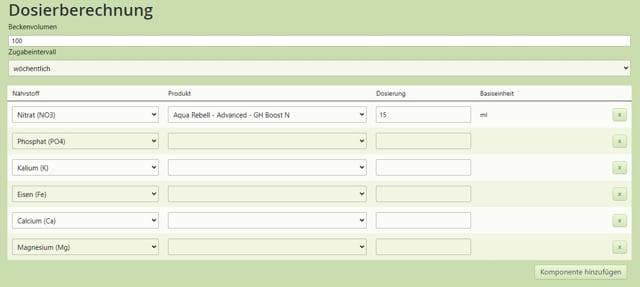
Now you have to experiment a little: under dosage, you enter a number and then click "Calculate". Using trial and error, we then have to find out the dosage until our desired fertilization value is displayed under nitrate in the results below. In our example, this was 11 mg/l NO3, which we reach with an approximate addition of 15 ml of GH Boost N.
If the nutrient level of an element in the aquarium water is already below the target value, either the daily fertilization has to be adjusted or a further calculation for additional fertilization of the old water has to be made.
Quite complicated, isn't it? This way of dealing with nutrient values and the water change is very meticulous, but with the weekly testing and calculating it also involves a certain amount of time. We would now like to present a somewhat more convenient approach.

The idea behind this concept is basically based on the Estimative Index method. It provides for unlimited nutrient availability. Since all nutrient elements are present in lavish amounts, they don't have to be checked regularly with water tests, as a nutrient shortage generally doesn't occur. A regular weekly water change of 50% ensures that nutrients don't accumulate too much. Nutrient spikes are simply cut off again by the water change. It is therefore intended that nutrient values are low at the beginning of a week and rise toward the end of the week.
This basic idea is adopted here in principle. The daily doses of the fertilizers are, so to speak, always a little larger than the plants' daily nutrient requirement, so that certain nutrients accumulate over the course of a week. With the water change at the end of the week, you then carry out a kind of reset, cut off any nutrient spikes and set them back to a minimum or to a certain baseline value.
In other words: by slightly overdosing the fertilizers over the course of the week, the fertilization of the fresh water is, so to speak, already included. This eliminates the weekly final check and the regular testing of the water.
The amount of fertilizer added over the week depends on the size of the water change. The more fresh water is added at the change, the more the daily fertilization should be adjusted slightly upward. We definitely recommend a water change rate of 50% per week. That way, the water change still has enough influence on the nutrient balance and on other water pollution (germ density), but on the other hand does not remove too many nutrients.
Of course, to find the right daily doses, you have to check the water values somewhat more often with a suitable test at the beginning. At some point, however, you reach the point where daily fertilization, the plant stock in the aquarium and the weekly water change form a certain balance and all values stay within the desired target ranges. Instead of regular testing, you can then rely more on simply observing the plants. Only when deficiency symptoms or algae growth appear is it worth switching back to "analytical mode" and checking certain parameters with water tests as well. All in all, this method without fresh water fertilization is the much less complicated one, but sometimes requires a certain amount of experience.
Are you having problems with your plant growth or your fertilization concept? No problem, write to us and we'll be happy to help!