We use cookies to offer you an optimal shopping experience. These cookies can be grouped into categories. The necessary ones are essential for your purchase. Functional services enable additional content such as videos and maps. With further cookies we produce anonymized statistics. Others serve primarily marketing purposes and are used for the personalization of advertising. These cookies are used by 11 Services used in the shop. You can decide for yourself which cookies you want to allow.
We store your choice on your device (“local storage”) and ask you again after 12 months at the latest. You can change it at any time under “Cookie Preferences” in the footer. You can find details on cookie lifetimes and necessary cookies in our privacy policy.
These services are required to run the shop and for your purchase and cannot be switched off.
Strictly necessary cookies enable basic functions and are required for the website to work properly.
Description:
Shop functions: Essential Shop functions This includes: JTLSHOP (cookie, until you close the browser; keeps your session, the cart and your login), consent (browser storage; remembers your cookie choice, 12 months at most, during the session also in session storage), has_starting_point, cur_product_id and product_page_visits (session storage; navigation between products) as well as aquasabi-search-index-last-url, aquasabi-search-index-results and aquasabi-search-index-data (session storage; search results and lists when paging).
easyVision: easyVision lets website visitors customize the display – e.g. by adjusting contrast, font size, line and letter spacing, color rendering, a blue light filter or by disabling animations. Developed and hosted in Germany, the service is GDPR-compliant and supports statutory accessibility requirements (BFSG) from 2025. The service loads its scripts from cdn.sitecockpit.com and stores your settings (easy-vision-*) in your browser storage (no cookies).
Reviews: aquasabi_guid (cookie, 12 months) is only set when you click “Helpful” under a review. It stores a random ID so that the same person cannot count a review as helpful more than once.
Sorting and view: aquaSort and aquaDisplayType (cookies, 90 days) store the sorting or view (gallery or list) that you choose in a product list. They are only set when you choose a sorting or view.
Amazon Pay: Payment processing with Amazon Pay.
The service provider is Amazon Payments Europe S.C.A. Where Amazon Pay is offered (e.g. in the cart and at the checkout), the shop loads scripts and images from static-eu.payments-amazon.com, payments-eu.amazon.com and m.media-amazon.com and sets cookies (language, ledgerCurrency, apay-session-set). You can find out more in the privacy policy at https://www.amazon.de/gp/help/customer/display.html?nodeId=GRFTMVHP4HXMESSP
PayPal: Payment processing with PayPal.
The service provider is PayPal (Europe) S.à r.l. et Cie, S.C.A. Where PayPal is offered (e.g. in the cart and at the checkout), the shop loads scripts from www.paypal.com; for invoice payment via PayPal, c.paypal.com is added for fraud prevention. PayPal stores an entry in your browser storage (__paypal_storage__), and the shop remembers the chosen PayPal payment method in session storage (chosenPPCPaymentOption). You can find out more in the privacy policy at https://www.paypal.com/en/legalhub/paypal/privacy-full
Sofortüberweisung: On the confirmation page after an order with this payment method the shop loads a Klarna logo from x.klarnacdn.net.
Additional functions such as embedded videos and maps, spam protection in forms or the rating badge. Data is transferred to the respective provider when they load.
Show Youtube Videos
Description:
Displaying videos
Processing company:
Google Ireland Limited, Google Building Gordon House, 4 Barrow St, Dublin, D04 E5W5, Ireland
Helps us understand how the shop is used so that we can improve it.
We measure which pages and products are viewed and how visitors move through the shop. Google Analytics sets cookies (_ga, _ga_*) and sends usage data to Google.
Description:
Audience measurement and analysis of how the shop is used
Measures our advertising and enables personalised advertising on other sites.
We measure whether an ad on Facebook or Instagram led to a purchase and show visitors relevant ads again. Cookies are set for this: _fbp and _fbc (Meta) and as_fbclid (ours, 30 days; remembers the ID of the ad click). Meta receives data about your actions in the shop (e.g. product views, cart, purchase), your IP address and browser information; for a purchase our server may also send them directly to Meta (Conversions API). More in our privacy policy (retargeting/remarketing and conversion tracking).
Description:
Measure advertising success and show relevant ads again (Facebook, Instagram)
We measure whether an ad on TikTok led to a purchase. Cookies are set for this: _ttp, ttclid and _tt_* (TikTok) and as_ttclid (ours, 30 days; remembers the ID of the ad click). TikTok receives data about your actions in the shop (e.g. product views, cart, purchase), your IP address and browser information; for a purchase our server may also send them directly to TikTok (Events API). More in our privacy policy (retargeting/remarketing and conversion tracking).
We measure whether an ad in ChatGPT led to a purchase. Cookies are set for this: __oppref and __obref (OpenAI) and as_oppref (ours, 30 days; remembers the ID of the ad click). OpenAI receives data about your actions in the shop (e.g. product views, cart, purchase), your IP address and browser information; for a purchase our server may also send them directly to OpenAI (Conversions API). Data may be transmitted to OpenAI OpCo, LLC (USA). More in our privacy policy (retargeting/remarketing and conversion tracking).
Description:
Measure the success of ads in ChatGPT
Processing company:
OpenAI Ireland Limited, 1st Floor, The Liffey Trust Centre, 117-126 Sheriff Street Upper, Dublin 1, D01 YC43, Irland
We measure whether an ad led to a purchase and show visitors relevant ads again. Google Ads sets cookies (e.g. _gcl_*) and receives purchase data, where applicable in hashed form (SHA-256).
Description:
Measure advertising success and show relevant ads again (remarketing)
We use cookies that are essential for payment processing through our partners. Please select which payment providers you would like to use.
In order to unlock offers for extended payment options, in particular express checkout and payment in instalments, we require your consent to the data transfer and storage of third-party cookies of the payment provider PayPal. This allows us to also offer you express checkout and payment by instalments. Without your consent, only the technically necessary data transfer to PayPal will take place, but you will then not be able to use the express checkout or extended offers for payment by instalments on this site.
Description:
Using express checkout and Displaying offers for payment in instalments for individual items or your entire purchase.
Your consent ID:With this randomly generated number we can show on request what you selected. It contains no information about you.
Data privacy settings
Would you like to see these contents? Activate the desired contents for one session only or allow the website to remember these settings. Once you have given your consent, the third-party data can be loaded. For this, third-party cookies might be stored on your device. You can change these settings at any time (footer: “Cookie Preferences”). For further details, please see the Privacy notice.
Nitrate is the last link in the denitrification chain of the so-called nitrogen cycle. It is part of a functioning ecosystem and serves to decompose and transform organic pollution in an aquarium. In this process, ammonium is converted into nitrite and finally nitrite into nitrate by various bacteria. While the two precursors ammonium and nitrite can be dangerous for animal inhabitants of an aquarium, nitrate is first of all a non-toxic substance. The ideal nitrate concentration The ideal content of nitrate is set to different levels in the various aquaristic varieties (freshwater, saltwater, breeding, shrimp keeping, planted tanks). In a regular community aquarium, slightly higher values in the range of 50 to 100 mg / l NO3 (nitrate) are still tolerable, depending on the type of fish, even higher concentrations might still be well tolerated. If this limit is considerably exceeded, we recommend the aquarist to think about suitable countermeasures and to investigate the causes. An extremely high nitrate content is primarily to be seen as an indicator that the ecosystem in the aquarium is not working properly or is overloaded. Basics like filtration, maintenance or feeding need to be reconsidered.
Nitrate in a planted aquarium
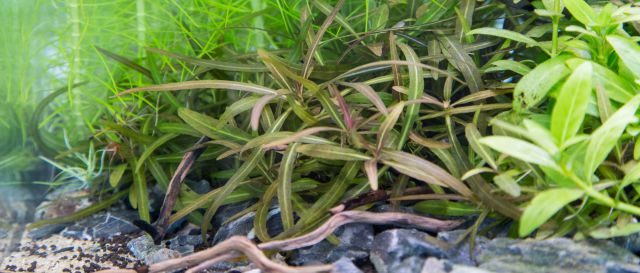
Nitrogen in the shape of nitrate is an important nutrient for aquatic plants. If the growth conditions are good, nitrate - among other elements - is consumed by the aquarium plants. In densely planted aquariums or aquascapes, the nitrate consumption can get so high, that a dedicated nitrate fertilizer has to be added, to prevent deficiency symptoms and growth defects. In some cases, an aquarium with many fast-growing plants can have a daily consumption of up to 5 mg/l NO3, meaning that a plant aquarium should have a nitrate concentration of 10 to 25 mg/l NO3. Significantly higher levels are not detrimental to aquatic plants, but there may be a change in colour, e.g. some reddish plant species tend to turn a greener hue.
Nitrate in a fish breeding tank
In aquariums with a high stocking density, as is the case in breeding tanks, the ecosystem is more concerned with reducing organic pollution. If factors such as excessive feeding, insufficient filter placement and having only a few, rather slow-growing plants come into play, increased nitrate and phosphate concentrations may arise. In aquariums focused on the breeding of animals a too high nitrate concentration is not at all desirable. Although nitrate is not a toxic substance per se, in high concentrations it can cause problems during the rearing of fish. This may probably be due to the fact that any salt (nitrate in this case) above a certain level may have osmotic effects on the water balance of an animal’s body, adversely affecting it.
Nitrate in a shrimp tank
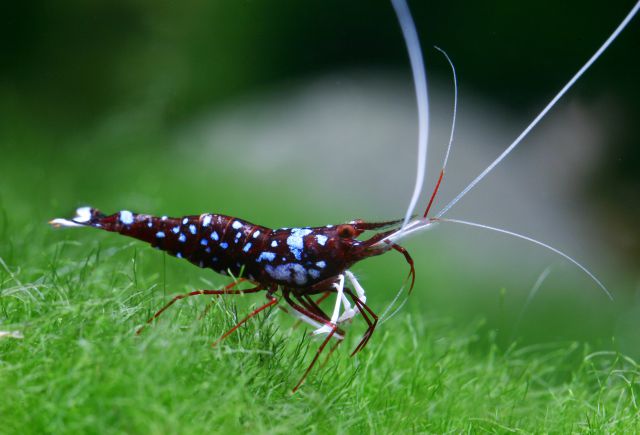
Caridina dennerli - Copyright by Chris Lukhaup.
The content of nitrate in breeding tanks of dwarf shrimp plays a special role. For successful moulting, they need enough iodine to form the molting hormone crustecdysone. However, an excessively high nitrate content inhibits the absorption of iodine by shrimp. As a result of this, too little molting hormones are formed and failed or missing molts may occur, ending in the death of the animals. In particular, dwarf shrimp from very clean habitats (Bee Shrimp and similar, but also the Sulawesi shrimp) are much less tolerant towards nitrate than those from more nutrient-rich habitats such as Neocaridina Davidi. In high-breeds, a maximum content of 15 mg/l nitrate is desired, more resistant species can tolerate values up to slightly above 25 mg/l.
For nitrate reduction and to keep the water pollution caused by organic compounds low, we recommend a generous and regular water change. If these care measures can not be held up or are insufficient, you may switch to alternative options. Here are some ways to reduce nitrate.
Utilize aquatic plants
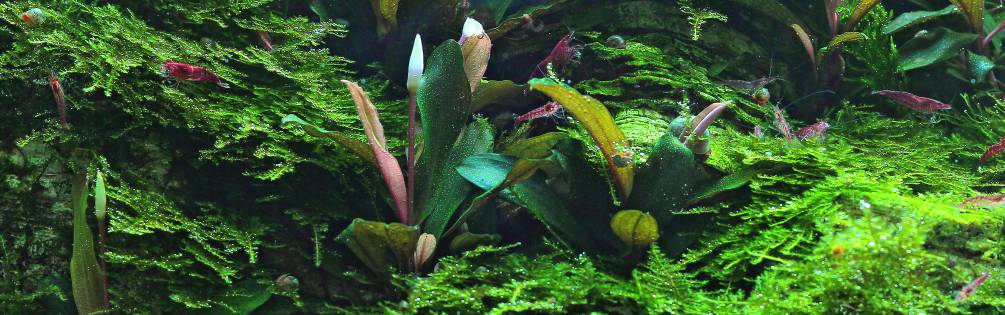
Fast growing aquatic plants in particular have a high demand in elements such as nitrate and phosphate among other nutrients. Thus they can contribute to the lowering of nitrate and phosphate concentrations. In addition, the aquarium plants offer great natural hiding and spawning opportunities for animal inhabitants such as fish and shrimp. In addition, oxygen is produced by the photosynthesis process, which also benefits the aquarium occupants. In this respect, the introduction of aquatic plants is a very natural means of reducing nitrate, which additionally supports the aquarium’s complete ecosystem. To ensure an optimal growth of your aquatic plants it is vital to supply them with all nutrients needed. More detailed information on this can be found in our article "fertilizing a planted aquarium".
Use of biological filter media
Equipping the filter with so-called high-performance filter media benefits the settlement of nitrate-degrading bacteria. Biological filter materials such as JBL BioNitrat Ex or Oase Hel-X have highly porous properties, offering a lot of surface for the settlement of useful bacteria.
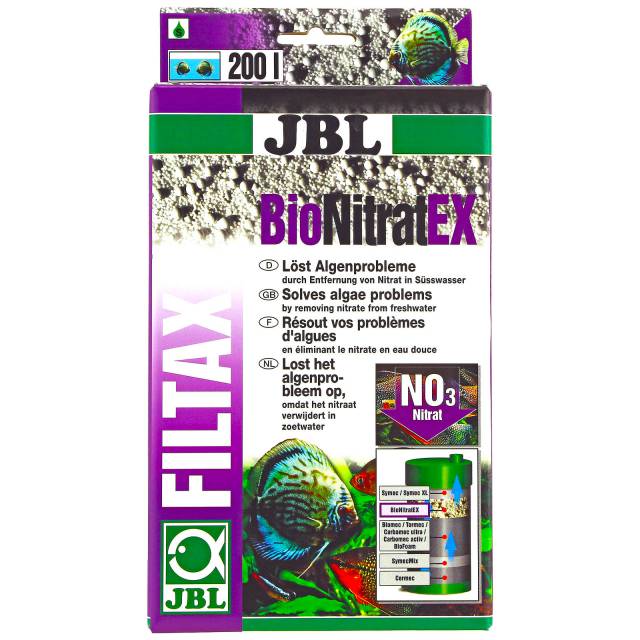
Often these filter media are made of sintered glass or ceramic. An immediate reduction of the nitrate content does not take place, however, as the bacteria first have to develop and multiply. This measure has more of a long-term effect.
Removal using an ion exchanger
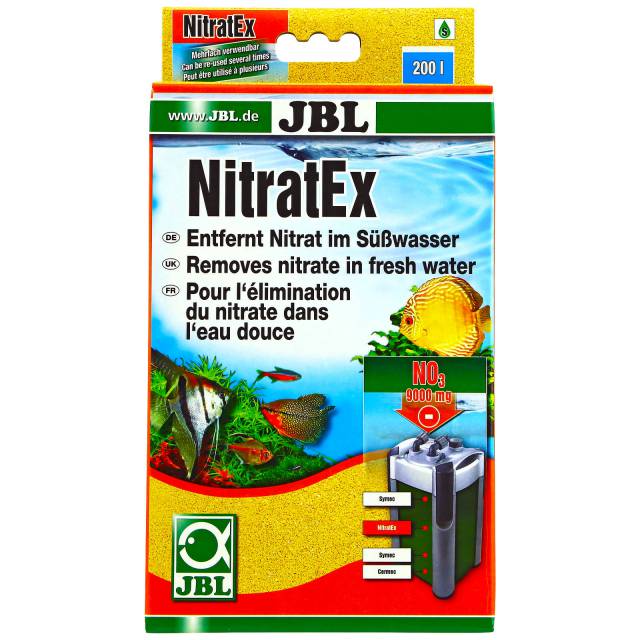
Chemical filter media such as JBL NitratEx which work under the ion-exchange principle, are suitable for an immediate removal of nitrate. These resins bind nitrate ions and usually release chloride ions to the water. However, their exchange capacity is limited, so the nitrate content in aquarium water should be checked regularly with a water test. As a rule, these resins can be regenerated well with a treatment with common salt.