 Using Aqua Rebell fertilizers in a saltwater aquarium
Just like aquarium plants in freshwater, corals (although animals) in a saltwater aquarium also need nutrients for healthy growth and a vital appearance. Some nutrient elements are identical to those of aquatic plants in a freshwater aquarium, so it is natural to assume that certain aquatic plant fertilizers can also be used in saltwater. In this article, we clarify which Aqua Rebell liquid fertilizers can be used for this.
Nutrients for corals
Like practically all living things, corals in saltwater also need certain nutrients. The elements phosphorus and nitrogen, which are listed under the group of macronutrients in planted aquarium keeping, are among them as well. In aquaristics, these two substances are often supplied in the form of phosphate (PO4) and nitrate ( NO3). Similar to aquatic plants, Liebig's law of the minimum also applies to corals: even if all other nutrient elements are sufficiently present but one nutrient is lacking, deficiency symptoms or stunted growth can occur. Even though completely different target values apply to nutrients such as nitrate and phosphate in a saltwater aquarium with corals, they are still important elements that sometimes have to be supplied artificially. Although both NO3 and PO4 arise as end products or waste products from fish excretions and feeding, consumption by the corals can be higher than the input. Consequently, a deficiency can arise here.
Nitrogen deficiency in corals
If corals have a nitrogen deficit, both growth and the polyp appearance can be disturbed. A nitrate value that sits completely at zero does not make a good environment for corals in the long run. On the other hand, the nitrate level should not be too high either, as this can likewise lead to growth disorders or discoloration in corals. Small-polyp stony corals (SPS) then tend to turn brown, because the zooxanthellae embedded in them multiply too much. In the saltwater field, values between 0 and 2 mg/l NO3 are therefore often given as guideline values for an aquarium stocked with SPS. Soft corals, large-polyp stony corals (LPS) as well as disc anemones and zoanthids, however, prefer "dirtier water," that is, higher phosphate and nitrate values. A maximum value of 5 mg/l NO3 is often given here.
Raising the nitrate value with an Aqua Rebell fertilizer
If you want to raise the nitrogen concentration or nitrate value in the aquarium in a targeted way, various fertilizers from Aqua Rebell are suitable. First, we have Macro Basic Nitrate, which, however, also raises the potassium value at the same time. Per 100 l of aquarium water, adding this fertilizer raises the nitrate value by 1 mg/l NO3 (and the potassium value by 0.63 mg/l K). In this nutrient calculator, the requirement can be calculated individually by changing the aquarium volume and the dosage to reach a certain target value.
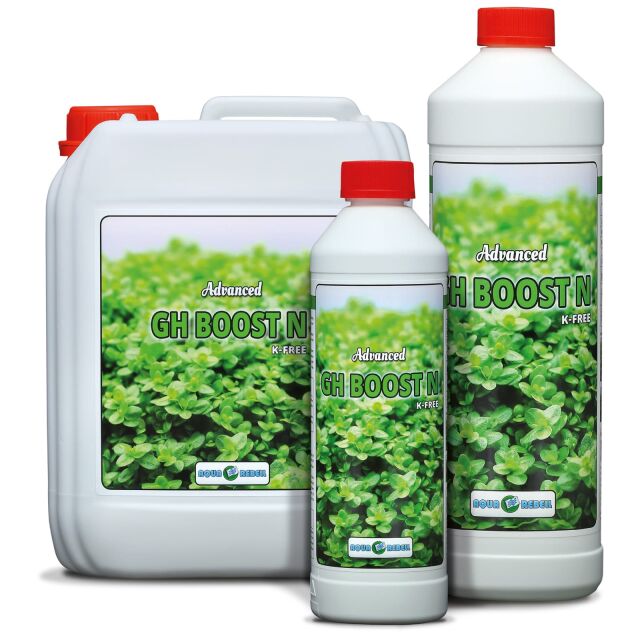
As a potassium-free alternative, you can use Aqua Rebell Advanced GH Boost N. It also adds calcium and magnesium to a small degree (1.33 ml per 100 l of aquarium water raises the levels by approx. 1 mg/l NO3, 0.2 mg/l Ca and 0.07 mg/l Mg). These elements are also heavily consumed in a saltwater aquarium with corals, so adding them can even be an advantage. Here you can use the nutrient calculator to determine the individually suitable dosage.
Phosphorus deficiency in corals
Corals suffer more obvious damage from a phosphate deficiency; dying tissue and even coral bleaching can occur. The aquarist often notices dead spots in the lower area of the coral. A phosphate value that is too high is not ideal either, though; it can, for example, disturb the coloration of the corals. Phosphate also acts antagonistically to calcium, so that a PO4 value that is too high blocks the uptake of calcium. As a result, the corals are no longer able to build their calcium skeleton properly, which is especially important for stony corals. Finding the right phosphate level in a saltwater aquarium and maintaining it is sometimes not that easy. On the one hand, phosphate is introduced through food, and PO4 also arises as a breakdown product, for example of fish excrement. On the other hand, phosphate should not sit completely at zero. In saltwater aquaristics, a range of 0.02 to 0.05 mg/l PO4 is given as target values, which, however, always also depend on the stocking. A value of 0.1 mg/l may still be tolerable.
Raising the phosphate value with an Aqua Rebell fertilizer
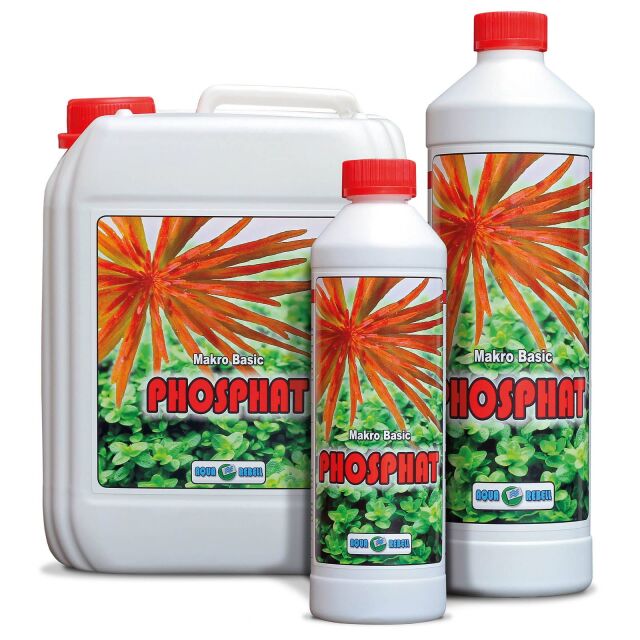
To increase the phosphorus concentration in a saltwater aquarium, you can use Aqua Rebell Basic Phosphate without concern. It raises the potassium content of the water to a very small degree. This phosphate fertilizer is very economical: 1 ml of the fertilizer per 100 l of aquarium water raises the PO4 level by 0.05 mg/l. So if you want to raise the phosphate level by 0.01 mg/l in a 100 l aquarium, you only need 0.2 ml of Aqua Rebell Basic Phosphate. To calculate a dosage individually, you can use the Flowgrow nutrient calculator. Here you enter the aquarium volume and the respective dosage to have the target value displayed.