 When is the best time to fertilize?
Every ambitious aquatic-plant aquarist probably uses various liquid fertilizers for his or her plants, whether complete iron fertilizers, NPK macronutrient fertilizers or even single components. Some of the substances have a reputation for reacting with each other when fertilized at the same time and precipitating as a solid. We show you what you should pay attention to here.
When should you fertilize aquarium plants?
For aquatic plants in an aquarium, a constant nutrient supply is important. Regularly adding liquid fertilizers, preferably at short intervals such as a daily rhythm, has proven very promising. This ensures that all the important nutrients are available almost permanently, above all those that are consumed in large amounts.
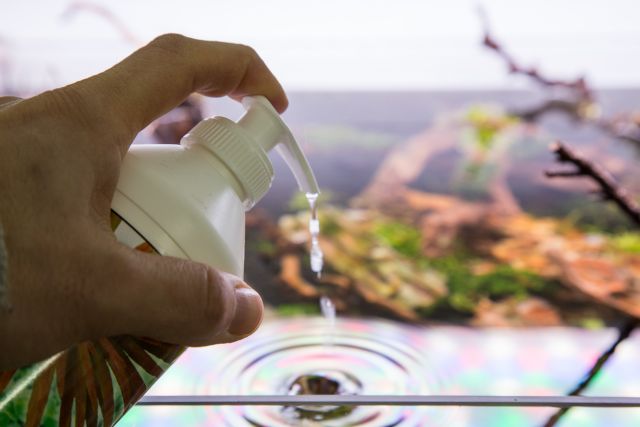
Although plants can take up some specific nutrients at night, when the plants' metabolism is running at full speed, that is, during the day in full light, the demand for nutrients is significantly higher. That is when photosynthesis takes place under the influence of light. A lot therefore speaks for adding your liquid fertilizers during the day. In a planted aquarium, the fertilizers are therefore often added when the lighting is switched on. CO2 injection generally starts at the same time. This way, the aquatic plants have all the necessary nutrients available as photosynthesis begins. In a somewhat more ambitious fertilizing system, several liquid fertilizers are used. This means handling several bottles. For this reason, nothing would be simpler and more convenient than adding all the fertilizers at the same time. However, this can sometimes lead to difficulties.
The precipitation of iron phosphate
One of the big concerns when adding various nutrients is that they can react with each other and then precipitate as a solid. This can happen when combining an iron-containing fertilizer (for example a complete iron fertilizer or a pure iron fertilizer) with a phosphate-containing fertilizer. The latter includes, of course, pure phosphate fertilizers, but also some macronutrient mixes whose components contain NPK.
Iron and phosphate can react with each other and then precipitate as iron phosphate. This can sometimes lead to cloudiness. These solids are then almost no longer soluble in water and are no longer available to the aquatic plants in the water column as a nutrient.
Chelation is what counts
Whether and how great the risk of iron phosphate precipitation is depends primarily on the chemical protective shells that encase the iron in a liquid fertilizer. These shells are called chelates. Strong chelation with complexing agents such as EDTA, DTPA and HEEDTA can often prevent an unwanted reaction to solids on a large scale. These chelates have further advantages, because through their protection the nutrient elements are available to the plants over a longer period. This increases the long-term effectiveness of fertilizers and makes handling as a weekly fertilizer possible in the first place. In addition, the chelates protect against the metals they contain, such as copper, acting harmfully toward sensitive animals such as snails and shrimp. Thanks to the chelates and the very low concentrations of such trace elements, fertilizers such as Aqua Rebell Mikro Basic Eisen are then safe and invertebrate-friendly.
Common practice
In planted-aquarium keeping, a method has therefore become very widespread that divides micro- and macronutrients across the day. For this, iron-containing fertilizers are added in the morning, often at the start of the lighting. In the evening, macronutrients are then fertilized. The large time offset avoids the problem of any nutrient precipitation. It also ensures that nutrient elements needed in small amounts (trace elements) are then sufficiently present at the start of photosynthetic activity.
When should you add Aqua Rebell fertilizers?
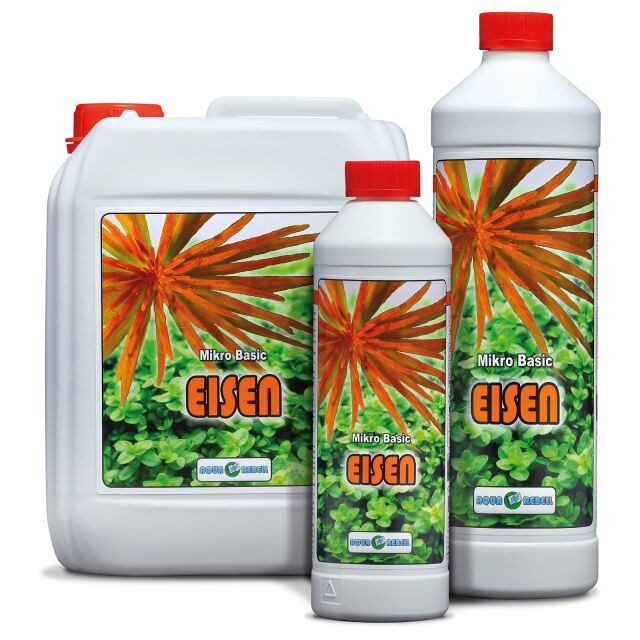
In principle, many Aqua Rebell fertilizers can also be added almost at the same time. There is fundamentally no risk of any precipitation. The minimal time offset of a few seconds, which is needed anyway to reach for the next fertilizer bottle, is often enough. The current in the aquarium also dilutes and distributes the nutrients very quickly and reliably.
With regard to the risk of iron phosphate precipitation, you can certainly give the all-clear when using Aqua Rebell Mikro Basic Eisen in combination with a phosphate-containing fertilizer. Although precipitation is theoretically possible, the multiple chelators in Basic Eisen protect the nutrients sufficiently against precipitation, so no disadvantages are to be expected in aquarium practice. It looks slightly different with more weakly chelated complete iron fertilizers or iron fertilizers. These include Mikro Spezial Eisen (Fe) and Mikro Spezial Flowgrow. Here the gentle chelation ensures quick nutrient availability, but the complexing agents can sometimes protect less well against precipitation. With these two fertilizers it is therefore advisable to allow for a clear offset in the timing of addition when combining them with a phosphate-containing fertilizer.