
Spontaneous accompanying fauna: snails
Published
Translated from German with AI assistance and reviewed by our editors.
Almost every aquarist knows the problem: you have bought new plants, replaced decoration or soil or administered live food - and all of a sudden, unknown animals appear in the aquarium, which apparently have been introduced by one of the above measures. These unexplained critters could be described as “spontaneous, accompanying fauna”. Quite often various types of snails are introduced into the aquarium unknowingly. Not all snails are considered pests, though, but they can be visually distracting, especially when a mass breeding occurs (see also our article "A plague of snails"). Biologically speaking, snails are an enrichment for the ecosystem, since they speed up the degradation of organic waste.
In the following, we’ll show you an overview of the snails most frequently occurring spontaneously in aquariums, along with detailed descriptions.
Snails and their clutches
Sometimes aquarists discover weird critters or organisms they can’t really identify. Those simply may be snails or their eggs. Where most snails are usually easily recognized by their soft body and typical shell, their spawn is harder to identify especially for laymen. Depending on the species, snail eggs small white cocoons, or transparent, colorless to yellowish-colored gelatinous structures with a few dots visible inside. Snail spawn can stick to almost any surface: on the panes, the decoration, the tech, the aquatic plants, even on the cover or inside the lid.
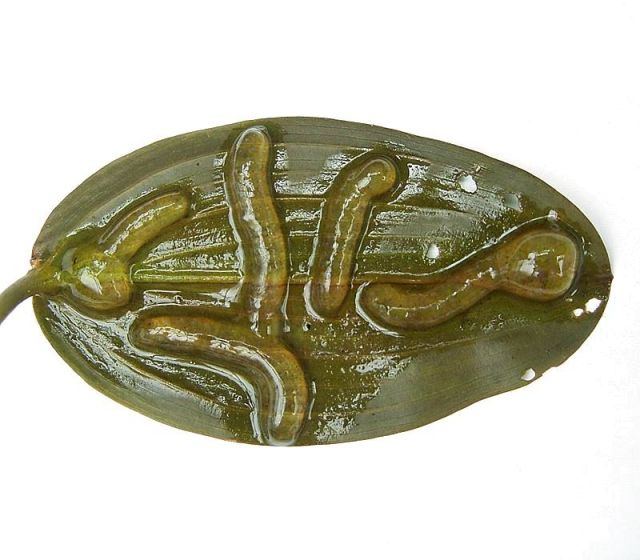
spawn of Lymnaea stagnalis, deposited on the bottom of a floating aquatic plant (Potamogeton natans). Picture copyright: Frank Vincentz Reference - own creation, license: CC BY-SA 3.0.
Few snails pose a danger to the occupants of an aquarium, so there is usually no cause for concern. On the contrary, snails are a great benefit for the ecosystem. They are excellent salvors and reduce, for example, visible biofilms and algae growth. Food leftovers, dead plant parts, fish droppings and even animal carcasses are "taken care of" by the snails and chopped up. In this respect, snails, but also other invertebrates such as shrimp, help pushing forward the pollutant degradation.
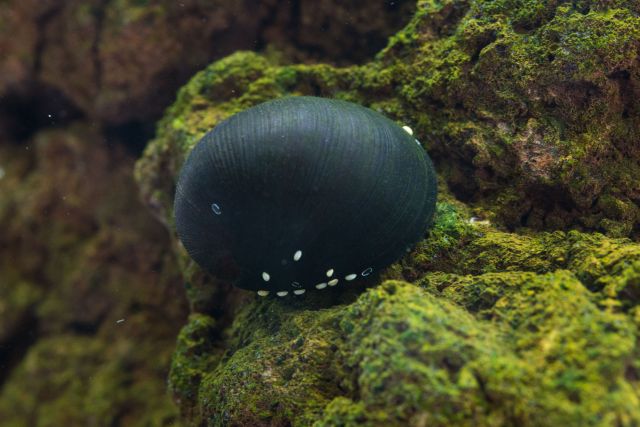
a black Neritina pulligera with adherent cocoons.
Nevertheless, there are some species that may attack aquatic plants, or maybe the owner wants to keep his aquarium snail-free for aesthetic reasons, a snail-free aquarium. Many aquarists are afraid of a veritable snail plague, in which the animals multiply acutely. If you have problems with a plague of snails, are looking for tips how to handle snails, we recommend the accompanying article with more accurate info.
Cap- and lake limpets
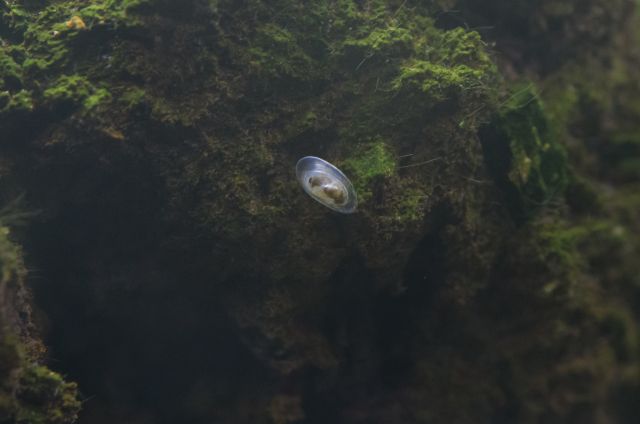
It is not uncommon to find small, oval, flat, translucent structures on aquarium panes, other objects and even plants, which are often hardly perceived as animals, much less as snails. These are aquatic snails with a curiously shaped shell, reminiscent of a jelly bag cap and hardly longer than 3mm.
Most of the time, these are so-called cap limpets of the class Ferrissia. Perchance, the similar lake limpet Acroloxus lacustris ends up in aquariums accidentally.
Cap- and lake limpets are not closely related, despite their similarities, but both belong to the group of basommatophora like Ramshorn- and bladder snails. They are hermaphrodites and multiply via eggs; Their tiny, flat, transparent clutches stick to objects or the aquarium panes and contain very few eggs.
Cap- and lake limpets are harmless. They crawl around very slowly, grazing algae coverings and other biofilms; Plants are not damaged by these tiny creatures. Pest control is unnecessary.
Bladder snails
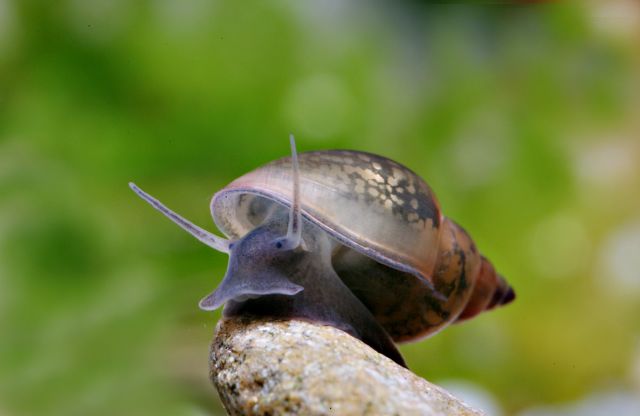
A Physella bladder snail. Copyright: Chris Lukhaup.
The bladder snails of the family Physidae are probably the snails with the worst reputation and also the most likely to get introduced as stowaways. Mostly it’s Physella species, but Physa are possible, too.
Those 12mm (at most), but usually smaller snails have a transparent, bulbous, acute or obtuse shell, letting their dark, brightly dotted mantle tissue shine through. This makes the bladder snail appear gold speckled. Unlike many other snails, they have left-wounded shells, which means, when looking at the shell from the top, the spiral runs counterclockwise outwards. The bladder snail’s body is rather dark, the rear end of its foot is tapering, and their feelers are typically thread-like, very long and actually look almost elegant. For snails, the animals can crawl remarkably fast.
Bladder snails are hermaphrodites but can self-fertilize and store seed. A single bladder snail can already be enough to populate the whole aquarium. The bladder snail’s spawn has a slightly curved shape, is gelatinous to the touch and doesn’t appear to be very sturdy. The eggs are recognizable as bright spots and do not lie in one plane.
Bladder snails eat algae growth, biofilms and remains. They won’t touch living plants. Sometimes the opposite is claimed, but this is probably always due to confusion with other snails, such as pond snails (family Lymnaeidae, see below), which actually eat live plants. With plenty of food, the bubble snails tend to proliferate enormously, which makes them so dreaded. The feed supply is in every individual aquarist’s hands, though. If there’s no overfeeding and no negligence in aquarium hygiene, there hardly will be mass propagation. Bladder snails are no more than a "cosmetic" problem anyway. As scavengers and biofilm exterminators, they even make themselves pretty useful in the aquarium.
Great Ramshorn
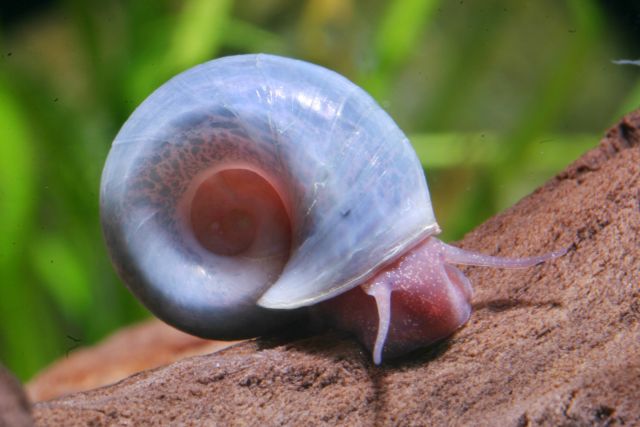
Blue variation of a Great Ramshorn snail, probably Planorbella duryi. Copyright: Chris Lukhaup.
The popular Great Ramshorn snails are often deliberately put into the aquarium - they are available in the colors blue, red-orange, pink and brown. However, the brown Great Ramshorn snails often appear "just like that" in the aquarium because they have been bought with plants. Great Ramshorn snails are lung breathers, and belong to the Planorbidae family. Aquariums have several hard-to-distinguish species, but different color forms can be of the same species. Often it’s Planorbella species, native to America; older literature mentions the South American Helisoma nigricans, whereas the European, 4 cm sized species Planorbarius corneus is a rare guest in aquarium tanks.
The Great Ramshorn’s clutches are flat, watch-glass shaped and surprisingly rigid to the touch. They are protected by a lid. The eggs are next to another in an even layer. The shells of Great Ramshorn snails are up to 2.5 cm tall and have the typical round shape that looks as if it’d been rolled up into one plane. Young animals may have a typical leopard pattern, which usually disappears as the snail ages.
Great Ramshorn snails are scavengers and eat left over fish food, algic growth, remains of dead plant tissue and also dead aquarium inhabitants. When too much food is offered, they can multiply quite drastically. An increased occurance of Great Ramshorn snails should be a sign to the aquarist to check of his feeding habits and aquarium hygiene. Since post-horn snails are capable of self-fertilization, even a single animal can be sufficient to establish a respectable population in the aquarium over time.
Great Ramshorn snails have a bit of a bad reputation, though, of attacking soft plants and their shoot tips. This might be species-dependent, as there are several species of Great Ramshorn found in aquariums. The popular Planorbella duryi is purported to have a soft rasping tongue, not being able to harm aquatic plants. Other, similar looking Maybe other, similar looking species like Planorbella anceps or Planorbella trivolvis (synonym Helisoma trivolvis) are a bigger threat to your plants, but nothing can be said for sure about that.
Ramshorn snails
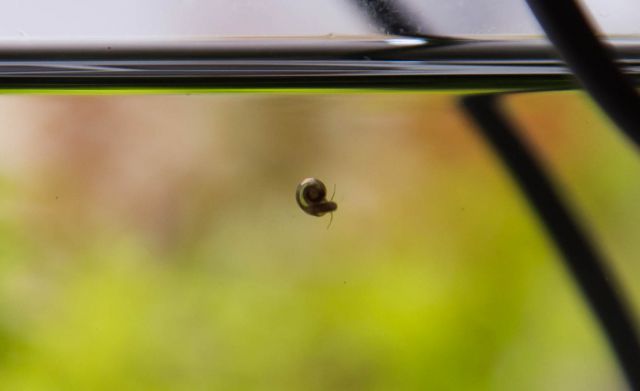
Often only 3-4 mm in size, Ramshorn snails are also among those aquarium snails, most often introduced with new plants or decoration. They belong to the same family (Planorbidae) as the Great Ramshorn and have a similar brownish-transparent, plane shell. However, the shell is not perpendicular to the body of the Ramshorn snail, but almost horizontal; it is more flattened and much finer from the structure. For example, the species of Ramshorns in aquarium tanks can be of the genera Anisus or Gyraulus. They also procreate hermaphroditically and lay clutches, which are so small, that they can’t be really seen or noticed inside the aquarium. The small snails are not very assertive and disappear automatically in the presence of food competitors. They do not nibble on living plants but rather feed almost exclusively on fine algae coatings and biofilms.
Pond snails
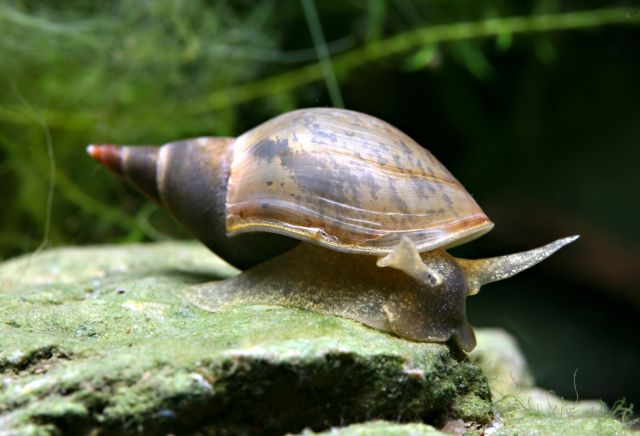
Great pond snail (Lymnaea stagnalis). Copyright: Chris Lukhaup.
Pond snails are lung breathers, just like the previously presented snail groups. They are grouped in the family Lymnaeidae, and the individual genera and species are often difficult to distinguish. Pond snails, often introduced into aquarium tanks, often belong to the genera Lymnaea and Radix - lesser known species are to be expected as well. Slug snails can be recognized by their bulbous, pointy shell, the rather light body and their triangular feelers with a broad base, tapering off into a tip. Those triangular “ears” have earned this 3cm long Great pond snail (Lymnaea stagnalis) the nickname “Yoda snail”. Unlike the snails mentioned above, pond snails may very well nibble on living plants, but cause no real deforestation but rather pitting.
Small pond snails are often considered to be bladder snails (see above), but bladder snails do not have wide and triangular, but stringy and thin feelers, as well as a left-wound shell (right-wound in pond snails).
Pond snails have a reputation of eating hydra. Mud snails are hermaphrodites, too and lay clutches. These have a typical shape: they are very elongated and laid in slight curves or straight, and the eggs lie in two or more rows side by side.
New Zealand mud snail
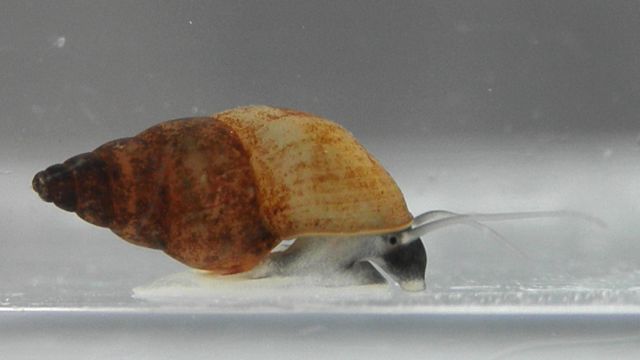
Picture copyright: Michal Maňas - own creation, license: CC BY 4.0.
Potamopyrgus antipodarum, the New Zealand mud snail, pops up quite often in aquariums. Originally native to New Zealand only, it has been introduced to fresh- and brackish waters by humans almost worldwide.
At first glance, this tiny snail can be easily confused with a small Trumpet (see below), which it really resembles quite a lot. The New Zealand mud snail also has a lid on the top of its foot, with which it can “shut the door” when retreating into its shell. Also, like the Malaysian trumpet snail, it not a pulmonate; it breathes with gills in its mantle cavity. Its shell is a little bit more bulbous – with a good pair of magnifying glasses or in a macro picture, the difference between the relatively flat and straight shells of Melanoides tuberculata can be seen pretty well. A further highlighting characteristic is the small size of the New Zealand mud snail. Adult specimens are only roughly 2 to 3 mm small.
While trumpet snails often burrow in the ground, the New Zealand mud snail crawls on all sorts of surfaces – floor, panes, plants etc. Potamopyrgus antipodarum mostly eats biofilms and young algic growth, but also food leftovers. If sufficient food is available, this tiny snail can procreate on a massive scale. By the way, predatory snails can not be used to contain this type of snail, as their shell’s aperture is too tiny to fit a Clea helena’s proboscis. By collecting and a significant feed reduction, the population can be contained.
The New Zealand pond snail is viviparous and gendered (male and female specimen), as are the Trumpet snails, but the populations outside of New Zealand consist almost entirely of females who can clone themselves by parthenogenesis - so it's already enough to accidentally introduce one single animal. The tiny snails often sit on purchased or traded plants.
Red-rimmed Melania
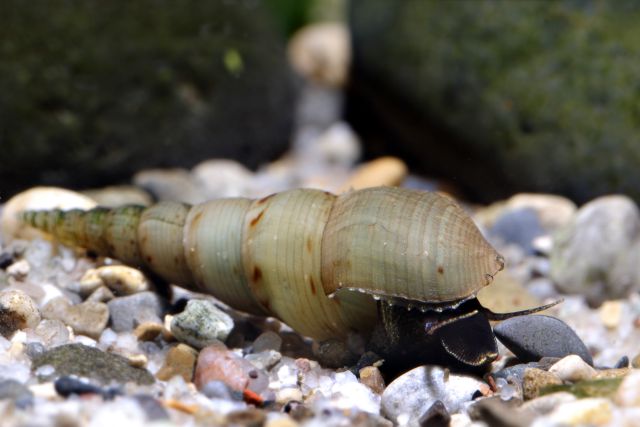
Copyright: Chris Lukhaup.
The Red-rimmed Melania, Melanoides tuberculata, is often abbreviated with MTS, which is the acronym for Malaysian Trumpet snail. Even though it originates in Asia and East Africa, it’s been introduced and highjacked into other continents and is so widespread in aquaristics, that there are virtually no more aquariums out there without them.
These usually 2-3 and rarely over 4 cm small snails usually live in the substrate, keeping them largely unnoticed. Their shells can be light creme coloured to light brown and dark brown, with some specimens sporting a fine, dark spot or stripe pattern. Just like Sadleriana, the MTS is viviparous and actually gendered, but the females are capable of parthenogenesis, meaning, that depending on the temperature, they’ll birth an exact genetic copy of themselves every one to three weeks. SO one individual snail can already be enough to create a whole population.
MTS have the reputation of being an excellent cleaning troop in aquarium tanks, taking care of food leftovers and loosening the substrate, making sure the plants’ roots will find a pleasant environment. They prevent water contamination by rotting food residues and a compaction of the soil, which could lead to rot. If a lot of food is present, MTS tend to increase in mass. So they are good indicator animals, if the aquarium is roughly overfed. In the presence of nitrite (NO 2) in the water or when there is a lack of oxygen, the MTS snails move to the surface en bloc - again they are good indicator animals that something is wrong in the aquarium and that the aquarist should intervene to avert consequential damage to its inhabitants.
However, it should also be noted that Melanoides tuberculata will gladly ruin each and every modeling of the substrate. The ground is gradually leveled by the MTS with the unstoppable stubbornness of a tiny but very efficient bulldozer. For aquariums or aquascapes with sloping substrates, this type of snail is obviously unsuitable.
Pagoda snail
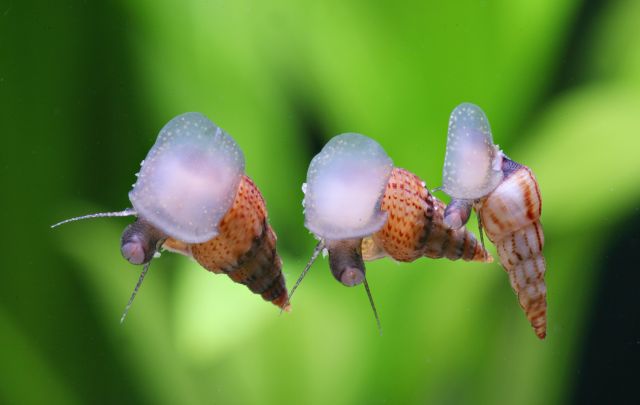
On the left two Pagoda snails (Mieniplotia scabra), on the right an MTS (Melanoides tuberculata). Copyright: Chris Lukhaup.
Mieniplotia scabra was also known as Thiara scabra. Here and there, this tiny snail is still sold under that name in aquaristics. Often it is also erroneously called Thiara winteri. The Pagoda snail is an old acquaintance in aquaristics. It was originally spread from East Africa through tropical Asia to northern Australia and was also introduced to other warm regions. Its shell is only 2.5 cm long and is usually light brown with a dark brown dot pattern. The snail got its name from its tiered shells bedecked with spiralling spikes along its ridges.
Mieniplotia scabra procreates even better than the MTS and fills the same ecological gap in an aquarium’s ecosystem: a bottom-dwelling, root-ventilating, scavenging, aquarium tank garbage man. The spiky Pagoda snail procreates via parthenogenesis and is very productive in that when enough food is available. Mieniplotia scabra births living offspring, which develop from eggs in a brood pouch inside the mother’s shell.
Just like the MTS, the Pagoda snail tends to level an aquarium’s substrate completely. Safe to say: this snail is a lot less suitable for lovingly designed aquascapes.
Copyright Header-Foto: Chris Lukhaup.