We use cookies to offer you an optimal shopping experience. These cookies can be grouped into categories. The necessary ones are essential for your purchase. Functional services enable additional content such as videos and maps. With further cookies we produce anonymized statistics. Others serve primarily marketing purposes and are used for the personalization of advertising. These cookies are used by 11 Services used in the shop. You can decide for yourself which cookies you want to allow.
We store your choice on your device (“local storage”) and ask you again after 12 months at the latest. You can change it at any time under “Cookie Preferences” in the footer. You can find details on cookie lifetimes and necessary cookies in our privacy policy.
These services are required to run the shop and for your purchase and cannot be switched off.
Strictly necessary cookies enable basic functions and are required for the website to work properly.
Description:
Shop functions: Essential Shop functions This includes: JTLSHOP (cookie, until you close the browser; keeps your session, the cart and your login), consent (browser storage; remembers your cookie choice, 12 months at most, during the session also in session storage), has_starting_point, cur_product_id and product_page_visits (session storage; navigation between products) as well as aquasabi-search-index-last-url, aquasabi-search-index-results and aquasabi-search-index-data (session storage; search results and lists when paging).
easyVision: easyVision lets website visitors customize the display – e.g. by adjusting contrast, font size, line and letter spacing, color rendering, a blue light filter or by disabling animations. Developed and hosted in Germany, the service is GDPR-compliant and supports statutory accessibility requirements (BFSG) from 2025. The service loads its scripts from cdn.sitecockpit.com and stores your settings (easy-vision-*) in your browser storage (no cookies).
Reviews: aquasabi_guid (cookie, 12 months) is only set when you click “Helpful” under a review. It stores a random ID so that the same person cannot count a review as helpful more than once.
Sorting and view: aquaSort and aquaDisplayType (cookies, 90 days) store the sorting or view (gallery or list) that you choose in a product list. They are only set when you choose a sorting or view.
Amazon Pay: Payment processing with Amazon Pay.
The service provider is Amazon Payments Europe S.C.A. Where Amazon Pay is offered (e.g. in the cart and at the checkout), the shop loads scripts and images from static-eu.payments-amazon.com, payments-eu.amazon.com and m.media-amazon.com and sets cookies (language, ledgerCurrency, apay-session-set). You can find out more in the privacy policy at https://www.amazon.de/gp/help/customer/display.html?nodeId=GRFTMVHP4HXMESSP
PayPal: Payment processing with PayPal.
The service provider is PayPal (Europe) S.à r.l. et Cie, S.C.A. Where PayPal is offered (e.g. in the cart and at the checkout), the shop loads scripts from www.paypal.com; for invoice payment via PayPal, c.paypal.com is added for fraud prevention. PayPal stores an entry in your browser storage (__paypal_storage__), and the shop remembers the chosen PayPal payment method in session storage (chosenPPCPaymentOption). You can find out more in the privacy policy at https://www.paypal.com/en/legalhub/paypal/privacy-full
Sofortüberweisung: On the confirmation page after an order with this payment method the shop loads a Klarna logo from x.klarnacdn.net.
Additional functions such as embedded videos and maps, spam protection in forms or the rating badge. Data is transferred to the respective provider when they load.
Show Youtube Videos
Description:
Displaying videos
Processing company:
Google Ireland Limited, Google Building Gordon House, 4 Barrow St, Dublin, D04 E5W5, Ireland
To submit forms on this page, you need to consent to the transfer of data and storage of third-party cookies by Google.
With your consent, reCAPTCHA, a Google service to avoid spam messages via contact forms, will be embedded.
This service allows us to provide our customers with a safe way to contact us via online forms. At the same time, the service prevents spam bots from compromising our services.
After you gave your permission, you might be asked to answer a security prompt to send the form.
If you do not consent, unfortunately you cannot use the form. Please contact us in a different way.
Helps us understand how the shop is used so that we can improve it.
We measure which pages and products are viewed and how visitors move through the shop. Google Analytics sets cookies (_ga, _ga_*) and sends usage data to Google.
Description:
Audience measurement and analysis of how the shop is used
Measures our advertising and enables personalised advertising on other sites.
We measure whether an ad on Facebook or Instagram led to a purchase and show visitors relevant ads again. Cookies are set for this: _fbp and _fbc (Meta) and as_fbclid (ours, 30 days; remembers the ID of the ad click). Meta receives data about your actions in the shop (e.g. product views, cart, purchase), your IP address and browser information; for a purchase our server may also send them directly to Meta (Conversions API). More in our privacy policy (retargeting/remarketing and conversion tracking).
Description:
Measure advertising success and show relevant ads again (Facebook, Instagram)
We measure whether an ad on TikTok led to a purchase. Cookies are set for this: _ttp, ttclid and _tt_* (TikTok) and as_ttclid (ours, 30 days; remembers the ID of the ad click). TikTok receives data about your actions in the shop (e.g. product views, cart, purchase), your IP address and browser information; for a purchase our server may also send them directly to TikTok (Events API). More in our privacy policy (retargeting/remarketing and conversion tracking).
We measure whether an ad in ChatGPT led to a purchase. Cookies are set for this: __oppref and __obref (OpenAI) and as_oppref (ours, 30 days; remembers the ID of the ad click). OpenAI receives data about your actions in the shop (e.g. product views, cart, purchase), your IP address and browser information; for a purchase our server may also send them directly to OpenAI (Conversions API). Data may be transmitted to OpenAI OpCo, LLC (USA). More in our privacy policy (retargeting/remarketing and conversion tracking).
Description:
Measure the success of ads in ChatGPT
Processing company:
OpenAI Ireland Limited, 1st Floor, The Liffey Trust Centre, 117-126 Sheriff Street Upper, Dublin 1, D01 YC43, Irland
We measure whether an ad led to a purchase and show visitors relevant ads again. Google Ads sets cookies (e.g. _gcl_*) and receives purchase data, where applicable in hashed form (SHA-256).
Description:
Measure advertising success and show relevant ads again (remarketing)
We use cookies that are essential for payment processing through our partners. Please select which payment providers you would like to use.
In order to unlock offers for extended payment options, in particular express checkout and payment in instalments, we require your consent to the data transfer and storage of third-party cookies of the payment provider PayPal. This allows us to also offer you express checkout and payment by instalments. Without your consent, only the technically necessary data transfer to PayPal will take place, but you will then not be able to use the express checkout or extended offers for payment by instalments on this site.
Description:
Using express checkout and Displaying offers for payment in instalments for individual items or your entire purchase.
Your consent ID:With this randomly generated number we can show on request what you selected. It contains no information about you.
Data privacy settings
Would you like to see these contents? Activate the desired contents for one session only or allow the website to remember these settings. Once you have given your consent, the third-party data can be loaded. For this, third-party cookies might be stored on your device. You can change these settings at any time (footer: “Cookie Preferences”). For further details, please see the Privacy notice.
Sand, just like gravel and soil, is one of the most popular substrates in the aquarium hobby. What would a South American aquarium be without a sand bottom? In aquascaping, too, sand is often used as a decorative element. In this article we explain what advantages sand has and what to keep in mind when handling sand in the aquarium.
Grain size
Basically, sand is a great substrate for an aquarium that is very fine and light. Bottom-sifting animals such as armored catfish in particular love this substrate. Moreover, because of the shape and small size of the particles, it is harmless and has no sharp edges on which animals could sometimes injure themselves.
By definition, however, the transition between sand and gravel is fluid, so it depends very much on the so-called grain size. If the particle size is smaller than 2 mm, it is called sand, and above that it is called gravel. There are further gradations within the classification of sand as well. A grain size of 0.63–2 mm is called coarse sand, and a grain size of 0.2-0.63 mm is medium sand. Fine sand is defined by a particle size of 0.063-0.2 mm.
Because of its small grain size, sand has a higher density than gravel. Consequently, a sand bottom in the aquarium has significantly fewer gaps and voids. This slightly reduces the flow through the substrate, but it also has the advantage that these gaps do not clog up as quickly with detritus (mulm) and other organic waste. Often the "dirt" in the aquarium simply stays lying on the sand surface and can easily be vacuumed up with a hose during maintenance. If organic waste still accumulates in the lower substrate layers, however, there is sometimes unfortunately a risk of putrefaction gases forming with sand. The aquarist should therefore check this regularly (poke around in the substrate with a long stick and watch whether air bubbles rise) and avoid as well as possible letting organic material get deeper into the substrate. For these reasons, using substrate fertilizers that contain organic components under sand substrates is also not really recommended. To support plant growth in a targeted way, better suited fertilizer tablets can be used.
Types of sand
Besides different grain sizes, and thus coarse sand, medium sand and fine sand, stores offer substrates above all in various colors. You can also distinguish between natural sand substrates and those that are produced artificially. Natural substrates are simply mined in nature and otherwise generally not processed further (sometimes pre-washed, however). Artificial sand substrates are mostly particles that have been dyed. To protect the color, the substrates are additionally coated with synthetic resin. This also makes very loud colors such as green, purple, red or blue available. Natural substrates tend to offer ordinary colors such as various shades of white, black, gray or brown.
Light-colored substrates in particular reflect light quite strongly and make aquatic plants and fish positively shine. For shy and rather skittish animals, however, a darker substrate is sometimes the better choice, especially if they are used to a dark bottom from their natural habitat.
For an aquascaper, sand lends itself above all to decorative zones, such as in the foreground or for use in small lanes or gorges. This is then referred to as a sand path. The sand is then used where the nutrient-rich soil substrate is not needed for the plants. This way, great aquarium designs can be created with different types of substrate. Keeping the two substrates well separated from each other takes a few tricks. You can learn more about it here.
Occasionally, a few natural substrates can harden the water slightly, for example when there are lime inclusions in the little stones. This effect is much stronger when a CO2 system is used in the aquarium. Then KH, GH and the pH value may rise. Without the introduction of carbon dioxide, this effect is almost negligible. Otherwise, sand substrates are to be understood as passive substrates that otherwise have no influence on the water parameters in the aquarium.
Preparing aquarium sand
Similar to gravel, it can also be a good idea to pre-wash sand before adding it. This makes sense if the substrate still contains a number of dust particles, for example through abrasion, which could otherwise cloud the water. For this you need a suitable container that is large enough to hold the substrate, and preferably a place to set it up where the container can be deliberately allowed to overflow. For example, you can simply set up a bucket outside. You fill the container with the substrate and then let water in very carefully. Dust and other dirt particles are now washed to the water surface. You can now stir the substrate slowly and gently to intensify the cleaning process. Then you tip off the dirty surface water a little or, with the utmost care, deliberately let the container overflow in order to remove the dust. You repeat this process several times until the water in the container is as clear and clean as possible.
In contrast to the heavier gravel substrate, however, the utmost care is required, especially with very fine sand substrates. The small particles are extremely light and are in danger of simply being washed away during the cleaning processes. The aquarist should therefore always proceed very slowly and gently with the water movements.
Caring for sand in the aquarium
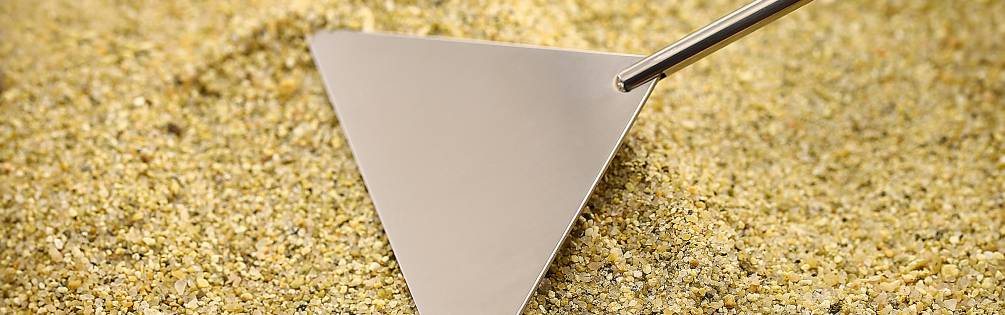
A flawless look of the sand takes some care. Over time, detritus, fish waste or plant remains settle on the surface of the sand layer. You should remove these regularly. This is easiest if they are vacuumed up with a hose during the weekly water change. A sufficient stock of shrimp and snails also ensures that as much dead organic material as possible is processed and broken down. If the sand is ever out of shape, you can smooth it again or reshape it very easily with a sand flattener, for example to restore slopes.
Nutrients in sand?
Sands and gravels are generally passive substrates that offer no nutrients at all for the aquarium plants. This is why a substrate fertilizer is often used under gravel. With fertilizer balls or tablets, sand can also be enriched with nutrients at specific spots, so that especially heavy root feeders such as Cryptocorynes can benefit greatly.
There are also some exceptions, however; the manufacturer Seachem, for example, also offers nutrient-containing sand substrates. The Flourite substrates differ in grain size, color and nutrient composition.
How much sand for my aquarium?
When setting up and planning an aquarium design, it is important to know how much substrate you need for your aquarium size. Unfortunately, this is not entirely easy, because the volume of the aquarium is given in liters, while substrates such as sand or gravel are generally given in kilograms in stores. If you know roughly the grain size of your substrate, however, you can calculate your sand requirement with the help of the following rule of thumb.