 The Australia aquarium
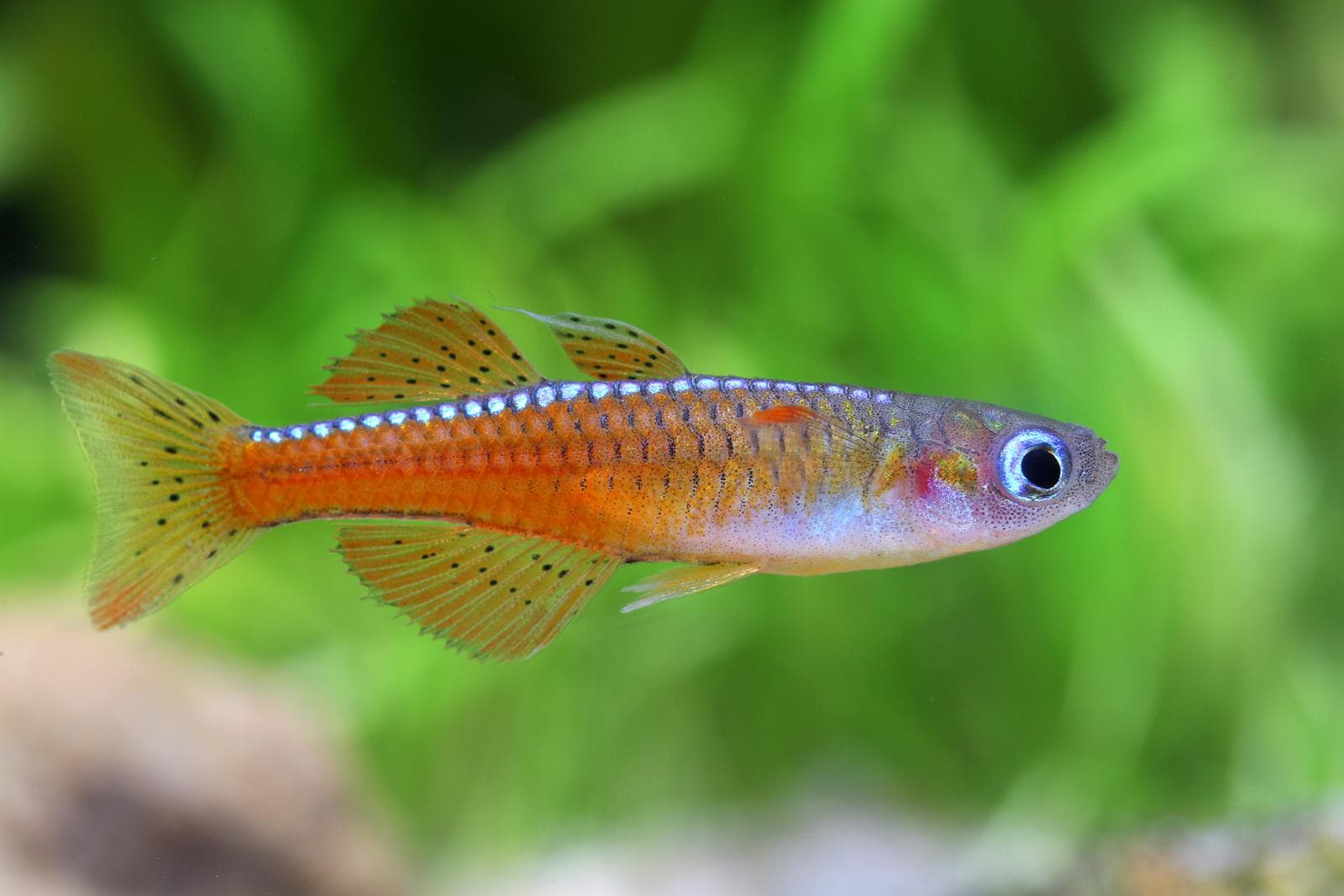
An Australia aquarium is about a thematic focus on ornamental fish and aquarium plants originating from Oceania. This includes countries such as Australia, but also New Zealand or Papua New Guinea. If you want an environment that is as natural as possible for your aquarium inhabitants, this is usually referred to as an Australian biotope aquarium. Blue-eyes or rainbowfish, which are extremely colorful, are often kept in it. The peacock gudgeon is also a popular classic ornamental fish that comes from the region around Australia. In this article we show you what you need and need to know for such an aquarium.
Ornamental fish such as rainbowfish and blue-eyes are group animals that travel in a school or loose associations. Especially with Pseudomugil species, the courtship and display behavior of the males is a true splendor. The open swimming space in the aquarium should accordingly be large. The current can also be somewhat stronger. In the background, dense planting is helpful to offer hiding places. Fine-leaved aquatic plants in particular are then often used as spawning substrates, because many of the blue-eyes and rainbowfish are continuous spawners.
The water parameters in an Australia aquarium

The keeping conditions for an Australia aquarium cannot be fully generalized; the parameters of the habitats can be too varied. Many rainbowfish and blue-eyes, however, prefer neutral to slightly alkaline water with a pH value of 7 or above. The water hardness can fittingly be medium-hard. Our harder German tap water is often already well suited for these purposes.
Some Pseudomugil species, however (such as the neon blue-eye), are used to slightly acidic and soft water. Here, a low general hardness and a pH value slightly below 7 are called for to create ideal conditions.
In contrast to a South America aquarium, the water temperature does not need to be quite as high. Temperatures of 23 to 27°C are often sufficient here.
If a slightly acidic pH value is desired and the aquarium is also equipped with aquatic plants, CO2 injection is an option, which is also beneficial for plant growth. Especially for species that come from soft-water biotopes, adding humic substances to the aquarium is also very supportive of their well-being. In the natural biotopes, humic substances play a role that should not be underestimated. Adding humic substances in an Australia aquarium with soft-water parameters is therefore definitely relevant for such ornamental fish.
Aquatic plants in an Australia aquarium
Australia, too, offers a number of remarkable aquatic plants that can be put to good use in an Australia aquarium. The aquarium plants should not simply spruce up the ambiance; they also have a biological significance. Tall edge planting in particular serves as hiding and retreat places for weaker ornamental fish. Together with the hardscape, aquatic plants also provide the necessary structure in the aquarium. The plants make use of excess nutrients in the water and serve as an oxygen supplier. This vital gas is produced during photosynthesis. An aquarium with many, and above all fast-growing and healthy, aquatic plants also offers resilient natural competition to algae and provides stable conditions in the ecosystem.
There are certainly some well-known aquatic plants for a normally planted aquarium, but also for an aquascape, that originate in Australia. Here we list some examples sorted by design level.
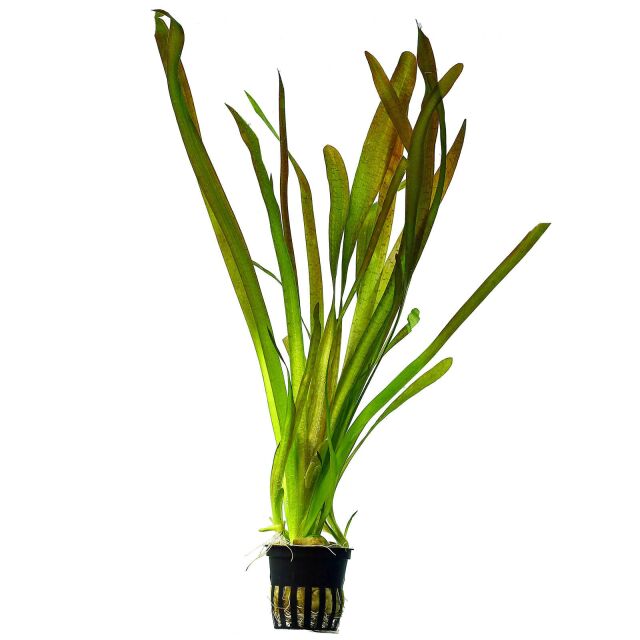
Vallisnerias are an absolute standard in the aquarium hobby, especially for simple and fast-growing background planting. They are fast-growing, robust and easy to keep. And many of the species, such as Vallisneria australis, originally come from Australia. These grass-like and elongated plants have surely been encountered by every aquarist at some point. Vallisnerias can grow quite tall and are a great and easy way to green up the background of the aquarium.
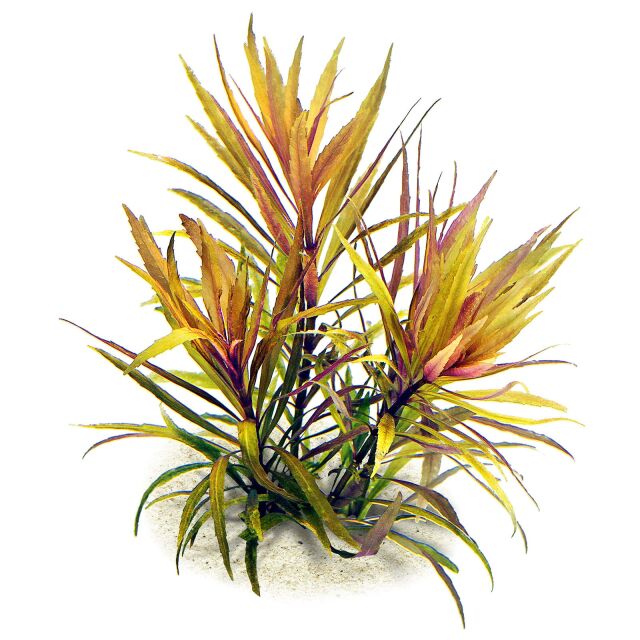
Pogostemon stellatus "Broad Leaf" is likewise a background plant originating from Australia. This stem plant offers attractive reddish tones and can therefore create great contrasts with green aquatic plants. Good liquid fertilization, sufficient lighting and CO2 supply support this plant's growth. The typical genera Limnophila and Myriophyllum also include a few Australian representatives. Myriophyllum tuberculatum, the red foxtail, is a fine-leaved reddish stem plant that is quite well known in the aquarium hobby. Limnophila brownii and Limnophila wilsonii are further fine-leaved species for the background, but in greenish shades.
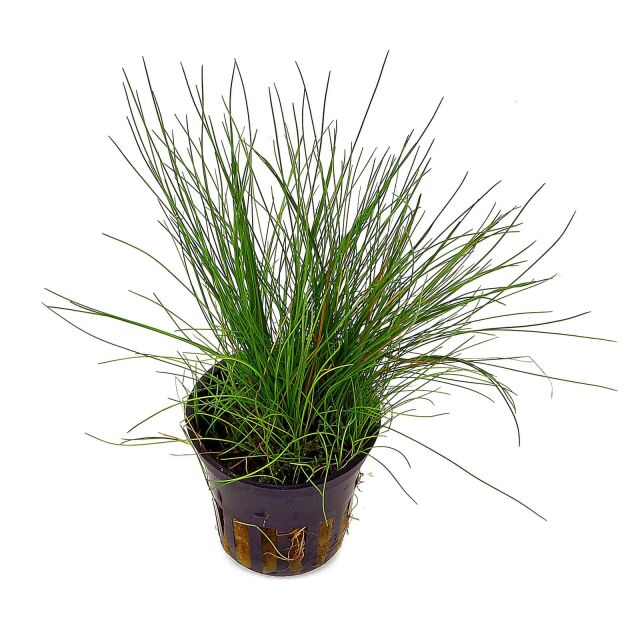
Some aquatic plants from Australia are also represented for the midground. Eleocharis acicularis, the needle spikerush, is a grass-like aquarium plant with elongated, thin stalks that grow approx. 15 cm long. Since it multiplies via runners, this carpet-forming plant can also be used in the foreground. Hydrocotyle tripartita is very popular in aquascaping and in Nature Aquarium keeping and most likely comes from Australia. It is a fast-growing, carpet-forming plant that is reminiscent of clover leaves but is light green in color.
Nelsonia canescens is a still fairly new and little-known species from Australia that grows to a medium height and is reminiscent of a Staurogyne. It has egg-shaped leaves and a light green coloring.
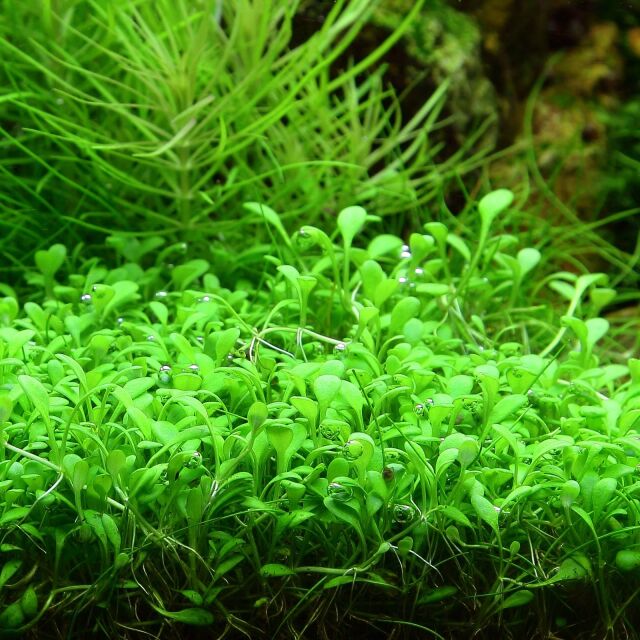
In the foreground of an aquarium, you do come across some well-known ground cover plants that have their home in Australia. Glossostigma elatinoides is a classic in Nature Aquarium keeping and a fast-growing, light green ground cover plant with droplet-shaped leaves. This plant needs quite a lot of light and enough nutrients to grow sufficiently. If you want something grass-like for the foreground, you can turn to Eleocharis parvula. The thin stalks are green in color, and with enough fertilization and sufficient light, a great underwater lawn forms in quite a short time.
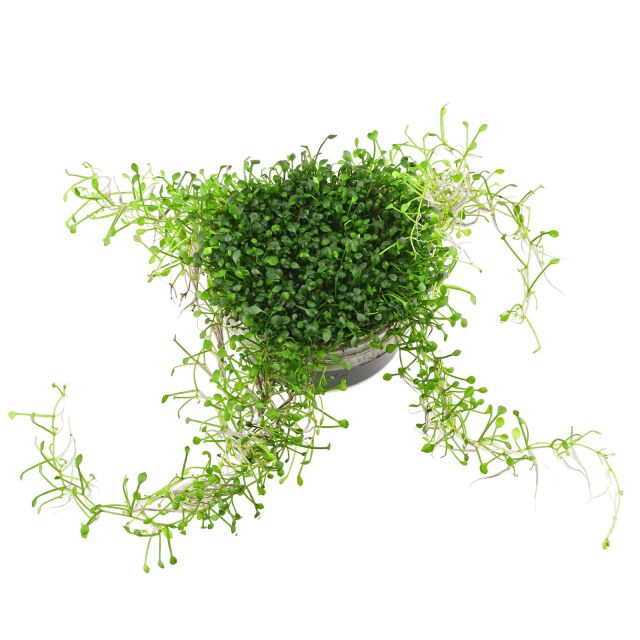
Marsilea hirsuta and crenata are very undemanding foreground plants that are easy to keep. Their dark green shoots vary somewhat in leaf shape and can be droplet-shaped or resemble a clover leaf.
Ranunculus inundatus, the river buttercup, comes from southeastern Australia and is a long-stemmed plant for the foreground of an aquarium, but can also be used in the midground. It offers a pretty serrated leaf shape and is therefore a special eye-catcher among the ground cover plants.
The substrate in an Australia aquarium
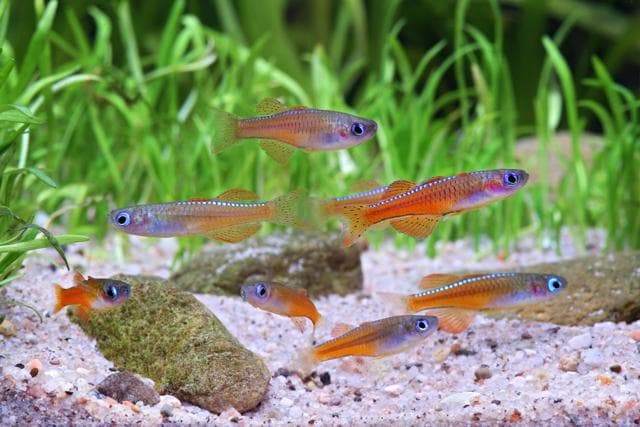
Pseudomugil luminatus prefers rather soft water. Copyright: Chris Lukhaup.
For rainbowfish and blue-eyes, which stay more in the upper to middle water zone, the substrate does not play such a big role at all, since they hardly stay near it. You can therefore let the aquarist's taste decide a little. Some rainbowfish keepers say, however, that the animals look better against a dark substrate and that the colors stand out better. The preferred water parameters also play a role in the choice of substrate. If rather hard and alkaline water is needed, you should avoid active substrates such as soils, since they work in the opposite direction and acidify the water again. Soil substrates would rather be for fish species that need soft-water parameters and a slightly acidic pH. In a few rare cases, however, there may be Pseudomugil species that suit this. It therefore depends very much on the stock here.
Furnishings in an Australia aquarium
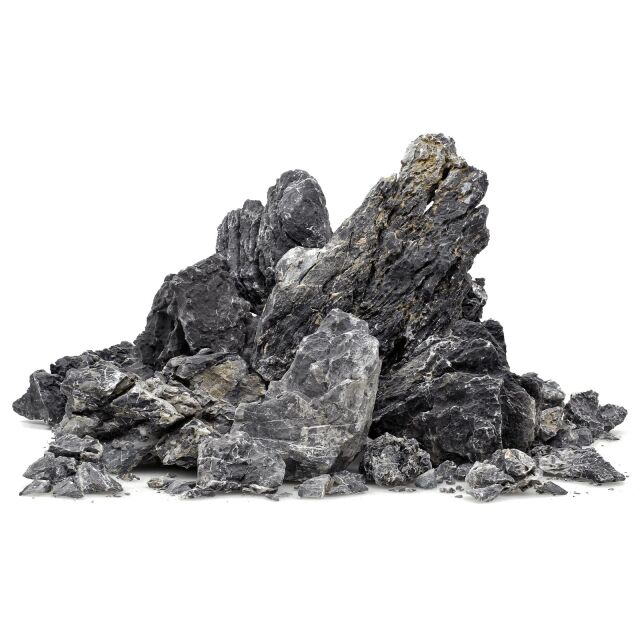
For an aquarium with a thematic focus on Australia or Oceania, besides aquatic plants and the matching substrate, driftwood and stones in particular can be used to create a natural environment. The so-called hardscape provides the necessary structure in the aquarium and creates many hiding and shelter opportunities for many aquarium inhabitants. For the very swimming-loving rainbowfish and blue-eyes, however, the emphasis should also be on enough swimming space. If alkaline water values are our target parameters, the aquarist can rely on water-hardening rock, such as Mini Landscape. These raise the hardness of the water and thus provide an alkaline pH value.
Fish in the Australia aquarium
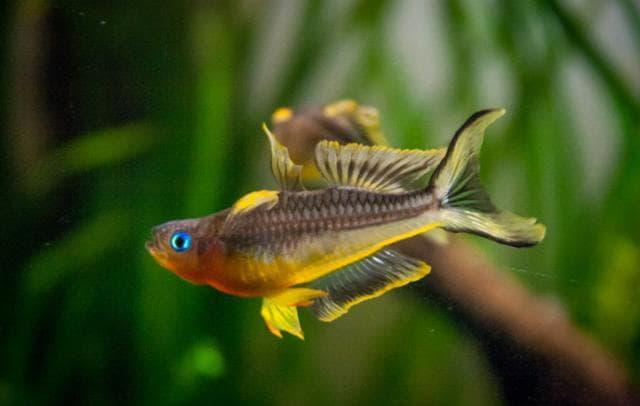
From Australia, it is mainly rainbowfish and blue-eyes that are found in the aquarium hobby. Pseudomugil furcatus, the forktail blue-eye (see photo above), is a nice example of a typical Pseudomugil species in an Australia aquarium. These colorful animals grow to approx. 6 cm, with the females usually staying somewhat smaller. The courtship dances and display behavior of the males, in which they raise their fins and circle each other, are wonderful to watch. At least 80 liters should be available for a school of these beautiful group animals. The forktail blue-eye needs medium-hard water with a pH value around 7.
There are other Pseudomugil species that are similar in terms of keeping and therefore well suited to the aquarium hobby. Pseudomugil gertrudae or Pseudomugil connieae may be mentioned as examples.
Source and copyright: Dirk Godlinski - Own work via Wiki Commons, License: CC BY-SA 3.0.
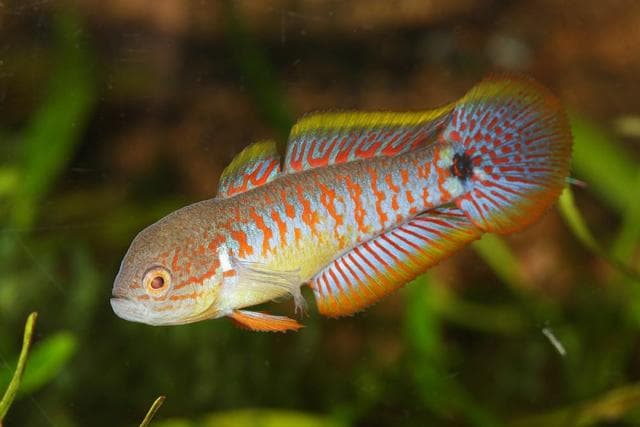
Particularly colorful is the so-called peacock gudgeon (Tateurndina ocellicauda) from Papua New Guinea. This freshwater goby is very popular in the aquarium hobby and can be kept in pairs or in a small group. The gobies grow to around 6 cm and are very calm ornamental fish. It is important that the animals are fed mainly with live food. The gobies stay mostly near the bottom; suitable hiding places and caves (tubes) serve as retreats and are suitable for reproduction. Soft to medium-hard water with a pH value around 7, as well as a water temperature of 22 to 25 °C, are good conditions for keeping Tateurndina ocellicauda.
Source and copyright: Eileen Kortright (Roan Art) - Own work via Wiki Commons, License: CC BY-SA 3.0.
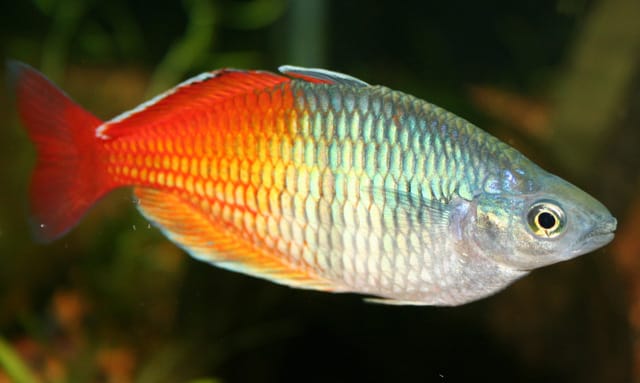
The Boeseman's rainbowfish (Melanotaenia boesemani) is a popular classic in the aquarium hobby. These schooling fish, which grow up to 10 cm and are quite high-backed, captivate with their special coloring. In terms of color, male specimens have the body divided into a reddish-orange half at the back and a smoky-blue front half. These ornamental fish need a lot of space and a correspondingly large aquarium (500 liters and up). They are lively swimmers that need free swimming space but also dense edge planting as retreats. They are uncomplicated in their diet. Soft to medium-hard water, as well as temperatures of 24 to 28 °C, are good keeping conditions for this great schooling fish.
Source and copyright: Dirk Godlinski - Own work via Wiki Commons, License: CC BY-SA 3.0.
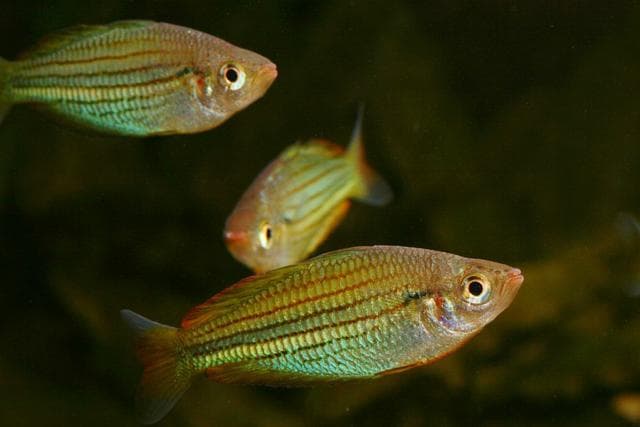
The sixline rainbowfish (Melanotaenia sexlineata) is another popular schooling fish from Australia with interesting coloring. The animals shimmer slightly bluish-green and additionally have five to eight reddish longitudinal stripes. The ornamental fish grow to around 7 cm. There are various collection-locality variants that differ slightly in color. The "Kiunga" variant can be seen in the picture here. Melanotaenia sexlineata is used to rather soft and slightly acidic water from its habitat. They are typical group animals that look better under more subdued lighting. The rainbowfish can then show off their full color potential.
Source and copyright: Gianmaria Visconti - Own work via Wiki Commons, License: CC BY-SA 2.5.
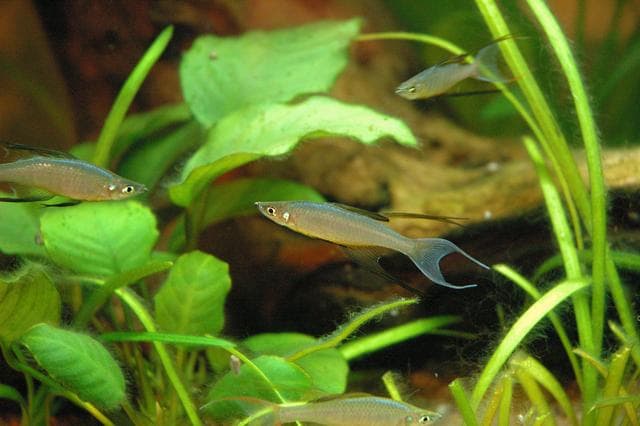
The threadfin rainbowfish (Iriatherina werneri) from Australia has a particularly majestic appearance. The body color is rather silvery, but the elongated fins of the male animals are striking. They are rather calm and delicate representatives that should also only be kept with other gentle-natured tank mates. At approx. 5 cm adult size, Iriatherina werneri stays rather small. This ornamental fish should be kept in a group, and the aquarium can be densely planted. Soft to medium-hard water and a water temperature of 24 to 28 °C are preferred. For feeding, it is important that the food is mouth-sized, because the mouths of threadfin rainbowfish are extremely small. Fine live food such as Artemia nauplii, but also fine granular food, is gladly eaten.
Copyright header photo: Chris Lukhaup