 Breeding water fleas as live food
Water fleas are a very popular live food in the aquarium hobby. Daphnia do not contain an excessive amount of fat and protein, but thanks to their high chitin content they are very rich in fiber, which benefits the fish's digestion and gut health. Daphnia also provide a relatively large amount of vitamin A and vitamin B2. Their chitin content also makes water fleas an interesting live food for shrimp and crayfish, which even catch them out of the water in some cases. Chitin is also the main component of the shell of the decapod crustaceans in our aquariums, so an external supply is very helpful for forming the new skin and for supporting molting.
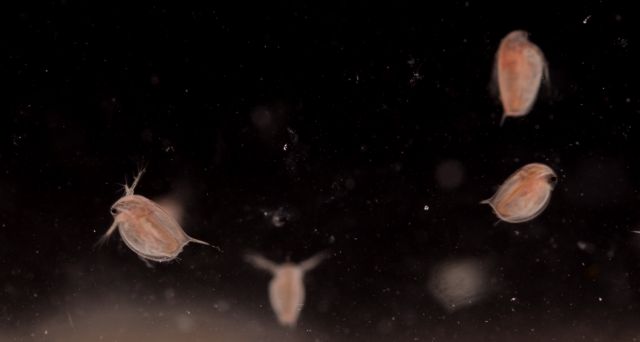
The fairly roundish water fleas have a clearly visible nauplius eye in the middle of the head and conspicuous little paddle arms. With these they move through the water in their typical hopping, flea-like way of swimming. The females have a light-colored so-called saddle on the back, in which they carry their eggs. If resting eggs are produced under unfavorable conditions, this saddle turns dark.
Water fleas are suitable as live food for almost all aquarium fish as well as for shrimp, dwarf crayfish and large freshwater crayfish, and also for crabs - as the sole food they are not nutritious enough in the long run, but as a low-calorie snack rich in vitamins and fiber for in between they are perfect.
Water fleas are filter feeders; they feed on suspended algae, bacteria and other microorganisms in the water. Daphnia do not tolerate water current well, and in a filtered aquarium they quickly run out of strength because of the lack of food in the water. So if, in an invertebrate aquarium, some of the water fleas are not eaten right away, they still die after a relatively short time in the clean water with its strong flow. At the latest then, they are consumed by invertebrates such as snails or shrimp.
If, on the other hand, you run the shrimp aquarium without a filter, water fleas can be used very well as a natural filter. They clarify the water and rid it of cloudiness caused by suspended algae, bacteria and other single-celled or multicellular microorganisms.
Breeding water fleas easily
Breeding water fleas is very simple and uncomplicated. All you really need for it is a bucket of fresh water. Water movement would be counterproductive. The bucket is placed in a bright spot, but not in full sun, so that the water does not overheat. This is especially important with black buckets or mason's tubs. The bucket can even be placed indoors, because water flea culture produces hardly any odor nuisance - provided you feed correctly.
Plants or substrate are unnecessary. You can add a few bladder snails or ramshorn snails as a clean-up crew, which consume dead water fleas, settling food and the shed skins of the daphnia. This keeps the water clean, and bacteria in turn form on the snails' droppings, which the water fleas can consume.
Where do you get water fleas?
Water fleas are regularly sold as live food, vacuum-sealed in little plastic bags, in pet stores. Some aquarists with well-running cultures also give away a starter culture of daphnia. Since some water flea species are native here, you can also catch them in nature in ponds. Caution - only net in fish-free waters so that you don't introduce fish parasites - and of course you should find out beforehand how the removal of animals from nature is regulated by law in your country or state.
Feeding water fleas
Feed water fleas with the highest-quality and richest food possible, in order to enrich them somewhat with nutrients. The very fine food should stay in the water column for as long as possible: dry yeast mixed into some water, chlorella or spirulina powder, phytoplankton or suspended algae or "green water", Liquizell or Nobil Fluid Artemia and so on. Milk or condensed milk is also an excellent food for water fleas, but may only be fed drop by drop because the water can crash very quickly as a result.
Feed again only when the water in the water flea bucket is completely clear again. This keeps the water load within limits.
Water care for the daphnia
Over time, the water turns slightly brownish because of the humic substances forming in it. From time to time you should change some water, ideally with fresh water, not with aquarium water. Evaporated water should be topped up now and then; here too it is best to use fresh water or RO water.
General tips
The more often you net water fleas out of a running culture, the better the breeding generally goes. For safety, you can run another culture at a low level in parallel in case production in the bucket collapses - which can certainly happen once in a while.
Under unfavorable conditions, water fleas form a black saddle with resting eggs. If you increasingly find water fleas with a dark spot on the back in your live food culture, you should urgently change the water, feed better or move the bucket.
Even if the water flea culture collapses once because the water has crashed or - outdoors - frozen through, thanks to the resting eggs small crustaceans will be hopping through the water in the water flea bucket again by spring at the latest.