 Community aquarium
A community aquarium is certainly the most popular form in the aquarium hobby and is particularly interesting for aquarium beginners and ordinary aquarium owners. In this article of our Aquascaping Wiki, we show you what community tanks are all about.
What exactly is a community aquarium?
In a community tank, different animal species are kept together that would otherwise never meet in the wild. For example, tetras from South America are housed with Asian danios in the same aquarium. First and foremost, it is the aquarium owner's "taste" that decides which fish go into the tank and in which combination. However, the fish should be chosen carefully, so that, as far as possible, species are combined whose behavior suits each other and that prefer similar water parameters. For this reason, the aquarist should begin by looking at the parameters of the source water and use water tests to determine basic values such as pH, carbonate hardness and general hardness. The most important elements are often summarized in a drinking water analysis, which you can request from your local water supplier.

A community aquarium is therefore completely different in approach from aquariums that are far more limited in variety but closer to nature. These include above all the species tank (only one particular fish species) and themed or biotope aquariums (for example with regional focuses such as "South America", "Asia" or "Amazon"). A community aquarium therefore represents the maximum compromise for keeping animals with different requirements together. This relies heavily on the adaptability of the fish and invertebrates in an aquarium. Of course, it is rounded off by the equipment needed for an aquarium: aquatic plants, decoration, substrate and technology. We will now look at these points in more detail.
Aquarium technology for a community tank
First of all, every type of aquarium needs a certain basic technical setup. Besides the glass tank itself, whose volume determines the dimensions of its contents, a functioning aquarium needs the following equipment:
- Lighting: Without light, you can't see anything. However, the aquarium lamp does not only serve to make the contents of the community aquarium visible to the viewer. The inhabitants themselves also need (depending on the species, of course) a suitable light source to find their bearings in their surroundings and to feel comfortable there. Last but not least, the aquatic plants in the aquarium above all need light for photosynthesis. You will find suitable and, above all, energy-saving LED-based aquarium lighting in our shop. Here we have presented the various manufacturers of LED systems in more detail.
-
Filter: To keep the water in the aquarium clear and clean, appropriate filtration is necessary. Not only are suspended particles retained, but the bacteria living in the filter also break down pollutants in the contaminated water. The aquarist can choose between different filter types (external filter, internal filter, hang-on-back filter). We have presented these in more detail in this separate article.
![Water filtration]()
- (optional) Heater: Especially when tropical aquarium inhabitants are to be kept in a community aquarium, temperatures above normal room temperature are sometimes necessary. For this purpose, a suitable heater can be purchased, which is usually attached to a glass pane in aquariums. However, there are also species that get by with the average room temperature (20° Celsius) or even cooler temperatures. In these cases, installing an aquarium heater is not necessary, or at least only for cold winter days. In any case, it is advisable to monitor the water temperature in the community aquarium with a thermometer.

Furnishings in the community aquarium
For an environment that is as close to nature as possible, an aquarium is equipped with various furnishings.
-
Substrate: The substrate plays an important role in an aquarium and is not simply a visual component for the person looking at the aquarium. Aquatic plants need the substrate to anchor themselves with their roots and to supply themselves with nutrients. There are plenty of fish species that need the substrate to search it for food, as a spawning medium or to build hiding places. Furthermore, the substrate in the aquarium is also an important biological component, because, similar to the filter, many beneficial bacteria that break down pollutants also live in the soil (or in the detritus).
Common substrates for aquariums are sand, gravel and active soil substrate, which is especially recommended for keeping shrimp and for planted aquariums. Besides different grain sizes, various colors (such as black, brown, gray and many more) are also available. Note that sharp-edged gravel should not be used, especially with bottom-digging animals such as corydoras. The animals can injure their barbels on it. Substrates with rounded particles are better recommended for this.![Aquarium gravel]()
-
Aquatic plants: Crisp green and red colors, leaves swaying in the current - aquarium plants are simply a feast for the eyes. But these plants do not only enrich a community aquarium visually; they also take on important biological functions. Through their unique metabolism, nutrients and pollutants are processed out of the water, and photosynthesis produces oxygen, which is of particular importance for all inhabitants of the aquarium, from fish to invertebrates, microorganisms and bacteria. As direct competitors, aquarium plants help to prevent algae growth.
They also serve to structure the community tank, provide hiding and spawning places and generally create a very natural impression in the aquarium. You will find a very large selection of aquatic plants in our shop.![Aquatic plants]()
- Decoration: Decorative items such as driftwood or aquarium stones help to give the community aquarium some structure. They give the inhabitants places to retreat and hide, and for some species special tubes and caves (for example for shrimp or catfish) are even available. Wood in particular is gladly grazed on by some animal species. Certain catfish species rasp at its surface, as they need the cellulose it contains for their digestion. Some caution is advisable with certain types of stone, as there are some varieties that can harden the water. You will find an overview here. By the way, aquarium decoration is a great place to hide technology that spoils the look, such as heaters and filter pipes. We describe how to do this in this article.
![Hiding the heater]()


Stocking a community aquarium
When you, as an aquarium owner, select the animals for your community tank, you can theoretically choose from the full range of fish and invertebrates available on the market. For the well-being of all aquarium inhabitants, however, a few things should be kept in mind:

- Stocking density: How many fish can go into the aquarium? This is a very important question that every owner of a community aquarium should consider before planning the stock and buying fish. We go into this topic in a little more detail in this article. As a general rule, though, an aquarium should not be overstocked. Before buying the animals, we recommend taking into account the adult size, the preferred water zones and the required group size of the fish, and relating them to the available aquarium volume.
- Water parameters: As already mentioned in the introduction above, animal welfare benefits greatly if the aquarist only selects and combines species that prefer roughly the same parameters in terms of water parameters. As a basic rule, you should distinguish between species that like soft water (with low KH and GH and a pH below 7) and fish that prefer harder water. The latter prefer a pH above 7 and higher KH and GH values. Consideration should also be given to the water temperature, and tropical ornamental fish should not be kept together with cold-water fish.
- Equipment: Some animal species have very specific wishes and requirements regarding the equipment and furnishings in the aquarium. Depending on the species, a special substrate, hiding places or certain decoration such as driftwood or aquatic plants can be a prerequisite for successful keeping. This, too, must be taken into account accordingly in your planning.
- Stock harmony: Depending on the species, fish, shrimp and snails display their own social behavior. There are many animals that can live together well and peacefully with other species. But especially with territorial animals, or animals that sometimes become very aggressive during breeding, the owner of a community aquarium should proceed with care when choosing the stock.
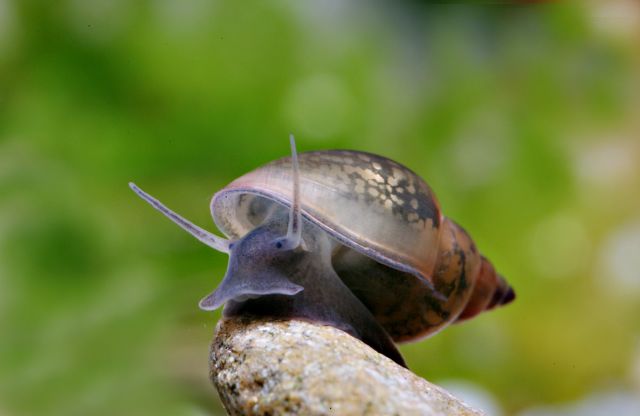
- Invertebrates: Invertebrates such as snails and shrimp are a great addition to a community aquarium. They provide a contrast to the fish stock, are very colorful and interesting to watch. In addition, they take on important biological functions as scavengers and algae eaters and thus contribute a not insignificant share to the breakdown of pollutants in the aquarium. You can find further useful information on the topics of shrimp and snails in the aquarium by clicking the corresponding links.
Copyright: Chris Lukhaup.